
Healthy snack ideas work when they come from your own answers to what you want at 3 o'clock: flavor, texture, logistics, and what keeps you steady until dinner. A list written for nobody in particular never will.
TL;DR
- A snack list fails because it was written for nobody in particular.
- You may not have a snack problem. You may have a short list from a definition you never chose.
- Answer a few questions about taste, texture, and logistics before you open the pantry.
- For one week, jot down what you're actually asking for when you want something to eat.
- All foods fit. The better question is what suits your body and your day.
The Healthy Snack Question I Dread Most
Every client I've ever worked with has asked me some version of the same question: "What are some healthy snack ideas?" I'm a health coach, so I should be able to name a few things. I have, many times. I've just never once given an answer that worked.
I figured out why this week while editing a recipe on my website. I thought, "Oh, that would make a really great snack." Then I remembered I don't eat snacks. My very next thought was that I have clients who would read that recipe and say, no thanks.
Why a Snack Idea List Never Works
When I give a direct answer, like "try cottage cheese with some cantaloupe," what she hears is a menu. She says thanks and eats what she was going to eat anyway, or she tries the cottage cheese, doesn't like it, and asks me again.
What I like is different from what you like. You might want something sweet at 3 o'clock, or something salty and crunchy. Maybe you have a refrigerator at work, or maybe all you have is your purse. That's also why I don't write meal plans for clients. It would be my foods, and my tastes aren't your tastes.
A snack list fails for the same reason every generic list fails: it was written for nobody in particular. It doesn't know whether you have a refrigerator or whether you can stand anything cold.
You've probably lived this. You download fifty snack ideas, scroll through them with your coffee, and think, "None of these really work for me." You're right. They don't. And whatever you grab at 3 o'clock can change how you feel for the next couple of hours.
PREFER TO LISTEN?
I walk through this whole idea in episode 298 of the Done with Dieting podcast.
What Even Counts as a Snack?
A snack is smaller than a meal. After that, it gets personal.
When we have meatballs for dinner, my husband eats the leftovers as snacks, standing at the counter popping them in his mouth like cookie bites. Some of you just cringed. But Cheetos are messy too, and nobody asks whether Cheetos count. Mess doesn't decide what counts. We each carry a picture of what a snack looks like, and we picked it up somewhere. Commercials. What our moms kept in the cupboard.
Then there's the leftovers rule. A lot of women tell me cold roasted chicken is a dinner food, so it can't be a 3 o'clock food. I think leftovers make some of the best snacks. They're already cooked, and there's nothing to wash.
Others say a snack has to be carrot sticks and hummus. If that works for you, keep it. But you'll run out of ideas fast and grab whatever is closest.
You may not have a snack problem. You may have a very short list of what counts as a snack, and it came from a definition you never chose.
What "Healthy" Means to You
When a client asks for healthy snack ideas, she wants something good for her that also tastes good. Then her mind goes straight to chicken breast and steamed broccoli. Picture pulling a bowl of broccoli out of your purse in the car. It feels like homework, so you grab whatever is in the break room.
You don't need to live on chicken breast and vegetables to eat a healthy diet. All foods fit, including the ones you've been calling "bad" for years. So instead of "What's healthy?", ask, "What foods are right for my body and my day-to-day life?" It's a better question because you can actually answer it.
The Questions Behind the Question
Here's what goes through my head when someone asks me for a snack idea. Do you want sweet or savory? Crunchy or soft? Finger food, or are you okay with a fork and knife? Messy or neat? Then the practical part. Do you have a refrigerator where you'll be, or a microwave? Or does this have to sit in your purse for four hours? And how much time do you have: two minutes between meetings, or ten in your own kitchen?
I know that's a quiz when you wanted one idea. But if I don't ask, I'm guessing, and the answers matter more than any list I could give you. You're the only one who has them.
How to Build Your Own Snack List
If your answer is "I don't know what I want," that's normal. Nobody ever asked you. Here's what I do for myself.
- Write your definition (today). Finish "A snack is..." in your own words, then ask where you got that idea.
- Answer the questions (today). Use the ones above. Rough answers are fine.
- Notice what you're asking for (this week). Each time you want something to eat, pause and ask, "What am I actually looking for right now?" Jot a few words on your phone or a sticky note. Describe what you want from the food, not the food itself. (More on listening to your body in episode 7.)
- Check in an hour later (this week). Am I steady, sleepy, hungry again, or irritable? Write it next to what you ate.
- Build and test your list (next week). Look for the pattern, like four afternoons out of five saying "salty and crunchy." Now you can say, "I need something salty that fits in my purse," and somebody can actually answer that.
Describe what you want from the food, not the food itself. "Something sweet, and I'm in the car" gives you something to work with. "A healthy snack" doesn't.
TAKE IT PAST SNACKS
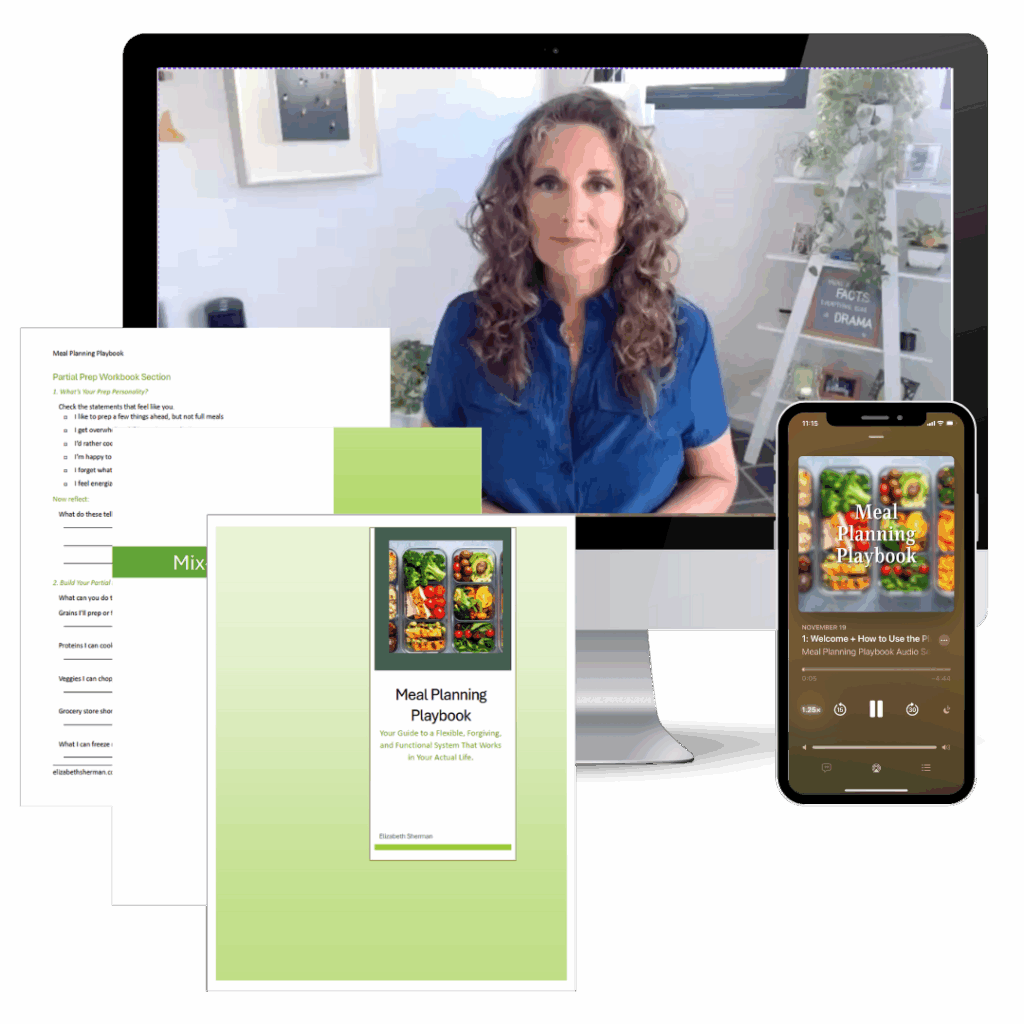
These same questions run through the Meal Planning Playbook, for every meal and not only snacks.
What Your Body Needs at Different Times of Day
What your body wants at 10 in the morning can be very different from what it wants at 3. (How many times a day to eat? That's episode 23.) Some women feel steady on eggs, others need oatmeal, and some do well with avocado on toast. None of these is the right way to eat. Each one just makes you feel different.
A snack is a good place to start noticing, because it's small. Eat it and check in an hour later. A handful of nuts might keep you full until dinner while a granola bar has you looking for more in 45 minutes. Or it might go the other way. Research suggests protein tends to be filling for many people, though studies are mixed and often done in people with overweight or obesity, so treat it as somewhere to start looking, not a rule. (Source)
Healthy Snack Ideas by What's in Them
Now, actual food. These are examples of how I think about it, not a list to copy. I sort snacks by what's mostly in them: protein, fat, carbohydrate, and the mixes.
| Group | Examples | Worth knowing |
| Protein | Cottage cheese with cantaloupe; yogurt; deli turkey rolled around a pickle spear; turkey lettuce wraps | Quick, cold, and one-handed |
| Fat | A cheese stick; a small handful of almonds | Fine to eat, and easy to eat past hungry, so portion it ahead |
| Carbohydrate | An apple; pretzels; cookies, yes | If a cookie is what you want at 3, it counts. Notice how you feel an hour later |
| The mixes | Apple slices with peanut butter; crackers with cheese | Cover more than one group, and many women stay full longer |
Your limit here is mostly creativity. If you wrote "salty, crunchy, fits in my purse," look at pretzels or a cheese stick with an ice pack. If you wrote "warm, and I have a microwave," leftovers show up on your list. (More on carbs in episode 14.) Your list will look different from mine. It should.
How to Read a Bar or a Label
The snack aisle is where a lot of us get fooled. An energy bar usually has more carbohydrate, mostly the simple kind, which can give a quick lift and leave some people hungry again sooner. A protein bar is built around the protein. My rule of thumb: if it looks like a candy bar and tastes like a candy bar, it's probably closer to a candy bar. You can still eat it. I just want you to know what you're buying.
I teach my clients a simple tool for comparing two bars, or two packages of tortillas, by their labels. (For a general primer, try the FDA's guide to the Nutrition Facts label.) You don't need to count macros. What helps is knowing whether you feel best with more protein, more fat, more carbohydrate, or a mix. That's just information about you.
TURN YOUR ANSWERS INTO MEALS
The Mix and Match Meal Builder comes with the Meal Planning Playbook. It helps you put together meals that feel creative without starting from scratch every time.
Frequently Asked Questions
Ones that fit what you want, where you'll be, and how much time you have, like cottage cheese with fruit, deli turkey roll-ups, a cheese stick, or last night's leftovers.
Anything smaller than a meal that you decide is a snack, including leftovers and Cheetos. There's no official definition.
Start with what you want and what you have, then pick something that leaves you steady an hour later. If you don't know, spend a week jotting down what you're asking for.
An energy bar usually has more simple carbohydrate. A protein bar is built around protein. If it looks and tastes like a candy bar, it's probably closer to one.
No. All foods fit in a healthy diet. Notice how different snacks make you feel an hour later, and treat that as information, not a rule.
They're written for nobody in particular, so they can't know whether you have a refrigerator or can stand anything cold.
Back to the Question I Dread
So, "What are some healthy snack ideas?" Figure out what you want a snack to do for you, name your preferences, and let those answers shape your ideas. A list that comes from you will work better than any list I could write.
Next time it's 3 o'clock and you're at the pantry, you'll know what to ask yourself. Asking it tired and hungry before a 4 o'clock call is a different skill, though. If knowing what to do and doing it feel like two separate things, episode 164 is for you.

YOUR NEXT STEP
Download the Meal Planning Playbook. It asks the same questions for all of your meals, and the Mix and Match Meal Builder comes with it as a bonus.
Evidence & Attribution
- How to Understand and Use the Nutrition Facts Label (FDA).
- Dietary protein and appetite sensations in individuals with overweight and obesity: a systematic review (Eur J Nutr, 2020).
- Effects of energy-restricted high-protein, low-fat compared with standard-protein, low-fat diets: a meta-analysis of randomized controlled trials (Am J Clin Nutr, 2012).
Elizabeth is a Master Certified Life and Health Coach with over 20 years of experience, dedicated to helping women in midlife thrive through holistic health and wellness. Her personal journey began with a desire to reduce her own breast cancer risk, which evolved into a mission to guide women through the complexities of midlife health, from hormonal changes to mental clarity and emotional resilience.
Elizabeth holds certifications from prestigious institutions such as The Life Coach School, Precision Nutrition, and the American Council on Exercise, as well as specialized training in Feminist Coaching and Women’s Hormonal Health. Her approach is deeply empathetic, blending her extensive knowledge with real-life experience to empower women in their 50s and 60s to build sustainable health habits that last a lifetime.
Recognized as a top voice in women’s health, Elizabeth speaks regularly on stages, podcasts, and webinars, inspiring women to embrace midlife with energy, confidence, and joy. Her passion is helping women regain control of their health, so they can fully engage in the things that matter most to them—whether that’s pursuing new passions, maintaining strong relationships, or simply feeling great in their own skin.