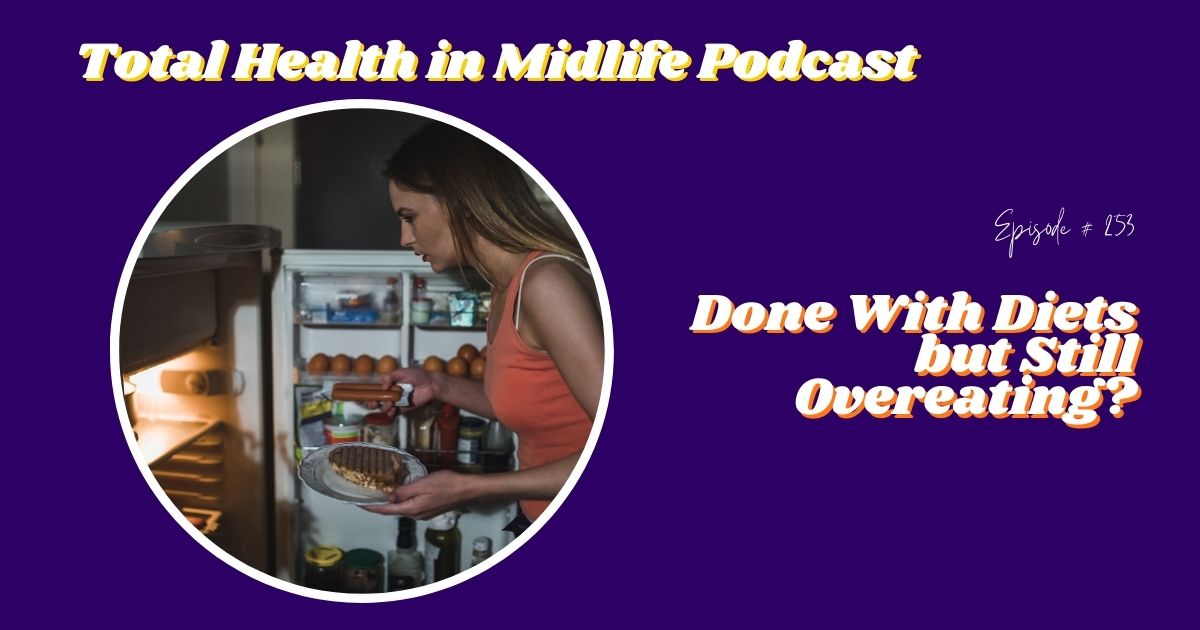
You’ve done the diets. You know the rules. You can list calories and carb counts in your sleep. But somehow, you still find yourself standing in front of the pantry at 10:30 pm, finishing the bag of pretzels and asking, “What is wrong with me? I know better than this.”
In this episode of Total Health in Midlife, we’re talking about what’s really going on when you’re done with dieting… but still overeating. We’ll look at why all the plans, macros, and rules haven’t fixed this pattern, and why your late-night snacks, weekend overeats, and “village-sized” takeout orders aren’t actually proof that you’re broken—they’re clues.
You’ll learn how to recognize the moment you’re truly ready to stop overeating (it’s not just “I hate my body, I need to lose weight”), and we’ll unpack the three quiet thoughts that keep smart, high-achieving women stuck: “I should be able to do this on my own,” “It’s selfish to spend money on me,” and “What if it doesn’t work?”
If you’re tired of waking up with food regret, feeling like you “blew it” again, and wondering if you’ll still be doing this at 65 or 70, this episode will help you see your overeating in a new light—and show you the first small step out of the cycle.
The Biggest Problem Midlife Women Face Regarding Stopping Overeating in Midlife
For most midlife women, overeating isn’t about not knowing what to eat. You already know you “should” eat more vegetables, drink more water, move your body, watch sugar, and limit snacks at night. The real problem is that none of the popular diets or quick-fix plans address why you’re reaching for food in the first place—especially when you’re not physically hungry. They ignore the stress, the loneliness, the pressure to hold everything together, and the way food has quietly become your fastest way to turn down the noise in your head.
On top of that, diet culture doesn’t prepare you for real life: the work happy hours, the birthday dinners, the holidays, and the nights when everyone else is eating wings and pizza and asking why you’re “being so good.” You’re stuck between wanting to belong and wanting to feel better in your body. So you make promises to yourself—“I’ll be good tomorrow,” “This is the last time”—and then break them, which erodes your self-trust a little more each time. The biggest problem isn’t overeating itself; it’s the quiet belief that if you haven’t fixed it by now, you never will.
This episode reframes overeating as a solution your brain has been using to give you relief, comfort, and escape from an overfull life. Once you see overeating that way, you can stop making it a moral failure and start treating it as a pattern you can understand and change. Instead of trying to bully yourself into another diet, you’ll learn how to recognize the moment you’re finally ready to do this differently—and what support you might actually need.
What You Can Do Right Now
Right now, instead of promising yourself you’ll “start over on Monday,” you can begin by getting curious about your overeating. The next time you find yourself reaching for food when you’re not hungry—late at night, after a stressful day, or at a party you don’t even want to be at—pause for just a moment and ask: “What am I hoping this food will do for me?” Are you looking for comfort, a reward, a break, or a way to not feel something? You don’t have to stop yourself yet. Just notice.
Then, take one small step to understand your patterns more clearly by downloading 82 Reasons You Overeat That Have Nothing To Do With Food. It’s a gentle, non-shaming guide that helps you see all the hidden jobs food has been doing in your life—soothing stress, filling loneliness, marking the end of the day—so you can stop making yourself wrong and start working with what’s actually true. That alone can lower the shame, calm your nervous system, and make change feel less like punishment and more like support.
The Listener Takeaway: Why This Episode Matters
This episode matters because most midlife women secretly believe they should have “figured this out” by now. They’re juggling careers, caregiving, relationships, and aging bodies—yet they still feel out of control around the snack drawer. That disconnect creates a painful story: “If I can’t handle food, what does that say about me?” By the end of this conversation, you’ll understand that your overeating is not proof that you’re broken. It’s a learned response to a life that has demanded too much of you for too long.
When you shift from blame to understanding, everything changes. Instead of measuring success by perfection—never overeating again—you start measuring it by self-trust: fewer episodes, less intensity, less shame, and faster recovery when it does happen. You’ll walk away with a clearer picture of the future you want—one where your 65- or 70-year-old self is not still going to bed angry about what she ate—and a concrete, doable first step to start becoming that woman today.
Are you loving the podcast, but arent sure where to start? click here to get your copy of the Done with Dieting Podcast Roadmap (formerly Total Health in Midlife) Its a fantastic listining guide that pulls out the exact episodes that will get you moving towards optimal health.
Take the Quiz: Why Do Your Healthy Habits Keep Falling Apart? If you've ever wondered why you know exactly what to do but still can't seem to stick with it, this quiz was built for you. In about 3 minutes, it identifies your specific pattern: the real reason your follow-through keeps breaking down, and what to address first. Your results are delivered straight to your inbox.
I am so excited to hear what you all think about the podcast – if you have any feedback, please let me know! You can leave me a rating and review in Apple Podcasts, which helps me create an excellent show and helps other women who want to get off the diet roller coaster find it, too.
Watch or Listen to the Episode:
WHAT YOU’LL LEARN
- The simple first step to understand what overeating is really doing for you right now
- Why you still overeat even though you “know what to do” (and why it’s not about willpower)
- The 3 quiet thoughts that keep smart midlife women stuck in the overeating cycle
- How to tell if you’re truly ready to stop overeating—not just ready to start another diet
- A new way to measure success that isn’t “I never overeat again”
RESOURCES – Mentioned resources in the episode
- Free Guide: 82 Reasons You Overeat That Have Nothing To Do With Food
- Podcast Roadmap: Total Health in Midlife with Elizabeth Sherman
- Total Health in Midlife Podcast Ep #189: How to Stop Overeating
- Total Health in Midlife Podcast Ep #201: How to Stop Overeating Without Dieting
- Total Health in Midlife Podcast Ep #233: How to Eat Intuitively
- Total Health in Midlife Podcast Ep #234: Why you Overeat at Night
- Total Health in Midlife Podcast Ep #235: "Food Is Fuel" is a lie
- Total Health in Midlife Podcast Ep #236: The One Thing Diets Never Teach
- Total Health in Midlife Podcast Ep #251: Cravings, Stress, Belly Fat: Why Willpower Isn’t Your Problem
- Total Health in Midlife Podcast Ep #252: Nighttime Cravings in Midlife: It's Not a Willpower Problem
- Total Health in Midlife Podcast Ep #253: Done With Diets but Still Overeating? How to Break the Cycle
- Total Health in Midlife Podcast Ep #254: How to Trust Yourself Around Food Again in Perimenopause
- Total Health in Midlife Episode #262: 3 Types of Overeating
Full Episode Transcript:
253 - Done With Diets but Still Overeating? How to Break the Cycle
Elizabeth: [00:00:00] Alright.
let me ask you a question that might sound a little bit uncomfortable. Ready? How old do you think you'll be when overeating finally stops being a thing in your life? Like, do you picture the woman that you'll be at 65 or 70? Still standing at the pantry at 10 30 at night, sneaking pretzels straight from the bag so that no one else will see.
Are you still planning those nights where you over order takeout because it's the only way that you know how to shut your brain off? Are you still waking up the next morning thinking, what is wrong with me? I know better than this. Now, most women I talk to imagined that by midlife, their eating would just work itself out.
The kids would be older, life would calm down, the drama would fade, and somehow their relationship with food would magically fix itself too. And yet, here you are. You're [00:01:00] smart, you are capable, you are responsible for everyone and everything, but you're still fighting with your sweet tooth. Now in today's episode, I am gonna walk you through how to know if you're actually ready to stop overeating for good, not just ready to start another diet on Monday. And we are gonna talk about why this problem still persists, even though you know exactly what you should be doing. The three quiet thoughts that are keeping you from getting help and the first step to building a relationship with food that your future self will actually thank you for.
If there's even a tiny part of you that is tired of having the same fight with yourself every single night, you are not gonna wanna skip this one.
Welcome to the Total Health and Midlife Podcast, the podcast for women over 40 who want peace with food, ease in their habits, and a body that they don't have to fight with.
Hey everyone. [00:02:00] Thank you so much for tuning into the Total Health and Midlife podcast. I am your host, Elizabeth Sherman, and I am really super glad that you are here with me today because I know that when I was a young teen sneaking food into my bedroom to eat, I never thought that this was a habit that would persist into adulthood yet it did.
And so I wanna start with a question that might make you pause for just a second. How do you actually know when you're ready to stop overeating for good? Not ready to start another diet on Monday or not ready to be good until the next stressful day at work and not wanting to want to do it. I mean, really ready?
The kind of ready where something inside of you goes, okay, I am done doing this to myself. I want you to imagine yourself in the future for just a minute. I want you to pick an age that feels. [00:03:00] Real to you, attainable. Maybe it's your next big birthday, maybe it's five or 10 years from now, and maybe you're picturing yourself as a grandmother, baking with a little girl, watching how you eat and listening to how you talk about your body food and your health.
Now, in that picture. Is she still doing what you are currently doing now? Is she still standing in the pantry at 10 o'clock at night eating chocolate so fast that she barely tastes it? Is she still planning the night on the couch with the pizza and the ice cream?
That's the only way that she knows how to turn her brain off. Is she still waking up saying, what is wrong with me? I know better than this, or is she different? Is she calmer around food? Is she able to leave half the burger on the plate enjoying dessert without needing to finish the whole pan [00:04:00] just so that it stops calling her name?
Stop obsessing about her weight at every doctor's appointment and actually being present in her life instead of arguing with herself about what she ate yesterday. Here's the hard truth that no one tells us. Overeating doesn't just fade away with age. It doesn't just magically disappear when the kids move out or when work slows down or when retirement starts.
If nothing changes this pattern, it just comes with you as you age. So in today's episode, we are gonna talk about why you're really stuck in this cycle and the three sneaky thoughts that keep you from getting the help that you need.
And so we will walk through how to know if you're truly ready for a different relationship with food, and I will give you a clear next step, so that you can start to see what's really going on here. Because if that future version of you is not still wrestling with [00:05:00] food, we need to talk about how she actually got there.
So let's talk about why you're actually here listening to an episode about overeating in January of all time. So for a lot of women that I work with, this all comes into sharp focus right after the holidays. December is a blur of buffets and cookie exchanges and special cocktails. There's the office party, the neighborhood gathering, the family dinner where every aunt brings her famous.
Hi or something, and you tell yourself, it's the holidays. I'll deal with this later when it comes to January. It's too hard right now, and then January shows up and your genes are a little bit more uncomfortable than your New Year's resolutions that you have. Maybe you remember standing in the kitchen after everyone else has left picking at the dessert tray.
And not because you were hungry, but because it was there and you were exhausted being on all day. And honestly, it [00:06:00] felt easier than going to bed with your own thoughts.
Or maybe your thing isn't parties. Maybe your thing is the night, your house finally goes quiet. Everyone's in bed, the dog is snoring. You close the last browser tab and you turn off the tv, and then there's this drop in your chest. You open the refrigerator or pantry to grab your nightly snack ritual.
Maybe it's wine, maybe it's ice cream, chocolate chips, or popcorn. And part of you knows as you're doing it, you even question yourself a little bit. But the other part of you is actually. Really looking forward to it. You snuggle down into the couch and you've got your treats. You turn on the show and you're really looking forward to it because it doesn't require any brain cells and for a little while it feels like relief.
No one needs anything from you. No one is arguing with you. No one is commenting on what [00:07:00] you're eating. It's just you. The food and the feeling of finally not having to hold everything together. Now, if that's you, I want you to hear this. That makes total sense. Overeating has been doing a job for you. It's been comfort when you're lonely.
It's been a way to celebrate the little wins that no one else notices. It's been your I Survive Today badge at the end of a long, draining day. It's been a company when you feel left out or invisible and it's been your off switch when your brain will not shut up. So of course you don't wanna give that up casually.
When I first started changing my own overeating, I had so much grief. I wasn't just eating less. I was losing something that had been with me for years. Food has been there when [00:08:00] people haven't, food doesn't judge you. Food doesn't argue. So when we even float the idea of maybe I don't wanna keep doing this, it can feel like.
Well then what do I have? How do I relax? How do I celebrate? What do I look forward to? And if you've ever had that little panic, like if I stop overeating is life just salads and sadness. You are not alone and nothing has gone wrong. You just use food in way more ways than it was ever meant to do.
And this is where I wanna gently shift how you see all of this. Overeating is not a sign that you're weak or lazy or out of control, and it's not proof that you have no discipline. It's a strategy. It's a solution that you've been using to try to meet your very real needs. Needs for comfort, rest, pleasure, connection, and escape.[00:09:00]
It's just that at some point that solution starts creating as many problems as it solves. Here's the moment that I think is the real moment of readiness. It's not when you say, I hate my body, I have to lose weight. It's when you start to notice very quietly and subtly, this used to help, but I don't think it's serving me anymore.
When you wake up after a night of overeating and instead of just beating yourself up, you think. Something about this isn't working for me anymore. You still might not know what to do. Instead, you still might be half in love with the ritual. You still might be scared of changing it, but that honest, tiny thought, that soft, quiet, I don't think this is actually helping me anymore.
That's the part of you I wanna talk to in this episode, because she's the one who's ready to start doing things a little bit differently. Now, here's the funny part [00:10:00] in all of this. You do not need me or the internet to tell you what you're supposed to do with food you already know. You could probably rattle.
A ton of rules right now. Eat more vegetables, drink more water. Get your protein in, move your body. Don't eat so much sugar. Stop snacking after dinner. If information were the answer, every woman listening to this would've solved overeating 20 years ago. You've read the books, you've downloaded the meal plans, you know exactly how many calories are in a glass of wine and a brownie, even if you haven't tracked in years.
So when your brain says, I should be able to do this on my own, that's the twisted part. It's using the fact that you're smart and informed as a weapon against you, but here's what all those diets and plans have never taught you. They don't teach you what to do when you're at a party and everyone is standing [00:11:00] around the kitchen island eating spinach, dip and chips and refilling their drinks, and someone says, Hey, wait.
Why aren't you having any? Are you on a diet again? They didn't teach you what to say. When your friend shoves a plate at you and says, you have to try my pie, I made it just for you. I know it's your favorite. You're already full. You're maybe even uncomfortable, but you don't wanna look rude. You don't wanna make it weird, so you eat it not because you don't want it, but because you want her to feel loved.
They didn't teach you what to do at nine o'clock at night when you finally sit down after a day of putting out fires and you feel like a balloon that's about to explode from all of the stress,
and the only thing that sounds even remotely soothing is standing at the counter eating whatever is easiest right from the container. Diets are [00:12:00] real good at food rules. They are terrible at real life. They don't talk about belonging and connection. They don't talk about the pressure to be fun and easygoing with food around other people.
They don't talk about the loneliness that creeps in when the house goes quiet or the relief after being on all day. They don't talk about the way that you use food to mark the end of the day. Okay, now I can finally have something that's just for me, and I wanna be really clear here. Emotional eating is not the villain.
Everybody eats emotionally. Sometimes birthday cake is emotional. Ice cream on vacation is emotional. Popcorn at the movies. Totally emotional. The goal is not to become a robot who eats plain chicken and broccoli and never has feelings. The real problem is when emotional eating is an automatic and unconscious [00:13:00] behavior.
So you're halfway through the chips before you even register that your hand is in the bag. You get to the bottle of the ice cream carton and think, wait a minute, how did that even happen? I don't think I even tasted it. Or you tell yourself, I'll just have one, and then suddenly the whole sleeve of cookies is gone and you have no recollection of what it tasted like.
That's the part that keeps you stuck. Not the fact that food is tied to your emotions, but that the whole process happens on autopilot outside of your awareness, and then you wake up for the shame at the end. So unfair. So if it's not a lack of information and it's not that you're weak or broken, what's really going on here?
So let me tell you what this looked like for me. Let me Share what this looked like in my life, because on paper, I was the last person [00:14:00] who quote unquote, should have had a problem with overeating when all of this was really at its peak. I was in fitness.
I was a relatively new personal trainer. I knew all of the rules. I knew the calorie counts. I knew the macros. I could tell you exactly what I should and should not be eating for fat loss, for muscle gain, for maintenance. My days looked something like this. My alarm would go off at 4 45 in the morning, and I would go out for a run.
It was still dark. I would come home, take a quick shower, and then I would go off to train clients. I would cheer them on and talk about fueling their bodies and parroting all of the health information that influencers on Instagram spout these days. And then when there was a break in my schedule, I would go back to the gym and lift weights for myself.
Now, from the outside, I looked like the poster child for discipline, but [00:15:00] behind the scenes. It was a totally different story. I logged my food religiously, but only when I was being good. I had spreadsheets, I weighed things. I knew exactly what was going into my mouth, and because I was trying so hard to do it right, I started leaning hard into all of the health hacks.
You know what I'm talking about. So instead of ice cream, I made this ricotta cheese thing with cocoa powder and stevia. It was like a diet cannoli filling if you've squinted really hard and lowered your standards. And then I went through a serious sugar-free pudding phase, and the kind that's in the box with sugar free, cool whip piled on top.
And I would tell myself, it's basically air. It doesn't count. Then there were the black bean brownies. I've talked about these on the podcast before. So no flour, just black beans as the base. They're high fiber, high protein, and blah, blah, [00:16:00] blah, blah, blah. And because they were quote unquote healthy, I would cut myself this enormous square and then another, and then stand at the counter with a fork, just taking one more bite out of the pan.
I call this the halo effect because the food has a health halo. It's high protein, low sugar, whatever, and my brain decided that the rules of calories didn't apply. So instead of, okay, I'll have a normal serving and enjoy it, it was, well, it's healthy so I can eat more. So I did a lot more. And so during the week, I kept myself on a pretty tight leash.
I was good quote unquote all day, and then the wheels would come off at night. And on top of that, I still believed in cheat days. So Monday through Friday, I was totally white knuckling it. I would write actual lists of all of [00:17:00] the foods that I was craving. Chocolate covered pretzels. There was this bulk nut, chocolate mix called Mocha Mix that I could not get enough of.
And for me, most of it was high sugar stuff, but Saturday nights were pizza night and we'd usually go out for dinner on Fridays. And so I would write everything down like a shopping list for the future version of me from that weekend and when the weekend would hit. It was supposed to be just a cheat day, but it really spanned the entire weekend.
So first I would stop logging my food. Not only did I have no idea how to log what I was eating, but quite honestly, I didn't wanna face it. I'd start working my way down the list of everything that I desired from the week. Wine, the mocha mix lunch, or maybe burgers for lunch. Definitely cookies or chocolate covered pretzels or anything else sweet that I had been craving or resisting.[00:18:00]
And then Saturday nights were pizza night, so there would be that. And then for sure, dessert after dinner. And then don't forget the more wine. By Saturday night, I would go to bed so full that I literally felt sick to my stomach. Not uh, that was a nice meal, kind of full, but I mean lying there under the covers, stomach stretched.
I cannot roll over. I am so super uncomfortable. Please let this pass so that I can sleep full. And here's the part that really messed with me. On Monday, I would turn around and tell my clients how to eat moderately, how to honor their hunger, how to avoid overeating. I knew what to say. I knew what to do.
I wasn't lying to them on purpose. I was giving them the best information that I had, but it wasn't my reality. My reality was that I had a secret relationship with [00:19:00] food that did not match my job title. The shame of that was heavy. And I remember thinking, I am literally helping other people with this.
Why can I not get my own act together? And that shame just drove me further into the cycle, be perfect, lose control, beat myself up and repeat again the next week. One of the first cracks in that pattern came from a really simple habit. I joined a program that had us experiment with portion sizes. One of the tasks was just try reducing your portions by about 20% and see how that feels.
At the time, I was buying these beautiful New York strip steaks for dinner, one for my husband, one for me. They were so amazing. So when I decided to do this experiment, I took my steak and I cut it in half, and I remember standing there at the counter of the kitchen with this piece [00:20:00] of meat and feeling this ridiculous wave of grief.
It wasn't annoyance and not inconvenience, but grief rather. I had this thought that I'm not gonna be able to eat my whole steak losing something. It felt like someone had taken away my toy, my joy. Now, logically, I knew that this was not a tragedy, that I still had plenty of food, and honestly, if I was still hungry, I could go back and eat more if I felt like I needed it.
I was not being deprived of nourishment, but emotionally it landed like a loss. And that was one of the first times I really saw how attached I was to that feeling of. I get to eat as much as I want. It wasn't just about flavor, it was about comfort, entitlement, reward, all of that wrapped up together. And so fast forward a bit, when Gary and I decided to move to [00:21:00] Mexico, I made a big decision.
I threw away my scale. I didn't bring it with me here, and that number on the thing had way too much power over how I felt about myself. If it was down, I was quote unquote good. Right? And if it was up, I was bad. Even if everything else in my life was exactly the same.
But if I was going to get rid of the scale, I knew I needed another way to feel okay in my body. I couldn't just hope that I would stay the same size by magic. We also knew that we were gonna be eating out a lot more. That was part of the joy of moving more restaurants, more tacos, more date nights, more socializing.
So I had this moment with myself where I thought, okay, if I'm not gonna use the scale to control myself, I have to learn how to eat in a way that feels good without going off the rails Every single time I sit in a restaurant. I had to figure out [00:22:00] how not to eat like an asshole when the menu was full of delicious things and nobody was watching.
I had to figure out how to not make eating at a restaurant a special occasion when we were doing it on a regular, normal basis. It was part of our way of life, and that's when I really started paying attention to how hungry I was before I ate. How I felt afterwards, and so I experimented with stopping when I was comfortably full instead of stuffed, but happy full.
I let myself order things I genuinely wanted. I practiced leaving bites on the plate, and let me tell you, that was emotionally messy. There was grief in not cleaning my plate. There was anxiety and not having the scale to keep me in line. So there were so many awkward, uncomfortable moments where I had to sit with myself instead of [00:23:00] just numbing out with food.
And so I share all of this with you because I want you to know I have been where you are. I have known better and still over eaten, honestly sometimes. I still do. I have done the health hacks. I have had the secret bingey nights. I have the grief of eating less and the fear of changing something that felt like my main source of relief.
And so when I tell you that this isn't about willpower or intelligence. I'm not saying that from an ivory tower. I am saying it as someone who has lived through the disorienting emotional process of doing it differently, and that's exactly what I wanna help you with, starting with the thoughts that are quietly keeping you stuck.
So let's talk about one of the loudest thoughts that comes up around this, and that is I should be able to do this on my own. Now, if that thought is running around your head, [00:24:00] of course you think that Because you are smart and capable, you've handled jobs, you have a family, bills moves, health scares, you are the person that other people lean on, and so the idea that you quote unquote need help with something as basically as eating can feel.
Embarrassing. Almost like seriously, I can run a household, but I can't be trusted around a sleeve of cookies. So you are not the only one who thinks this way. Almost every single client that I work with has said some version of, I know what to do, I'm just not doing it. And she's right. She does know.
Here's where the gap shows up. At seven in the morning, you can very calmly say, tonight, I am not gonna eat cookies after dinner. And that's it. And you truly believe yourself. Nine o'clock rolls around, you're tired. Your day has been [00:25:00] a dumpster fire of a day. You've been putting out fires all day long. And Janice from accounting said something annoying in a meeting like always.
And so you open the pantry and your brain starts making a very compelling case. It's just one. It doesn't even matter. You are good all day. You'll work it off tomorrow. You deserve this. Today was a lot, and here's the sneaky one. Normal people don't obsess like this. They just eat it and move on. You can do this and so you eat it, and then you eat another and maybe another.
None of that makes you a bad person. It just shows you that this is not an information problem. This is a moment to moment brain problem. What often happens next for many is the I'll add extra workout time tomorrow, or I'll go for a longer walk. I'll skip breakfast. [00:26:00] Now, on the surface, that sounds responsible because after all, calories in versus calories out, right?
But underneath it. It's training your brain to believe that I can do whatever the FI want right now, and the future version of me will deal with it later. That's where self-trust erodes. Present. You says F it. I'm eating it. Future you has to deal with the tight waistband and the heartburn and the shame spiral.
That over and over pattern of throwing future you under the bus, that's self abandonment. It's leaving yourself alone with the consequences of decisions that you didn't really agree to. Now, this is a huge part of the work that I do with my clients. We don't just talk about stopping overeating. We slow the whole process down and look at the decision point.
Where were you? What were you [00:27:00] feeling in your body right before you reached for the food? What did you need in that moment? Was it relief, comfort, distraction, connection, applause? Was it a reward? Did the food actually give you that or did it just distract you for a few minutes and then add guilt on top of the result?
When we start answering those questions, we can see very clearly, oh, I wasn't actually hungry. I was anxious. I was lonely or resentful or bored out of my mind. One of my clients said something really powerful about this. She told me, I honestly didn't think I was an emotional eater. I thought I just really liked food.
That's my story too. And once we started looking at her evenings, she realized that most of the time she was eating to soften feelings. She didn't wanna sit with the food wasn't random. It was solving a problem. And [00:28:00] then from there, the work isn't about shaming her for that. It's about helping her to build enough self-trust to say, okay, I see what I'm doing.
Do I still want to do it this way? If not, what else could help in this moment? And this is why trying to do it on your own can feel so frustrating. It's not that you're incapable. It's that you're too close to your own brain. Your excuses sound reasonable. They sound like truths. Your stories feel like facts.
And because you've been doing it for decades, it all feels completely normal. Getting help isn't about having someone hand you a set of rules. It's about having a guide who can help you to see the patterns that you can't see yet, question the excuses that feel true, and build self-trust and self-esteem in months instead of scraping it together like I did over years.[00:29:00]
You absolutely can figure this out on your own, and some women do, but you don't get bonus points for taking the longest, hardest road there. Now let's get into the other big barrier that pops up when you consider coaching or getting support with overeating, and that is that it's selfish to spend money on me if this one hits you in the gut.
You are very much my people. You are the partner who notices when the toilet paper is low. You're the mom who remembers the deadlines, the dentist appointments, and the birthdays. You are the employee or the boss who picks up slack when someone else drops the ball. You're the daughter who's starting to worry about her aging parents, and you are the unofficial project manager for everyone else's life.
So of course, when you look at the cost of doing something for your health. Your brain immediately goes to that money could really go to college tuition. [00:30:00] That could help be a home repair or it could be a vacation for the family. It feels like taking something from them and taking it for all of you. And I see that.
I want to offer you a different lens. One of my clients came to me feeling this exact same way. She almost didn't sign up because she said, I really can't justify spending this on me when my husband is the one who really needs to lose weight. She felt guilty for investing in herself when he wasn't getting anything but she signed up anyway.
We didn't put him on a plan. She didn't nag him. She didn't lecture him about sugar. She just started doing the work. She started paying attention to her hunger, eating enough instead of to stuffed. She chose treats that she actually loved instead of eating everything because it was there and she lost weight, her energy changed.
She was calmer after dinner. And you know what [00:31:00] happened? Her husband started losing weight too. There wasn't any drama. There wasn't any big family meeting. He just followed her lead. He saw what she was doing, how she was treating herself and started following it. That's the ripple effect when you change your relationship with food.
It doesn't just live in your head. It shows up in the table. It shows up in your relationships with other people, and the shift isn't just physical. Think about what your family gets when you're not sitting there silently doing calorie math in your head at dinner. When you're not pushing food around your plate, obsessing about whether you've blown it or not.
When you're not irritable because you're starving and on a diet and no one else is experiencing this, they get all of you actually being present, actually listening, laughing, enjoying the [00:32:00] meal.
Now? Contrast that with what most diets ask you to do. The first option is you eat separately. You've got your sad little diet meal and everyone else is eating pizza or spaghetti with garlic bread, and you feel left out like you're watching your own life from the outside. Or option number two is you drag everyone in your household onto the diet with you, and so now there's a ton of resentment.
There's grumbling and eye rolls and jokes about rabbit food, and you feel guilty for quote unquote ruining family dinners even though you're just trying to feel better in your own body. Now, neither of those options feels great, which is just one of the many reasons that diets don't work. The way that I work with clients doesn't require that anyone else change how they eat.
Your family can still have Friday night pizza or Taco Tuesday. You can still [00:33:00] go out for burgers on date night. We focus on how much you eat and why you're eating. Not on policing everyone else's plate, and that alone reduces so much tension. So now let's talk about the investment In a very practical way, if overeating is a regular thing, you are already spending.
Extra money on food. There's takeout, there's drive-through, there's snacks that get eaten in one sitting. There's the cost that you can see on your grocery receipt, and there's the cost that you can't see yet in your health. Over time, overeating, especially if it's tied to stress and not great sleep, can show up in your lab, work in your blood pressure, in your joints, and in your energy.
That can mean more medications, more doctor's visits, higher insurance premiums, and more times sitting in the waiting rooms during [00:34:00] years that you thought that you would be traveling or playing with your grandkids. So yes. Coaching is an investment, and I will never pretend that it's not. But there's also a cost to staying exactly where you are.
And honestly, the biggest return on investment my clients talk about isn't the number on the scale or the lab slip, it's the mental space. They get back. Not having food noise in your head all day. Not having to rehash last night's, overeating all morning long and not planning your day around what you're allowed to eat.
That mental bandwidth that you free up, you spend it on your work, on your relationships, on your hobbies, on your future. So when your brain says, it's selfish to spend money on me, I want you to gently ask yourself, is it really selfish or is it one of the most generous things that I can do for myself and anyone [00:35:00] else who has to live with me?
And the last big thought that usually shows up around this is, what if it doesn't work? And underneath that are a few quiet fears that are honestly pretty brutal. There's the fear of wasting money. There goes another chunk of cash that I could have used for something else. There's the fear of proving once again, and once and for all that you are broken, that there is something fundamentally wrong with you.
That program worked for her and for her, and for her, and it still didn't work for me. I must be the person who cannot be helped. Then there's the fear of your own inner critic, because you already know what she's gonna say. If you invest in something and still find yourself standing in front of the pantry at night, she's gonna say, see, there you go again.
What is wrong with [00:36:00] you? You are hopeless. You can't even do this when you're paying someone to help you. Now if hearing me say that makes your stomach drop a little bit, that tells me something really super important that you've tried a lot. You've tried diets, challenges, programs, books, maybe therapy.
Maybe someone else is coaching and you're not lazy and you're not indifferent and you care deeply about this, or you wouldn't even be listening to me right now. So before we go any further, I want you to hear this very clearly. Your willingness to even consider one more thing is not pathetic. It is evidence of how much you want this different life for yourself.
You keep getting back up and that matters. Now, let me talk about what working actually means, because this is where a lot of women get stuck. Most of us were trained to [00:37:00] believe that success with food looks like this. You pick a plan, you follow it perfectly, and you never overeat again. You write off into the sunset.
You never feel out of control around food. The end roll the credits. So, of course you are scared. If that's the expectation, the standard, then anything less than that, it means that it didn't work right, that I failed and that I am still the problem. And that's not how I look at it at all.
So let me give you an example. I've had clients come in who were used to really big overeating episodes. I'm talking an extra 1000 to 2000 calories in a night, multiple fast food stops, entire bags of snacks, eating until they couldn't lie on their stomachs because it hurt. Now I get this because I've done it too, and when I was having those cheat weekends, I logged my [00:38:00] food the best that I could one night just to see.
I had eaten well over 5,500 calories when we start working together. My goal is not that you will never overeat again. My goal is let's lower the volume on the shame. Let's reduce how often these episodes happen. Let's reduce how intense they are. When they do happen, and let's help you recover without tearing yourself apart.
So maybe at the beginning you overeat like that four or five nights a week, a few weeks in, maybe it's only twice a week, and instead of 2000 extra calories, it's a couple hundred. So instead of feeling super uncomfortable, it's just feeling like you've eaten too much enough to feel a little uncomfortable, but not enough to wake up with a food hangover and self-hatred.
So you start to notice, oh, I can feel the [00:39:00] difference between pleasantly full and I need to unbutton my pants. And you start to catch yourself earlier like, I'm heading towards the pantry because I'm annoyed and I'm not hungry. And so you still overeat sometimes. That's to be expected. So do I. So does everyone, but the way that you talk to yourself afterwards is completely different.
Instead of what is wrong with you, it becomes, huh, I see what happened there. That was about stress, not hunger. Okay. That's good to know. What could I do differently next time? That might not sound as dramatic as I never overeat anymore, but that is what real sustainable change looks like. And I wanna be really clear here, that shift does not happen through beating yourself up.
It cannot happen that way. A lot of women hear me talk about compassionate and [00:40:00] immediately think if I'm kind to myself, I will just let myself off the hook and eat whatever I want, and then I'll end up in a house coat all day. I get it. I used to think that too. What I teach is not, oh, well, you overeat. No big deal.
Who cares? What I teach is self-accountability without cruelty. So we tell ourselves the truth. Yes, I overeat. We look at why. Honestly, I was tired and lonely and I didn't wanna feel that. And then we decide what we wanna try next time from a place of respect, not punishment. That's how you build self-trust.
You show yourself I can make mistakes without destroying myself. I can learn from what happened instead of hiding from it. So when your brain says, what if it doesn't work, I want you to ask, what am I expecting [00:41:00] working to look like? If you secretly mean that, what if I'm not perfect? Well then yeah, I can guarantee that you will not be perfect.
Neither am I. Neither is any woman that you've ever admired. This is life. It's not a fantasy. But if for you working looks like fewer nights of going to bed, painfully full, smaller overeating episodes when they do happen and recovering or resetting in hours instead of days, feeling more in tune with your body, with less shame and more curiosity.
Having more evenings where you are present with the other people at your table and you actually enjoy the taste of the food that you're eating, and then you move on with your life. Then that's a very different conversation. The fear that it won't work usually comes from using the wrong measuring stick.
And I'm not [00:42:00] interested in perfection. I'm interested in the direction that you're moving. Are you moving towards self-trust with more calm, more peace and being around food? That's what matters.
Okay, so I wanna circle back to that future version of you that we talked about at the beginning of the episode. pick her up again in your mind. Maybe she's 65, maybe she's 72. Maybe she's a grandma with a little girl watching how she eats and listening to how she talks about her body and food. And in your best case scenario, is that woman still going to bed mad at herself over a bag of pretzels?
Is she still standing at the pantry eating chocolate in the dark so that no one sees? Is she still waking up every January thinking. This is the year I finally get my act together and then beating herself up in March. Or is she just softer with herself, more [00:43:00] relaxed around food? Is she able to enjoy a slice of birthday cake without it turning into a three day food hangover?
More present in her life because her brain isn't constantly running food, math in the background. Now, if the woman that you imagine in the future is different from the woman that you are right now, I want you to hear this. She does not happen by accident. You do not magically wake up at 70 with a peaceful relationship with food after decades of hating your body and using overeating as your primary coping tool.
Something has to change between here and there,
and you are standing at a bit of a crossroads now. On one side is what you've already been doing. You've been white knuckling diets, and promising yourself that you will quote unquote, be good tomorrow. Hoping. Sheer willpower will somehow fix decades of patterns, and then blaming [00:44:00] yourself when it doesn't.
Now, on the other side is something completely different, not a new set of rules and not a no cleanse. It's you getting curious about what overeating is actually doing for you. It's learning. How to meet those needs in ways that don't leave you feeling sick and ashamed, and it's building self-trust instead of tearing yourself down.
Now, if you heard yourself in this episode at all, your next right step is small and simple. I wanna invite you to grab my guide, the 82 Reasons That You Overeat That Have Nothing to do with Food. Get it by going to elizabeth sherman.com/eight. Two dash reasons, and I'll link it in the show notes as well.
You can get it there. It's a gentle, non-shaming way to see all of the hidden jobs food has been doing for you in your life. Comfort, reward, escape company, and to start [00:45:00] understanding your overeating instead of just judging it. And then from there, if you want support going deeper through this podcast, my emails, coaching, or one of my programs,
you'll already have a clearer picture of what you're actually working on. You don't have to keep doing all of this alone, and you definitely don't have to keep doing it the hard way. That's all I have for you today. Have an amazing day, and I will talk to you next time. Bye-bye.
Now before you go, if today's episode hit a little too close for home, or if you've ever wondered why did I eat that, I have something for you. It's called The 82 Reasons You Overeat that have nothing to do with food Now, it's not a guilt trip, and it's definitely not another diet plan. It's a free guide that will help you to finally understand why you keep eating, even though you swore you wouldn't.
Here's a secret. It's not about willpower, it's about [00:46:00] everything else. You can grab your copy right now@elizabethsherman.com slash 82 reasons. Seriously, go download it. You'll feel seen, and it might just be the start of something different.
Enjoy the Show?
- Don’t miss an episode, follow the podcast on Spotify and subscribe via Apple Podcasts or RSS.
- Leave me a review in Apple Podcasts.
- Join the conversation by connecting with me on Social!


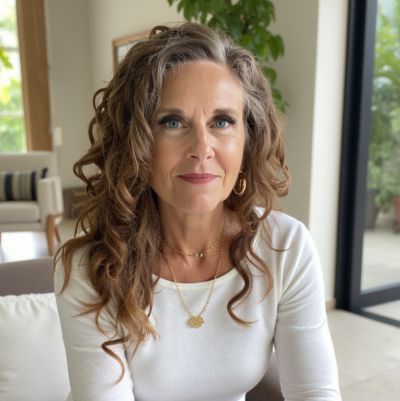
Elizabeth is a Master Certified Life and Health Coach with over 20 years of experience, dedicated to helping women in midlife thrive through holistic health and wellness. Her personal journey began with a desire to reduce her own breast cancer risk, which evolved into a mission to guide women through the complexities of midlife health, from hormonal changes to mental clarity and emotional resilience.
Elizabeth holds certifications from prestigious institutions such as The Life Coach School, Precision Nutrition, and the American Council on Exercise, as well as specialized training in Feminist Coaching and Women’s Hormonal Health. Her approach is deeply empathetic, blending her extensive knowledge with real-life experience to empower women in their 50s and 60s to build sustainable health habits that last a lifetime.
Recognized as a top voice in women’s health, Elizabeth speaks regularly on stages, podcasts, and webinars, inspiring women to embrace midlife with energy, confidence, and joy. Her passion is helping women regain control of their health, so they can fully engage in the things that matter most to them—whether that’s pursuing new passions, maintaining strong relationships, or simply feeling great in their own skin.