If you’ve ever said, “I just need more willpower around food,” this episode will challenge that belief in the best possible way.
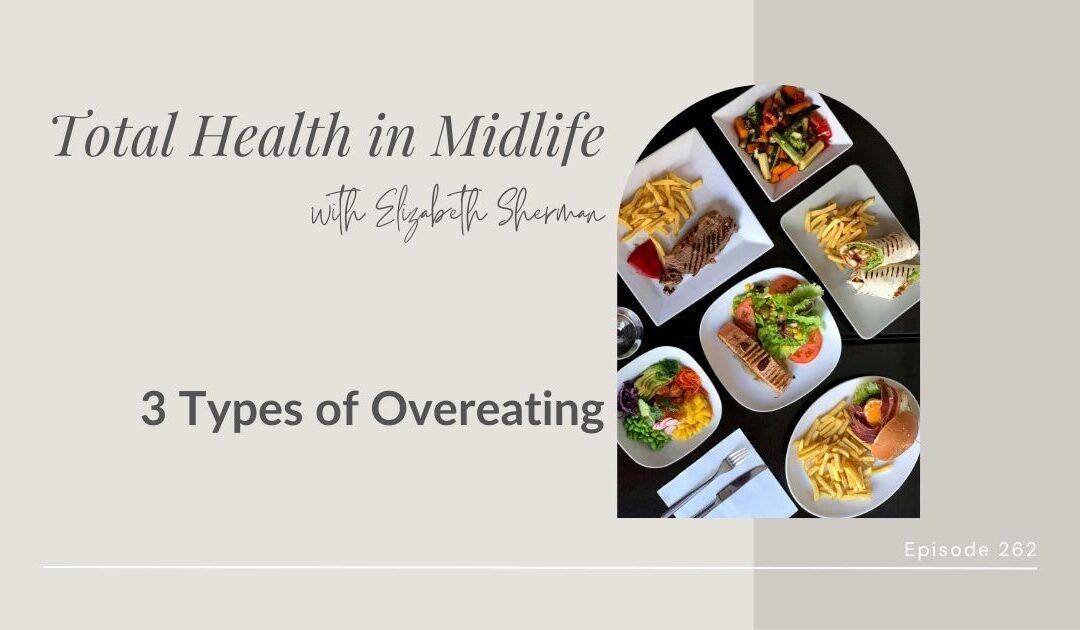
In this episode of Total Health in Midlife, Elizabeth Sherman breaks down the three types of overeating most common in high-functioning midlife women: end-of-day reward eating, all-day grazing, and weekend or social overeating. While they all feel like the same problem, they’re driven by very different triggers—and that’s why one-size-fits-all solutions keep failing.
Instead of offering another set of food rules, Elizabeth explains how to identify the cue behind your overeating pattern. When you can name what’s actually driving the behavior—stress relief, boredom, connection, habit, resentment—you stop fighting food and start rebuilding self-trust.
If you’ve been stuck in the cycle of “being good” during the week and “starting over” on Monday, this episode will help you understand why—and what to do instead.
The Biggest Problem Midlife Women Face Regarding Overeating in Midlife
The biggest problem midlife women face with overeating in midlife is misdiagnosis. “Overeating” is often treated as a discipline issue, when in reality it is a symptom of different habit loops driven by specific cues. These cues may include time of day (evening reward eating), environment (restaurant or social triggers), emotional states (stress, boredom, depletion), or habitual sequences (kitchen grazing between tasks).
When midlife women experience unexplained weight gain, stubborn belly fat, or inconsistent eating habits, they often respond by tightening control—cutting out foods, tracking calories, restricting during the week, or attempting strict meal plans. However, these approaches fail because they assume that every overeating episode is caused by the same problem. In reality, end-of-day stress eating requires a different intervention than all-day grazing or social overeating.
Without understanding the cue and reward behind the behavior, diets and food rules only address the surface. They do not resolve the underlying need for decompression, connection, micro-reward, or emotional regulation. As a result, women feel stuck in an exhausting cycle of restriction, rebellion, and regret—leading to increased stress, shame, and disconnection from their bodies.
What You Can Do Right Now
Start by identifying which pattern is most common for you. Notice when the urge shows up. Is it after dinner when you finally sit down and want to turn your brain off? Is it mid-afternoon when you’re restless and walking through the kitchen? Is it at restaurants when you don’t want to disrupt the connection or routine with your partner?
Instead of asking, “How do I stop eating this?” ask, “What is this food doing for me right now?” Is it providing relief, belonging, reward, distraction, or comfort? That shift moves you from autopilot to awareness. Awareness is the interruption point. Once you can see the cue, you can design a different response—one that honors both your health goals and your real life.
The Listener Takeaway: Why This Episode Matters
Midlife health challenges often feel confusing and personal. Unexplained weight gain, loss of control around food, or emotional eating can feel like evidence that something is wrong with you. This episode reframes that narrative. Your brain is repeating trained patterns. And trained patterns can be retrained.
When you can name your overeating pattern, you reduce shame and increase clarity. That clarity allows you to intervene earlier, practice “both/and” thinking instead of all-or-nothing extremes, and rebuild self-trust through small, consistent follow-through. This is how sustainable health is built in midlife—not through stricter discipline, but through better awareness.
Are you loving the podcast, but arent sure where to start? click here to get your copy of the Done with Dieting Podcast Roadmap (formerly Total Health in Midlife) Its a fantastic listining guide that pulls out the exact episodes that will get you moving towards optimal health.
Take the Quiz: Why Do Your Healthy Habits Keep Falling Apart? If you've ever wondered why you know exactly what to do but still can't seem to stick with it, this quiz was built for you. In about 3 minutes, it identifies your specific pattern: the real reason your follow-through keeps breaking down, and what to address first. Your results are delivered straight to your inbox.
I am so excited to hear what you all think about the podcast – if you have any feedback, please let me know! You can leave me a rating and review in Apple Podcasts, which helps me create an excellent show and helps other women who want to get off the diet roller coaster find it, too.
Watch or Listen to the Episode:
WHAT YOU'LL LEARN
- Why “overeating” is a symptom label—not a diagnosis—and how that changes everything
- The difference between stress eating at night, grazing during the day, and social overeating on weekends
- How to identify the cue behind your eating pattern before it turns into another cycle of regret
RESOURCES
- Download: 82 Reasons You Overeat That Have Nothing to Do with Food
- Total Health in Midlife Podcast Ep #189: How to Stop Overeating
- Total Health in Midlife Podcast Ep #201: How to Stop Overeating Without Dieting
- Total Health in Midlife Podcast Ep #233: How to Eat Intuitively
- Total Health in Midlife Podcast Ep #234: Why you Overeat at Night
- Total Health in Midlife Podcast Ep #235: "Food Is Fuel" is a lie
- Total Health in Midlife Podcast Ep #236: The One Thing Diets Never Teach
- Total Health in Midlife Podcast Ep #251: Cravings, Stress, Belly Fat: Why Willpower Isn’t Your Problem
- Total Health in Midlife Podcast Ep #252: Nighttime Cravings in Midlife: It's Not a Willpower Problem
- Total Health in Midlife Podcast Ep #253: Done With Diets but Still Overeating? How to Break the Cycle
- Total Health in Midlife Podcast Ep #254: How to Trust Yourself Around Food Again in Perimenopause
Full Episode Transcript:
262: 3 types of overeating
Elizabeth: [00:00:00] So. Keep telling yourself, I just need more willpower. I want you to listen closely today because when we overeat, it's not because there's one overeating problem. I find that there are actually many, and if you've been trying to fix all of them with the same solution, that might be why you're not able to rid yourself of this habit.
Here's what I mean. There's one habit, which is popcorn on the couch at nine 30 overeating, and that's not the same as the, I eat three bites of cheese every time I walk into the kitchen all day. Snacking type of overeating, and neither of those is the same as the, we went out to dinner and suddenly I feel like I'm at the Cheesecake Factory ordering an entire meal for a small village.
Overeating. They're all overeating. But they are triggered by different cues. They're serving different needs and they [00:01:00] breakdown in different places. So if you keep treating them like they're the same problem, you'll keep reaching for one. Fix more rules restriction.
Pantry purges. Then you'll wonder why it's popping back up like a game of whack-a-mole. So in this episode, I'm gonna help you name your actual pattern so that you can interrupt it before it hijacks your night, your weekend, or your entire day. Because if you can't name your pattern, well, you can't interrupt it.
So stay tuned.
Welcome to the Total Health and Midlife Podcast, the podcast for women over 40 who want peace with food, ease in their habits, and a body that they don't have to fight with.
Hey everyone. Thank you so much for tuning into the Total Health and Midlife podcast. I am your host, Elizabeth Sherman, and I am really glad that you're here with me today. So let me start out with something that I hear all of the time. I just keep [00:02:00] overeating. Elizabeth, why can't I just stop? Maybe for you, it's at night.
The kitchen is closed, the dishes are done. You finally sit down on the couch and you have your remote in hand, and then all of a sudden you're back in the pantry five minutes later. Or maybe it's not overeating in one sitting, but it's a handful of nuts While you're on a zoom call or a few cherry tomatoes while you're putting the groceries away, a slice of cheese while you're deciding what to make for lunch.
Nothing huge, nothing that feels like a binge, but by the end of the day, you feel meh. Like you were eating all day and you never really chose anything. Or maybe you've been good all week. You eat the salad, you skip the bread, and then Saturday night hits and it's burgers and fries and dessert, and that voice in your head that's saying, well, we've already blown it.
May as well go all in. Now, all of those situations are overeating. It feels out of control, like [00:03:00] you have no willpower. But here's what I want you to consider. All of those scenarios are actually not the same thing. You are responding to different patterns that all wear the same description, which is overeating.
They all feel like, why can't I get a handle on this? But the driver underneath each one is completely different. It's a different cue. It's a different emotional need, it's a different environment. And when you treat them like they're one problem, just overeating, you reach for one solution. More rules, tighter control, cleaning out the kitchen.
No more chocolate ever again. And it works until it doesn't. And so by the end of this episode today, you are gonna be able to name your pattern, and once you can name it, then you can interrupt it.
So here's the trap you feel outta control around food. [00:04:00] So. You reach for control and that makes perfect sense. You are a competent woman. When something isn't working, you tighten it up so you make rules. No more chocolate after dinner. No wine during the week. No eating after 7:00 PM. No peanut butter in the house because you cannot be trusted with an open jar of peanut butter and a spoon, you do the pantry, purge the January kitchen makeover, outgo the crackers, outgo the ice cream, the problem foods, and suddenly your shelves look like the perfect kitchen pantry with everything lined up and pretty.
And of course there is no food in the house. Only ingredients, and so you tell yourself, I'm going to be good this week, which usually means stricter lunches, maybe skipping the afternoon snack. Definitely not touching the complimentary tortilla chips. If you go out to dinner, you might even [00:05:00] track your food for a few days until the numbers start to feel like a moral report card and you quietly close the app because you don't wanna log what you just ate.
I know that because I used to do it, and if you're not restricting, you're white knuckling it. You're at the restaurant telling yourself, just order the salad. Just order the S salad. Just stick to the rules. Meanwhile, everyone else around you is sharing pizza and potato skins or queso, and they're laughing and having a great time.
And meanwhile, you are in your head doing math about everything that you've eaten and not enjoying the conversation. All of these are one size fits all solutions. They assume that the problem is food or appetite or discipline. They assume that every time you overeat the same thing is driving it. But let me ask you something.
Is the handful of popcorn on the couch at night, the same as the cheese and crackers that you pick at [00:06:00] while answering emails at 3:00 PM in the afternoon. Is Saturday night pizza with your partner the same as standing in your kitchen eating spoonfuls of peanut butter because you're exhausted and don't wanna think anymore?
They don't feel the same and they don't start the same way either. When you label all of it as overeating, you treat all of it the same exact way with more rules, more restriction, and more effort. And when that doesn't hold you assume that it's a character flaw. Now, here's why that fails. Those tools only work if the queue is exactly the same every single time.
If every episode of overeating were triggered by the same exact thing, then one rule might fix it, but it's not. Sometimes it's time of day. Sometimes it's the end of a long string of [00:07:00] decisions. Sometimes it's boredom. Sometimes it's needing connection. Sometimes it's resentment. Sometimes it's just a habit that you've done over and over and over for years.
Maybe one that your mom taught you when you were a kid. When you don't know what's kicking it off, you can't interrupt the cycle in the right place, so you end up playing defense against food instead of understanding the pattern and why it's there. And that keeps you stuck in this exhausting cycle of on and off.
So you're either being good, quote unquote, or you are quote unquote, off the rails. You eat salad or a burger, you're perfect, or screw it. That black and white thinking feels responsible. It feels like you're trying, but it also keeps you from seeing what's actually happening. So let's talk about what's actually kicking this off, because the cue is the [00:08:00] whole thing.
So we need to zoom out for just a second here and look at what's actually happening. There's a simple framework called the habit loop. It's not fancy, it's just three parts. The cue, the routine, and the reward. Something kicks the habit, loop off. You do a behavior and you get something out of it. That's it.
And if you've ever thought, why do I keep doing this? The answer is almost always in the cue. The cue is the trigger, the thing that sets the entire habit. Loop up the thing that lights the behavior without you really deciding. And cues are usually really ordinary. Time of day is a big one. So if you've eaten lunch at noon for 30 years and your body starts sending you hunger signals around noon, whether you're truly hungry or not, if you've had something sweet after dinner for [00:09:00] the last decade, 8:30 PM starts to feel like dessert o'clock.
So you're not crazy. Your brain loves patterns. Then there's sequence of events. So you have dinner, you do the dishes, you sit on the couch, turn on the TV, and have a snack. You don't even notice the steps anymore. It's like muscle memory. Your brain links those actions together. The couch isn't just the couch anymore.
It's the beginning of the food ritual. People and environment are also really powerful cues. You walk into a movie theater and suddenly popcorn feels mandatory. You sit down at a restaurant you love and your brain thinks, we always get the french fries here. You're with friends who order appetizers to share, and your hand moves before you've checked in with your body.
Do I really want that? It's not [00:10:00] weakness, it's just conditioning. Then there's emotional state, things like stress, boredom, loneliness, resentment, relief. So you've had a long day of making decisions. You've been on since 6:00 AM and you finally exhale and your brain goes to, we know how to handle this. Get out the chocolate.
Now here's the important. Your brain is not trying to sabotage you. It's trying to repeat what has worked before, what has brought you pleasure. If popcorn has consistently given you comfort at night, your brain will suggest popcorn at night. If grazing in the kitchen gives you a little mental break between tasks, your brain will suggest grazing between tasks.
It's efficient. It likes shortcuts. It doesn't like to think hard about things, so when you tell yourself, I just need more willpower, you're basically trying to argue with a [00:11:00] system that has been rehearsed hundreds, if not thousands of times. Willpower is a weak strategy against repetition. If you've practiced a pattern every night for five years, it's not going to disappear just because you made a Monday morning decision.
This is where a lot of folks start to feel defective. They think other people can just stop. Why can't I? But what you're experiencing isn't a flaw. It's actually a trained, ingrained learned pattern and patterns can be unlearned or retrained, but not by banning food, and not by shaming yourself, but by being able to identify the cue, what is happening that's leading up to the behavior.
Because if the queue is 9:00 PM and exhaustion, that's one conversation. If the queue is boredom at 3:00 PM that's a totally different [00:12:00] conversation. Now, if the queue is your partner saying, let's grab burgers for date night, that's another one entirely. Once you see which queue you're responding to, the pattern becomes obvious, and when the pattern becomes obvious, you finally have something to work with and you can create a strategy to work against it.
Here's one pattern that I see the most and one that I struggled with for the longest time. Sometimes I still do, it's the end of day reward eating. This is the evening's unravel pattern. It usually doesn't start with hunger. In fact, I'm usually not hungry after I eat. It starts with being done and wanting a break.
Dinner is over. The kitchen is clean, the counters are wiped down, the dishwasher is running. If you have kids at home, they're finally in their rooms away from you doing their homework, [00:13:00] doing their showers, phones, whatever your nightly shuffle is. And if you don't have kids at home, it probably feels a lot of the same.
The house is quiet, your body finally gets to UNC Unclench, and then you sit down on the couch with a blanket and you're remote and an exhale, and your brain goes, okay, now it's time. We get to treat ourselves.
This is where the cue is often the whole sequence dinner cleanup sitting down, and the craving is not really for food, but it's for relief. It's for having some time to yourself. You've been managing all day thinking, planning, deciding, taking care of other people, taking care of work, taking care of the house, taking care of everything.
Even if you love your life, it's still a lot of input. And at the end of the day, you want a hard stop. You want a boundary [00:14:00] between being on and being off. And so the treat becomes the ritual that marks the shift, wine and popcorn ice cream. Chips, chocolate, the nightly thing, whatever it is, and this is where the permission statement shows up.
It sounds reasonable. Like I deserve this. Ugh, it has been a day. It's just this, once I can eat everything in moderation, right? I'm not hurting anyone by having some chocolate. Sometimes it's even framed as self-care, which is honestly kind of offensive to self-care. But I get why we do it, because you are not trying to be reckless.
You're trying to take the edge off. But here's what happens. The treat works. It tastes good, it's comforting. It gives you pleasure, it changes your state. It gives you that little ah, feeling, [00:15:00] and then it keeps going. Because the relief is real, but it's also just temporary. So you reach for a little bit more and you don't stop when you're satisfied because satisfaction wasn't the goal.
Taking your mind off your problems was the goal. You wanted to turn your brain off, and then you go to bed, and then the next thing that shows up is the judgment, the regret. Now, sometimes it's super mean. Sometimes it's just a quiet heaviness. I didn't need that. I was already full from dinner. Why did I do that?
And then the bigger one, what is wrong with me? Why can't I resist this? I'm never gonna reach my goals. If I keep doing this, I need to get it together tomorrow. I promise I will be better. That's the loop, and the reason it [00:16:00] keeps repeating is that the brain learns fast, it learns end of day treat relief.
It doesn't fully register the pain, the judgment, and the regret. So the next day it starts queuing the craving earlier and earlier. So you finish dinner and you're already thinking about the snack, not because something is wrong with you, but because your brain has learned a really efficient pattern.
Your brain is basically a golden retriever with opposable thumbs. And now I wanna tell you a story for my own life, because this one is so relatable. It's almost embarrassing. I told this story in another episode, but I wanna share it again here because I think that it's appropriate.
I love something sweet after dinner. I always have. And at one point I decided in my infinite wisdom, that I was going to stop eating chocolate at night. Just. No more [00:17:00] chocolate after dinner. That was the rule. Very simple, very responsible, very Pinterest worthy. Right? And I did it for about two or three weeks.
Do you relate? I was proud of myself. I felt disciplined. I felt like I had overcome the habit. I felt like a woman who had her life together. And then one night I wanted chocolate. Not in a, I need chocolate, not in a, I'm starving, obviously, but just that familiar thought of I want some chocolate. But now there was this rule, and I remember standing there, I specifically actually remember where I was in my house, and I remember standing there feeling genuinely confused.
Like, I know I'm not supposed to eat chocolate, but. Why did I make that rule? Why did I decide this again? And then my brain offered me the [00:18:00] most compelling argument it said, and I remember this clearly. Well, if you can't eat chocolate at night, then you are never going to be able to eat chocolate ever again.
Which, as I say, it sounds ridiculous. I mean, obviously I could eat chocolate at 2:00 PM if I wanted to. I could eat chocolate on a Tuesday. I could eat chocolate on vacation. I could eat chocolate at a birthday party. I could eat chocolate whenever I wanted. But in that moment, it felt true. It felt believable.
It felt urgent. It felt like deprivation. That's the problem with rules. They take something that could be neutral and turn it into a scarcity situation, and I was able to catch it. I literally stopped and went, oh my gosh, that is so interesting. My brain was using black and white thinking to pressure me back [00:19:00] into that old loop to be able to have some pleasure from the chocolate.
That's probably something that happens for you as well. You try to stop the nightly eating by going cold Turkey. You last a couple weeks and then you get the cocky syndrome and your brain starts negotiating, and then the craving feels louder, and then you feel powerless and then you eat, and then you beat yourself up about it.
And what you're really trying to get, and this is important. Is not just a treat. You're trying to get release relief, decompression, a clean ending to your day. So if you treat this like a food problem, you'll keep trying to fix it with food rules, but it's not a food problem. It's a pressure release problem.[00:20:00]
Now to compare that to the pattern, that looks fine on paper it. All day Grazing is another sneaky variation on overeating because it doesn't look like overeating. There's no moment where you're doubled over on the couch thinking, what did I just do? You're not eating huge amounts in one sitting. You're not even really quote unquote indulging.
You're just eating a little bit all day long. A few cherry tomatoes here, a handful of almonds there. A piece of cheese while you're cutting something up for dinner, two crackers because you walk past the box or they were on a plate, a couple of bites of whatever is sitting out because you're in the kitchen anyway, and the thought that goes along with it is almost always the same.
You know, it's not that big of a deal. It doesn't really matter, or [00:21:00] it counts in the good direction. It's just nuts. That's a healthy fat, right? It's good for me. It's just tomatoes, vegetables are good for me. It's not like I'm eating cookies. It's not that much. It's fine. And listen, each of these thoughts is technically true, which is why it's believable.
Nuts are healthy. Tomatoes are healthy. Cheese has protein. It's not a giant meal. This is where I want you to notice something. A thought can be true and still not be helpful because the impact of grazing isn't about whether the food is good or bad. It's about the pattern. It do you want to keep reinforcing this behavior?
The pattern is you're never fully hungry and you're never fully satisfied. You're just in this constant gray zone. [00:22:00] The pattern is that you're eating when you're not hungry. You're eating to take the edge off without even noticing that you're taking the edge off. And what's driving it is usually not hunger.
It's something like, I have five minutes before my next thing. I deserve a little break. I'm bored, I'm restless. I'm avoiding starting the hard thing. I'm avoiding the awkward call. I can eat that if I want it. I'm procrastinating, but in a very productive looking way because I'm also standing in the kitchen eating my healthy cherry tomatoes.
It's a micro reward, a tiny hit of something between tasks. It also becomes a habit of proximity. So you're home. The kitchen is just steps away. Food is visible, food is accessible. Food is easy, and so your brain uses it like a reset [00:23:00] button. And because it's small, it feels harmless. But the cumulative effect is that you're constantly feeding.
So you never get clear on your hunger signals. You don't get the clean obvious, I'm full cute. You just stay in this loop of nibbling and by the end of the day, you feel kind of chaotic, not stuffed, just off. Now, here's why diets don't solve grazing. When you're a grazer, you often think the answer is structure.
So you buy the plan, the meal plan, the app. They eat these exact things at these exact times approach. And again, it works for a hot minute until those true but unhelpful thoughts show up, it's just a few nuts. It's not that big of a deal, it's just this. Once I should be able to eat what I want, I'm empowered.
Those are all true. [00:24:00] But they're being used like a little chisel, chipping away at the structure, one snack at a time, and then one day you realize that you're back to grazing, and now you're mad at yourself. Why can't I just follow the plan? Why do I keep messing this up? Maybe I need a stricter plan. You don't need a stricter plan.
You need to understand what the grazing is doing for you, because it's not really about the tomatoes, it's about the breaks that you are not taking. It's about decisions that you're postponing. It's about low level restlessness that you're trying to smooth out.
Okay, so the third type of overeating really is not about food at all. It's about the contract that you think that you are supposed to uphold. The third type of overeating is weekend and [00:25:00] social overeating. This is the one where you're like, I don't even know what happened because it wasn't planned.
It was just life. It's Friday and your partner says, Hey, I made plans for dinner at that nude steak place. And there's part of you that is genuinely excited. You want connection, you want something fun. You want to feel like a person again, not a bedraggled woman in a suit. And so you say yes, and then here comes the first layer underneath this pattern.
I've been good all week. Meaning that you ate the healthy breakfast, you stayed on track, you didn't buy the cookies, you were responsible. And so now the weekend feels like the time that you finally get to exhale. And if you've been doing that tight control thing Monday through Friday, the exhale is not a gentle exhale.
It's. Backlash. Exhale. Like the lid coming [00:26:00] off of a pressure cooker. So you walk into the restaurant and your brain is already starting to think about, I deserve this. And then there's the environment shift At home. You can control your kitchen. You know what's in the fridge, you know what dinner is. But out in the world, it's unpredictable, it's impulsive, it's, Hey, let's pop into this bar for drinks before dinner.
Or, oh my God, they have my favorite thing. It's appetizers and drinks and baskets of bread or chips and a menu that's designed to seduce you. And in that environment, a lot of women go into this false choice. You become either the salad girl. Or the screw it girl. The salad girl is the one who orders the grilled chicken salad while everyone else is eating pizza and laughing and dipping crust into ranch Dressing salad.
Girl is [00:27:00] technically good, but she's also quietly resentful because she didn't come here for their amazing salad. In fact, it's kinda lame. She came here for connection and screw it. Girl is the one who's like f future me. She can deal with that tomorrow. I'm going all in. She orders the burger and fries, maybe dessert, maybe a second drink.
And she's trying to be carefree because the past version of herself was so restrictive,
she had herself on a leash. There's a part of her already bracing for the aftermath of that decision because she knows what Sunday night feels like. That heaviness, that regret the why did I do that again? Now, let's add the part that a lot of women don't talk about, but they feel in their bones, which is the contract, the social contract, the unspoken [00:28:00] agreement that says date night means that we do this together.
If you and your partner always go out and split appetizers, if you always get the fries, if you always get the dessert, if that's part of your thing together. Then changing. It doesn't feel like changing food. It feels like changing connection, the agreement that you have as partners. And a lot of women are afraid to change the rules because they're afraid of what that means.
Will he think that I'm no fun? Will he be disappointed in me? Will he make a comment? Will we lose our ritual and our connection? So she goes along, even if she's half worried the entire time.
And if it's social friends, family groups, there's the belonging peace too. Food is how we connect with others. Sharing fries, [00:29:00] sharing the pizza, passing the nachos around, ordering a little bit of everything. You're talking, you're laughing. You're in the emotion of the moment, and your attention is on the conversation, not on your hunger cues.
So you keep eating, not because you're hungry, but because you're participating. This is what we do, and yes, alcohol can play a role here for some people, not because you're bad, but because it lowers your guard. It makes the sure why the hell not voice louder and the I'll regret this voice a lot quieter.
Now I'm going to paint a scene because I think that you might recognize it. So it's Saturday you're out running errands. You're already slightly annoyed because the line at the bank took forever and your partner is hungry and everyone needs something. And then he says, Hey, I'm really hungry.
Let's just [00:30:00] stop at five guys. And so you have this split second where you think, well, we have food at home, but also do I want that food at home? Do I wanna deal with making it? Do I wanna be the person who says, no? Do I wanna be the buzzkill? No, of course you don't. So you say yes, and then later that night, you're at the Cheesecake Factory because the Cheesecake Factory is basically where all good intentions go to die, and the menu is 12 pages long and everything is delicious.
And you feel like, well, what am I supposed to do now? Not live? That's the point. This pattern is not driven by hunger. It's driven by connection with others, with environment and a social contract that you are trying to uphold. So if these are three different patterns, what happens when you try to [00:31:00] fix them with one strategy?
Here's the line I want you to land with. Overeating is a symptom. It's not a diagnosis. It's like saying, I have a headache. Okay? Why is it dehydration? Is it stress? Is it hormones? Did you skip lunch? Do you need some sleep? If you treat every headache with the same solution, sometimes you'll get lucky. A glass of water might fix it, but sometimes you just need rest.
Sometimes you need food. Sometimes you need to stop staring at a screen. Overeating works the same exact way. It's the outward behavior that we can visibly see. It's the visible part. But underneath it, the driver is different depending on the cue, and this is why the real goal is not never eat emotionally ever again, because I don't even know that that's realistic [00:32:00] because food is part of life.
Food is part of connection. Food can be pleasurable. It is pleasurable. Food can be absolutely comforting at times. The goal is ending unconscious overeating. The goal is going from autopilot to awareness. Right now, a lot of what is happening feels automatic. You're on the couch and suddenly you're in the pantry.
You're in the kitchen, and suddenly you're eating. You're at the restaurant, and suddenly you've ordered everything and you're halfway through before you've checked in with yourself. That's autopilot. Awareness sounds small, but it changes everything because when you can name the pattern, a few things shift immediately.
First, you stop feeling broken. You stop telling yourself, I have no willpower. And [00:33:00] instead you can say, oh, I see it. This is my end of day pressure release pattern. Or this is my micro reward grazing pattern, or this is my connection and contract pattern. I get it. That language alone completely softens the shame.
Second, you can expect it and intervene earlier, not when you're already halfway through the ice cream, but earlier when you finish dinner and feel that first tug of, well, now what? When you stand up from your desk and automatically drift into the kitchen when your partner says, Hey, let's grab burgers, and you feel that split second of tension in your chest, that's the interruption point, and it's different for each pattern.
Third, you can practice both. And now this is [00:34:00] where most women don't give themselves permission. You think. Your only options are total control or total chaos salad girl, or screw it girl. But once you understand the cue, you can ask a better question like, what am I actually trying to get right now? What do I need?
What role is the food fulfilling? If it's relief, at the end of the day, maybe you build a different decompression ritual that doesn't rely entirely on food. If it's connection on date night, maybe you still have the burger and you stop when you're satisfied instead of using it as a rebellion against your weekday restriction.
If it's boredom at 3:00 PM maybe you take a real break instead of a handful of nuts break. That's both. And you honor your goals, your needs, and your humanity all at the same time. And this is where [00:35:00] self-trust gets built. Not by being perfect, not by white knuckling it, but by noticing, by choosing, by following through in small ways, and then seeing the result.
Every time you interrupt earlier, every time you respond, instead of react, you are teaching your brain something new. You're teaching it that you are not at the mercy of the loop, and that's a very different experience than trying to out discipline yourself.
So here's what I want you to walk away with. You don't need more discipline. You don't need a stricter rule. You don't need to ban peanut butter from your house. You don't need to promise yourself that this is the last time that you will ever eat chocolate after dinner. You just need a little bit of clarity.
You need to know which pattern is running, because once you can see whether it's pressure release, [00:36:00] micro reward, grazing, or connection and contract, you stop fighting food and start understanding the cue, and that changes everything. Now if this episode felt uncomfortably accurate, I want you to take the next step.
Go download my guide, 82 Reasons you Overeat that have nothing to do with food. The link will be in the show notes, or you can find it@elizabethsherman.com slash. 82 dash reasons. It's not a meal plan. It's not a diet. It's not a cut. Carbs, and call me in the morning situation. It's a detailed look at the real drivers behind overeating, pressure release, belonging, boredom, resentment, reward, avoidance, habit environment, because diets only address what you're eating.
They don't address why. And if food is serving a purpose, if it's helping you [00:37:00] decompress, connect, avoid, rebel, no amount of calorie counting is going to solve that. You have to understand the loop. So go download the guide again. You can find it@elizabethsherman.com slash 82 dash reasons, or I'll make sure to put the link in the show notes as well.
Read through it slowly notice which reasons make you feel seen. Start naming your pattern instead of judging it. That's where your power is. That's all I have for you today. Have an amazing day, and I will talk to you next time. Bye-bye.
Now before you go, if today's episode hit a little too close for home, or if you've ever wondered why did I eat that, I have something for you. It's called The 82 Reasons You Overeat that have nothing to do with food Now, it's not a guilt trip, and it's definitely not another diet plan. It's a free guide that will help you to finally understand why [00:38:00] you keep eating, even though you swore you wouldn't.
Here's a secret. It's not about willpower, it's about everything else. You can grab your copy right now@elizabethsherman.com slash 82 reasons. Seriously, go download it. You'll feel seen, and it might just be the start of something different.
Enjoy the Show?
- Don’t miss an episode, follow the podcast on Spotify and subscribe via Apple Podcasts or RSS.
- Leave me a review in Apple Podcasts.
- Join the conversation by connecting with me on Social!


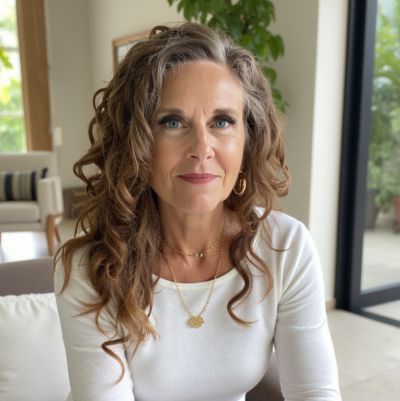
Elizabeth is a Master Certified Life and Health Coach with over 20 years of experience, dedicated to helping women in midlife thrive through holistic health and wellness. Her personal journey began with a desire to reduce her own breast cancer risk, which evolved into a mission to guide women through the complexities of midlife health, from hormonal changes to mental clarity and emotional resilience.
Elizabeth holds certifications from prestigious institutions such as The Life Coach School, Precision Nutrition, and the American Council on Exercise, as well as specialized training in Feminist Coaching and Women’s Hormonal Health. Her approach is deeply empathetic, blending her extensive knowledge with real-life experience to empower women in their 50s and 60s to build sustainable health habits that last a lifetime.
Recognized as a top voice in women’s health, Elizabeth speaks regularly on stages, podcasts, and webinars, inspiring women to embrace midlife with energy, confidence, and joy. Her passion is helping women regain control of their health, so they can fully engage in the things that matter most to them—whether that’s pursuing new passions, maintaining strong relationships, or simply feeling great in their own skin.