
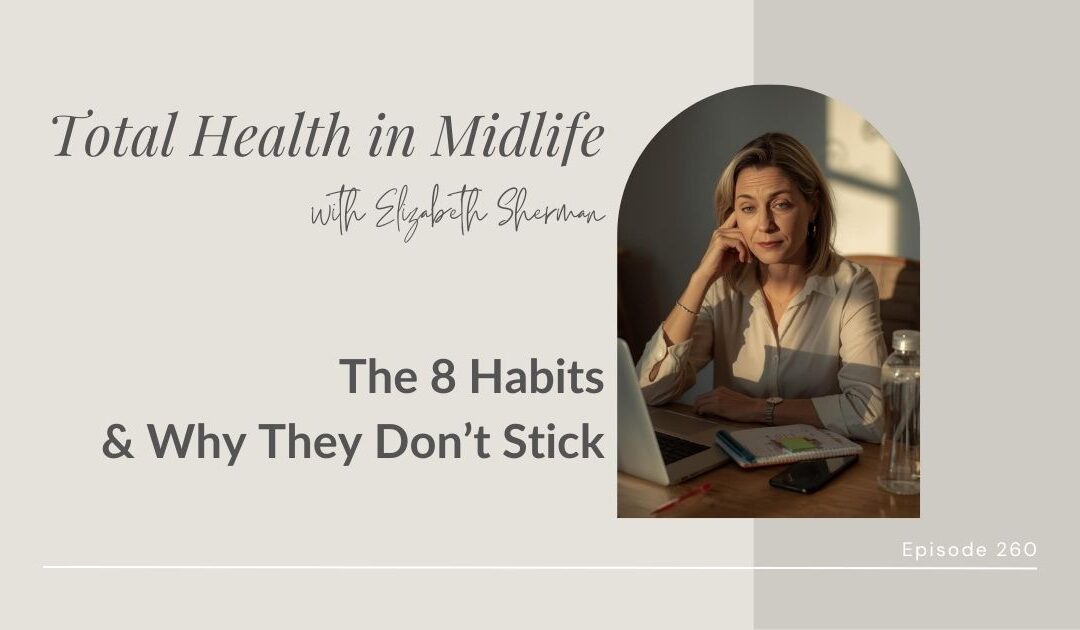
If you’ve ever found yourself thinking, “I know what I should be doing… so why am I not doing it?”—this episode is for you. Because the problem isn’t that you don’t know the basics. The problem is what happens in the ten seconds between intention and follow-through.
In today’s episode, I’m talking about the 8 healthy habits that are the foundation of my work with clients—and the real reasons midlife women keep skipping them, even when they’re motivated, smart, and genuinely want to feel better.
We’ll unpack why “simple” doesn’t mean “easy,” how years of diet culture and wellness rules have warped your definition of success, and why the life you’re living now (stress, hormones, time pressure, decision fatigue) makes old health strategies fall apart.
If you’re tired of starting over, blaming yourself, and wondering why your midlife body feels harder to manage than it used to, you’ll want to listen to this one all the way through.
The Biggest Problem Midlife Women Face Regarding Midlife Health Habits
The biggest problem midlife women face with health habits isn’t a lack of information—it’s the midlife knowing-doing gap. You already know that drinking water, eating protein, eating vegetables, sleeping, moving your body, and managing stress would help with fatigue, cravings, brain fog, mood swings, bloating, and weight gain. But knowing doesn’t automatically translate into doing—especially when your day is packed, your stress is high, and your body is changing.
In midlife, the “just try harder” approach starts to fail because your stress response is more sensitive, your sleep is more easily disrupted, and your recovery is slower than it used to be. Add a demanding job, caregiving responsibilities, and constant mental load, and the basic habits get pushed to “later.” The result is a predictable pattern: you skip one small thing because you’re busy (“It’s fine, it’s just this once”) and over time, that becomes your default.
On top of that, most women are operating with a rigid, outdated definition of what “counts” as healthy—8 glasses of water, an hour workout, perfect meals, daily meditation, 8 hours of sleep. When your life can’t meet that standard, your brain doesn’t scale down—it quits. Then you blame yourself, feel guilty, and go looking for a more intense “fix” (fasting, gut health protocols, macro tracking, Ozempic curiosity) instead of building the foundation that actually supports a changing midlife body.
What You Can Do Right Now
Start by changing what you’re diagnosing. Instead of treating skipped habits as a discipline problem, treat them as a system problem. Pay attention to the specific moment you renegotiate: when you decide to skip water, skip lunch, skip movement, stay up late, or grab something quick. That ten-second window tells you more than any plan you’ve tried. Your job is simply to notice the pattern—without turning it into a moral judgment.
Next, loosen your definition of what “counts.” If your brain believes the habit has to be done at 100% to matter, it will keep choosing zero when life gets busy. Midlife health improves when you stop chasing “perfect” and start building consistency around the basics—especially on high-stress days, travel days, and messy-life days. This is how you reduce shame, reduce friction, and stop living in the weekly loop of “I’ll start again Monday.”
The Listener Takeaway: Why This Episode Matters
This episode matters because it gives you relief from the story that you’re failing your health. If you feel stuck with midlife weight gain, fatigue, cravings, poor sleep, brain fog, or bloating—and you’re frustrated that you can’t seem to “get it together”—you’re not broken. You’re working with an outdated operating system that doesn’t fit your current life stage.
When you understand why you’re skipping the basics, you stop wasting energy on guilt and start making better decisions from a calmer place. You don’t need more rules. You don’t need a stricter plan. You need a foundation that holds up when life gets intense—so your health doesn’t depend on having a perfect day.
Are you loving the podcast, but arent sure where to start? click here to get your copy of the Done with Dieting Podcast Roadmap (formerly Total Health in Midlife) Its a fantastic listining guide that pulls out the exact episodes that will get you moving towards optimal health.
Take the Quiz: Why Do Your Healthy Habits Keep Falling Apart? If you've ever wondered why you know exactly what to do but still can't seem to stick with it, this quiz was built for you. In about 3 minutes, it identifies your specific pattern: the real reason your follow-through keeps breaking down, and what to address first. Your results are delivered straight to your inbox.
I am so excited to hear what you all think about the podcast – if you have any feedback, please let me know! You can leave me a rating and review in Apple Podcasts, which helps me create an excellent show and helps other women who want to get off the diet roller coaster find it, too.
Watch or Listen to the Episode:
WHAT YOU'LL LEARN
- Why “It’s fine if I skip this one time” quietly becomes your health pattern
- The all-or-nothing rules that make water, sleep, exercise, and food feel impossible
- How diet culture + “optimal health” advice creates burnout, shame, and constant restarting
RESOURCES
- Download the 8 Habits Healthy People Do guide
- Total Health in Midlife Episode #174: The Foundation v2.0
- Total Health in Midlife Episode #177: Why do I Need to Drink Water?
- Total Health in Midlife Episode #182: Why You’re Not Eating Enough Veggies and How to Fix It
- Total Health in Midlife Episode #187: The Ultimate Guide to Protein for Midlife Women
- Total Health in Midlife Episode #190: Breaking the Midlife Exercise Myths
- Total Health in Midlife Episode #195: How Sleep Impacts Your Health, Weight, and Mood
- Total Health in Midlife Episode #198: Stress: The Hidden Saboteur of Your Health
- Total Health in Midlife Episode #201: Eat Just Enough
- Total Health in Midlife Episode #202: How to Enjoy Treats Without the Guilt
Full Episode Transcript:
260 - 8 Habits & Why They Don’t Stick
Elizabeth: [00:00:00] So, you know, the eight basic habits that are the foundation of my work with my clients to help them create optimal health. Right. So let me ask you a slightly uncomfortable question. Do you actually do them? No. Okay. Then let's talk about why. Because if you've ever thought, I know what I'm supposed to do, why can't I just do it?
This episode is for you. And I'm not saying that from a pedestal. I'm the person who teaches habits for a living, and there are still days when my brain is like, no, thank you. We're gonna be having coffee and chaos instead. The habits are simple, but they are not always easy. And if you're waiting for a day, when life calms down, when your schedule opens up and when your stress disappears, when you are magically turned into this person who loves meal prep and goes to bed early.
You are going to be waiting for a while. [00:01:00] So in today's episode, I'm gonna show you what's really happening in those 10 seconds between I know what I should do, I know what I'm supposed to do, and I'm not doing it because it's not a discipline problem. It's actually a systems problem. And once you can see the pattern, you're not gonna be able to unsee it.
Which is annoying, and also the beginning of actually being able to change it. So if you've been stuck in the loop of trying harder quitting and starting over, do not skip this one because I'm about to tell you exactly why it keeps happening and then what to do next.
Welcome to the Total Health and Midlife Podcast, the podcast for women over 40 who want peace with food, ease in their habits, and a body that they don't have to fight with.
Hey everyone. Thank you for tuning into the Total Health and Midlife podcast. I am your host, Elizabeth Sherman, and welcome to today's [00:02:00] episode. I am fired up about this one. So if you've been with me for a little bit, you've heard me talk about the eight habits that healthy people do. My promise is that if you do these eight habits, you will never have to go on another diet ever again.
Now, I talk about them all the time. You know what they are. Here's what we're doing today, and maybe more importantly, what we're not doing today. We are not doing another episode where I explain the eight habits and try to sell you on them. If you've been around here for a minute. You already know what they are, and if you're newer, you can go back and listen to those episodes whenever you want.
I promise I will put the link in the show notes for you, but that is not the problem. The problem isn't that you don't know what to do. The problem is what happens in the 10 seconds between. I know what I should do, I know what I'm supposed to do. I know what I committed to doing. I know. [00:03:00] That I'm supposed to do all these things, and maybe I even told myself that I was gonna do it and then not doing it.
That's the part I wanna talk about today because this is the thing that I keep seeing when I'm coaching my clients, when I'm talking to women out in my own life and when I'm in the world standing in line somewhere and end up in one of those weird little conversations where a woman tells you her whole life story while you're both waiting to pay for, I don't know, sunscreen and diet Coke.
There are a handful of beliefs and behaviors that show up over and over and over again, and they're really sneaky because they sound totally reasonable. They don't sound like self-sabotage. They don't sound dramatic. They sound normal and logical things like it's fine. It doesn't matter if I skip this one time.
When you've got a to-do list that's longer than your arm, or I'll start when things calm [00:04:00] down, when life starts to demand a lot, or the classic, I just need to get back on track. And I'm not saying any of this in a gotcha kind of way. I'm saying it because these thought patterns are incredibly common and.
They're incredibly unhelpful. They keep you stuck in this loop where you keep trying to get better at doing the habits without ever noticing the mental traffic jam that's happening before you even begin. So today, the goal is to not give you more things to do, no more tips. It's to help you recognize getting in your way so that you can stop treating this like there's something.
When it's actually a pattern that shows up for so many women, because when you can spot the pattern, you can stop letting it run your health on autopilot, and once you see it, you can't unsee [00:05:00] it, which is both annoying but also extremely useful. Now, most women hear that and their brain immediately does what most brains do.
They make it personal. They don't say, huh, that's interesting. Maybe my environment is working against me. They say, wow. Why can't I just do this? Everyone else can, and that's the false conclusion that I wanna pull apart right now. Because if you've been quietly carrying this belief that you're inconsistent or lazy, or that there's just something wrong with you, I want you to be able to consider something else.
Like what if you're trying to run midlife health on an outdated operating system? Like what if you're an iPhone 15, but you're still trying to use a charger from 2009 and then you're mad at the phone? That's the [00:06:00] analogy of what I see all the time with women and the rules that they follow with their health.
Women who are genuinely capable, they're high functioning, responsible. They run entire departments. They keep their families afloat. They remember birthdays and dentist appointments and what size shorts their daughter wore in seventh grade. Then when it comes to drinking water or eating a real lunch or going to bed before midnight, or moving their body in a way that feels good, they're like, what am I like this?
Because you're using a system that was never designed for the day that you actually live today. Most health advice assumes that you have time, you have energy, that your life is low stress, that it, you have a predictable schedule. And a brain that isn't carrying 47 different open tabs at the same time.
And that might [00:07:00] have been more true when you were 25, but in midlife the stakes are totally different. The stress is different, your responsibilities are different, your hormones are different, and the way that you rest and recovery needs to be different. And the old just do it approach the one that we've all been taught.
It just starts to fall apart because willpower is not a system. Motivation is not a system, and shame is definitely not a system. It's just a loud, unpleasant emotion that makes you wanna hide and eat something satisfying. Here's the way I think about it. A health operating system is the set of default settings that determine what happens on a Tuesday at 6:00 PM when you're tired, when you're behind and someone texts you, can you just do this one thing for me and you feel your blood pressure start to rise, that's when your real system shows up. [00:08:00] Not the version of you who meal preps on Sunday with a podcast on an a cute little container situation.
the version of you who's been in back to back meetings, who hasn't peed since noon and is starting.
Is staring into the fridge like it personally betrayed you and screwed you over. If your current operating system is built on perfection and rules, and I'll do it when I have time, then it will fail you over and over and over again because midlife is not a low demand season. So when you're thinking, why can't I just stick to these basics?
The answer isn't that you need more motivation to do them. It's that you need a structure that can hold up when your life gets intense. Because right now what most women have is a health plan that only works on their best days when everything is calm. And that's not a plan, that's a fantasy.
And again, [00:09:00] this is where shame stops making sense If your plan works, when you have a quiet morning, a clear, good sleep, no stress, and no one needing anything for you, the problem is the plan. Once you start seeing this as a systems issue, an outdated operating system, you stop trying to fix yourself and instead you start getting curious like, oh.
This is why I keep renegotiating the basics because your brain isn't broken. It's just doing what it always does. It follows the path of least resistance. It defaults to what feels familiar. It chooses what. Gets rewarded in your life, which for most women is productivity and taking care of everyone else.
So if you've been treating this like a personal failure, I want [00:10:00] you to take that pressure off, not because it doesn't matter actually it matters a lot. Because beating yourself isn't going to build the foundation that you need.
One of the biggest ways your health operating system quietly fails you is. What we call all or nothing thinking. And if you're listening to this and thinking, oh, I'm not an all or nothing thinking kind of person, stay with me for just a second. Because most women don't think they're all or nothing. They think they're being responsible.
They think they're being realistic. They think they're being and doing things the right way, but what they're actually doing is carrying around a very rigid definition of what counts. Things like magazines, health gurus, your first personal trainer, whoever. They installed a template in your head for what success is supposed to look like.
And it usually sounds a little bit like this.
Getting your [00:11:00] water in means drinking eight glasses of eight ounces a day and not some water. Not more than yesterday. Eight. Like there's some law, which actually makes no sense because our water demands change based on our body composition and the time of year. Exercise means you have to do it for an hour and not an hour.
Total movement throughout your day. An hour like a real workout, preferably at a gym, preferably with leggings that don't roll down, and a sports bra that doesn't make you feel like you're in a fight with yourself when you're trying to take it off. Stress management means meditation, sitting still, being calm, clearing your mind.
Just breathe. And if you're bad at it or if you hate it or it makes you wanna crawl out of your skin, then you just decide stress management isn't for you. Now food [00:12:00] means being perfect, of course. Balanced meals, no weird snacking, no emotional eating, no treats unless you've earned them. And then when you eat something normal like chips at 4:00 PM because you're hungry and annoyed, you act like you've committed a crime.
Sleep. That means you have to get eight hours, not. I got to bed earlier, not I'm trying, but eight hours of Undisrupted sleep, like it's a requirement for entry into the Healthy People Club. So if you've got these full version expectations for yourself, here's what happens next. If you can't do the full version, your brain does this really annoying, but very common thing.
It decides it's not worth doing any of it because if you can't drink eight glasses of water, then why bother drinking one? If you can't work out for an hour, then [00:13:00] why would you even think about doing five or 10 minutes? If you can't meal prep like a person who owns matching glass containers, then why even try to eat vegetables today?
And the part that makes me want to gen, and the part that makes me want to gently flip a table is that most women don't even realize they're doing it. They just feel like they're constantly failing. They look at their day and they think, I didn't do it again. But what's really happening is that their definition of success is so extreme and so rigid that it's basically unworkable.
Especially after 40, because life after 40 is not a blank calendar and a fresh nervous system. It's meetings, it's travel, it's aging parents, it's work demands. It's your phone lighting up like a slot machine. It's your brain trying to remember 15 different things at once. It used to be [00:14:00] able to remember, but it can't anymore.
It's waking up at 3:00 AM and mentally reorganizing the entire week like you're running a small corporation and your capacity changes
not in a, you are falling apart kind of way in a normal human midlife kind of way. You don't recover the same way that you used to. Your stress response is more sensitive. You have less tolerance for pushing through. You can get depleted faster. You need more intentional rest, not less. Then we pile that reality on top of these rigid health templates and act shocked when they don't hold.
Let's take water for example, because it's such a perfect example.
If you're telling yourself you have to drink eight glasses a day, you might already be thinking about the downside. Like, okay, that's fine. Cool, great. I'm hydrated and now I have to pee every 12 minutes.
So if you have back to back [00:15:00] meetings or you're driving or you're in and out of appointments or you're taking care of someone else, your brain is like, no, I cannot do that. So you don't drink the water, not because you don't wanna be healthy, because the success template. Your holding is inconvenient and unrealistic for your actual day.
The same thing applies to exercise. If your template says exercise equals an hour at the gym, then what happens on a Tuesday when you have 30 minutes between work and picking someone up, or you're just exhausted or you just don't have it in you?
Your brain doesn't think, okay, well let's do what we can. Let's try a shorter version. It thinks, well now I can't exercise, and then you don't do anything. You don't move at all. The same thing with sleep. If you tell yourself it has to be eight hours, then the minute that you realize that you can't get eight, you shrug and stay up scrolling [00:16:00] because, well, it's already ruined.
Then you wake up tired, which makes everything else in the day more difficult. This is how the all or nothing template quietly creates a loop. It sets an unrealistic standard. Your life can't meet it, so you do nothing. Then you judge yourself for doing nothing, and now you're not just tired. You're tired and disappointed in yourself.
So let me say this clearly because I really want this to land for you. Your brain is using an unrealistic definition of success and then calling you a failure. That's not a personal flaw, that's a systems problem, and it's one of the main reasons that you keep skipping the habits, even though you know that you should be doing them.
The second big blocker. And honestly, this one is really sneaky because it's been in the [00:17:00] water that we've all been swimming in for decades, and that's conditioning bad health advice. Diet culture, wellness culture, the whole optimal everything industrial complex.
And I wanna be clear here. I'm not talking about one specific influencer or one specific program. I'm talking about the constant cultural noise . That has trained women to believe that health is something that you do correctly or you don't do it at all, or you get criticized, right? It's the steady drip of rules that sound official.
Don't eat after seven, eat six small meals per day. Never eat carbs. Carbs are fine, but only the good ones. You need to fast for 16 hours. You need to lift heavy, but also do Pilates and yoga, but also walk 10,000 steps, but also do zone two training. Track your macros. Don't be obsessive, cut out sugar, but fruit is healthy, but [00:18:00] not too much fruit.
Because that spikes your insulin. Take magnesium, but not that kind. Sleep eight hours, but wake up at five to be productive. It's like being in a group chat where everyone is shouting different instructions and then getting mad at you for not following them. And here's what happens. When you've absorbed years and years of that noise, you start to believe that to be healthy.
You need to do it all. You need to do everything and you need to do it perfectly. Not some things, not just the basics, but all of it. And not at a good enough level at 100% all in. So you're trying to drink enough water, eat enough protein, eat vegetables, get enough sleep, manage stress, get steps, do strength.
Do cardio, stop eating treats. Stop emotional eating, stop snacking. Stop being tired. Stop being human. And [00:19:00] you're doing all of this while working, running a household, managing relationships, keeping track of other people's needs, and trying to have a life that doesn't feel like a never ending list that you are failing at.
And then you look at your day and you feel like you are failing. On all levels because you can't do all of it at a hundred percent, which makes perfect sense because quite honestly, no one can. But instead of concluding, wow, this standard is ridiculous, your brain concludes, wow, I am ridiculous, and this is the trap.
When the standard is extreme, your brain protects you by quitting. Not because you're weak, but because your brain is practical. It doesn't like failing. If the rules feel impossible, your brain does the math and says, okay, why even start? I can't win. So you [00:20:00] don't. Then you feel guilty and then you make a plan to get back on track, which usually means you pick something extreme again, because that's what we've all been taught, that health has to feel hard in order to count.
This is exactly why I keep coming back to the eight habits because these habits are not moral achievements. They're not a test of whether you're a good person or not. They're fundamentals. They're the baseline stuff that makes everything else in your life work, but the fundamentals get buried under this nonsense.
Under rules, under trends, under this is the one thing that you're doing wrong under the idea that you need a complicated strategy to fix a very human situation. And the truth is, most women don't need more rules. They actually [00:21:00] need fewer rules. They need a foundation that's simple enough to do consistently, even when life is busy.
Even when stress is high, even when they're tired. Because if your health plan only works when everything is calm and perfect, it's actually not a plan. Instead, it's a setup. The third blocker is friction and access, and this is the one where a lot of women get extra mean to themselves because the judgment sounds something like this.
How hard is it for you to drink water? How hard is it, Elizabeth, for you to eat a vegetable? How hard is it to just go to bed on time and on paper? Yeah. These are not complicated tasks, but we do ourselves a huge disservice when we assume that because something is simple, that it should be easy as well.
Simple [00:22:00] does not mean effortless, and I need you to hear me on this because I have been doing health and fitness for well. A long time, like long enough that I have owned multiple kinds of resistance bands and at least one very embarrassing pair of sneakers that I loved at the time. But anyway, and I still have to be intentional about all of these habits, all of them drinking enough water, vegetables, protein, sleep movement, stress management, rest limiting my treats.
Every single one of these things takes intention. It takes care. It takes a decision because here's the truth that nobody wants to say out loud. I have never accidentally eaten a vegetable in my life. I have never accidentally drank a full glass of water. I have never accidentally gone to bed early.[00:23:00]
These things do not happen by accident. They happen because you decide and then you follow through and your brain will resist that. Not because you're broken or anything's wrong with you, but because your brain is doing what brains do. Your brain is constantly trying to conserve energy.
It wants the easy path. It wants familiar, it wants immediate reward. It wants to stay asleep. When the alarm goes off, it wants to keep scrolling. It wants the pasta instead of the broccoli. It wants the couch instead of the wok. Even when you like broccoli, even when you want to feel better. This is why the habits don't magically become automatic because you know that they're good for you.
Knowing doesn't remove friction. So let's talk about what's actually happening when the basics should be easy, but they're not. The first thing is friction. Friction is [00:24:00] the tiny annoying barrier that makes a good decision. Harder in the moment. It's the water bottle that's empty. It's the vegetables that are still in the crispr drawer in the bag that you bought.
Three days ago that have not been cut yet. It's the fact that you are hungry and your next meeting starts in seven minutes. It's the fact that going to bed means that you have to stop doing, stop solving, stop producing, and that feels weirdly unsafe for a lot of women. Second is context switching. So your day is not built for consistent basics.
It's built for demands. Your brain is bouncing from email to meeting to someone needing something to, oh my God, I forgot that deadline to, can you take care of this really quick to, I should text her back to, I need to order more dog food, or My dog is gonna starve. And when your brain is in that mode, the basic habits [00:25:00] don't feel urgent.
They feel optional, like background apps that keep you swiping away. The third is decision fatigue and stress physiology. The more decisions that you make in a day, the less bandwidth you have for the decision that is technically small, but still requires you to override your default setting. When you're stressed, your brain prioritizes what feels immediately relieving.
Not what's important long term. So you reach for what's quick, what's easy, what's rewarding, and then you tell yourself a story about it. Usually it's something like, I just do not have any discipline, which brings us to the double bind. You struggle and then you judge the struggle. You say, this shouldn't be this hard.
That creates judgment and shame, and that shame is not just a feeling, it's a chemical and emotional state [00:26:00] that makes you wanna avoid hide, disconnect, and numb out. So now you're not just dealing with the original friction, you're dealing with friction plus shame. And when you feel shame, avoiding the habit becomes the logical next step.
Because doing the habit would require you to face the part of that feels like you're failing. This is why women get stuck in that loop of, I'll do it tomorrow, not because tomorrow is better, but because tomorrow is where your brain puts the discomfort. And this is also where the deeper theme shows up.
Because if you're a high achieving woman, your life probably rewards productivity. You get a dopamine rush from crossing things off your list. You get praise for being the one who handles it all. You feel valuable when you're needed, so when you're choosing between sitting down to eat a real [00:27:00] lunch or knocking out three more tasks, your brain chooses the tasks, not because you don't care about your health.
Because your operating system is wired to prioritize urgency, performance, and other people over yourself, and the quiet basics that keep you well, and if you've ever actually slowed down a whole different set of feelings can pop up. Guilt. I should be doing something I'm behind. This is indulgent. So staying busy becomes a way to avoid those feelings, and then we act surprised when rest, recovery, sleep, and nourishment keep getting pushed to later.
So no, this isn't about you being dramatic about water. This is about you expecting simple to mean effortless, and then using that as evidence that something is wrong with you. But there isn't. There's [00:28:00] just friction. And a life that's demanding and a brain that's doing what brains do. If you put these three blockers together, this all or nothing success template, all the conditioning and bad health advice and very real friction living in an adult human life, you get something that looks like non-compliance.
That's the word that people use, like you are a difficult patient, but what it really is is predictable. Because if your definition of success is extreme and your brain is carrying years of shoulds programming, and your days are full of stress and context switching and decision fatigue, of course you're not doing these habits consistently.
Not 'cause you don't care, but because your system isn't designed for your life. Here's the part that I really want you to take in, especially if you've been in midlife long enough to feel like your body has started changing the [00:29:00] rules on you because it has, your hormones are shifting, your stress response is different.
Your sleep might be lighter, your recovery might be slower. Your appetite might be weirder, your energy might be less predictable, and your life is changing too. Your kids might be grown or launching or boomeranging. Your parents might need more from you. Your friendships might be changing, your marriage might be changing.
Your social support might feel thinner than it used to, and your tolerance for everyone else's nonsense is definitely changing. So the old approach, the one that we grew up with, doesn't fit anymore. And I'm not just talking about diets requiring perfection, I'm talking about how they require you to override your body, to ignore hunger, to push through fatigue, to treat rest like weakness.
Pretend stress doesn't count. That might have worked when you were 27 and [00:30:00] running on adrenaline and vibes. After 40, it starts to feel like you're fighting your own biology. So if you've been thinking, why aren't my old techniques working anymore? This is why. Not because you're failing, but because your body and your life are asking for different strategy.
You don't need to become super human. You don't need to try harder, and you don't need more discipline. You need a system that works for a human, a system that works when you are busy, a system that works when you're stressed, a system that works when you didn't get great sleep last night. A system that works when life is loud.
And I wanna say one more thing here because I'm not interested in the take care of yourself so that you can take care of everyone else. Messaging. I hate the oxygen mask analogy. You don't care for yourself so that you can be more useful to others.
You take care of yourself because you matter. You don't have to earn rest. You don't have to [00:31:00] earn food, you don't have to earn health. Taking care of your body is one of the most basic ways you communicate with yourself and say, I am worth being cared for. And that's the foundation that we are building here.
Not perfection, not performance, just a version of health that fits your actual life. So here's the decision. You can keep running the old system. You can keep doing what most women do and white knuckle it for a few days. Get back on track on Monday. Try something more intense when you're scared. Loosen your grip when you're tired, and then spend the rest of the week feeling like you're always behind.
You can keep renegotiating the basics every single day, or you can do something different. And when I say different, I don't mean more advanced. Something more honest, more realistic, more aligned with the life that you actually live and the body that you actually have. Because the goal here is not to [00:32:00] become the healthiest person who ever lived.
I'm not trying to help you win some imaginary wellness award. The goal is to build a foundation that makes your life work, a foundation that holds when work gets busy, when your stress spikes, when your schedule changes, when you're tired and your brain wants the easy thing. That's what we're doing. So if you want the next step, and this is a simple one, download my eight habits.
Healthy people Do guide. This is the baseline. Just go to elizabeth sherman.com/habits. These are the fundamentals I come back to with my clients again and again because they are the habits that make everything else easier. And yes, I fully stand behind this. If you can do these eight habits consistently.
You will never to need to do another diet ever again, not because you will be perfect, but because you will have a system. You will have a foundation that supports your appetite, your energy, your sleep, your stress [00:33:00] response, your metabolism, your mood, and all of it. You'll stop living in that constant cycle of I know what to do, why can't I do it?
So go grab the guide. The link is in the show notes. Go to elizabeth sherman.com/habits, and as you read it, I want you to keep the lens from this episode in mind. This isn't about trying harder, it's about building a LifeProof foundation that holds when life gets intense. That's the work and it's worth doing.
That's all I have for you today. Have an amazing day, and I'll talk to you next time. Bye-bye.
Speaker 3: Thank you for joining us on today's episode. If you're feeling overwhelmed by all the health advice out there and looking for something that's straightforward, my eight basic habits that healthy people do, guide and checklist is just what you need. It breaks down essential habits into simple, actionable steps that you already know how to do.
By following these habits, you'll set yourself on a path to better health, surpassing most people that you know. To get your free [00:34:00] copy, just click the link in the show notes or go to elizabeth sherman.com/habits. It's an easy start, but it could make all the difference in your health journey. Grab your guide today and take the first step towards a healthier you.
Enjoy the Show?
- Don’t miss an episode, follow the podcast on Spotify and subscribe via Apple Podcasts or RSS.
- Leave me a review in Apple Podcasts.
- Join the conversation by connecting with me on Social!


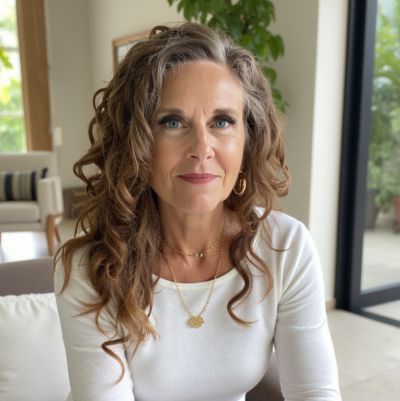
Elizabeth is a Master Certified Life and Health Coach with over 20 years of experience, dedicated to helping women in midlife thrive through holistic health and wellness. Her personal journey began with a desire to reduce her own breast cancer risk, which evolved into a mission to guide women through the complexities of midlife health, from hormonal changes to mental clarity and emotional resilience.
Elizabeth holds certifications from prestigious institutions such as The Life Coach School, Precision Nutrition, and the American Council on Exercise, as well as specialized training in Feminist Coaching and Women’s Hormonal Health. Her approach is deeply empathetic, blending her extensive knowledge with real-life experience to empower women in their 50s and 60s to build sustainable health habits that last a lifetime.
Recognized as a top voice in women’s health, Elizabeth speaks regularly on stages, podcasts, and webinars, inspiring women to embrace midlife with energy, confidence, and joy. Her passion is helping women regain control of their health, so they can fully engage in the things that matter most to them—whether that’s pursuing new passions, maintaining strong relationships, or simply feeling great in their own skin.