
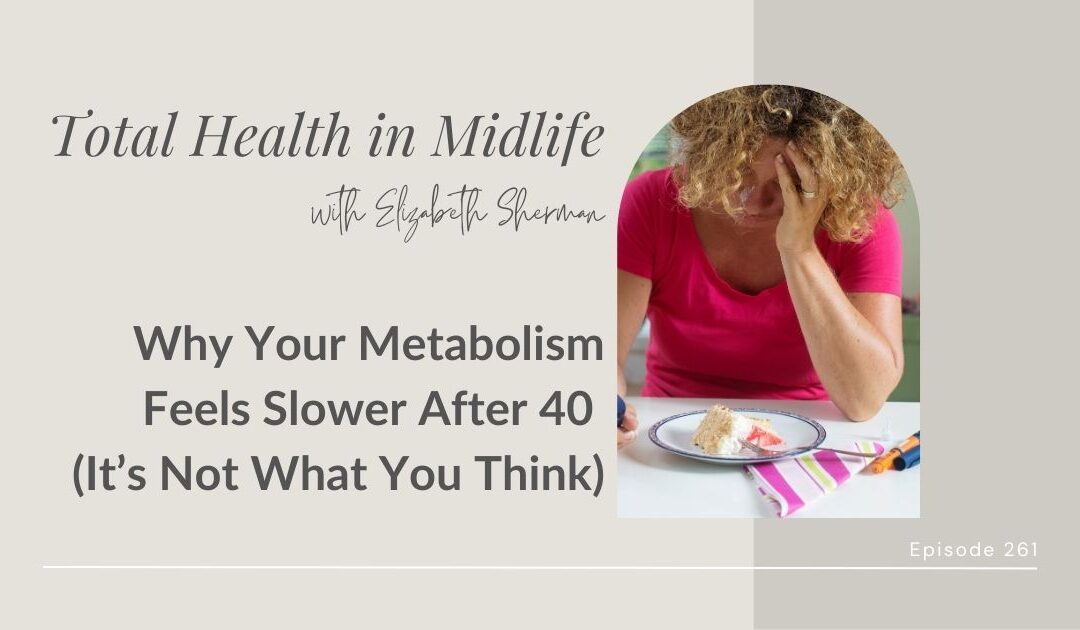
If you’ve hit your 40s or 50s and suddenly feel like your metabolism stopped cooperating, you’re not imagining things—but the explanation might not be what you think.
Many midlife women assume their metabolism is “broken.” The scale creeps up, energy drops, and the strategies that worked in their 20s and 30s—eat less, move more—no longer seem to work. It’s easy to blame hormones, aging, or menopause.
But what if the real issue isn’t a broken metabolism at all?
In this episode, Elizabeth Sherman explains why metabolism often feels slower after 40 and how decades of dieting, muscle loss, sleep disruption, and lifestyle changes quietly shift how the body uses energy. She also explains why eating less and less can backfire—and how to recognize the early signs that your metabolism and body are starting to recover.
If you’ve been frustrated with weight gain, constant cravings, or low energy in midlife, this episode will help you understand what’s actually happening inside your body—and why the solution may be very different from what you’ve been told.
The Biggest Problem Midlife Women Face Regarding Slower Metabolism After 40
One of the biggest frustrations women experience in midlife is the feeling that their metabolism has suddenly slowed down. Weight gain after 40, increased belly fat, lower energy levels, and stronger cravings can make it feel like the body has stopped responding to healthy habits. Many women search for answers online using phrases like “why is my metabolism slower after 40” or “why am I gaining weight in perimenopause.”
But in most cases, the metabolism itself is not broken. Instead, several small shifts accumulate over decades. Loss of lean muscle mass, reduced daily movement, poor sleep, higher stress levels, and years of restrictive dieting all affect how the body burns energy. These changes happen gradually, which is why many women don’t notice them until midlife.
Diet culture also plays a role. Women are often told that eating less and exercising more is the answer to weight gain. But repeated dieting cycles can disrupt hunger signals, reduce muscle mass, increase food cravings, and lower energy levels. Over time, the body adapts to these conditions, making weight loss harder and metabolic stability more difficult to maintain.
Understanding these hidden factors is the first step toward restoring metabolic health and building sustainable habits that actually support the body.
What You Can Do Right Now
Instead of focusing exclusively on the scale, start paying attention to the signals your body gives you every day. Stable hunger patterns, steady energy levels, fewer cravings, improved mood, and better sleep are early indicators that your body is receiving the resources it needs to function well.
Supporting metabolic health in midlife often means shifting away from extreme dieting and toward consistent, foundational habits: eating enough nourishing food, moving your body regularly, prioritizing sleep, and managing stress. These behaviors create the conditions your body needs to restore energy balance and metabolic stability.
Many women already know these habits in theory. The real challenge is understanding why they’re difficult to follow consistently in real life—and learning how to remove the barriers that get in the way.
The Listener Takeaway: Why This Episode Matters
If you’ve been blaming yourself—or your metabolism—for weight gain and low energy in midlife, this episode offers a different perspective. Your body may not be broken. In many cases, it’s simply responding to years of dieting, stress, sleep disruption, and lifestyle changes.
When you begin supporting your body consistently instead of fighting against it, things can start to shift. Hunger becomes more predictable. Energy stabilizes. Cravings quiet down. And over time, your body begins to respond differently.
Understanding how metabolism actually works in midlife can replace frustration with clarity—and help you focus on the habits that create lasting health instead of another short-term diet.
Are you loving the podcast, but arent sure where to start? click here to get your copy of the Done with Dieting Podcast Roadmap (formerly Total Health in Midlife) Its a fantastic listining guide that pulls out the exact episodes that will get you moving towards optimal health.
Take the Quiz: Why Do Your Healthy Habits Keep Falling Apart? If you've ever wondered why you know exactly what to do but still can't seem to stick with it, this quiz was built for you. In about 3 minutes, it identifies your specific pattern: the real reason your follow-through keeps breaking down, and what to address first. Your results are delivered straight to your inbox.
I am so excited to hear what you all think about the podcast – if you have any feedback, please let me know! You can leave me a rating and review in Apple Podcasts, which helps me create an excellent show and helps other women who want to get off the diet roller coaster find it, too.
Watch or Listen to the Episode:
WHAT YOU'LL LEARN
- Why your metabolism can feel slower after 40—even when nothing is “wrong” with your body
- The surprising reason decades of dieting can actually make weight loss harder
- The early signs your metabolism and body are starting to recover (before the scale changes)
RESOURCES
- Done with Dieting Podcast Ep 159: Fault vs Responsibility
- Download the 8 Habits Healthy People Do & Why They Don’t Stick Guide and Checklist
Full Episode Transcript:
261 - Why Your Metabolism Feels Slower After 40 (It’s Not What You Think)
Elizabeth: [00:00:00] So if you have looked at your body recently and thought, what the heck has happened to my metabolism? This episode is for you. Because a lot of women hit their forties and fifties and suddenly they feel like. The rules have changed, their body has slowed down, and the things that used to work like cut back a little bit on your food exercise a little bit more, stop producing the results that they used to produce.
So the conclusion often feels obvious. My metabolism must be broken. Here's the problem with that belief. If you think that your metabolism is broken, you keep trying to fix it the same way that most women have been taught to fix it. To eat less, to try harder, to be more disciplined. And honestly, that approach often produces the exact thing that makes the problem worse.
So in this episode, I am gonna explain why metabolism [00:01:00] can feel sluggish in midlife even when. Nothing is actually wrong with your body. And then we'll talk about the hidden effects of decades of dieting. The surprising research that explains why eating less can backfire, and the early signs that your metabolism is actually.
In recovery mode, even before you see changes on the scale. Because once you understand what's actually happening inside your body, you can actually stop fighting with it and start going with it, and you actually start working with your body instead. And so if you've been blaming yourself or your hormones for something that might have completely a different explanation, you are gonna wanna hear this.
Welcome to the Total Health and Midlife Podcast, the podcast for women over 40 who want peace with food, ease in their habits, and a body that they don't have to fight with.
Hey everyone. [00:02:00] Welcome to the Total Health and Midlife Podcast. I am your host, Elizabeth Sherman, and if you are listening to this exact episode, there's probably a decent chance that you've had a moment recently where you looked at your body or maybe the number on the scale and thought something like, what is happening to my metabolism?
Maybe the weight that you gained during the holidays didn't come off like it used to. Maybe you've been doing the same things that you've always done. Eating pretty healthy, trying to watch your portions, getting your walks in, and the scale still isn't moving. Or worse, it is moving, but just not in the direction that you want it to move in.
And at some point the thought crosses your mind. There is something wrong with my metabolism. It must be broken. That's the only logical choice. So you are not alone in that. And women Google this all the time. Why is my [00:03:00] metabolism slower after 40? Why am I gaining weight even though I eat healthy? Is menopause ruining my metabolism?
And it makes sense that we automatically go there because if something used to work and now it doesn't. The logical explanation seems to be that something in our body must have changed the hormones my age, my metabolism. But here's the thing that I want you to hear right at the beginning of this episode.
Most of the time. Your metabolism isn't broken. It's actually responding exactly the way that a human body is designed to respond. And once you understand why, it feels slower right now, a lot of the frustration and honestly, a lot of the self blame starts to make a lot more sense. So in this episode. I'm gonna talk about what's actually going on, why your metabolism can feel like it [00:04:00] suddenly slowed down in midlife.
Why the classic advice of eat less, move more often makes the situation even worse. And. What signs actually tell you that your metabolism and your body are starting to work with you again? Because when you can understand what's really happening inside that body, you stop fighting with your body and you start working with it instead.
So one of the biggest misunderstandings about metabolism is that women think that it slows down seemingly overnight. Like you wake up one morning at 45, you look in the mirror and suddenly your metabolism has packed its bags and it's headed across country.
But that's usually not. What's happening most of the time, what I see with my clients is something much quieter, much slower, and much easier to miss, which is why it sneaks up on us and it's this [00:05:00] lifestyle drift. It's not anything dramatic and nothing that you would notice in a single year. It's just very small shifts that accumulate over the periods of time.
And one of the big ones is muscle loss. Now, muscle is metabolically active tissue, which just means that it requires energy for your body to maintain it even when you're sitting still lying in bed, falling asleep. Many women spent their younger years avoiding strength training, not because they were lazy, but because that's what we were taught as young women that we didn't wanna look like Arnold Schwartzenegger.
When I was growing up, the body ideal for women wasn't a strong body. It wasn't muscular, it wasn't powerful. It was thin, like way thin, heroine chic thin, and a lot of women absorbed this message somewhere along the way that lifting weights would make them bulky. [00:06:00] I have had clients say to me, completely, seriously.
I don't want to look like Arnold Schwarzenegger, and I always have to pause and say that. I promise you that's not something that you need to worry about, but you will have signs and if it does, then we will back off. But when women try to avoid strength training for years or decades, something happens slowly over time, they start to lose muscle.
And when you lose muscle, your body simply doesn't require as much energy to maintain itself. And so right away you've got one quiet shift happening underneath the surface. Less muscle mass means slightly lower daily energy expenditure. Your metabolism. And then there's the second shift that happens in parallel.
Just normal movement, not necessarily exercise, but just daily movement around the [00:07:00] walking you used to do without thinking, taking the stairs, standing more, moving around during the. Here's something I see all the time. Women will tell me that they are busy all day, freaking long, and I believe 'em. They're answering emails, they're driving kids around, they're running errands.
They're sitting in meetings doing 10 things at once. Their brains are going nonstop, but their body. Isn't so much now. I remember when I was working as a personal trainer, years and years and years ago, I had a client who would show up right before our sessions and I would tell her, go ahead and jump on the treadmill for a few minutes.
And she would say, oh, but I've, I'm already warm. I've been busy all morning, running errands, doing carpool. And when we talked about what that morning actually looked like, it was mostly driving, sitting, being busy. [00:08:00] Not being active. And this is what happens to so many of us. We confuse our mental busyness, our mental thought process with physical activity.
We feel exhausted, but the body knows the difference. And over time, those small reductions in movement really add up. It's less walking, more sitting. Less spontaneous activity, and none of this happens dramatically enough for you to notice. But year after year and decade after decade, those tiny shifts accumulate.
And so you have less muscle, you have less daily movement, which means. Your body is simply burning fewer calories throughout the day than it used to, and not because your metabolism is broken, but because the environment that your metabolism is operating in has slowly changed, and most [00:09:00] women never even notice it happening.
And so another big piece of the metabolism story is that almost no one talks about the effect of decades of dieting. And if you are a woman in midlife, chances are good that dieting has been part of your life for a very long time. Maybe since high school, maybe since you were in grade school, maybe since you were in college, maybe since the moment your mom brought you to Weight Watchers.
Maybe once someone made an offhand comment about your body when you were 14, and your braiden quietly filed that away as evidence that you should probably start watching what you eat. And so a lot of women have spent years, sometimes even decades running the same cycle.
During the week, you're good, right? You're good in quotes, you're careful. You eat the salad, you skip the bread basket. You promise yourself that you're gonna stay on track this time, but then by Friday night something shifts, you're tired, you're [00:10:00] hungry. You want to relax, and suddenly it's pizza night or a glass of wine that turns into two, or standing in the kitchen after dinner, finishing the leftovers.
Then Monday rolls around and you start over again. There's the weekend restriction, followed by the weekend overeating, and it happens on repeat. And I see this pattern constantly with my clients. And what most women don't realize is that this cycle has real physiological consequences
When you repeatedly restrict calories, your body adapts. You lose muscle, your energy drops, your hunger signals get confusing, and some women actually stop recognizing their hunger entirely because they've spent so many years. Ignoring it, and the brain becomes increasingly preoccupied with food. There's actually a famous research study that illustrates this example [00:11:00] beautifully.
It's called the Minnesota Starvation Study, and it was conducted in the 1940s. Now, researchers took a group of healthy young men and restricted their calories for several months now. These weren't people with eating disorders. These were normal, physiological, psychologically healthy men. And as the study went on, something fascinating happened.
The men became completely. Preoccupied with food. They talked about food constantly. They read cookbooks for entertainment. They lost energy. They became irritable and emotionally unstable. Some of them even started collecting recipes and obsessing over meals in a way that really surprised the researchers.
So in other words, when the human body is under fed. The brain shifts into survival mode. It [00:12:00] becomes focused solely on food because its job, your body's job is to keep you alive. Now, here's the part that most women don't connect. Many women unknowingly recreate similar conditions every time they start another diet, they eat less, then they eat less again, when things are starting to get stuck, and then a little less after that when the scale stops moving.
And the body responds exactly the way that the body was designed to respond. Your energy drops, food thoughts increase, cravings, get stronger, and eventually the system rebounds. You eat more, your body tries to protect itself, and then the whole cycle starts again. So when women say. Their metabolism is broken.
What I often see is not a broken metabolism. It's a body that has spent years trying to protect itself from repeated periods of perceived [00:13:00] scarcity, and it's gotten very good at doing exactly that. So when weight loss slows down, and at some point it always does, the most common reaction is very predictable, you think?
Okay. So I've stalled on my weight loss. I just need to eat a little less. Maybe you cut back on your snacks. Maybe you stop eating after dinner. Maybe you decide that carbs are the problem, and suddenly bread has been banished from your house like it's some sort of toxic substance. And for a little while that might work. Eventually something happens that a lot of women interpret as a personal failure. You start to feel tired, your motivation to move drops, you find yourself thinking about food more often.
The cravings start creeping in and the scale stops cooperating, and so the logical conclusion feels obvious. I must not be trying hard enough. [00:14:00] I'm doing something wrong. And so again, the response becomes eat less. And this is where things start to backfire because the human body is not a simple math equation.
Your body is not a calculator that tallies up calories and produces weight loss like an Excel spreadsheet. Ask me how I know. Your body is a survival system, and survival systems are designed to adapt when resources start disappearing. When your body senses that food intake keeps dropping, it doesn't just passively accept that it starts making adjustments, and so your energy drops because if energy is scarce, conserving energy becomes a really smart move, so you move less.
Again, not because you're lazy, but because your brain is quietly dialing things down, and so you sit a little [00:15:00] bit longer. You skip the walk that you were planning and you choose the elevator instead of the stairs. You don't even notice that these things are happening, but they do add up, and then there's the muscle issue when the body doesn't have enough.
Incoming fuel, it will start breaking down your own tissue to keep things running. And unfortunately, muscle is metabolically expensive, which means it's often the first thing to go. So now you've got less muscle, you have less energy, less spontaneous movement, which means your overall daily calorie burn starts dropping as well.
At the same time, your brain starts pushing back. Food becomes really super interesting. Your cravings get louder. You might find yourself standing in the kitchen at night thinking about something crunchy or something sweet or something just [00:16:00] mouth feels soft. Not because you lack discipline, but because your brain is trying to solve what it believes is a survival problem, and eventually something gives you give into that you eat more. And often it's on weekends or at night when the day is finally over and the mental breaks come off and then the scale stalls or it starts creeping up, which leads to the very conclusion that started the whole cycle, which is.
My metabolism must be broken, but the truth is a lot less dramatic. Your body is doing exactly what it was designed to do. Its primary job is not to help you fit into your jeans. It doesn't care about that. Your body's job is keeping you alive, and when it believes food is scarce, it becomes very good at protecting the resources it has, which is why eating less and less [00:17:00] often ends up producing the exact opposite result that many women were hoping for.
If eating less and less often makes things worse, how do you know when things are actually starting to move in the right direction? Because most women are looking at one signal the scale every single morning, and if the number doesn't change quickly enough, the assumption automatically is that nothing is happening.
This isn't working. But the body gives us a lot of information long before weight ever changes. So I call these biomarkers in my practice with my clients, and they're the signals that I pay attention to when I'm working with my clients. So the first one is hunger. When your body is getting what it needs, hunger becomes.
Pretty predictable. You get hungry around meals you eat and then you feel satisfied for a few hours, so you're not [00:18:00] constantly grazing, but you're also not white knuckling your way through the afternoon, wondering how long you can hold off until you have dinner. The second signal is energy. Now, not caffeine, energy, but like real energy.
Energy to think. You wake up and you feel. Reasonably alert, you move through your day without crashing at three o'clock in the afternoon and you're not dragging yourself through basic tasks. And then there are cravings. When the body is under fed or stressed, cravings get really loud. When it's properly fueled, those cravings tend to die down a little bit.
Not disappear in completely. Trust me, we are human, but they do stop feeling like an utter emergency. And then your mood is another signal. People are often surprised by this one, but when your body is supported with enough food, enough [00:19:00] sleep and movement, your mood becomes much more stable. And then there's sleep.
Consistent sleep is one of the clearest signs that your body is starting to feel regulated again. So these are the things that I watch for first, not the scale, because weight loss is not the first thing that happens when the body starts getting healthier, which brings me to a phrase that I absolutely love, which is don't force fruit.
So let me explain. If you plant an apple seed. The first thing that grows is the root system. You can't see it. You can water the soil every single day and stare at the ground and think that nothing is happening, but underground the roots are spreading. Then eventually a small chute pushes through the soil.
The tree starts growing, ranches form leaves appear, and [00:20:00] only after the tree is strong enough. It's stable enough, it's safe enough. Does it start to produce apples? Weight loss is the apples, it's the fruit. But most people focus on the fruit first. They want the apples immediately without building the roots, without building the structure, without building the tree.
And when the fruit doesn't appear fast enough, they assume that something is wrong and they give up. And then they try something else. But often what's actually happening is that the roots are finally starting to grow. There's another piece to this conversation that I think is also really super important to talk about, and it's the difference between fault and responsibility.
I actually have a podcast on it, and I'll link it in the show notes because a lot of women land in one of two different places. The first place is blame. They think something must be wrong with them. [00:21:00] They think they're lazy. They're not disciplined enough. They lack willpower. They think that they're the only person who can't seem to figure this freaking thing out, and I want you to know that that just is not true.
The second place, some women land is the opposite, which is where I was for a really long time. They say, well, it's not my fault. It's the hormones, it's menopause, it's genetics. It's getting older and while there's some truth to those things, our bodies do change with time. Sometimes that belief quietly turns into something else.
It turns into the idea that there's nothing that we can do about it. And I understand why that happens because many of us grew up swimming in diet culture. We were taught that thinner was always better. We were taught that eating less. Was always the answer. We were told to fear carbs and then [00:22:00] fear fat, and then fear sugar, and then fear gluten, and at some point it just became so exhausting trying to keep up.
We were also living through a time where the ideal female body was extremely thin. Like think about the nineties, the wave look, the heroine and cheek look, no one was telling women to build muscle. No one was talking about strength. No one was talking about fueling the body properly. So a lot of women spent years trying to follow rules that were never designed to support their basic health.
In the first place, and that means something really important there. It may not be your fault that you ended up here, but responsibility is a different conversation. Responsibility means asking a different question, not who's to blame, but. What can I do with the body that I've been given? Because this is the only body [00:23:00] that you have, and the good news is that the body is incredibly responsive.
When we start supporting it properly, when we give it enough food, when we give it enough movement, enough sleep, enough consistency, then things begin to change, not overnight. But steadily, and that shift from blame to responsibility is often the moment when women finally start moving forward again. So if your metabolism isn't broken, what actually helps it to start working with you Again, here's some slightly uncomfortable truth.
Most women already know what healthy habits look like. You know that eating a balanced diet. Matters. You know that moving your body regularly helps you know that sleep affects everything from cravings to energy, to mood, and you probably know [00:24:00] that stress plays a role as well. Now, none of that is new information.
The real problem is not knowing what to do. The real problem is actually doing those things consistently in a real messy life. And there's another layer to this that I think is really super important. Two people can be doing the exact same habits and get completely different results. If you are eating well, moving your body, and taking care of yourself from a place of punishment because you are trying to force your body to lose weight.
Your experience is going to be very, very different than if you are doing those exact same things from the mindset of being good to yourself, being good to your body, being someone who really wants to feel good, being someone who wants to support your body, who supports it, who works with it. [00:25:00] That shift in energy actually changes a lot, which is why I created the guide called.
Eight habits healthy people do and why they don't stick. Now, these are the fundamental habits that support metabolic health. They are the things that I do with my clients. They're simple things like eating regularly, moving your body, sleeping well, managing stress. They're nothing extreme. They're nothing trendy either, but.
The guide doesn't just list the habits. It also helps you understand why smart, capable women struggle to follow through with them even when they know that these habits are important because there are real psychological and behavioral barriers that get in the way. And once you can see those things clearly.
Things actually start to get a lot easier. So if you can consistently practice these eight habits, I promise you you'll never need to go on [00:26:00] another diet ever again in your life. So if you wanna take the next step, you can download the eight habits guide and checklist using the link that's in the show notes.
Go to elizabeth sherman.com/habits. It will help you to identify what's actually getting in the way from you. And from there, you can start building the kind of habits that support your health for the long haul.
So again, go to elizabeth sherman.com/habits or click the link in the show notes. That's all I have for you today. Have an amazing week, and I'll talk to you next time. Bye-bye.
Thank you for joining us on today's episode. If you're feeling overwhelmed by all the health advice out there and looking for something that's straightforward, my eight basic habits that healthy people do, guide and checklist is just what you need. It breaks down essential habits into simple, actionable steps that you already know how to do.
By following these habits, you'll set yourself on a path to better health, surpassing most people that you know. To get your free [00:27:00] copy, just click the link in the show notes or go to elizabeth sherman.com/habits. It's an easy start, but it could make all the difference in your health journey. Grab your guide today and take the first step towards a healthier you.
Enjoy the Show?
- Don’t miss an episode, follow the podcast on Spotify and subscribe via Apple Podcasts or RSS.
- Leave me a review in Apple Podcasts.
- Join the conversation by connecting with me on Social!



Elizabeth is a Master Certified Life and Health Coach with over 20 years of experience, dedicated to helping women in midlife thrive through holistic health and wellness. Her personal journey began with a desire to reduce her own breast cancer risk, which evolved into a mission to guide women through the complexities of midlife health, from hormonal changes to mental clarity and emotional resilience.
Elizabeth holds certifications from prestigious institutions such as The Life Coach School, Precision Nutrition, and the American Council on Exercise, as well as specialized training in Feminist Coaching and Women’s Hormonal Health. Her approach is deeply empathetic, blending her extensive knowledge with real-life experience to empower women in their 50s and 60s to build sustainable health habits that last a lifetime.
Recognized as a top voice in women’s health, Elizabeth speaks regularly on stages, podcasts, and webinars, inspiring women to embrace midlife with energy, confidence, and joy. Her passion is helping women regain control of their health, so they can fully engage in the things that matter most to them—whether that’s pursuing new passions, maintaining strong relationships, or simply feeling great in their own skin.