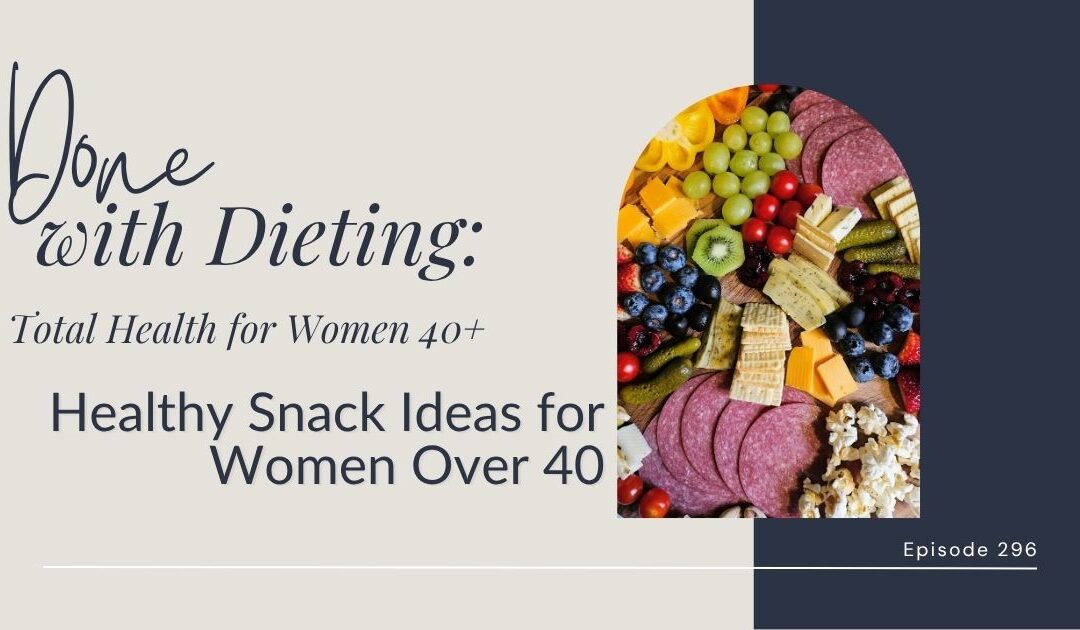
What are some healthy snack ideas for women over 40? It's the question every one of my clients asks me, and it's the one I dread most. I figured out why while I was editing a recipe on my website this week.
It sounds like it should have a quick answer, but it doesn't, because "snack" means something different to each of us. My husband eats leftover meatballs with his fingers like they're cookies. Some of you wouldn't count leftovers as a snack at all. Plenty of people eat Cheetos without wondering if they count.
In this episode, I explain why a list of snack ideas never seems to work, and what you need to know about yourself first so your own list does. We talk about what you picture when you hear the word "healthy," what you might need at 10 a.m. versus 3 p.m., and what to look for when you're standing in the bar aisle holding two wrappers.
If you've ever downloaded a list of snacks, scrolled through it, and thought, "none of these really work for me," this one is for you.
The Listener Takeaway: Why This Episode Matters
It's 3 o'clock, you're tired and hungry, and you're standing in front of the pantry. What you grab can change how you feel for the next two hours. This episode gives you a way to decide ahead of time what you want a snack to do for you, so you aren't guessing while you're hungry.
When a list of snack ideas doesn't work for you, that tells you the list didn't know your day. It says nothing about you. Once you can name what you want, like salty and crunchy, or warm and easy, or something that fits in your purse, you can come up with ideas that fit. You can also stop feeling like you're doing snacks wrong.
Are you loving the podcast, but arent sure where to start? click here to get your copy of the Done with Dieting Podcast Roadmap (formerly Total Health in Midlife) Its a fantastic listining guide that pulls out the exact episodes that will get you moving towards optimal health.
Take the Quiz: Why Do Your Healthy Habits Keep Falling Apart? If you've ever wondered why you know exactly what to do but still can't seem to stick with it, this quiz was built for you. In about 3 minutes, it identifies your specific pattern: the real reason your follow-through keeps breaking down, and what to address first. Your results are delivered straight to your inbox.
I am so excited to hear what you all think about the podcast – if you have any feedback, please let me know! You can leave me a rating and review in Apple Podcasts, which helps me create an excellent show and helps other women who want to get off the diet roller coaster find it, too.
Watch or Listen to the Episode:
WHAT YOU'LL LEARN
- Why a list of healthy snack ideas usually leaves you in front of the pantry at 3 o'clock with no better answer than before
- The questions to ask yourself that make snack ideas fit your real day: sweet or salty, finger food or fork and knife, fridge or no fridge, and how much time you have (plus why what you want at 10 a.m. can be different from 3 p.m.)
- Whether leftovers count as a snack, and where your idea of what a snack "should" look like came from
- How a protein bar differs from an energy bar, and what to compare when you're holding two labels in the store
RESOURCES
- The Meal Planning Playbook: download it here
- The Mix and Match Meals Builder, which comes with the playbook and helps you make meals that are creative and fun without being completely different every time
- Episode 225: Answering the Question, "Is it Healthy?" - If the "healthy" section of this episode made you rethink what that word means to you, this one goes further.
- Episode 191: Meal Plan Your Way to Intuitive Eating - If you want to apply the same questions to the rest of your day, this episode shows you how planning ahead can work with what you want to eat.
Full Episode Transcript:
296 - Healthy Snack Ideas for Women 40+
[00:00:00]
Elizabeth: So every client that I have ever worked with has asked me some variation of this very same question. And whenever it gets asked, I always dread it. It is, "What are some really good healthy snack ideas for me, Elizabeth?" Now, I always thought I dreaded it because I couldn't come up with enough answers or the right answers for my client, but I realized that that wasn't the reason, and I figured out the real reason this week while I was editing a recipe on my website.
And once I saw it, I knew I had been answering that question the wrong way for as long as I've been coaching. So in this episode, I will tell you why you can Google snack ideas, but it will never be satisfying or something that sticks, no matter how good the list is. And I will give you the questions to ask yourself at 3:00 before you open the pantry and grab whatever is easiest.
So stick [00:01:00] with me. By the end of the episode today, you will have your own answers to that very lovely question
Welcome to the Done with Dieting Total Health for Women over 40 podcast, the podcast for women who are done with the start over cycle and ready for a way of taking care of themselves that actually works.
Hey, everyone. Welcome to the Done with Dieting podcast, the podcast for women over the age of 40 who want lasting health and are done with dieting. I am your host, Elizabeth Sherman, and I am super glad that you are here with me today. Now, I was recently doing some administrative work on my website this week, and I have a lot of recipes on there, and I was editing one of them.
I was fixing the SEO on it, making sure that it would show up in Google search, and as I was reading through the recipe, I was like, "Oh, I forgot about this one. That would make a really great snack." Now, here's the funny thing about that, uh, [00:02:00] idea. I actually don't snack. I just don't. I eat my meals, and I'm good until the next one.
But if I did eat snacks, that recipe would be on my list. And then my very next thought was, "You know, I have clients who would look at that and think, 'No, that doesn't do it for me.'" And then I thought about the question that every single client asks me: what are some good healthy snack ideas? And I'll just say it.
This is the question that I dread most from anyone, and I know how that sounds. It looks like the easiest question in the world, right? Someone wants a snack idea. I'm a health coach. I should be able to name a few things, and I've done that, but I've never once given a short answer that seemed to work for my client.
So I sat there with my laptop, and I started wondering, "Why do I dread that question so [00:03:00] much?" And once I started looking at it, I couldn't stop. I came up with a lot of reasons. And when I give a direct answer like, "What about cottage cheese with cantaloupe?" what she hears is a menu. You can pick from these things, a list of foods that you're supposed to pick from, and she's never really happy with it.
She says, "Oh, thank you. Yeah, I'll figure something out." And then she goes on and eats whatever she was gonna eat anyway, or she's confused. And she tries the cottage cheese. Maybe she doesn't like it. A lot of people don't, so she's back to asking the same question.
Here's why. What I like is different than what you like. What you like is different from the woman who's sitting next to you, and what one client likes is different from what the other client likes. So you might want something sweet at 3:00, or you might want something salty and crunchy. Maybe you have [00:04:00] a refrigerator at work, or maybe you only have your purse.
That reason is also why I don't do meal plans for my clients. I can write one, but it would be my foods or what you think the right foods are, and my tastes aren't your tastes, and this matters for your health. If it's 3:00 and you're tired and hungry and you're standing in front of the pantry, whatever you grab can change how you feel for the next two hours.
So you might be sharp for your 4:00 call, or you might be just dragging, wanting to fall asleep. So I'm not gonna answer the question, well, kind of, or hand you a list today. Instead, I'm gonna help you figure out what you want when you say snack, so that you can come up with ideas that work for your body and your day.
So let's start with the word itself, snack. I [00:05:00] think we can all agree on one thing. A snack is a smaller thing than a meal, but that's probably where our agreement ends. My husband is a great example of this. When we make meatballs for dinner, he eats the leftovers as snacks. He stands at the counter with the container open and pops them in his mouth one at a time, the same way that you would eat a cookie or a cake ball.
Now, some of you may have just cringed with that. Messy fingers or sauce on your shirt, or maybe you think meatballs are a dinner food and it needs to have a plate and a fork. I get that. It's a fair way to look at it. But what about Cheetos? They're messy, too. Orange fingers, orange dust on your steering wheel, orange smudges on your keyboard, and nobody questions whether Cheetos count as a snack.
Keep- plenty of people eat them most afternoons and [00:06:00] don't think twice about it. Now, I'm not saying Cheetos are a healthy snack. Maybe they're not. What I am saying is that mess doesn't decide what counts as a snack. We each have a picture in our heads of what a snack looks like, and we picked that picture up somewhere.
Maybe it's from commercials or school lunches, what our moms kept in the cupboard. Now, here's another one I hear all the time. Clients tell me that leftovers don't count. I think they do. Whole roasted chicken from last night is a dinner food, so she thinks that she can't eat it at three o'clock. A half-baked sweet potato in the fridge is a side dish, so it just kinda sits there.
I think leftovers make some of the best snacks. They're already cooked, there's nothing to buy, nothing to wash. You open the fridge and there's a small container of last night's chicken and rice, and you [00:07:00] are done in two minutes. Then there are the women who have a strict rule about it. Some of you say a snack has to be finger food, nothing that needs to be eaten with a knife and fork.
Others say it has to be something that you'd never eat at a meal, like carrot sticks and hummus. And if that's your definition, that's fine. Keep it if it works for you. But I want you to notice what that does to your options. If a snack only counts when it's carrot sticks and hummus, you're gonna run out of ideas pretty quickly, and you'll stand in front of the refrigerator at 3:00 feeling stuck, and then you'll just grab whatever is closest.
And usually, that's the thing that you were trying to avoid. So, you don't necessarily have a snack problem. What you might have instead is a very small list, and the list came from a definition that you [00:08:00] didn't consciously choose. That's what I wanna work on with you today. For the next few minutes, I want you to ask yourself two questions: What counts as a snack, and where did I get that idea from?
Now, you might be surprised by your own answer. So let's talk about the word healthy, and I'm putting that in air quotes. When a client asks me for healthy snack ideas, I kind of figured out what she really needs. She wants something that's good for her, something that gives her energy so she's not yawning at 3:30.
Something that moves her towards the goal that she's working on. But it also needs to be tasty That makes complete sense to me. But here's what happens next. When she pictures good for me, her mind immediately goes straight to chicken and vegetables, grilled chicken breast, steamed broccoli, plain green beans.
Now, [00:09:00] those foods are good for you, absolutely, but trying to picture yourself snacking on chicken breast at your desk or pulling out a bowl of broccoli out of your purse, it doesn't really feel like a snack, does it? It feels kind of unsatisfying. So you skip it, and you grab a handful of whatever is in the break room.
Now, here's what I want you to hear. You don't have to live on chicken and vegetables in order to eat a healthy diet. You never did. All foods fit in a healthy diet. Yes, even the ones that you've been calling bad for years. So the question changes. Instead of asking, "What's healthy?" maybe you wanna ask, "What foods are right for my body and my day-to-day life?"
Now, that question has a different answer for you than it has for me, and it's a better question overall because you can actually answer it. So what do you wanna [00:10:00] eat at 3:00 that still has you feeling good at 4:00? Hold onto that question because we're gonna build on it. Now here's what what goes through my head when you ask me for a snack idea.
I don't say it out loud because it would be a lot, but I'm going to say it out loud today so that you can hear what I'd need to know before I could answer that question for you. Do you want something savory or something sweet? Do you want something crunchy or soft? Do you want finger food, or are you okay with a fork and a knife?
Do you want it to be neat and handy, or is it okay if it's messy? If you're about to jump on a video call, sticky fingers might be a problem. Then come the practical questions. Do you have a refrigerator where you're going to be? Do you have a microwave, or does this snack have to sit in your purse for four hours and still be good when you pull it out later?
[00:11:00] And how much time do you have? Two minutes between meetings or 10 minutes in your own kitchen? Now think about how that lands. You said, "I want a snack. I get hungry around 3:00. What can I eat?" And I just fired back eight different questions, and it can feel completely overwhelming. I get it. You wanted one idea, and I handed you a quiz.
And you'd probably say, "Gee, Elizabeth, I don't know. I just want something to eat, something that tastes good." And that's fair. But here's my side of it. If I don't ask, I'm just guessing. I might tell you to have a yogurt with some cantaloupe when you don't have access to a fridge. I might suggest a bowl of chili when you only are sitting in your car.
I might hand you a bag of almonds when what you really want is something comforting. And that's exactly why a [00:12:00] PDF of snack ideas doesn't seem to ever work. You've probably done that before. You downloaded a list of 50 different snack ideas. You scroll through it with your coffee, and you think, "Yeah, none of these really excite me."
And you're right. They don't.
The list was written for no one in particular. The PDF didn't know that you eat y- at your desk without a refrigerator. It didn't know that you can't stand anything cold, especially in the wintertime. So you close the PDF, and you're back in front of the pantry at 3:00 without any answer that's closer to your needs.
And the answer to those questions matter more than any list that I could give you. And here's the good part. You are the only one who actually has them. So you might be listening to all of this and those questions and thinking, "Okay, Elizabeth, I don't know what I want." [00:13:00] Now, if that's you, that's okay. Most of us don't, especially when you ask these questions because no one ever asked, and we've never really thought about it.
We just think, "Snack." Here's what I do for myself when I can't figure out my patterns or what to eat. I pay attention for a week. Every time I notice that I want something to eat, I stop for a few seconds and I ask myself, "What am I actually looking for right now?" And then I mentally take note or write down the answer on my phone, on a sticky note, on the back of an envelope, wherever is quickest.
I keep the answer short, something like, "I want something easy. I want something sweet. I want it to be grab and go. Nothing messy 'cause I'm in the car. I don't mind heating it up.
I'd happily use a fork and knife if it tasted good. I have 20 minutes, so I can actually put something together for myself. [00:14:00] Now, notice that none of those are actually food names. I haven't given you any snack ideas. What they do is they describe what I want from the food. Now, you can do the same thing.
On Monday at 3:00, you might write something sweet and I'm in the car. On Thursday, it would be warm. It's cold out and I wanna sit down. Now, this isn't meant to be homework. Don't judge your answers and don't try to fix them. Just notice them because it's what you want, and by the end of the week, you will start to see a pattern.
Maybe four out of five afternoons you said salty and crunchy. Maybe every single one said fast. And now you have something real to work with. When you ask me or anyone else for snack ideas, you're not starting with nothing. You can say, "I need something salty that fits in my purse." Somebody can actually [00:15:00] answer that.
Now, this is something that I help my clients figure out, and it surprises most of them. What your body wants at 10:00 in the morning can be very different from what it wants at 3:00 in the afternoon, and what it needs at 10:00 can be very different than at 3:00 or 9:00. Some women feel best when they start the day with protein, two eggs and a little turkey sausage, and they are steady until lunch.
Other women need some carbohydrate in the morning, a bowl of oatmeal or toast with peanut butter. Some women do well with more fat like avocado on toast or a piece of cheese, and some do best with a mix of all of those. Now, none of these is the right way to eat. Each one just makes you feel different. So here's what I mean.
Let's say that you eat a big bowl of sweetened cereal at 7:00 in the morning. By 10:00, you might be hungry and a little shaky, and [00:16:00] you want something else pretty soon. But then on another day, you eat eggs and fruit, and you don't think about food again until noon. It's the same you, it's the same morning, but it's different food and a different result.
Part of what I do with my clients is help them to figure out what they need at different times of the day in order to feel and function their best, and we go by what their body tells them. A snack is a really good place to start noticing this. It's small so that you can eat it and check in with yourself an hour later.
Ask yourself, "Am I steady? Am I sleepy? Am I hungry again already? Am I irritable?" And then write down what you ate, how you felt in the same place that you're writing down what you want. After a couple weeks, you might see that a handful of nuts keeps you full until dinner, and a granola bar has you looking for more in 45 minutes.
[00:17:00] Or you might see it go the other way. Only you can find that out. Okay, so now let's talk about actual food, and I wanna be clear about something first. What I am about to share are examples. I'm not handing you a list to write down and copy. I'm showing you how to think about it so that you can start to build your own list using what you figured out in the last few minutes.
So I sort snacks by what's mostly in them. What I mean by that is protein, fat, or carbohydrate. And then there's a fourth group, which are foods that mix. So let's start with protein.
So this is the one most of us think of first, things like cottage cheese or flavored yogurt. So an example might be a cup of cottage cheese with cantaloupe cubes or, um, maybe some sliced tomatoes and a little pepper. That's one that, uh, folks tend to really like a lot. And then there's one from the low-carb [00:18:00] craze that a lot of women still really like.
You take a slice of deli turkey or ham, you lay a few cucumber sticks or a pickle spear inside, and then you just roll it up and pop it in your mouth. It's cold, it's salty, and you can eat it with one hand. You can also take a lettuce leaf, put a sliced turkey or chicken in it, and add some mustard and fold it up.
That's a mini lettuce wrap, and it takes about two minutes. But then there's the fat category. Cheese is the big one in this category. So, like a string cheese stick or a few cubes of cheddar. Nuts go in this category, too. A small handful of almonds or walnuts in a baggie. Both are fine. Now, I'm not here to tell you anything wrong with that.
Just know that these things are higher in fat, and nuts especially are easy to overeat. If you've ever reached into the bag just once and looked down to find it half empty, you know what I [00:19:00] mean.
A small container with a portion that you've already portioned out ahead of time can really help with that. And then finally, carbohydrates. Things like fruit, like an apple, banana, or a small bunch of grapes. Or things like pretzels, crackers, and cookies belong in this category as well. Now, if a cookie is what you want at 3:00,
You just might wanna notice how you feel an hour later. And then finally, we have the mixes, the fourth category. So things like apple slices with peanut butter or crackers with a slice of cheese. Maybe it's yogurt with a spoonful of granola. Those cover more than just one group at once, and a lot of women find that they stay fuller for longer with them.
Here's what I want you to take away from all of this. Your limit here is mostly creativity. That's the only thing holding you back. You don't need to memorize my [00:20:00] examples.
Take your notes from the week and the answers to the questions that we just went through. Maybe you wrote salty, crunchy, and fits in my purse. Then you know how to look for things like nuts, pretzels, a cheese stick that you can pack with an ice pack. Maybe you wrote warm and I have a microwave. Now leftovers might show up on your list.
Your list will look different from mine, and it should. So let's talk about the snack aisle for a minute because this is where a lot of us get fooled. Let's say that you're at the grocery store, maybe you're looking for a protein bar, and you walk down the bar aisle. Now, there are protein bars, there are energy bars, there are meal replacement bars, and there are wellness bars.
They all have bright wrappers with words like clean and fuel on them. Now, here's something that helps. A protein bar and an energy bar are not the same thing, even when they sit on the same [00:21:00] shelf. The energy bar usually has more carbohydrate in it, and it's mostly simple carbohydrate, the kind that give you a quick lift and can leave you hungry again an hour later.
Now, a protein bar is built around protein. Here's my rule of thumb. If it looks like a candy bar and it tastes like a candy bar, it's probably closer to a candy bar than it is a protein bar. I'm not saying that you can never eat one, but I just don't want you to fool yourself. If you love it and it's what you want at 3:00, that is your call.
I just want you to know what you're buying. Companies know that you want something that tastes like dessert and sounds like a health food, so they make it and they make money when you can't tell the difference. So how do you tell the difference? Now, I teach my clients a simple tool for reading a label.
The idea is easy. When you're standing there holding two bars or two [00:22:00] packages of tortillas or two loaves of bread or two things of yogurt, you can compare them. I look at the carbohydrate, the fiber, the protein, the fat, and the sodium, and based on the calculation, I can make a better choice about which one's a better fit for me.
Same type of product, two different labels, and one is clearly the better pick for your body. And here's the part I really want you to hear. You don't have to count macros. I don't teach that, and I don't do it myself. What I want you to know is whether you tend to feel best with more protein, more fat, or more carbohydrate, or a mix of all of them.
Different macro balances work for different women. Your best friend might feel great on foods that make you feel sluggish. That's just information about you and how your body works, and the more you notice it, the faster you'll be able to stand in that aisle and pick one [00:23:00] So let's go back to the question that I posed at the beginning of the episode.
What are some healthy snack ideas? Here's my answer now. Figure out what you want a snack to do for you. Name your preferences, like sweet or salty, crunchy or soft, refrigerator or purse, and then let those answers shape your ideas.
A list that comes from you will work better than any list I could ever write. If you'd like help with that, I have something for you. Go to elizabethsherman.com/meal-planning-playbook and download the Meal Planning Playbook. It asks similar questions to what we talked about today, except for all of your meals.
What do you want to eat? How much time do you have? Where will you be? What will you have on hand when you get there? It works for snacks, and it works for breakfasts, [00:24:00] lunches, and dinners too. And the Mix and Match Meal Builder comes right along with it. It helps you put together meals that feel creative and fun so that you don't get bored and you're not eating the same thing every day, and you aren't planning something brand new every single time either.
Again, that's elizabethsherman.com/meal-planning-playbook. And I will make sure that it's in the show notes for you as well. Thank you for spending this time with me today. The next time it's 3:00 and you're standing in front of the pantry, you will know what to ask yourself. That's all I have for you today.
Have an amazing day, and I will talk to you next time. Bye bye. Hey, thanks for listening to today's episode. Now, if meal planning feels like one more thing that you should be doing, but every week turns into standing in front of the fridge wondering, what do I make today? You are going to love my meal planning playbook. [00:25:00] This isn't a rigid meal plan or a binder full of complicated recipes.
It's a flexible real life system that helps you make healthy meals easier, faster, and way less mentally exhausting. Inside, I will show you how to simplify your food decisions, stop the last minute scramble, and create meals that actually work for your life. You can grab your copy through the link in the show notes.
Thanks again for being here, and I will see you next week
Enjoy the Show?
- Don’t miss an episode, follow the podcast on Spotify and subscribe via Apple Podcasts or RSS.
- Leave me a review in Apple Podcasts.
- Join the conversation by connecting with me on Social!


Elizabeth is a Master Certified Life and Health Coach with over 20 years of experience, dedicated to helping women in midlife thrive through holistic health and wellness. Her personal journey began with a desire to reduce her own breast cancer risk, which evolved into a mission to guide women through the complexities of midlife health, from hormonal changes to mental clarity and emotional resilience.
Elizabeth holds certifications from prestigious institutions such as The Life Coach School, Precision Nutrition, and the American Council on Exercise, as well as specialized training in Feminist Coaching and Women’s Hormonal Health. Her approach is deeply empathetic, blending her extensive knowledge with real-life experience to empower women in their 50s and 60s to build sustainable health habits that last a lifetime.
Recognized as a top voice in women’s health, Elizabeth speaks regularly on stages, podcasts, and webinars, inspiring women to embrace midlife with energy, confidence, and joy. Her passion is helping women regain control of their health, so they can fully engage in the things that matter most to them—whether that’s pursuing new passions, maintaining strong relationships, or simply feeling great in their own skin.