
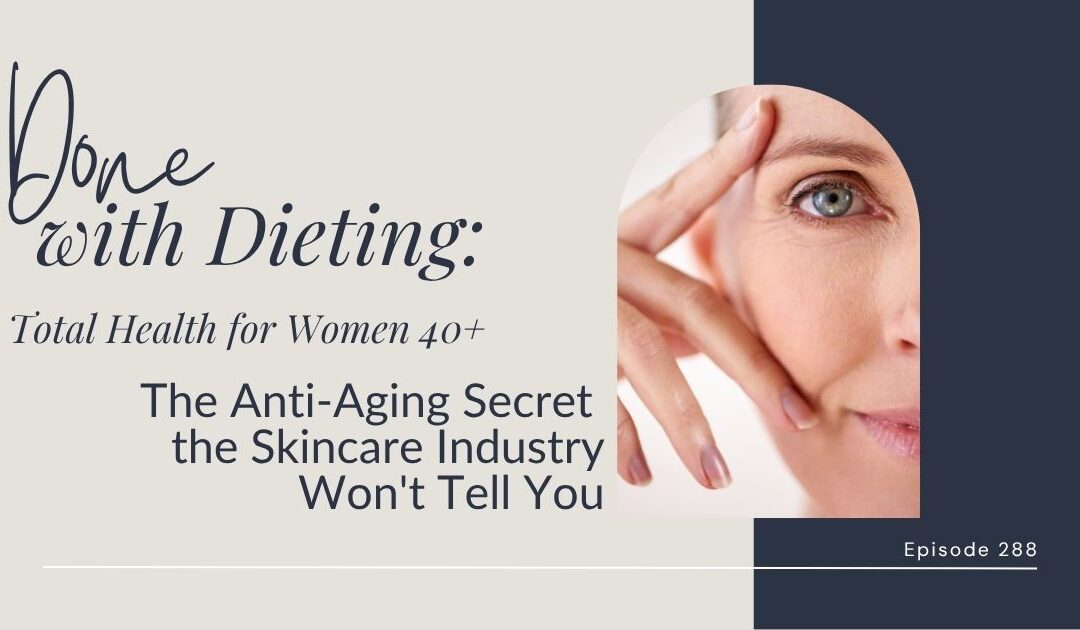
You've been told that looking older is a problem, and that the fix is a shelf full of serums, creams, and a morning-and-night routine that eats your money and your time. In this episode, Elizabeth Sherman makes a different case: the thing that actually shows up on your face as you age isn't a missing product. It's stress. And the skincare industry will never say that out loud, because there's nothing to sell you against it.
Elizabeth pulls this apart from a mall in Boston, where she catches her own brain deciding a new dress and a new couch will make her life better. That same pull, she explains, is exactly what happens when you look in the mirror at 55 and reach for the next bottle. She then does something most people in the wellness space won't: she lays out her own privilege honestly, including the cosmetic work she's had done and the reasons she looks the way she does at 57, so you can see clearly what's actually driving how a face ages.
The turn in this episode is the part that matters most. Some of your stress is structural and you can't change it. But a second layer, the worrying, the anxiety, the resentment about things you can't control, is yours, and it's costing you more than the circumstance itself. Elizabeth connects this to what chronic stress does to your body over time and to research on how your beliefs about aging affect how long and how well you live.
This isn't a stress-management protocol, and it isn't another product to buy. It's a clear look at why you're spending money and mornings on something that was never going to work the way it promised, and what to pay attention to instead.
The Listener Takeaway: Why This Episode Matters
If you've ever stood at a counter and handed over real money for a small bottle because someone told you what it would do for the lines around your eyes, this episode is going to feel like a weight coming off. You are not failing at aging, and you are not behind. You've been sold a fix for a problem that a product can't touch.
What you'll walk away with is permission to stop, and something more useful than another routine: a clear-eyed way to see where your stress is actually coming from, what part of it is yours to work with, and why the resentment you're carrying about the rest is quietly doing more damage than the circumstance ever could. That awareness is where real change starts, and it costs you nothing.
RELATED EPISODES YOU MIGHT LOVE
Are you loving the podcast, but arent sure where to start? click here to get your copy of the Done with Dieting Podcast Roadmap (formerly Total Health in Midlife) Its a fantastic listining guide that pulls out the exact episodes that will get you moving towards optimal health.
Take the Quiz: Why Do Your Healthy Habits Keep Falling Apart? If you've ever wondered why you know exactly what to do but still can't seem to stick with it, this quiz was built for you. In about 3 minutes, it identifies your specific pattern: the real reason your follow-through keeps breaking down, and what to address first. Your results are delivered straight to your inbox.
I am so excited to hear what you all think about the podcast – if you have any feedback, please let me know! You can leave me a rating and review in Apple Podcasts, which helps me create an excellent show and helps other women who want to get off the diet roller coaster find it, too.
Watch or Listen to the Episode:
WHAT YOU'LL LEARN
- Why two women the same age can look a decade apart, and why it has almost nothing to do with their skincare shelf
- The difference between the stress you can't change and the stress you're adding on top, and which one is aging you
- What Elizabeth has actually done to her own face, and the surprising reason she did most of it
RESOURCES
- 198: Stress: The Hidden Saboteur of Your Health (https://elizabethsherman.com/198) — If today's turn toward stress hit home, this one goes deeper on why bubble baths and breathing exercises miss the root of the problem entirely.
- 205: How Body Image Changes in Midlife (https://elizabethsherman.com/205) — For the woman who's noticed the reflection change and felt the pressure to fix it, this episode unpacks where that pressure really comes from.
- 158: The Ripple Effect of Self-Care (https://elizabethsherman.com/158) — A companion to the idea that caring for yourself isn't vanity or indulgence, and reaches further into your life than you'd expect.
- The 8 Habits That Healthy People Do (And Why They Don't Stick) — free guide and checklist: https://elizabethsherman.com/habits
- Becca Levy, "Longevity Increased by Positive Self-Perceptions of Aging" (2002), and her book Breaking the Age Code (2022)
Full Episode Transcript:
288 - The Anti-Aging Secret the Skincare Industry Won't Tell You
[00:00:00]
Elizabeth: I am 57 years old. Now, people will often tell me that I look younger than my age, and I could let you believe that it's some sort of product that I use. I could sell you something right now that would capitalize off of that. But in today's episode, I am going to do the opposite. I am gonna tell you the truth about why, and most of it has nothing to do with products that I buy.
Some of it is luck that I didn't earn. Some of it is privilege, and I mean that word very seriously. And one piece of it is completely available to you no matter your genes, your budget, or where you live. That last piece is the one that the skincare industry will never advertise because there is no way for them to capitalize off of it.
So before you spend another $80 on serum, give me the next 20 minutes. I think it'll [00:01:00] change what you see when you look in the mirror
Welcome to the Done with Dieting Total Health for Women over 40 podcast, the podcast for women who are done with the start over cycle and ready for a way of taking care of themselves that actually works.
Hey, everyone. Welcome to the Done with Dieting podcast. I am your host, Elizabeth Sherman, and I am super glad that you are here with me today. So thank you so much for tuning in and spending this bit of time with me. So recently, I went to Boston with my husband. Gary and I were there visiting his family, and one day we had to go to the mall because there are things that I just can't get in Mexico, like Target.
And I have to tell you something. Every single time I come back to the United States, the malls get me. The shopping. Now, as you probably know, I live in Mexico now, and we do have malls here, but it's not the exact [00:02:00] same thing. The malls in the United States are built for one reason, and that reason is to get you to buy something.
It's in the lighting. It's in the displays. It's the way that the displays are set up at eye level so that you cannot walk past without looking, and they are so beautiful. And every single time, it works on me.
Now, when we were in the mall, I walked past this store, and there was this dress, and my brain will immediately go to, "Oh my God, that dress is so cute." A few steps later, there's a couch in a furniture store, and my brain goes to, "Oh my goodness, that couch would look beautiful in my living room. I need that couch."
And this stuff keeps going the whole entire time that I am in the mall. I would love to have that. If I had that, my house would finally [00:03:00] feel finished, and honestly, I would feel so much better about myself because then my life would be perfect. But then I caught myself. Right there in the middle of the mall, I kinda stopped myself and I thought, "Hey, wait a minute.
I walked in here, like, 20 minutes ago not wanting or needing any of this. I didn't know that dress even existed, and I wasn't even thinking about my couch at home, which I love, and now I want all of it, and somehow I also feel a little worse about the perfectly good stuff that I already have." Now, that is the whole design around malls.
The place is built to make you want things that you were completely happy without five minutes earlier. And here's what I landed on, standing there in the middle of it. [00:04:00] Of course that dress is gorgeous. Of course that couch is beautiful, and honestly, that is all that they are.
They are not going to make my life better. They are not going to make me happier, and they are going to sit in my closet and in my living room and look nice, and my actual life is going to be exactly the same as it was before I handed over my credit card. Now, you're probably wondering what this has to do with anti-aging, and I wanna talk today about how this same thing happens with your body, with aging, with the way that you look in the mirror, whether you're 55, 45, or 60, because you are being sold to constantly.
And the promise is always the same thing that I heard myself thinking in the mall: buy this and you will feel [00:05:00] better about yourself. So stay with me, because the thing that protects against your premature aging actually isn't for sale. Because here's the thing, that pull that I felt in the mall, that little voice saying, "You'll feel better if you buy this," that voice doesn't only show up when you're looking at a dress.
It shows up when you're looking at your own face, or whether you're looking at advertising for skincare. And this was on my mind the entire time that we were visiting Gary's family because while I was there, I was having these long conversations with my mother-in-law and other family members about aging, about getting older, about staying healthy, about how much time any of us really gets.
Now, my mother-in-law is a little bit further down the road than I am, and I love talking to her about aging. And so I have this [00:06:00] conversation with her on one side of my mind and the mall on the other part of my brain, and somewhere in the middle of the week, the two of them kind of crashed into each other, and I couldn't stop thinking about the connection.
Because here is what we do to women as we get older. We are told that aging is bad. I mean, it's not that overt, right? It's pretty subtle, but it's pervasive, and it's prevalent. That the lines around your eyes are a problem to be solved, that your wrinkles are bad, that the softness under your chin is something to fix, that looking your actual age, whatever that even means, is a kind of failure that you should feel even embarrassed about.
And then right on cue, someone shows up with the answer, and the answer is a shelf full of little bottles or a program that you can do, [00:07:00] serums, creams, a morning routine, and a night routine, something with an eye cream that you dab on with your ring finger because apparently your ring finger is a little bit more gentle.
It costs money, like real money, and it costs you time every single morning and every single night. And I wanna tell you something that the people selling those serums and those creams will never say out loud. The thing preventing you from further aging actually isn't in any of them. Now, I wanna tell you what got me thinking about this in the first place, because it didn't start in the mall.
It actually started in airports quite a long time ago. Now, Gary and I travel a lot, and when you spend as much time as we do sitting in airports and walking through different cities, you start to notice something. And that is that people look different depending on where [00:08:00] they live.
And I notice it every time I'm traveling to a new city, and sometimes people look tired. And I don't mean tired like they had a bad night of sleep. I mean like there's something visibly tiring about the way that they hold themselves, that it's settled into their faces, like they have bags under their eyes, and potentially their skin looks a little off-color.
And on many, you can see those little broken blood vessels across the nose and the cheeks that come from years of drinking alcohol. And then we'll go someplace different like California, and it's a different kind of face. People seem a little bit more relaxed, more rested. Something in their shoulders and around their eyes and the way they hold themselves has let go.
Now, I [00:09:00] wanna be honest with you, because I'm not a scientist standing here reading you a chart. This is just my observation. Some of what I'm seeing might not be stress at all. It might be culture. I think about being in Greece and in Turkey, and the people there have this serious kind of stern look on their faces, and I don't think that it's a stressed-out type of life there.
Maybe it is. I think that's just how some people carry themselves. I can't read a person's whole life off of their face, and I'm not gonna pretend that I can. But the pattern is real enough that I keep noticing it every single time I travel, city after city, face after face. And it lines up with something that I know to be true about what actually makes us look older.
Here's what I think I'm seeing when I look at those faces. I think I'm seeing how hard someone's life is. Because the places where people look younger, where they look [00:10:00] rested, those tend to be places where life appears to be just a little bit easier to live. So think about what that means. It could be a lower cost of living so you're not lying awake doing the math about your electricity bill.
Or a climate where you can be outside most of the year, where going for a walk doesn't require a coat, boots, and 45 minutes to get ready to go outside and brave the wilderness. Sidewalks that actually go somewhere. A park close by that you actually use. Neighbors that you see often enough that they become your friends and your community so that you're not carrying everything by yourself.
Now, none of that is evenly handed out. Some people get an environment that holds them up. Some people get one that grinds them down a little bit more every single year, and that is why I want [00:11:00] to say something plainly. Anti-aging, the real kind, the kind that actually shows up on your face, is a privilege.
And I wanna be clear about who I'm talking to right now, because I'm not gonna pretend that this episode is for everybody. Now, if you're working two jobs to keep the lights on, this is really not about saying, "Hey, be happy with where you are." I'm not gonna stand here and tell you that you have to have a better attitude about it.
That would be incredibly insulting. But if you have ever stood at a counter and spent real money on a small bottle because the woman behind the counter told you what it would do for the lines around your eyes, and you walked out feeling a little hopeful, then keep listening, because I am talking to you.
And I say all of this with love, because I am you. I've gotten sucked in as well. And here's what I want you to hear. [00:12:00] You can actually opt out of this. You don't have to buy the bottles. You don't have to do the routine. You don't have to spend your money and your mornings and your mental energy chasing something that was never going to work the way that it was positioned or promised.
You are allowed to step out of the whole thing and say, "No, thank you." And I know that that's easy for me to say, so let me tell you exactly what I've done and what I haven't done, because I'm not standing above any of this. Now, as I said, I am 57 years old, and people tell me quite often that I look younger than my age.
And I'm not saying that to brag. I'm saying it because I wanna be honest with you about why, and almost none of the reasons are things that I can actually take credit for. The first one is genetics I think I just got blessed with [00:13:00] good skin. I didn't earn it, I didn't build it, I was just born with it. My mother had it, and she apparently handed it down to me.
That is luck, plain and simple. The second one is that we don't have any kids, and I want to be really careful here because I am not saying anything about you or your life if you do have children. If you have children, you know a kind of love and a kind of fullness in your life that I probably will never have, and I'm not pretending otherwise.
But I would be lying if I told you that raising children does not take something out of you. The worry, the years of uninterrupted sleep, the money that you're spending on them, and that's the other piece of it. Gary and I didn't have children, and that means that we have more economic room than we would have had otherwise.
That room is part of why my life [00:14:00] looks the way that it does. The third one is that we live in Mexico now. We've been living here for nine years, and it's a lower cost of living. There's sunshine all the time. I live near the beach. There's a slower pace, a life that is genuinely easier on my nervous system than the one that I had before.
And now let me tell you about the stuff that I have paid for, because I have, and I'm not gonna hide it. Most of this is recent, all within the past year or so. I tried Botox, and honestly, it didn't really do a lot for me. I didn't think I looked any younger or any differently. I didn't think it did much of anything, so I'm not gonna do that one again.
I also got my lips done. Quite honestly, I love them. I really do. And I just recently got my eyebrows done because I had been filling them in with makeup every single morning and doing a genuinely [00:15:00] terrible job of it. The one thing I've had for years is my eyelash extensions. I got them done for my very first business photo shoot, and I fell in love with them and have kept them ever since.
Now that I live in Mexico, they're probably a little over the top, but you know what? I don't care. They're mine. But here's the thing I really want you to hear about all of it. I didn't do any of that to look younger. I did it because, quite honestly, I hate spending time and energy on makeup. I always have.
Getting my lashes and my brows done means that I can wake up, I can take a shower, wash my face, and walk out the door. I didn't buy youth. I bought back time. Oh, and my actual skincare routine is terrible, and I'm not even gonna describe it because I will get 150 messages telling me that what I am doing is [00:16:00] wrong, but my skin is fine anyway.
Now, here is where I need you to stay with me because I know what your brain might be doing right now. Your brain might be adding all this up and going, "Well, that's great for you, Elizabeth. You've got the genes. You've got no kids. You've got Mexico. I've got none of that, so I may as well give up. It's not available to me."
Please don't do that. I'm not telling you my list so that you can measure yourself against it and come up short. I'm telling you so that you can see clearly what actually moves the needle on aging and what doesn't. Because once you can see it, there's a piece of this that is completely yours and completely inside of your control, and that's what we're gonna talk about next. So let's talk about what actually ages you, because I've been dancing around it, and here it is. It's stress, and no [00:17:00] serum on the shelf can touch it. There is no cream, no eye treatment, no $80 bottle that stops this one, because stress is the one thing that shows up on your face and in your body over time, and I mean that in a real, physical, measurable way.
I'll get to the science about that in just a second, because it does matter. But first, I wanna split stress into two different piles, because they are not the same thing, and this is the whole point of the episode. The first pile is the stress that is built into your life, the structural stuff. The commute is a really good example.
Now, if your job is 45 minutes away, that commute takes 45 minutes. You can't pretend that it was shorter. You can't wish it to be shorter. You can't make it shorter. You can't attitude your way out of the traffic. That is real, and [00:18:00] I'm not gonna sit here and tell you that it isn't. But then there's a second pile, and the second pile is the one that we build ourselves, the worrying, the lying awake at 11 o'clock at night running the same loop about your kid, your marriage, your bank account, the number on the scale.
It's the anxiety about the things that haven't happened, and quite honestly, may never happen. It's the resentment, the low simmer of being angry about your commute on top of the actual commute. Here's what I really want you to sit with. That second pile doesn't seem like it, but it's optional. It's not easy to put down, but it is possible.
Because think again about the commute. It's 45 minutes either way. You can spend those 45 minutes being pissed off at the [00:19:00] other drivers, gripping the steering wheel, being furious, getting into arguments with people, telling yourself the same story about how much your life sucks, or you can spend them another way.
The traffic doesn't care. The other drivers, they don't give a crap. The traffic is exactly the same. The only person experiencing your resentment and your stress is you. You are the one marinating it. Not your boss, not the other drivers, but you. And that marinating has a cost.
And this is where I wanna get into the actual science, because I don't want you to think that this is me just making stuff up. When you are stressed, your body pumps out a hormone called cortisol. I'm sure you've heard of it.
in small doses, cortisol is completely fine. It's supposed to be there. But when the stress never really switches off, when you're worried and [00:20:00] wound up for months and years at a time, that cortisol stays high, and chronically high cortisol does real damage to your cells. It breaks down collagen, which is the stuff that keeps your skin firm. It messes with your sleep, and bad sleep shows up on your face fast. You already know this.
You've seen yourself after a rough night, right? And it drives inflammation all through your body, which ages your skin, your joints, your heart, all of it. So the worry isn't just uncomfortable. It's not just in your head. It literally is aging you. The second pile shows up on your face. Now, I wanna tell you about a study because it stopped me in my tracks when I heard about it.
There is a researcher named Becca Levy at Yale. She followed a group of about 660 people, all of them 50 years and older, for a [00:21:00] long stretch of years, And what she found was that the people who had a more positive view of getting older lived about seven and a half years longer than the people who had a negative view of it.
Seven and a half years from how you think about aging. And when they dug into why, a big part of it came down to something really super simple: a will to live. The people who felt good about getting older wanted to be here. They had things that they wanted to do that pulled them forward.
Now, I wanna be careful and honest with you about what that study says because I don't wanna overstate it. It's not a wrinkle study. Becca Levy did not prove that a good attitude gives you smoother skin or makes you look younger.
What she found is about how long you live and how well you [00:22:00] live it. But I don't think it's a stretch to connect the dots. The woman who wakes up dreading her age, resenting her life, racing against getting older, she's carrying that second pile every single day. And the woman who's made some peace with it, quite honestly isn't.
And one of those women is wearing it, and one of them isn't. And so by now you might be waiting for me to tell you what to do about it, and I get it. Everyone wants the action list, the to-do list. I teach eight basic habits. The eight basic habits are the fundamental things that if you actually do them, mean that you never have to diet ever again.
And one of those eight habits is manage your stress.
Now, I'll be honest with you, that's the one that always sounds the vaguest, because it is. [00:23:00] Drink your water, we know what that is. Eat your protein, we can picture that. But manage stress? What does that even mean? It sounds like something on a poster, like an inspiration poster, right? So I'm not gonna hand you a breathing technique and send you on your way, because that's not really the work, and you'd forget about it by tomorrow anyway.
The work is underneath all that, and part of it is also awareness. Specifically, it's getting honest about what is actually inside your control and what isn't.
There's a fancy phrase for this. It's called locus of control, and I've done a whole podcast episode on it. But you don't really need to know about that specifically. You just need to start sorting what your stress is about. So for example, your commute is not under your control. Neither is the weather.
Your grown kids' choices are not yours to [00:24:00] control. Your partner's mood on a Tuesday is not in your control. What other people think of your face or your body or your attitude isn't your control. What is under your control is how you relate to all of it. And I wanna be super clear here. I'm not telling you to aim for a life with no stress.
That's not a real thing, and honestly, you wouldn't want it. Some stress is what gets you out of bed. Some stress means that you care. The goal was never to get to stress zero. The goal is to stop drowning in the part that's optional. So here's what I'd ask you to start noticing. Where in your life is your resentment costing you more than the actual thing that you're resentful about, and what can you do about it?
Where are you carrying a whole second pile of worry that isn't changing a single outcome and is only living inside [00:25:00] your own body? Because you are the only one who's carrying it. That's the part that gets me every single time. The traffic doesn't feel your anger. Your mother-in-law doesn't feel your worry, but you do.
You're the only one in there with it. Now, I'll be straight with you. Seeing this is not the same as being able to put it down. Unfortunately, I wish it were. If awareness alone fixed it, I would be out of a job, and so would every other therapist and coach on Earth. Noticing the pattern is the very first step.
Learning to actually work through it, that's a different thing, and that's the part that I do with my clients. So let me bring this back around before I let you go. The skincare industry is never gonna tell you that the thing aging you the fastest is the worry that you carry around all day. They can't fix it.[00:26:00]
There's no bottle for it. There's nothing to ring up at the counter. So instead, they sell you the serum, and they let you believe the problem is your face. The problem was never your face. The stuff that actually shows up on it over the years, a lot of it is the stress that you've been carrying, and a real piece of that stress is the part that you've been adding yourself.
That's it. That's the secret. It's not for sale, and it doesn't photograph well, So nobody's gonna run an ad about it. Now, what I talked about today, managing your stress, that's just one of the eight habits that I work with with my clients. It's habit number six, actually. And these are the simple foundational things that when you do them, it means that you will be healthier than most people that you know, and you will never have to do another diet ever again. I put them all together in a free guide. It's called The [00:27:00] Eight Habits That Healthy People Do and Why They Don't Stick, and that second part is the part that I really want you to have.
Because you already know most of these eight habits. You know that you should manage your stress. You know that you should go to sleep. The guide isn't there to tell you what you already know. It's there to help you understand why you don't do it even though you know. So you can grab it at elizabethsherman.com/habits.
That link will also be in the show notes so that you don't have to go digging. I am so super glad that you spent this time with me today. Thank you for being here. I will see you next time. Have an amazing day. Talk to you then. Thank you for joining us on today's episode. If you're feeling overwhelmed by all the health advice out there and looking for something that's straightforward, my Eight Basic Habits That Healthy People Do guide and checklist is just what you need. It breaks down essential habits into simple, actionable steps that you [00:28:00] already know how to do.
By following these habits, you'll set yourself on a path to better health, surpassing most people that you know. To get your free copy, just click the link in the show notes or go to elizabethsherman.com/habits. It's an easy start, but it could make all the difference in your health journey. Grab your guide today and take the first step towards a healthier you
Enjoy the Show?
- Don’t miss an episode, follow the podcast on Spotify and subscribe via Apple Podcasts or RSS.
- Leave me a review in Apple Podcasts.
- Join the conversation by connecting with me on Social!


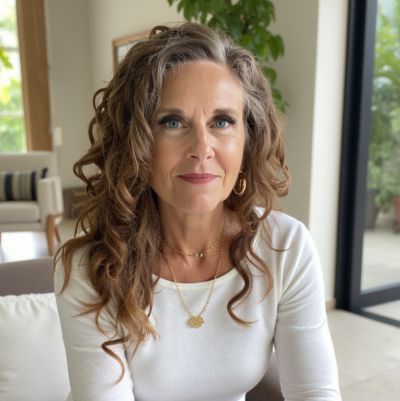
Elizabeth is a Master Certified Life and Health Coach with over 20 years of experience, dedicated to helping women in midlife thrive through holistic health and wellness. Her personal journey began with a desire to reduce her own breast cancer risk, which evolved into a mission to guide women through the complexities of midlife health, from hormonal changes to mental clarity and emotional resilience.
Elizabeth holds certifications from prestigious institutions such as The Life Coach School, Precision Nutrition, and the American Council on Exercise, as well as specialized training in Feminist Coaching and Women’s Hormonal Health. Her approach is deeply empathetic, blending her extensive knowledge with real-life experience to empower women in their 50s and 60s to build sustainable health habits that last a lifetime.
Recognized as a top voice in women’s health, Elizabeth speaks regularly on stages, podcasts, and webinars, inspiring women to embrace midlife with energy, confidence, and joy. Her passion is helping women regain control of their health, so they can fully engage in the things that matter most to them—whether that’s pursuing new passions, maintaining strong relationships, or simply feeling great in their own skin.