

You can't stick to healthy habits because your body quietly finds relief somewhere else when its real needs go unmet all day, and it will keep doing that until you give it what it needs on purpose.
TL;DR
- Your body doesn't just quit when its needs go unmet all day. It finds what it needs somewhere else, usually at night.
- The extra glass of wine or the late-night snacking, and the reaction that felt bigger than the moment deserved: none of it is a character flaw.
- The fix isn't trying harder. It's meeting the need earlier, on purpose, before your body goes looking for it on its own.
- Notice which need is actually unmet: rest, food, a boundary, or an honest feeling you talked yourself out of.
- The nightly pattern isn't proof something's wrong with you. It's proof something's unmet.
You made it through another day.
The calls got made and the emails got answered. And by 9pm you're on the couch with a second glass of wine or the bag of chips you swore you'd put away after one handful, wondering, again, why you can't just stick to the healthy habits you already know how to do.
Here's what's actually happening. You spent the entire day doing: the phone calls nobody else will make, the output your job expects, the household logistics that fall to you by default, the emails that multiply faster than you can answer them. Somewhere in there, being (resting, eating an actual meal, saying an honest no, or admitting how you actually felt) got pushed to the bottom of the list. Your body didn't forget about it. It found a way to meet that need anyway, later, without asking your permission.
I run this way too, more often than I'd like to admit. There's a specific satisfaction in reaching the end of a day and being able to list what you accomplished. Nobody hands out a gold star for having rested well or said an honest no to something that would have cost you. So the doing wins, every time, until the body's unmet needs show up somewhere else anyway.
Nobody hands out a gold star for having rested well or said an honest no to something that would have cost you.
The Work That Never Makes the To-Do List
Most days, your to-do list has nothing to do with your health and everything to do with keeping your life running: the insurance call, the school form, the report that's due, the load of laundry that's been sitting since Tuesday. None of it feels optional in the moment. All of it takes something out of you before you've made a single decision about your own health.
Researchers now have a name for the invisible layer underneath all of it: cognitive labor, or the mental load. It isn't the physical task of doing the dishes. It's the remembering and the planning that has to happen before the task ever starts. A 2024 study published in the Archives of Women's Mental Health found that women carrying a disproportionate share of that mental load reported higher rates of depression, stress, burnout, and strain in their relationships than the women who didn't. (The Cure for Low Energy & Fatigue in Midlife covers what this kind of load does to your actual energy levels.)
That's the doing. The being (the rest, the food, the boundary, the honest feeling) doesn't show up on anyone's to-do list. It doesn't get checked off. So it gets deferred, and deferred, until your body stops asking politely.
Want to hear this idea explored a different way? Episode 284 walks through it in more depth, if listening fits your day better than reading.
Why Trying Harder Doesn't Fix It
For decades, a popular psychological theory suggested that self-control works on a limited daily supply: use it up handling one thing, and less remains for the next. It's the idea behind almost every piece of advice that tells you to muster more effort to stick to your habits.
That theory has not held up well. In 2016, a coordinated effort across 23 research labs and more than 2,000 participants tried to replicate the effect and found no reliable evidence for it. The idea that self-control runs on a fixed daily supply has been in scientific trouble ever since.
Which means the story you've been telling yourself, that you simply need to try harder, was never a solid explanation to begin with. What actually predicts whether you'll stick to a habit isn't how much effort you can muster in the moment. It's whether your body already got what it needed earlier in the day. (If the gap between knowing what to do and actually doing it sounds familiar, I Know What to Do. I'm Just Not Doing It! digs into that specific experience.)
What actually predicts whether you'll stick to a habit isn't how much effort you can muster in the moment. It's whether your body already got what it needed earlier in the day.
What the Override Actually Looks Like
When a need goes unmet long enough, your body doesn't wait for permission. It finds relief through whatever channel is available.
Skip rest and run on stress hormones all day, and cortisol shifts your food preferences toward exactly what you were trying to avoid. Research has found that elevated cortisol reliably drives cravings toward sugar and fat, the foods that hit the brain's reward system hardest (Stress: The Hidden Saboteur of Your Health goes deeper on this mechanism).
Cut into your sleep, night after night, and the hormones that regulate hunger and fullness shift against you. A 2023 study published in the journal Obesity found that even a single night of lost sleep lowered the hormone that signals fullness and raised the one that drives hunger, with the shift showing up more strongly in women than in men.
Swallow an honest feeling because saying it out loud felt like too much to add to an already full day, and the effort of holding it in has its own cost. A study of more than 200 women found that those who habitually suppressed their emotions had less diverse gut microbiomes, a marker tied to broader physical health, than those who didn't.
None of this is a character flaw showing up at 9pm. It's a body that asked for something all day and didn't get an answer.

If you want a clearer read on which of these your body's most often going without, the quiz is built to help you pinpoint it.
How to Give Your Body What It Needs Before It Takes It Anyway
1. Notice the override before you judge it. The next time you reach for something to eat or drink, or a reply that comes out sharper than you meant, pause before deciding what it means about you. Today: pick one moment (the 3pm slump, the yes you gave when you meant no) and just notice it. No fixing required yet. (If the yes-when-you-meant-no pattern is a familiar one, How People Pleasing Impacts Your Health is worth a listen.)
2. Name what's actually missing. Rest, food, a boundary, or an honest feeling are the usual suspects. This week: attach a specific unmet need to one override you noticed. Not “I ate too much.” Instead: “I hadn't sat down since 7am.”
3. Meet that need earlier, on purpose. Before your body has to go find it another way. This week: build one on-purpose action into your day, something specific enough to actually do, like an actual lunch instead of eating standing at the counter, or one honest no you've been avoiding.
4. Track what changes for a week. Next week: repeat the one action and notice whether the override shows up less at night. This isn't about proving anything. It's about collecting your own evidence.
What's On Your List vs. What Your Body's Actually Asking For
| What's on your to-do list | What your body's actually asking for |
| Answer the work emails | An actual break before you're running on empty |
| Make the appointment calls | A meal you sat down to eat |
| Handle the household logistics | A “no” you keep swallowing |
| Show up for everyone who needs something | An honest answer to how you actually feel |
| Get through the day | Rest that isn't the last resort at 11pm |
This is exactly the kind of pattern the 8 Habits That Healthy People Do guide walks through in more detail, if you want a place to start.

Frequently Asked Questions
Knowing what to do and having the capacity to do it are two different things. If your body's basic needs (rest, food, a boundary, honesty about how you feel) are running on empty all day, there's nothing left to draw on for the habit itself. The habit isn't the problem. The unmet need underneath it is.
Overeating is often the body's way of getting relief it didn't get earlier in the day, whether that's comfort it didn't take time for, or a brief quieting of a stress-hormone spike that sugar happens to provide. Trying to control the eating without addressing what's driving it usually doesn't hold.
Motivation depends on capacity, and capacity is exactly what gets used up by an unrelenting to-do list. It's not that you lack the drive. It's that there's often nothing left by the time exercise is supposed to happen.
It means noticing what your body's asking for (rest, food, a boundary, an honest feeling) before it has to demand it through a craving or a sleepless night. It's a skill, not an instinct everyone's born trusting.
What looks like self-sabotage is often unmet needs that kept building underneath a good stretch. Feeling fine for a few days doesn't erase what's still unmet. It just delays when it shows up.
It can be a sign that something upstream (rest, food, a boundary, an honest feeling) has been neglected. Not always. But it's worth asking the question before assuming it's just a food problem.
Consistency gets easier when your body isn't running a deficit it has to make up for at night. Meeting real needs earlier in the day, on purpose, tends to do more for follow-through than any amount of forcing.
What it All Means
None of this means giving up wine or treats, or feeling like every unraveling evening is a crisis. It means understanding what's actually happening on the nights it does: a body that spent all day being managed like a task list, getting a say after all.
The habits you already know how to do get a lot more doable once your body isn't running on empty by the time you need it to cooperate. That's not something more effort fixes. It's a body that's been asking for something all day, and found a way to get it regardless.
It means understanding what's actually happening on the nights it does: a body that spent all day being managed like a task list, getting a say after all.

If you want help figuring out which need your body's most often skipping, the quiz is a good place to start.
Evidence & Attribution
- Hagger, M.S., Chatzisarantis, N.L.D., et al. (2016). A Multilab Preregistered Replication of the Ego-Depletion Effect. Perspectives on Psychological Science, 11(4), 546–573. https://doi.org/10.1177/1745691616652873
- Tomiyama, A.J., Dallman, M.F., & Epel, E.S. (2011). Comfort food is comforting to those most stressed: evidence of the chronic stress response network in high stress women. Psychoneuroendocrinology, 36(10), 1513–1519. https://pubmed.ncbi.nlm.nih.gov/21906885/
- van Egmond, L.T., et al. (2023). Effects of acute sleep loss on leptin, ghrelin, and adiponectin in adults with healthy weight and obesity: A laboratory study. Obesity, 31(3), 635–641. https://pubmed.ncbi.nlm.nih.gov/36404495/
- Aviv, E., Waizman, Y., Kim, E., Liu, J., Rodsky, E., & Saxbe, D. (2024). Cognitive household labor: gender disparities and consequences for maternal mental health and wellbeing. Archives of Women's Mental Health, 28, 5–14. https://doi.org/10.1007/s00737-024-01490-w
- Ke, S., Guimond, A.J., Tworoger, S.S., Huang, T., Chan, A.T., Liu, Y.Y., & Kubzansky, L.D. (2023). Gut feelings: associations of emotions and emotion regulation with the gut microbiome in women. Psychological Medicine. https://pubmed.ncbi.nlm.nih.gov/36942524/
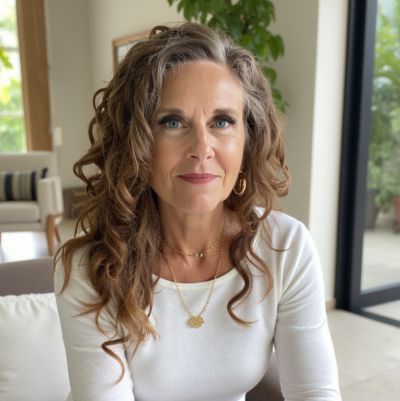
Elizabeth is a Master Certified Life and Health Coach with over 20 years of experience, dedicated to helping women in midlife thrive through holistic health and wellness. Her personal journey began with a desire to reduce her own breast cancer risk, which evolved into a mission to guide women through the complexities of midlife health, from hormonal changes to mental clarity and emotional resilience.
Elizabeth holds certifications from prestigious institutions such as The Life Coach School, Precision Nutrition, and the American Council on Exercise, as well as specialized training in Feminist Coaching and Women’s Hormonal Health. Her approach is deeply empathetic, blending her extensive knowledge with real-life experience to empower women in their 50s and 60s to build sustainable health habits that last a lifetime.
Recognized as a top voice in women’s health, Elizabeth speaks regularly on stages, podcasts, and webinars, inspiring women to embrace midlife with energy, confidence, and joy. Her passion is helping women regain control of their health, so they can fully engage in the things that matter most to them—whether that’s pursuing new passions, maintaining strong relationships, or simply feeling great in their own skin.