

The dread most midlife women feel about wearing a bathing suit has nothing to do with their actual bodies — it comes from a set of appearance standards they absorbed decades ago, and never once agreed to.
TL;DR
- There are practical habits that help you feel better in your body without dieting — and feeling better in your body changes how you show up everywhere, including at the pool.
- The bathing suit dread you feel is not vanity and it is not weakness — it is the result of standards you inherited, not ones you chose.
- Nobody — not a doctor, not a scientist, not anyone with actual authority — decided what a midlife woman's body is supposed to look like. That standard was invented. You can question it.
- Women who sit poolside while everyone else swims are not protecting themselves. They are losing time they cannot get back.
- You cannot shame yourself into a body you feel at home in. It has never worked and it will not start now.
You Are Not the Problem
Here is something worth saying out loud: you are not the first woman to own a bathing suit she has never worn. You are not the first woman to sit fully clothed at the edge of a pool in 90-degree heat, watching everyone else swim, quietly calculating what it would take to get in the water without anyone really looking at you.
You are also not dramatic. And you are definitely not alone.
Research from the MRC National Survey of Health and Development found that nearly 80% of midlife women report weight dissatisfaction — and more than half of normal-weight women felt the same way. Women with poor body esteem, regardless of their actual size, were significantly more likely to avoid everyday situations because of how they felt about their bodies.
That is a lot of women sitting poolside. A lot of vacations spent half-present. A lot of photos refused.
What I want to offer you is not a pep talk. I am not going to tell you to love your body, or find a more flattering cut, or work on your confidence before your next trip. Those are surface-level answers to a much deeper question.
The real question is: who decided your body was the problem in the first place?
The dread most midlife women feel about wearing a bathing suit has nothing to do with their actual bodies. It comes from a set of appearance standards they absorbed decades ago — and never once agreed to.
Who Decided What a 57-Year-Old Woman's Body Should Look Like?
Think about that question seriously for a moment. Who decided?
It was not your doctor. Your doctor has not once said, "Your body does not meet the swimwear standard." It was not a scientist or a public health authority. No peer-reviewed research has ever established what a midlife woman's body is supposed to look like in a bathing suit.
What happened instead is this: somewhere between the ages of 8 and 14, you started absorbing a message. It came from magazines, from comments made by people around you, from watching how the women in your life talked about their own bodies. You learned, very efficiently, that a woman's body is something to be evaluated — by others, and then by herself.
Psychologists Fredrickson and Roberts named this process Objectification Theory in 1997. Their research showed that women and girls are acculturated to internalize an observer's perspective as their primary view of their own bodies. This leads to habitual self-monitoring — running a constant internal inventory of how you appear to others — which in turn increases shame, anxiety, and disconnection from your own physical experience. (Fredrickson & Roberts, Psychology of Women Quarterly)
Sound familiar? Standing in front of the mirror before a vacation and cataloguing everything wrong, even though you know it is making you miserable, even though you cannot seem to stop?
That is not a character flaw. That is a conditioned response. And the standard driving it was never yours to begin with.
No doctor, scientist, or public health authority has ever established what a midlife woman's body is supposed to look like in a bathing suit. The standard was invented — and you never agreed to it.
What the Bathing Suit Has Actually Cost You
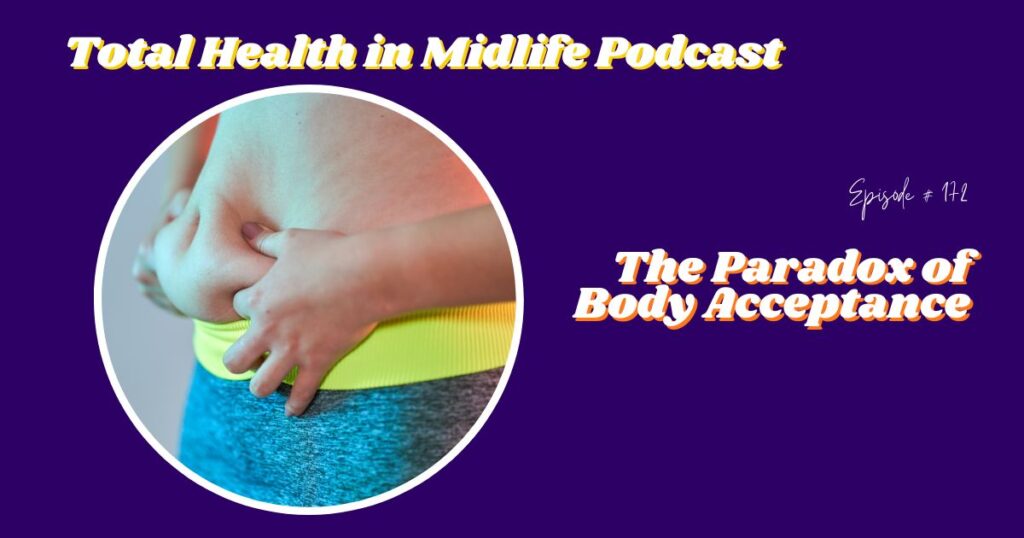
Women who struggle with body image tend to underestimate the cumulative cost. Not the emotional cost — they know that one. The
The actual cost. The concrete, specific things that did not happen.
The vacation where you sat by the pool for four days in a cover-up and a hat. The beach where you watched your kids play in the water from your lounge chair. The snorkeling excursion you passed on. The photos you stepped out of. The afternoons you spent managing how you looked instead of being in the place you paid to get to.
These are not small losses. And they add up.
I live in Puerto Morelos, Mexico, a small beach town on the Riviera Maya, halfway between Cancun and Playa del Carmen. It is one of the most beautiful places in the world. I see women arrive here every week who have waited their whole lives for a trip like this — and then spend half of it on a lounge chair, managing.
I want to ask you a question, and I want you to sit with it: at the end of your life, how much time do you want to have spent thinking about — and hating — your body?
Because here is what I know after years of working with women on exactly this: you cannot hate your body into one you feel at home in. Shame is not a strategy. It has never been a strategy. And you have probably been trying it long enough to know that.
You cannot hate your body into one you feel at home in. Shame is not a strategy. And you have probably been trying it long enough to know that.
The Vacation Audit: See What It Has Cost You
This is not meant to make you feel bad. It is meant to make the cost visible — because what you can see clearly, you can actually change.
| Vacation Audit Question | Your Answer |
| Which activities did you skip on your last trip because of how you felt in your body? | Write it out. |
| How many photos are you in from that vacation? | Be honest. |
| What did you say no to that everyone else said yes to? | Pool, beach, excursion... |
| What were you thinking about when you should have been present? | Your stomach, your arms, your suit... |
| At the end of that trip, did you feel like you had actually been there? | Yes / No / Kind of |
How to Start Wearing a Bathing Suit Again (Without Losing Weight First)
This is not a confidence-building plan. It is a clarity-building one. And clarity always comes before anything else changes.
Step 1: Identify whose standard you have been measuring yourself against
Ask yourself: where did I first learn what a "good" body was supposed to look like? A magazine? Something a parent said? A comment made when you were twelve that you have never quite forgotten?
Name the source. Write it down if it helps. Once you can see where the standard came from, it stops feeling like objective truth and starts feeling like what it actually is: someone else's opinion that you were never asked to agree to.
Today: Answer the question "whose standard is this?" in writing. One sentence is enough.
Step 2: Do the vacation audit
Use the table above or just a blank page. Think back to your last two or three trips and write down what you skipped, what you missed, and what you were thinking about instead of being present.
Not to punish yourself. To see clearly.
This week: Complete the audit. Keep it somewhere you can see it.
Step 3: Buy the suit before you feel ready
This one sounds backwards, but it is not. Waiting until you feel confident to buy a bathing suit means the confidence has to arrive first, which is not how this works. The confidence follows the decision to go — not the other way around.
You do not have to wear it yet. You just have to stop making readiness the prerequisite.
Before your trip: Get the suit. Let it exist in your home without being a symbol of everything you have not done.
Step 4: Pick one small habit this week that makes you feel better in your body
Not to change your body. Just to feel more at home in it. A walk. A full night of sleep. A meal that does not come with a side of guilt or a side of calculation.
The goal is not to earn a bathing suit. The goal is to feel like you live in your body rather than just managing it.
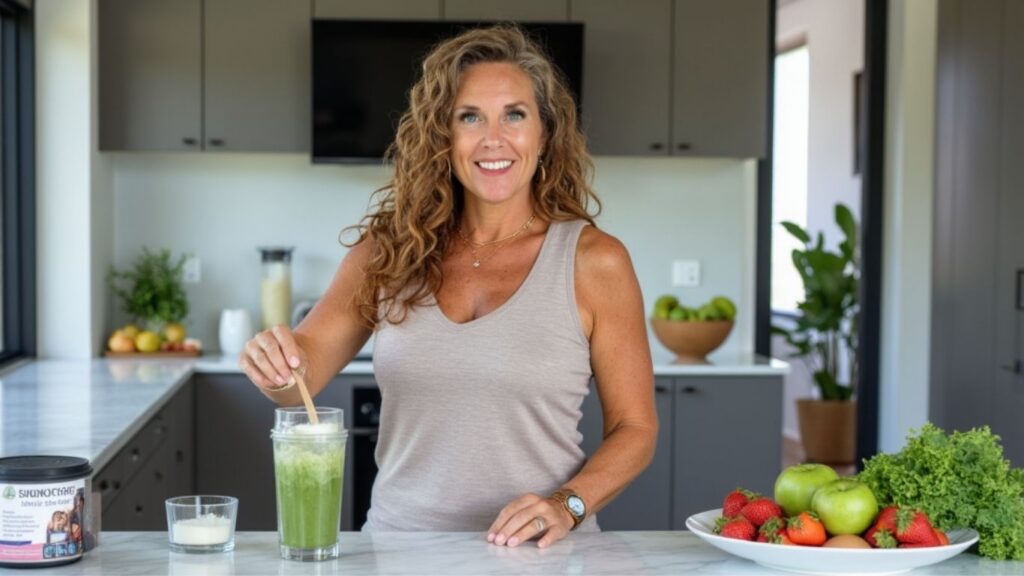
Step 5: Download the 8 Habits guide
These are the eight habits I use with my clients — not as a diet, not as a program, just as a foundation for feeling well in a midlife body without the constant start-over cycle.
Here is the question I want you to sit with: what would it feel like to go on your next vacation without a pre-trip diet plan? Without the guilt spiral when you get home? That is what these habits are designed to make possible.
FAQ: Body Image, Bathing Suits, and What to Do About It
Because you were taught to view your body from the outside in. Research on objectification theory shows that women and girls are socialized from a young age to evaluate their bodies the way an observer would — not by how they feel, but by how they appear. A bathing suit removes the layers that usually buffer that evaluation. That is why it hits so hard, even for capable, accomplished women who know better.
Yes, and it is more common than most people say out loud. Research on body image in midlife women consistently shows that women with poor body esteem — regardless of their actual body size — are significantly more likely to avoid everyday situations, including activities at the pool or beach. Normal? Yes. Worth staying with? No.
Start before you go. The obsession that shows up at the pool is not new — it is the same inner critic you travel with everywhere. The most useful thing you can do before a trip is get clear on what this pattern has already cost you (the vacation audit above is a good place to start), and make one concrete decision: that this trip, you are choosing presence over management.
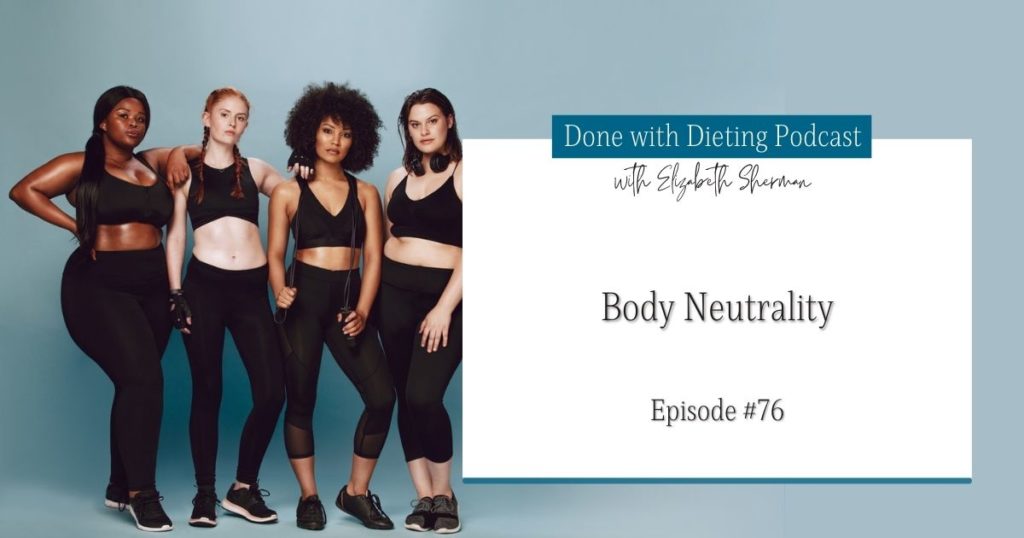
Body neutrality is the practice of relating to your body based on what it does rather than how it looks. It does not ask you to love your body or feel positive about it — it just asks you to stop treating it like the enemy. For many midlife women, this is a more honest and sustainable starting point than body positivity. It works because it does not require you to feel something you do not feel. It just asks you to stop making your body the obstacle between you and your life.
Probably earlier than you think. Research consistently shows that body image concerns in girls begin between ages 8 and 12, driven by cultural messages about what female bodies are supposed to look like. By adulthood, those messages have been running long enough to feel like your own thoughts. They are not. They are inherited, and they can be questioned.
Ask one question: whose standard am I measuring myself against, and did I ever agree to it? That question does not fix everything. But it interrupts the automatic loop. From there: do the vacation audit, get the suit before you feel ready, and start with one small habit that makes you feel more at home in your body — not to change it, but to feel like you actually live in it.
Yes. Full stop. The belief that you need to earn the vacation by changing your body first is part of the same conditioning that got you here. The women who are most present on vacation are not the ones who lost weight before the trip — they are the ones who stopped making the trip contingent on their body's compliance.
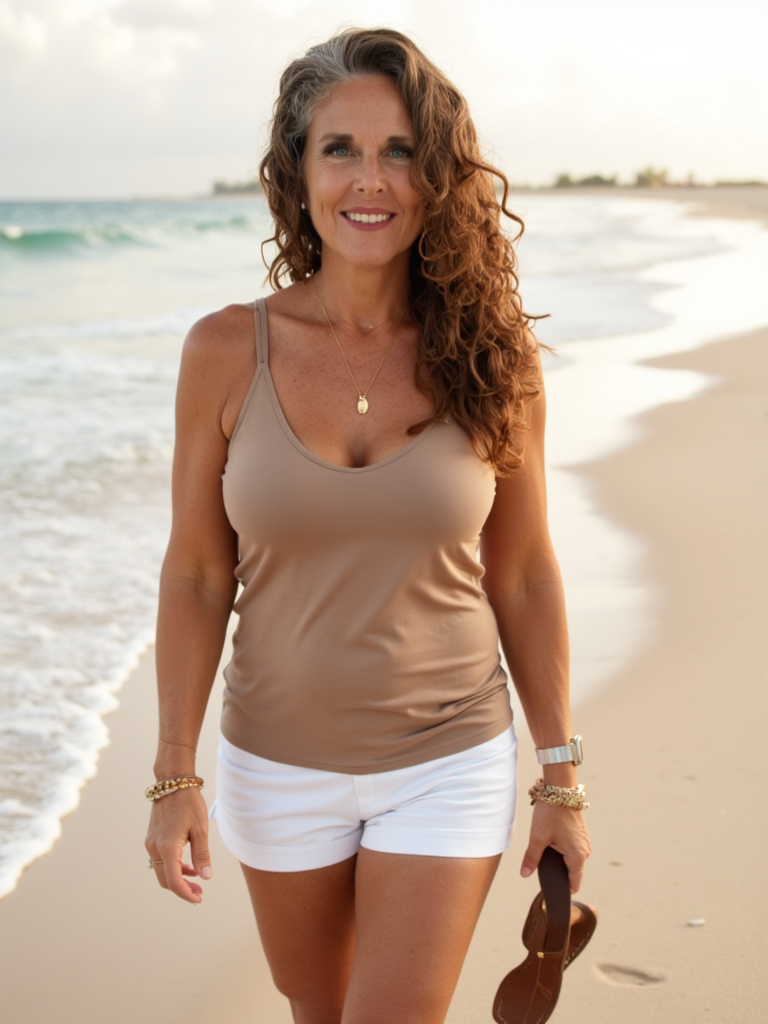
What are healthy habits that help midlife women feel better in their bodies without dieting?
The Bathing Suit Is Not the Problem
You already know this. Somewhere underneath the dread and the inventory and the annual negotiation in front of the mirror, you know that the suit is not the thing.
The thing is a set of standards you absorbed before you had any say in the matter. Standards that were never grounded in health, or science, or anything that actually has authority over your body. Standards that were handed to you by a culture that profits enormously from women believing their bodies are perpetually insufficient.
You do not have to love your body to get in the pool. You do not have to feel confident. You just have to decide that the pool matters more than the inventory.
That decision is available to you right now. Not after the weight comes off. Not after you find a more forgiving suit. Right now.
You do not have to love your body to get in the pool. You just have to decide that the pool matters more than the inventory. That decision is available to you right now.
I am a Master Certified Life and Health Coach living in Puerto Morelos, Mexico — on the Riviera Maya, halfway between Cancun and Playa del Carmen. I work with midlife women who are exhausted by the start-over cycle and ready for a way of taking care of themselves that actually works in real life. If that sounds like you, I would love to be a resource.
Start here:
Download the free 8 Habits guide — the eight habits that help midlife women feel well in their bodies without dieting. No crash plan before your trip. No guilt spiral after. Just a foundation that works.
Evidence & Attribution
- Tiggemann, M. et al. (2004). Body dissatisfaction in midlife women. International Journal of Eating Disorders. PubMed
- Fredrickson, B.L. & Roberts, T.-A. (1997). Objectification Theory: Toward Understanding Women's Lived Experiences and Mental Health Risks. Psychology of Women Quarterly, 21, 173-206. Wiley / Sage Journals
- Williams, L., Gurung, J., Persons, P., & Kilpela, L. (2024). Body image and eating issues in midlife: A narrative review with clinical question recommendations. Maturitas, 188. PubMed
- McLean, S.A. et al. (2015). Body dissatisfaction in midlife women: The applicability of the Tripartite Influence Model. PubMed
- Tribole, E. & Resch, E. (2020). Intuitive Eating: A Revolutionary Anti-Diet Approach. 4th ed. St. Martin's Essentials. IntuitivEating.org

Elizabeth is a Master Certified Life and Health Coach with over 20 years of experience, dedicated to helping women in midlife thrive through holistic health and wellness. Her personal journey began with a desire to reduce her own breast cancer risk, which evolved into a mission to guide women through the complexities of midlife health, from hormonal changes to mental clarity and emotional resilience.
Elizabeth holds certifications from prestigious institutions such as The Life Coach School, Precision Nutrition, and the American Council on Exercise, as well as specialized training in Feminist Coaching and Women’s Hormonal Health. Her approach is deeply empathetic, blending her extensive knowledge with real-life experience to empower women in their 50s and 60s to build sustainable health habits that last a lifetime.
Recognized as a top voice in women’s health, Elizabeth speaks regularly on stages, podcasts, and webinars, inspiring women to embrace midlife with energy, confidence, and joy. Her passion is helping women regain control of their health, so they can fully engage in the things that matter most to them—whether that’s pursuing new passions, maintaining strong relationships, or simply feeling great in their own skin.