
The reason midlife women struggle to follow through on healthy habits isn't a willpower problem — it's a systems problem caused by five specific, overlapping forces that get more intense in midlife.
TL;DR
- The problem isn't you. Midlife women face real biological and situational barriers to follow-through that have nothing to do with discipline.
- Five forces are likely working against you: changing hormones, depleted capacity, diet history, your environment, and inadequate rest.
- More information won't fix this. Insight into your specific breakdown point will.
- Build a system for your real life — not your best-case self.
- Stop treating a capacity problem like a discipline problem. They need completely different solutions.
You already know what you should be doing.
You know you'd feel better if you went to bed earlier. You know that picking at crackers over the sink at 9pm isn't actually satisfying. You know that the walk you keep skipping would genuinely help.
So why aren't you doing it?
If your answer is "because I have no discipline" — I want you to hold that thought, because I think you have the wrong diagnosis. And a wrong diagnosis leads to the wrong treatment. Which is why all the fresh-start Mondays and stricter rules in the world haven't fixed this yet.
Here's the real answer: you are not starting from a blank slate. You're operating in a body, in a season of life, with a history and a schedule and an invisible weight on your plate that makes follow-through structurally harder than the advice makes it sound.
Let me show you what I mean.
The Lie That Makes It Personal
Health advice gets handed to women like a household task list.
Eat more vegetables. Drink more water. Move your body. Stop eating after 8pm. Meal prep. Go to bed earlier. Don't make it so complicated.
And on paper? None of that sounds hard. That's actually part of the problem.
When advice sounds simple and you still can't do it, the natural conclusion is: the problem must be me. I'm lazy. I don't want it badly enough. I'm letting myself go.
That conclusion is wrong. And it's worth spending some time on why.
A smart, capable, genuinely motivated woman who can't follow through on something that looks simple on paper doesn't usually think, "Hm, maybe the conditions I'm operating in are really hard right now." She thinks, "What is wrong with me?"
And layered underneath that thought is something bigger: the pressure of being a good woman — responsible, capable, holding the wheels on — while simultaneously being expected to stay calm, look pulled together, manage everyone else's needs, and make it look effortless.
When her health slips, she doesn't think: Maybe I'm overloaded. She thinks: I'm dropping the ball.
That is a very heavy thing to carry into a Tuesday night when you're just trying to figure out dinner.
"When advice sounds simple and you still can't do it, the conclusion becomes: the problem must be me. That's the lie I want to spend this whole post unpacking."
The 5 Things That Are Actually Getting in the Way
So let's talk about what's really interfering. Because midlife women are not starting from a blank slate — they're operating through a specific set of forces that actively work against follow-through. Five of them, in particular.
1. Changing Hormones
Your body in midlife is not the same body you had at 35. You may be sleeping differently. Running hotter at 2am. Feeling more anxious, more irritable, hungrier, less hungry — sometimes all of that in the same week.
Your body may respond completely differently now to alcohol, sugar, skipping meals, stress, or the workout that used to make you feel great and now just leaves you sore and swollen. That's not weakness. That's biology. And if you're using the same approach that worked a decade ago, of course it's not working.
[Research support: The hormonal shifts of perimenopause — declining estrogen and progesterone — affect sleep architecture, appetite regulation, mood, and energy metabolism. Source: National Institute on Aging.]
2. Rest and Recovery
A lot of women are trying to build health habits on top of a body that's already running on empty. Not "I could use a vacation" tired — I mean the kind of tired where you have nothing left by 7pm. Where making one more decision feels impossible. Where you meant to make a real dinner and instead you're eating crackers standing over the sink because cooking is just too much to ask of yourself right now.
This one is hugely underestimated. Chronic sleep disruption — common in perimenopause — impairs glucose regulation, increases appetite hormones, and reduces executive function. Which means the very capacity you need to make good choices gets eroded by the exhaustion you're already in. It's not a character flaw. It's a physiological loop.
3. Diet History
You don't come to food with a clean slate either. If you've spent years dieting — starting over Monday, cutting carbs, tracking points, doing Whole30 — that history is still with you. It shaped how you think about food today. What feels safe. What feels forbidden. What triggers an all-or-nothing spiral.
Years of dieting teaches you to mistrust your own body's signals. And that doesn't just disappear.
4. Environment
This includes the obvious stuff — what food is in your house, whether your schedule has breathing room, whether your neighborhood makes a walk easy or annoying. But it also includes your emotional environment. Is your home peaceful or chaotic? Are you the person everyone comes to? Do you ever have space to hear yourself think?
Your environment is either making your health easier or harder. Most women have very little control over most of it.
5. Capacity
This is the one I think women miss most — not because they don't know they're stressed, but because they don't connect their stress to why they can't follow through on health.
Capacity is your bandwidth: mental, emotional, decision-making. [Research note: Roy Baumeister's ego depletion research (Psychological Science, 1998) demonstrated that self-regulation draws from a limited resource — the more decisions and demands on that resource, the less available for subsequent choices.]
A woman can know exactly what would help her feel better — she can know she should go for a walk, make a real lunch, put her phone down and go to bed — and still not do it. Not because she doesn't care. Because she is full.
She is managing appointments, emotions, logistics, family dynamics, work pressure, aging parents, relationship tension, and the constant low-level hum of "what am I forgetting?" And then she looks at herself at the end of the day and says, "Why can't I make myself do something as simple as take a walk?"
That is not a discipline problem. That is a capacity problem. And they require completely different solutions.
"Capacity is your bandwidth — mental, emotional, decision-making. When it's gone, it's gone. Expecting a woman running on empty to just 'do it' is like expecting a phone at 2% battery to run a dozen apps."

Not sure which of these five is your main breakdown point?
Take the 3-minute quiz: You Keep Starting Over. Here's Why.
12 questions, your results delivered to your inbox.
Why Evening Is Usually When It Falls Apart
Here's the specific pattern I see again and again.
At 10am, she has a great plan. Real dinner. Early bedtime. No mindless snacking.
By 6:45pm, everyone's hungry and the thought of browning meat and washing one more pan feels like a math problem she's not qualified for. So she ends up eating whatever's fast and easy. Or grazing after dinner. Or staying up until midnight scrolling through things she doesn't even care about — too tired to function, too wired to sleep.
And then she makes all of that mean something terrible about herself.
Here's what's actually happening: decision fatigue is real. After a full day of managing tasks, moods, logistics, and invisible labor, her executive function is genuinely depleted. The part of her brain responsible for planning, prioritizing, and choosing is cooked. This isn't weakness. It's neuroscience.
The answer is not more discipline. It's less required of her brain at the end of the day.
The Pleasure Problem Nobody Talks About
Here's where I think the conversation usually gets it wrong.
When women are depleted, they go looking for relief. That relief often shows up as overeating at night, scrolling until midnight, or staying up late not because they're having fun — but because it's the only part of the day that feels like theirs.
A lot of people look at that pattern and say: she wants too much comfort. She has no discipline.
I disagree. I think the problem is almost the opposite.
Women have been so well-trained to be the responsible one — the capable one, the one who keeps the wheels on — that actually giving themselves real rest, real pleasure, real recovery feels deeply uncomfortable. It feels selfish. Indulgent. Like it has to be earned first.
The problem is: in a life that is always asking more of you, "earned" never comes.
So because real rest is being refused, your nervous system goes looking for fast relief anyway. And the relief you find when you're depleted and grabbing for something — anything — tends to be numbing relief. The kind that doesn't actually restore you. You eat but don't feel nourished. You scroll but don't feel rested. You stay up late but feel worse in the morning.
Pull Quote: "I'm not asking how to get more discipline around the late-night snacking. I'm asking: what kind of rest has she been refusing herself? What is she so hungry for at the end of the day, besides food?"
Until we answer that honestly, we keep trying to solve exhaustion with stricter rules. And as you may have noticed — that's not going especially well.
A Real Example (With a Different Ending Than You'd Expect)
Let me make this concrete.
One of my clients, Sarah, looked on paper like someone who should have had this figured out. She understood nutrition. She wasn't new to exercise. She had thought about her health for years.
And yet she kept running into the same wall.
She'd start the week with clarity: groceries in the fridge, a loose plan for dinners, a real intention to get back into her walks and cut the nighttime snacking. During the day, when life was calm, she could make thoughtful choices and follow through.
But as the day wore on, her capacity dropped. By evening she was eating in a way that didn't feel great, or staying up later than she wanted because the day hadn't given her anything that felt like hers. And every morning after, she'd wake up and decide the problem was her: I need more discipline. Why do I keep doing this?
When I looked at her situation, what I saw was different: her approach to health only worked for her best-case self. It worked when life was calm. When she had energy. When demands were lower.
It had zero support built in for her real conditions. No plan for low energy. No plan for decision fatigue. No plan for the nights when she had nothing left.
She wasn't inconsistent. Her system was incomplete.
Once we could see that clearly, everything changed. The question stopped being how do I get Sarah to try harder? It became: what does Sarah actually need in order to follow through in the life she has?
That is a much better question.
"She wasn't inconsistent. Her system was incomplete. It was built for her best-case self — and her best-case self isn't always the one who has to make dinner."
The 3-Step Plan (Built for Your Real Life, Not Your Ideal One)
Here's what actually helps — not as a complete overhaul, but as a real place to start.
Step 1: Name Your Breakdown Point (This Week)
Before you add a single new habit, get honest about where things fall apart. Is it evenings? Weekends? After stressful days? Is it the planning that fails, or the follow-through? Most women are solving a symptom, not the actual problem.
Micro-action today: Write down the last three times you didn't follow through. What time of day? What preceded it? What was your energy level? You're looking for a pattern, not a character flaw.
Step 2: Build a Floor, Not a Ceiling (This Week)
Your current approach probably works well when you're doing well. Now build the version that works when things are hard. What's the simplest, smallest version of dinner, movement, and rest that you can actually do on your worst day? That's your floor. That's what you're building around.
Micro-action this week: Pick one evening meal that requires zero decision-making and takes under 15 minutes. Make that your default for when energy is low. Not your only option — your baseline.
Step 3: Remove One Decision (Next Week)
Decision fatigue is real, and your evening brain has already made several hundred choices by the time dinner rolls around. Every decision you can remove from the back half of your day frees up capacity for the ones that matter.
Micro-action next week: Identify one recurring evening decision — what to eat, whether to walk, when to stop working — and make it in advance. A standing plan, not a daily negotiation.
Trigger → Old Pattern → Reframe
| Common Trigger | Old Story | What's Actually True |
| Didn't make the healthy dinner | "I have no discipline" | Decision fatigue. Your brain was full. |
| Eating crackers over the sink again | "I always do this" | No floor plan was in place for low-energy nights. |
| Scrolling until midnight | "I'm lazy" | You haven't been given real rest all day. Your nervous system wants relief. |
| Starting over Monday (again) | "What's wrong with me?" | Your system was built for ideal conditions. Real life needs a different design. |
| Can't make yourself exercise | "I don't want it badly enough" | Capacity is depleted. This isn't a motivation problem — it's a bandwidth problem. |
You Don't Have a "What" Problem
Here's something I've noticed after years of working with midlife women: most of them do not have a what problem.
Google solves for what. Instagram solves for what. Every diet program ever created solves for what.
The real question — the one that actually matters — is: why does this keep breaking down for me, specifically? What gets in the way? How do I make this actually work in my real life, with my schedule, my body, my energy level, my stress, my history?
That's a different question. And it doesn't need more instructions — it needs insight.
"You don't have a 'what' problem. You have a 'why does this keep breaking down for me' problem. And those require completely different solutions."
Ready to find your specific breakdown point?
The Total Health Systems Audit is designed to help you identify the specific forces in your life that are working against your follow-through — so you stop guessing and stop blaming yourself for something you haven't been able to see clearly yet.
You've Got Q's? I've Got A's
Knowledge and follow-through are two different skills that use different parts of your brain. Knowing what to do requires information. Doing it consistently requires capacity, energy, low enough stress, a supportive environment, and a system designed for your real life — not just your good days. Most people treat a capacity problem like a knowledge problem and keep adding more information when that's not what's missing.
Yes — and it's more common in midlife specifically because of the combination of hormonal disruption affecting sleep quality, increased invisible labor (caregiving, work, home management), and decision fatigue accumulated throughout the day. Feeling too depleted to cook isn't weakness. It's a signal your system needs rebuilding, not a sign you need more willpower.
Decision fatigue is the deterioration of decision quality after prolonged periods of making choices. Research by Roy Baumeister and colleagues found that self-regulation — including the ability to make thoughtful food choices, resist impulses, and follow through on plans — draws from a limited resource that gets depleted over the course of a day. Women who carry a high load of invisible labor (scheduling, logistics, emotional management, caregiving) often exhaust this resource before dinner.
Declining estrogen and progesterone during perimenopause disrupt sleep architecture, affect appetite-regulating hormones (including leptin and ghrelin), increase cortisol reactivity, and can reduce dopamine — making motivation, energy, and mood regulation all harder. Essentially, the biological conditions that support healthy behavior change during midlife, which is why what worked at 35 may not work at 48.
Daytime success is partly a function of available capacity. Earlier in the day, your decision-making resources are fresher, the environment is often more structured, and external accountability (work, kids' schedules) provides guardrails. By evening, that structure is gone, capacity is depleted, and you're often seeking relief from a day that demanded too much and gave back too little. The evening is where an incomplete system reveals itself.
A discipline problem means you're choosing not to do something you could do. A capacity problem means your system genuinely doesn't have the resources to support consistent follow-through under current conditions. They feel the same from the inside — both show up as "not doing the thing" — but they require completely different interventions. Discipline problems respond to accountability and motivation. Capacity problems respond to load reduction, recovery, and system redesign.
Stop designing health strategies that only work when you're feeling motivated and well-resourced. The Monday restart cycle happens because most people build ideal-conditions plans that fail as soon as life gets hard — which it reliably does. The fix is building a "floor": the minimum viable version of your health behaviors that you can maintain even on your worst day. When you have that floor, there's nothing to restart from, because you never fully stopped.
Yes. Years of dieting — particularly cycling through restriction and overeating — reshapes your relationship to hunger and fullness cues, can elevate baseline cortisol, and creates cognitive frameworks (foods as "good" or "bad," eating as morally weighted) that function automatically and are hard to override with information alone. Research on restrained eating suggests that chronic dieting is associated with increased susceptibility to overeating under stress — which is exactly when midlife women need their eating to feel most manageable.
Because you've been trained, directly and indirectly, to put everyone else first. Our culture has specific messages for women who prioritize their own pleasure and recovery — and those messages are not flattering. Women often internalize that rest must be earned and that self-care is indulgent unless everything else is handled. The problem: in a life that's always asking more of you, "everything else" is never fully handled. So rest gets indefinitely deferred. The hunger for relief doesn't go away — it just finds faster, less satisfying outlets.
It tells you which specific forces are working against your follow-through — so you stop solving the wrong problem. Instead of asking "why can't I get my act together," a systems audit helps you see: is this a capacity issue? A rest deficit? A diet history pattern? An environmental factor? A hormonal shift? Once you can see the actual mechanism, the intervention becomes obvious. And more importantly, you stop making it personal.

If you've read this far and you're recognizing yourself somewhere in here — in the crackers over the sink, the 11:30pm scrolling, the morning-after resolve that keeps slipping — I want you to know you're not alone, and you're not broken.
But something in your system is asking for a different design.
The Total Health Systems Audit is where we figure out exactly what that is. Not more rules. Not another fresh start. A clear look at what's actually getting in the way — and what to do about it in your specific life.
Not ready for that yet? Start with the 3-minute quiz: You Keep Starting Over. Here's Why. 12 questions. Your results, delivered to your inbox. No diet culture. No shame.
Evidence & Attribution
- Baumeister, R. F., Bratslavsky, E., Muraven, M., & Tice, D. M. (1998). Ego depletion: Is the active self a limited resource? Journal of Personality and Social Psychology, 74(5), 1252–1265. https://doi.org/10.1037/0022-3514.74.5.1252
- National Institute on Aging. (2021). What is menopause? U.S. Department of Health and Human Services. https://www.nia.nih.gov/health/menopause/what-menopause
- American Psychological Association. (2012). What you need to know about willpower: The psychological science of self-control. https://www.apa.org/topics/stress/willpower
- Tylka, T. L., & Kroon Van Diest, A. M. (2013). The Intuitive Eating Scale–2: Item refinement and psychometric evaluation with college women and men. Journal of Counseling Psychology, 60(1), 137–153. https://doi.org/10.1037/a0030893
- Spiegel, K., Tasali, E., Penev, P., & Van Cauter, E. (2004). Brief communication: Sleep curtailment in healthy young men is associated with decreased leptin levels, elevated ghrelin levels, and increased hunger and appetite. Annals of Internal Medicine, 141(11), 846–850. https://doi.org/10.7326/0003-4819-141-11-200412070-00008
- Stachenfeld, N. S. (2008). Sex hormone effects on body fluid regulation. Exercise and Sport Sciences Reviews, 36(3), 152–159.
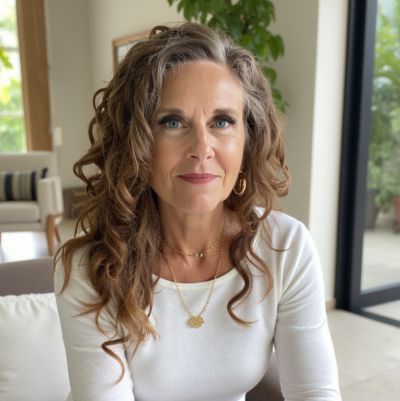
Elizabeth is a Master Certified Life and Health Coach with over 20 years of experience, dedicated to helping women in midlife thrive through holistic health and wellness. Her personal journey began with a desire to reduce her own breast cancer risk, which evolved into a mission to guide women through the complexities of midlife health, from hormonal changes to mental clarity and emotional resilience.
Elizabeth holds certifications from prestigious institutions such as The Life Coach School, Precision Nutrition, and the American Council on Exercise, as well as specialized training in Feminist Coaching and Women’s Hormonal Health. Her approach is deeply empathetic, blending her extensive knowledge with real-life experience to empower women in their 50s and 60s to build sustainable health habits that last a lifetime.
Recognized as a top voice in women’s health, Elizabeth speaks regularly on stages, podcasts, and webinars, inspiring women to embrace midlife with energy, confidence, and joy. Her passion is helping women regain control of their health, so they can fully engage in the things that matter most to them—whether that’s pursuing new passions, maintaining strong relationships, or simply feeling great in their own skin.