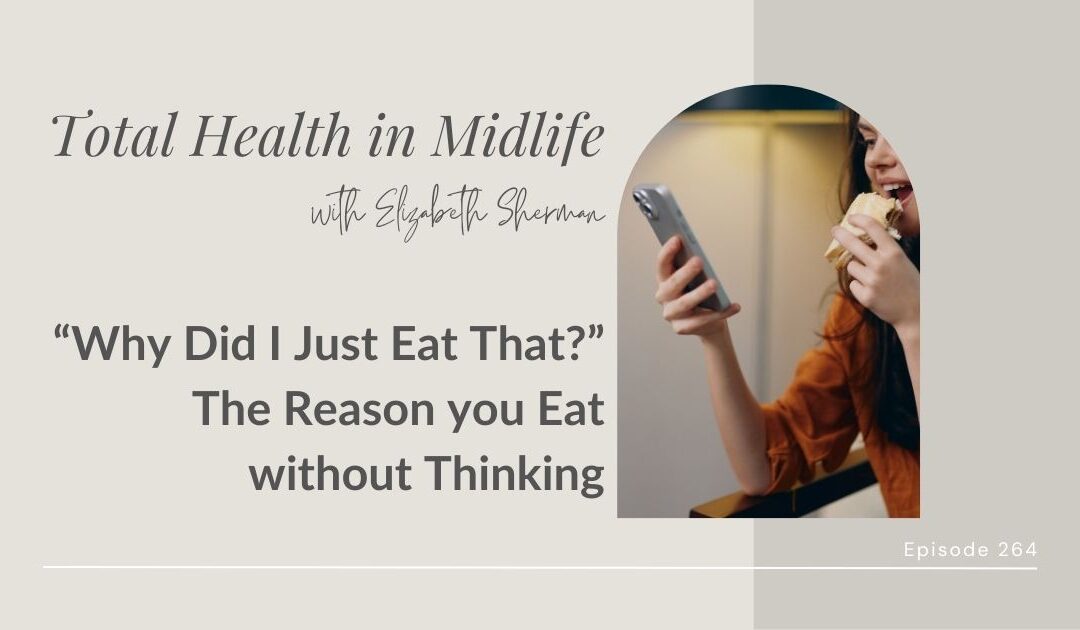
Have you ever found yourself eating something and realized halfway through… you don’t even remember deciding to eat it?
For a lot of midlife women, this moment feels confusing and frustrating. You know what healthy eating looks like. You’ve read the books, tried the diets, and built plenty of discipline in other areas of your life. And yet somehow you still find yourself standing in the kitchen at night thinking, “Why did I just eat that?”
In Episode 264 of Total Health in Midlife, we’re unpacking the real reason this happens. It’s not laziness. It’s not lack of willpower. And it’s definitely not a personal failure. There’s a psychological process happening between the moment you see food and the moment you eat it—and most women have never been taught how to recognize it.
When you understand what’s actually going on in that split second, you stop making the behavior mean something about who you are. And once that shift happens, you gain something much more powerful than another food rule: options.
The Biggest Problem Midlife Women Face Regarding Eating Without Thinking
One of the most common frustrations midlife women experience is eating without consciously deciding to eat. It feels like the behavior happens automatically. You open the pantry, grab something sweet or salty, and only afterward realize you weren’t even hungry. This pattern—often described as mindless eating or eating on autopilot—can make smart, capable women feel like they have no control around food.
The real issue isn’t the food itself. It’s the rapid mental cascade that happens after a small decision. A simple action—like eating one cookie—quickly becomes a story about what that action means. Thoughts like “I blew it,” “I have no discipline,” or “I can’t trust myself around food” create shame and frustration. That emotional reaction then triggers the familiar “might as well” pattern, where one small choice turns into continued overeating.
For midlife women already dealing with stress, hormonal shifts, fatigue, and brain fog, this loop can feel especially discouraging. Many women assume the solution is stricter food rules or more discipline. But the real skill is learning to recognize the tiny space between a trigger and a response—the moment where awareness and choice live.
What You Can Do Right Now
One of the most helpful shifts is learning to distinguish between physical hunger and soothing hunger. Physical hunger is flexible. When your body needs food, many different options sound appealing. Soothing hunger, on the other hand, tends to be specific—chocolate, chips, wine, or something very particular that promises emotional comfort.
When you begin noticing which type of hunger you’re experiencing, the urgency around food often softens. Instead of treating every urge as something you must immediately act on, you can pause long enough to understand what’s actually happening.
This awareness creates a small but powerful change. Instead of reacting automatically, you start responding intentionally. Over time, that space between the urge and the action gets bigger—and with it comes more freedom in how you eat.
The Listener Takeaway: Why This Episode Matters
Many midlife women believe their struggle with food means there’s something wrong with them. They feel embarrassed that they can manage careers, families, and responsibilities but somehow still feel “out of control” around snacks, sweets, or nighttime eating.
This episode reframes that entire narrative. The issue isn’t your character or your discipline—it’s a skill gap that most people were never taught.
Once you understand how thoughts, emotions, and urges interact, the pattern becomes far more workable. Instead of chasing perfect eating, you begin developing the ability to pause, see what’s happening, and choose what you want to do next. And that shift—from reaction to response—changes everything.
Are you loving the podcast, but arent sure where to start? click here to get your copy of the Done with Dieting Podcast Roadmap (formerly Total Health in Midlife) Its a fantastic listining guide that pulls out the exact episodes that will get you moving towards optimal health.
Take the Quiz: Why Do Your Healthy Habits Keep Falling Apart? If you've ever wondered why you know exactly what to do but still can't seem to stick with it, this quiz was built for you. In about 3 minutes, it identifies your specific pattern: the real reason your follow-through keeps breaking down, and what to address first. Your results are delivered straight to your inbox.
I am so excited to hear what you all think about the podcast – if you have any feedback, please let me know! You can leave me a rating and review in Apple Podcasts, which helps me create an excellent show and helps other women who want to get off the diet roller coaster find it, too.
Watch or Listen to the Episode:
WHAT YOU'LL LEARN
- Why so many midlife women find themselves eating without consciously deciding to
- The difference between physical hunger and soothing hunger, and why that matters
- How a single thought can turn a normal urge into something that feels impossible to resist
RESOURCES
Full Episode Transcript:
264 - “Why Did I Just Eat That?” The Reason you Eat without Thinking
Elizabeth: [00:00:00] If you have ever found yourself standing in your kitchen at night thinking, I don't even remember deciding to eat this, you need to listen to this episode because the problem is not the cookie and it's not your discipline either. It's the very microscopic space between seeing the cookie. And shoving it in your mouth.
And right now, that space might be so small that you don't even know that it exists. It happens before you know it. In this episode, I'm gonna show you why one perfectly normal decision turns into what is wrong with me, and how that identity spiral is the real thing, keeping you stuck. And so we're gonna talk about the difference between physical hunger and soothing hunger.
We're gonna talk about the thought that makes the urge feel inevitable, and we're gonna talk about why trying harder keeps failing you. Even though you're smart, you are capable, and you are [00:01:00] very good at literally everything else in your life. So if you skip this one, you will be doing what exhausted, high functioning midlife women do.
White knuckling it for a few days, slipping, shaming yourself, and then starting over. But if you stay with me, you're gonna start seeing the moment where your options live. Not perfect eating. Just more options sooner. And once you can see it, then you can't unsee it. So let's get into it.
Welcome to the Total Health and Midlife Podcast, the podcast for women over 40 who want peace with food, ease in their habits, and a body that they don't have to fight with.
Hey everyone. Welcome to the Total Health and Midlife podcast. I am Elizabeth Sherman, and I am really super glad that you are here today because I wanna talk about something that happens so fast. You almost miss it. You've cleaned up the kitchen. [00:02:00] After dinner, the house is quiet. In your soft jammy pants, you open the pantry, just a look, see what's there, and then somehow you're eating a cookie.
You didn't sit down, you didn't plate it, you didn't decide in any formal way. It just seemed to like jump in your mouth and almost immediately your brain starts up with, what is wrong with me? I just said I wasn't gonna do this. I can't be trusted around food. I have no discipline. It's not even the cookie that hurts.
It's what you make it mean because you know that you should be able to eat cookies as an adult. And if you're a woman over 40 who has read the books, listened to the podcasts, maybe even tracked your food at some point in your life, this is the part that feels especially humiliating because you know better.
You know, one cookie [00:03:00] isn't a big deal. You know that perfection isn't required. You know, strict diets don't work long term, and yet there's this tiny little gap between seeing the cookie. Eating the cookie that feels non-existent, like the decision has completely bypassed you entirely. And so here's what I want you to hear right now.
This is not a discipline problem, and it's certainly not a willpower problem. It's not that you secretly love sugar more than your goals either. It's that there's a skill in that tiny little space that no one's ever taught you before. And when that skill is underdeveloped, the cookie wins. Not because you're weak, but because the space between stimulus and response is so infinitesimally small.
So today we are gonna start expanding that space because when that space grows, your options grow. [00:04:00] And when your options grow, your health changes. So let's slow this down a little bit because the cookie is not the problem. I don't want you to think that it's the real damage happens in the 30 seconds after you eat the cookie.
Here's the cascade I see over and over in my clients, and frankly with myself in the past. So you make the decision, you eat the cookie. It's a neutral fact, but then comes the meaning behind it. I blew it. I can't stick to anything. I shouldn't have eaten that. This is why I'm still struggling at 56 years old.
I've tried everything. I'm never gonna get it right. And that meaning those things that I just said, that meaning creates shame. And shame is hot, it's urgent, and it wants relief. So then what comes next is a very logical thought. Well, I already messed up. [00:05:00] I ruined everything. I'm supposed to be perfect, and now that I'm not well, I may as well finish the sleeve.
I'll be better tomorrow. So you have the decision, the meaning behind it, the shame you might as well, and then that perpetuates the eating. That's the loop. And I want you to notice something very important here. At no point in that cascade did the cookie itself create the problem. The problem was the moral verdict.
You didn't just eat sugar in your mind, you failed. It's a character test. You weren't just someone who wanted something sweet at night. You became someone who lacks discipline, someone who can't be trusted, someone who is, and I hear this word so often, disgusting for not being able to have discipline, self-control.
That word hurts more than the bloating [00:06:00] caused by the cookie. It lingers longer than the taste of the chocolate. And here's what I want to say clearly, even if it makes you uncomfortable. Food is not a moral test. There's no virtue in grilled chicken, and there's no moral stain in a brownie. We have layered morality into food for decades.
There are good foods, there are bad foods, there are clean foods, there are cheap foods. Even the language sounds like a confession, and when you are already a woman who carries so much responsibility, your career, your aging parents, your adult children, marriage, the invisible mental load of remembering everyone's dentist appointments, the last thing that you need is another area where you are measuring your worth and failing.
One cookie does not mean that you lack discipline. Two glasses of wine do not mean that you have no self-control. And [00:07:00] eating when you're stressed does not mean that you're weak. It means that you are human. Now, does that mean that every decision is aligned with how you want to feel long-term? No, but misaligned is not the same thing as morally flawed.
When you treat food like a virtue system, every single bite becomes a referendum on your identity. When you remove morality from eating the cookie, something very interesting happens. You're left with a simpler question of, do I like my reasons? Not? Was I good? Not, did I stay under my calorie limit? Not did I earn this.
What happens more often than not is that we tell ourselves that whatever happened before eating the cookie was an excuse, and we've all heard the Jimbo Sprout on and on about no [00:08:00] excuses, right? When we can ask the question, did I like my reason for eating the cookie? That question doesn't create shame.
It starts to create discernment, and discernment is calm. Discernment says, Hmm, that didn't feel great. That's interesting. Shame says You're hopeless. There's something wrong with you. If you've been stuck in this cycle for years, it's not because you love cookies too much, it's because every small decision has been carrying the weight of your identity, and that is too heavy for any human to be holding every single night after a really long day at work.
So when we talk about expanding the space between stimulus and response, what we're really doing is protecting your identity. The moment you stop turning food into a moral scorecard, you [00:09:00] stop fueling the very spiral that you're trying to escape. The real problem was never overeating. It was identity damage and identity damage drives behavior far more than hunger ever will.
And so there's a quote that I love by a writer, Viktor Frankl. He said, between stimulus and response, there is a space, and in that space is our power to choose our response. Now, I know the minute you hear the word space or pause, it can sound like one of those posters that tells you to just pause, like one of those.
Inspirational posters, right? Just pause, breathe. Wait. That's not what I'm talking about. I'm not talking about waiting and white knuckling it while you distract yourself from the thing that you want to eat. When I say space, I mean [00:10:00] something much more practical. The stimulus is you see the cookie, the spaces you notice.
What just happened in your mind, and then your response is you decide what to do next, and whether it's in your best interest, that space is awareness plus choice, plus the ability to see your own thinking. That's it. It's not willpower, it's not punishment, it's not good girl energy. It's being able to catch the thought that shows up right after whatever happens to make you want to eat the thing.
Because here's what actually happens. You see the cookie, and within a split second, your brain offers you a sentence of, I deserve this. It doesn't matter. It's just one. If I don't have it now, I'll never get it again. I've been good all day. That sentence feels like it's the truth. [00:11:00] Because it is, but it's just a thought.
The space is the moment that you realize, oh, wait a minute. I don't actually have to do that. That's just a sentence my brain is offering me
some days. That space is a millisecond. You don't see it until you're already chewing. That doesn't mean that you failed. It just means the skill is still small and you're practicing it other days, especially when you've slept well, when work wasn't insane, when you're not already running on fumes, that space might be two seconds, maybe even five.
You notice the urge. You notice the thought you feel the pull, and you're still standing there in that space. It's not willpower, it's something more calm. And here's the key idea I want you to hear. The goal is not to make the urge disappear. The goal is [00:12:00] not to eliminate emotional eating forever.
The goal is to increase the size of that space over time. That's the skill, because when the space is tiny, your behavior feels automatic. You tell yourself, it just happens. I have no idea where it came from. When that space grows, even just a little bit, your behavior starts to feel chosen. Even if you still eat the cookie, that's important.
You can eat the cookie from a place of reaction, or you can eat the cookie from a place of intention or response. Those are two completely different experiences. One erodes self-trust, the other builds it, and the difference between the two is not calories or number of cookies. It's [00:13:00] awareness. It's whether you saw the thought before you obey it.
Most women I work with think the solution is to strengthen their willpower. Willpower is loud and it's resistant. It feels like a nervous energy, like someone is telling you to not think about the pink elephant in the room, whereas space, space is quiet. Willpower says, don't do it. Space says, that's interesting.
That's what I'm thinking right now. Willpower exhausts you, but space. Settles you, and this is why Just pause feels too simplistic because no one teaches how to build that space. No one teaches how to recognize the thought. No one teaches that the thought isn't a command. That's the work, that's the skill.[00:14:00]
And like any skill, it starts small, but when it grows, your options grow. When your options grow, your health starts to change, not because you're forcing it, but because you're finally choosing it. So now let's make a clean distinction that will change how you experience your urges forever. Physical hunger is flexible, soothing hunger is very, very specific.
Physical hunger says, I need food and I need it now. Soothing hunger says I need something specific, something sweet or salty, fatty. Now, if you are physically hungry, you could probably eat something like scrambled eggs. You could eat leftover chicken and broccoli. You could eat yogurt and berries. You could eat a peanut butter sandwich.
But you might prefer one over the other, but almost anything that has protein and some [00:15:00] substance will probably do. Your body just wants fuel. You feel it in your stomach. Maybe it's a hollow feeling. Maybe you're starting to get a little shaky. Maybe you're irritable
In that very charming midlife way where suddenly everyone around you becomes incompetent, and when you eat, you start to feel steady again. That's physical hunger. Now, when we look at soothing hunger, soothing hunger doesn't want food per se. It wants a brownie from the bakery down the street, or the salty kettle chips, or the specific chocolate that snaps when you break it.
Or the glass of wine in your favorite stemless glass, chicken and broccoli will not cut it. You can tell yourself, just have something healthy, and your brain will say, Nope, that's not good enough. Because soothing hunger isn't about energy. It's about relief, pleasure, [00:16:00] numbing, comfort, connection. It's about reward.
It's about changing how you feel, and here's the part that I want you to hear super clearly. It's not a flaw, it's human. You have a nervous system, you have emotions, you have stress. You have years, maybe decades, of pairing certain foods with comfort, with celebration, or with escape. Of course, your brain reaches for something specific.
Now if your grandchild hands you a cupcake that they decorated with lopsided pink frosting and way too many sprinkles you don't eat it because you're hungry for a cupcake, you're looking for connection. You want to see their face light up when you take a bite. You don't wanna be the grandma who says, oh no, I can't eat that.
I'm on a diet. That decision isn't about sugar. It's about belonging. Now, if it's [00:17:00] nine 30 at night and you just got off the phone with your sister about your aging parent and your chest feels tight, you don't want macronutrients. You want soothing and soothing. Hunger is not proof that you're broken. It's proof that you're alive.
The problem starts when you treat soothing hunger like it's an emergency. When the urge shows up and you think. I have to fix this right now when you cannot tolerate the feeling underneath it for even 20 seconds when the thought feels like a command. Physical hunger can wait a little bit. If dinner is in 30 minutes, you can function soothing.
Hunger feels urgent. I've gotta have it now immediately or something terrible will happen, and this is where that space that we talked about becomes really super powerful when you can tell the difference between, I need food and I need that [00:18:00] thing. Something shifts. You stop panicking, you stop making it dramatic.
You stop turning every urge into something that you have to do something about, and instead of, oh my gosh, I want chocolate. I'm out of control. It becomes, oh, I'm tired and I want comfort, or I'm bored, or I'm lonely, or even, I just want some pleasure. That's honest. That naming alone increases the space.
when you know that you're trying to soothe hunger, you have options. You still might choose the chocolate, but you're not confused about what's happening. You're not treating every craving like proof of a character flaw. You're not throwing your whole day away because you wanted something specific. And here's the very subtle but powerful shift.
[00:19:00] When you stop treating soothing hunger like an emergency, it loses some of its intensity. Density, urgency thrives on panic. Discernment slows everything down, and you begin to notice patterns. That is so interesting. This happens on Thursday nights, or this happens when I skip lunch. This happens after I drink wine.
That awareness is not about control. It's about clarity. And clarity is what allows the space between stimulus and response to grow. Because now instead of reacting automatically to every specific craving, you can say, that's interesting. Is this soothing hunger or physical hunger? It's not wrong. It's not bad, it's just information.
And when you see it as information instead of a threat, you stop letting it run the show, and that's where your [00:20:00] options begin to expand. And options are what change your health. Not rigid rules, not shame, not white knuckling it. The ability to tell what's actually happening in your body and in your mind in that very moment.
That's the skill, and it builds over time. So I have a story for you. It's about chocolate because of course I have a story about chocolate now. For years, my thing was chocolate. After dinner, I like something sweet. Not a lot, although there was a time when I did eat. On regular occasions, an entire bar of that fancy chocolate, but it was consistent and I didn't like it.
Dinner would end, dishes would be done and my brain would be like, okay, now's the chocolate. I went through all of the classic phases. I did the healthier versions. [00:21:00] I made pudding with protein powder that tasted gross. I did the frozen banana with cocoa phase. I did the, I'll just have a handful of almonds phase, which is interesting because almonds are absolutely not chocolate.
And then I did the strict phase, the I'm not doing this anymore. Enough is enough, and I made a rule. That's it. No more chocolate after dinner. And if you've done this, I probably had the same experience as you. It worked for a while,
a week, two weeks, maybe it was longer. I don't know I was very busy being proud of myself in that quiet way that we do when nobody else understands how hard we're trying to be normal. I got what I call the cocky syndrome. That part where you feel all self-righteous because you have kicked the habit.
And then one night I wanted chocolate. Nothing terrible happened that [00:22:00] day. I wasn't crying on the bathroom floor. I wasn't in a fight with anyone. I just had the thought, I want some chocolate. And immediately the next thought was, but I'm not supposed to have chocolate. So far so good. Right? This is where things got really interesting because right after that I tried to remember why I made the rule in the first place and for the life of me, I could not remember, like I legitimately could not remember.
I stood there in the kitchen kind of frozen, trying to access my own logic and I couldn't. I was blank. I had a rule, but I couldn't remember why I had created the rule. When that happened, my brain did what brains always do. It filled in the blank. It offered me a thought that felt extremely believable. It said, well, if you can't have chocolate after dinner, then you will never be able to [00:23:00] eat chocolate ever again.
Now, saying it out loud, I. Realize how ridiculous it sounds. But in the moment, it felt very true. And not only did it feel true, it felt urgent, because if it's never again, then this is not about a square of chocolate. This is about deprivation. This is about scarcity. This is about who do you think you are.
You are not the boss of me to the past version of myself. In that moment, I realized something that changed everything about how I teach this work. The urge wasn't the problem. The thought was the problem, the thought that made it feel inevitable, the thought that had a very thread of truth to it, which is what made it extremely dangerous because yes, if you are the kind of person who makes [00:24:00] rules and then follows them forever.
Then no chocolate after dinner could become no chocolate, but I'm not that person. You're probably not that person either. You're a woman who's over 40. You have a brain that likes to negotiate because you live in the real world. You go on vacation, you go out to dinner, you get handed cupcakes by small people that you love, so never again.
Was not a fact. It was a story, a very convincing story, and I caught it not because I'm special, not because I'm more disciplined than anyone else, but because I had learned to pay attention to my thinking and call BS on it in real time. I had learned that the first thought is not always the truth.
Sometimes it's the most dramatic option that your brain can come up with [00:25:00] to get you to do the thing that it wants you to do because it wants pleasure, and this is why trying harder doesn't work. Because trying harder usually means that you are trying to overpower the urge, but the urge is not the thing running the show.
The thought is the thought is the thing Whispering. It doesn't matter or you've already ruined it. Go all in, eat more, or you've been good all day. Or if you can't have it now, you'll never be able to eat it again. Those thoughts don't feel like thoughts. They feel like truths, and when you believe them, your behavior makes perfect sense.
Of course you eat the chocolate, of course, you keep eating the chocolate. Of course, you feel like you cannot stop. The [00:26:00] cookie isn't the boss. The story is the boss. And once you start seeing the story, you start to get your options back. And not by forcing yourself to be perfect, but by realizing that you are not obligated to obey every believable sentence your brain hands you.
That's the work, that's the skill, and it starts with catching the thought that makes the urge feel inevitable. So now this is the part where a lot of women get nervous because when I tell them that you can eat whatever you want, there's this little internal gasp. Well, but Elizabeth, if there are no rules, I'll eat cookies all day.
If I let myself, I'll never stop. I need structure or I'll spiral. I used to believe that too. I thought the only thing standing between me and total chaos was a tight set of food rules and. A very serious tone, [00:27:00] but here's what I've learned in my own life and with hundreds of women. Chaos doesn't come from freedom.
Chaos comes from disconnection. When you are disconnected from your body, from your feelings, from the way that food actually impacts you, you need rules because rules feel like guardrails. But when you start paying attention, like really paying attention. Something shifts. You notice that too much sugar makes you feel strung out.
The next morning, you notice that two glasses of wine wrecks your sleep. You notice that skipping protein at lunch makes you prow the pantry later the afternoon, like you're on a mission. That awareness builds trust and trust changes how you decide. So instead of, can I have this, it becomes, how do I want to feel [00:28:00] later?
And not in a judgy way or with guilt, but in a grounded adult way. Like you're taking care of yourself because you are not trying to win a moral award. You're trying to feel steady in your own body. You are trying to have energy in the afternoon. You're trying not to wake up sweaty and irritated at three o'clock in the morning.
That's the deeper shift from what tastes good right now to what will support the version of me I want to be tonight or tomorrow morning or next week. So let me give you an example. So let's say. You decided earlier in the week that you are gonna have a glass of wine on Friday night. That that was your treat.
You planned it, you were looking forward to it. So now it's Friday, and your grandchild shows up with that cupcake that I was talking about earlier, that they may just for you, [00:29:00] and they are beaming, like they just won a bake show. You could default to the rule. I can't. I'm being good. Then what are you modeling?
What are you reinforcing for that grandchild? Or you could say, you know what? I'm gonna have this cupcake and I'm gonna enjoy it. And the trade off I'm making is I will skip the glass of wine tonight. It's not punishment, it's a trade off. It's a woman who knows herself. That's self-respect. You're not spiraling into chaos.
You're making a decision based on connection and how you want to feel. You're choosing belonging in that moment, and you're choosing sleep later on as well. That's agency. Agency is not eating everything in sight. Agency is knowing that you can eat anything [00:30:00] and deciding what actually counts. Here's the truth that makes people uncomfortable.
When you trust yourself, you don't actually want cookies all day long, every single day. You wanna feel good. You wanna feel steady energy. You wanna feel comfortable in your clothes. You want your brain to work. When you're disconnected, food becomes the loudest voice in the room when you're connected.
Food is just something that's in there that's enhancing it. So when I say you can eat it, I'm not inviting chaos. I'm inviting responsibility and discernment, not the heavy shaming kind, the calm, adult kind, the kind that says I get to choose and I'm going to choose based on how I wanna feel, not just in the next five minutes, but later [00:31:00] on.
That's the difference between reacting and responding, and that's what builds real self-trust. So let's talk about why this is so hard to do on your own, because you might be listening to this and thinking, okay, Elizabeth, I get it. Notice the thought. Increase the space. Don't moralize the cookie. Check, check, check.
For a few days, maybe even a few weeks, you are able to do that. Maybe you catch a few thoughts. Maybe you feel proud of yourself. Maybe you eat one cookie instead of five, and then something stressful will happen. You'll be tired, you'll be overwhelmed. You're at a party, you're on vacation, and suddenly you're back in that old pattern.
This is where most humans stall. Not because they didn't understand the concept, but rather because awareness is not the same thing as a skill. [00:32:00] Awareness tells us what happened. Skill teaches us, trains us what to do next. Awareness says I ate the cookie because I was stressed Still. Creates, what was missing in that moment?
What muscle wasn't strong enough yet? Those are two very different conversations. When you're doing this alone, a few things tend to happen. First, there's perfectionism. You think, if I really understood this, I wouldn't have slips. So when you do slip, you assume that you failed. You go from, I'm learning a skill to, I should have this mastered by now.
I thought I mastered this because I hadn't had a slip for a while, and perfectionism is brutal. It doesn't allow for practicing repetitions. It doesn't allow for wobbling. It doesn't allow for [00:33:00] being a human in a very messy world. The second thing is misdiagnosis. You fall back into, I just need more rules.
I need more structure, more tracking, more restriction. You tighten the screws because that feels productive, but tightening rules doesn't build the skill of seeing your thinking. It just suppresses it because you're no longer observing. You're just doing until the next time you're tired or emotional. And the rules snap.
Third, and this is one of the ones that most people don't even see is missing skill identification. And so what I mean by that is you might look back and say, okay, I ate at the party. I was anxious, but you don't actually know what was missing. Was it the ability to identify the awkwardness of not eating when everyone else was?
Was it tolerating that discomfort for 30 seconds or a few [00:34:00] minutes? Was it the ability to make a trade off without resenting it? Was it the ability to plan flexibility instead of being rigid? Was it the ability to recognize soothing hunger before you were already holding the margarita? Without support, you often can't see that gap, and if you can't see the gap, you can't train it.
So what you default back to is what feels familiar. Rules shame starting over on Monday. And so this is why awareness alone doesn't stick, because building this kind of self-trust is not about knowing what to do. You already know what to do. You know vegetables are good for you, you know, protein matters.
You know, sleep affects your cravings. That's not the problem. The problem is that the moment of pressure. We forget what we [00:35:00] know. And when all of that collapses, you don't need a lecture. You need someone who can help you diagnose what actually happened, not to judge you, and not to hand you another food plan, but to say, ah, that's the muscle that we're building right there.
When you have that kind of guidance. Mistakes stop being moral failures. They become information and information is super useful. Shame is not so if you've ever thought, I understand all of this, but I still can't make it stick. It's not because you are incapable, it's because you are trying to build a skill without a coach.
And most of us don't learn complex skills in isolation. We learn them with feedback, with repetition, with someone helping us to see what we cannot see on our own. That's the difference between [00:36:00] insight and change, and that's why this work is deeper than just pause and think. It's about systematically building the skills that make space stronger over time.
So if this episode hit a little too close for home, I wanna be very clear about what the next step is. It's not another reset. It's not another start over on Monday. It's not cutting out sugar again and hoping that this time you'll be more disciplined. The next step is understanding why this hasn't stuck even though you are smart, capable and you know exactly what to do.
Now, I have updated my cornerstone guide called the Eight Habits That Healthy People Do. What's different is that it now has a subtitle of and Why They Don't Stick. The link is in the show notes, but also you can find it@elizabethsherman.com slash habits. And yes, just like before, it lays out all eight habits.
They're [00:37:00] simple things, eating enough protein, moving your body consistently. Getting enough sleep, managing your stress, drink water, those kinds of fundamentals. There is nothing flashy in this guide, but here's the part that matters to you. It now also walks you through why you might not be doing them consistently.
So nowhere in the guide is one of the reasons because you lack willpower, nor is it because you are lazy. Rather because your follow through for what you know has gaps, skills, gaps, follow through gaps, moments where the space between stimulus and response is way too small. When you download it, I want you to read it with this episode in mind, not necessarily as a checklist, but as a diagnostic.
Where does it break down for you? [00:38:00] Is it late at night? Is it at social events when you're tired, when you feel deprived? Because once you can see the breakdown, you can stop attacking yourself and you can start rebuilding the skill. That's the shift. Not perfect eating, but more options sooner. That's what changes everything.
So. Go download the guide, grab it, find it@elizabethsherman.com slash habits. Again, it's also in the show notes. Start there. That's all I have for you. Have an amazing week, and I will talk to you next time. Bye-bye.
Thank you for joining us on today's episode. If you're feeling overwhelmed by all the health advice out there and looking for something that's straightforward, my eight basic habits that healthy people do, guide and checklist is just what you need. It breaks down essential habits into simple, actionable steps that you already know how to do.
By following these habits, you'll set yourself on a path to better health, [00:39:00] surpassing most people that you know. To get your free copy, just click the link in the show notes or go to elizabeth sherman.com/habits. It's an easy start, but it could make all the difference in your health journey. Grab your guide today and take the first step towards a healthier you.
Enjoy the Show?
- Don’t miss an episode, follow the podcast on Spotify and subscribe via Apple Podcasts or RSS.
- Leave me a review in Apple Podcasts.
- Join the conversation by connecting with me on Social!


Elizabeth is a Master Certified Life and Health Coach with over 20 years of experience, dedicated to helping women in midlife thrive through holistic health and wellness. Her personal journey began with a desire to reduce her own breast cancer risk, which evolved into a mission to guide women through the complexities of midlife health, from hormonal changes to mental clarity and emotional resilience.
Elizabeth holds certifications from prestigious institutions such as The Life Coach School, Precision Nutrition, and the American Council on Exercise, as well as specialized training in Feminist Coaching and Women’s Hormonal Health. Her approach is deeply empathetic, blending her extensive knowledge with real-life experience to empower women in their 50s and 60s to build sustainable health habits that last a lifetime.
Recognized as a top voice in women’s health, Elizabeth speaks regularly on stages, podcasts, and webinars, inspiring women to embrace midlife with energy, confidence, and joy. Her passion is helping women regain control of their health, so they can fully engage in the things that matter most to them—whether that’s pursuing new passions, maintaining strong relationships, or simply feeling great in their own skin.