
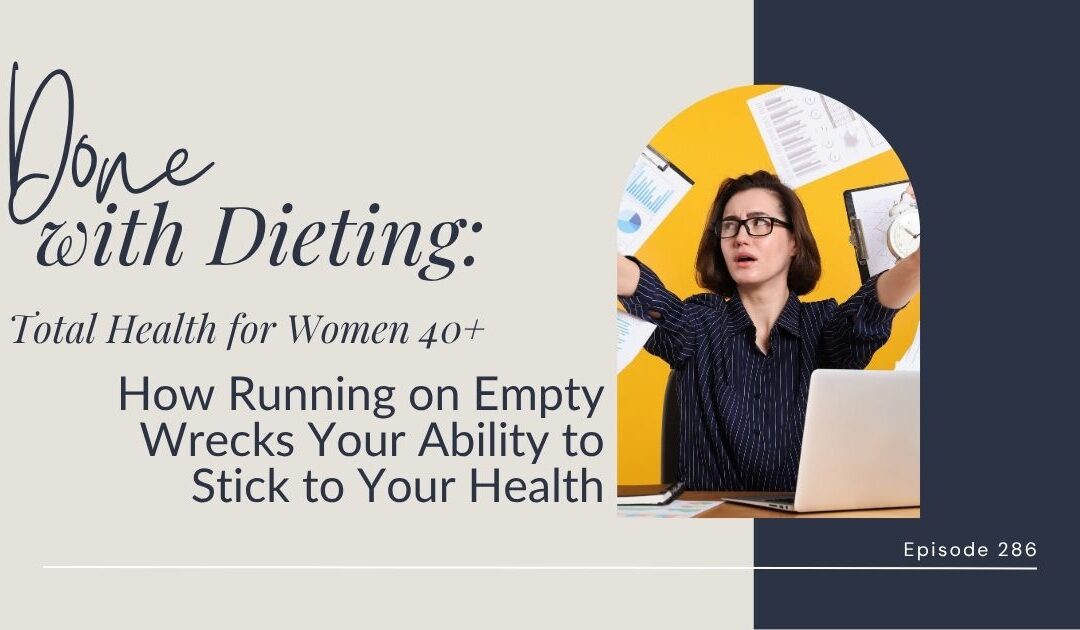
You finish the busy stretch. The launch, the deadline, the holidays, the season where everyone needed something from you. You held it all together. And then, the second you finally stop, you get sick. Or your back goes out reaching for a sock. If that pattern sounds familiar, this episode explains what your body has been doing to you for years, and why it keeps happening the moment you slow down.
Here's the part almost no one connects: the reason you can't follow through on the healthy stuff you already know how to do might have nothing to do with willpower. You're running on empty. And a body running that low on reserves can't hold a good choice in place at six o'clock when you're wiped out. In this episode I walk you through the real cost of never actually stopping, using a client I call Chris whose evening probably looks a lot like yours.

We get into why you don't rest even though you know you should, the family rule that taught you to earn it, and the quieter belief running underneath that says the need for rest applies to everyone except you. I talk about how you multitask your own downtime until it stops counting, and why sleep is the first thing you cut even though your body doesn't work on credit.
By the end, you'll see the pattern clearly. And you'll understand why seeing it and changing it are two different things, which is exactly where most smart women get stuck.
The Listener Takeaway: Why This Episode Matters
If you've been quietly wondering what's wrong with you, why you can list every healthy habit and still can't make yourself do them, this episode hands you a different answer. Not a character flaw. A body that's been running on empty for so long it can't hold anything in place. That reframe alone takes a weight off, because it means you were never lazy or undisciplined. You were depleted, and depleted women can't white-knuckle their way to follow-through.
You'll walk away seeing your own evenings, your own crashes, your own "I'll rest when the list is done" bargain with new eyes. And you'll understand that rest was never something you had to earn by finishing. You get to have it because you're a human being. That shift is where real change starts, and this episode shows you exactly where to look next to make it stick.
Are you loving the podcast, but arent sure where to start? click here to get your copy of the Done with Dieting Podcast Roadmap (formerly Total Health in Midlife) Its a fantastic listining guide that pulls out the exact episodes that will get you moving towards optimal health.
Take the Quiz: Why Do Your Healthy Habits Keep Falling Apart? If you've ever wondered why you know exactly what to do but still can't seem to stick with it, this quiz was built for you. In about 3 minutes, it identifies your specific pattern: the real reason your follow-through keeps breaking down, and what to address first. Your results are delivered straight to your inbox.
I am so excited to hear what you all think about the podcast – if you have any feedback, please let me know! You can leave me a rating and review in Apple Podcasts, which helps me create an excellent show and helps other women who want to get off the diet roller coaster find it, too.
Watch or Listen to the Episode:
WHAT YOU'LL LEARN
- Why you get sick or hurt the moment a busy stretch ends, and what your body was doing the whole time
- The real reason knowing what to do hasn't turned into doing it, and why "try harder" was never going to work
- The childhood rule about rest you're still living by, and the belief underneath it you've probably never said out loud
- Why you can't bank sleep on the weekend, and where the bill for skipping it actually shows up
RESOURCES
- Take the quiz: Why Do Your Healthy Habits Keep Falling Apart?
- 8 Habits guide
- 257 - The Truth About Step Goals, Belly Fat, and Burnout
- 265 - "Just Do It" and Why We Don't
- 260 - 8 Habits & Why They Don't Stick
Full Episode Transcript:
286 - Pillar 4: Rest & Recovery
Elizabeth: [00:00:00] Almost every time I finish a really big project at work, I get sick. Not just a little tired, but like flat out sore throat, box of tissues sick. And for years I thought that it was just bad luck. Well, it wasn't bad luck. My body had been keeping a tally the whole time I was just pushing and pushing and pushing, and the second I stopped and it knew, it collected on that debt.
If you've ever spent the first two days of a vacation with a fever or thrown out your back the morning after a hard week finally ended, this episode is gonna explain something about your body that changes how you see all of it. So stay with me
Welcome to the Done with Dieting Total Health for Women over 40 podcast, the podcast for women who are done with the start over cycle and ready for a way of taking care of themselves that actually works.
Hey, everyone. Welcome [00:01:00] back to Done with Dieting: Total Health for Women over the Age of 40. I am your host, Elizabeth Sherman, and I am so glad that you are here with me today. Thank you so much for spending part of your day with me. Now, I wanna tell you a little bit... Now, I wanna tell you about something that happens to me almost every time I run a launch of my program.
If you don't know what a launch is, it's a stretch of a couple weeks where I am promoting something, and generally what happens is my workload roughly doubles. I'm writing more, I'm posting more, I'm showing up more, I'm sleeping less. I'm thinking about how I can get this program in front of the people who need it the most.
And the strangest thing is I feel great when I'm doing it. I'm running on adrenaline, I'm focused, and I get every single thing done. And then the launch ends, and within about two days, [00:02:00] I collapse and I get sick, and not just a little run-down. The kind of sick where you're flat on the couch for three days with a sore throat and a box of tissues next to you, like every single time.
It got to where I could almost put it on the calendar. Launch ends on Friday, and I will be useless by Sunday. Now, for years, I chalked it up to just bad timing or some sort of virus, and then I started paying attention, and I realized my body wasn't getting sick in spite of the fact that I slowed down.
It was getting sick because I didn't slow down before. My body had been keeping a tally the whole entire time, every late night, every hour I should have rested and worked through instead. And the second I stopped moving, it was like, "Oh, okay, here we go. Now we can relax." Maybe you [00:03:00] can relate to this. You white-knuckle your way through the holidays, the work deadline, the family thing, the stretch where everyone needs something from you.
You hold it all together, and then the trip that you waited months for, you spend the first few days of it with a fever or a cold. You get through a hard week, and the morning after it ends, your back goes out reaching down to pick something up off the floor. That's what I wanna talk about today, because it's not a random pattern and it has a lot to do with why you can't seem to follow through on the things that you already know would make you feel better.
Now, here's the thing that I know about you. You already know what to do for your health. You know that you should eat a little bit more protein. You know that you would feel better if you moved your body most days. You know that you should drink more water and go to bed earlier and not pour the second glass of wine.
Now, none of [00:04:00] this is news to you, right? You could probably teach a class on it. So the problem was never that you don't know. The problem is that knowing it and doing it are two completely different things, and nobody ever explains why that is. We just believe that we are lazy. You wake up Monday ready to do it right this time, and by Wednesday night you are standing at the counter eating crackers out of the sleeve wondering, "What is wrong with me?"
Like, how come I don't have any discipline? And I wanna tell you what's actually going on because it's not the thing that you think it is. You are running on empty. Not tired like you need a nap, but empty like you never really stop going. Your foot is on the gas from the second your eyes open until you finally sit down at the end of the night.
And even then, your brain is still going on repeat. And a body [00:05:00] that's running on low reserves cannot hold a good choice in place. There is nothing left to hold it with. You can want the good choice. You can plan the good choice. And then 6:00 comes and you're wiped out, and the wanting doesn't really matter anymore.
Now, here's what I've learned, and it took me a really long time to figure this out. You cannot outthink your body's need for rest. You can push it and ignore it and negotiate with it and power through it, but it will win. Your body always wins.
The only thing you get to decide on is whether it wins on your terms or on its own. So let me tell you about a client of mine. Erin is one of the most capable women that I know. She gets so much done in a day and more than most people get done in a week, and she cannot stand [00:06:00] still. Here's what her evening looks like.
Her husband wants to watch a show together. Sweet, right? A nice way to end the day. So she sits down on the couch next to him, and within about 90 seconds, her brain starts up. The dishwasher needs to be empty. The clothes need to be folded. She never answered that text. The thing for work tomorrow isn't ready, or she didn't transition the laundry over from the washer to the dryer.
So she's sitting on the couch, but she's not really there on the couch. She's running through this mental list of things. Her body is next to her husband, but her mind is in seven different places. And so she gets up, and she'll do a couple things really quick, and he's like, "What the heck is going on? Why can't you just, like, relax?"
And a couple things then becomes 45 minutes, and now it's late, and she goes to bed later than she meant to [00:07:00] again, and there's no connection between them. And she lies there, because you can't run your brain at 10,000 miles an hour all evening and expect it to shut off the second your head hits the pillow.
It just doesn't have a brake like that. So she stares at the ceiling. She's exhausted and completely wired at the same time, which is one of the worst feelings that there is. You're like, "I'm exhausted and my brain is going a million miles an hour."
Now here's the thing that happens because it continues on to the next day, and that matters. Because she didn't go to sleep right away because she was so wired, she's now short on sleep, so her hunger is a little bit louder and her cravings are stronger, and by 2:00 in the afternoon she's reaching for something sugary just to keep her eyes open.
The workout that she planned is not happening because she doesn't [00:08:00] have the energy, and honestly, she doesn't have the will to do it either. She's a little bit short with people that she loves over nothing other than the fact that they are irritating. And her thinking is fuzzy, so every task takes a little bit longer than it should, which means that she's even more behind, which means that she's got even more on the list tonight.
And around and around it goes. Here's what I want you to see. Erin skipped the rest to get more done. That was the whole point. Sit down for a show? She doesn't have time for that. There's too much to do. But skipping rest is the exact thing that makes her less capable. It makes her slower, foggier, reaching for food that she didn't want, and skipping the movement that certainly would have helped. She would have gotten more done and felt better [00:09:00] doing it if she had just sat down and watched the show and enjoyed it.
The rest wasn't the thing standing in the way of her productivity. The rest becomes the productivity. She had it backwards, and she couldn't see it because she was too tired to see anything clearly. Her body was going to collect either way.
She could have given it 40 minutes on the couch, but instead it took the entire next day. And that's what I mean when I say that your body always wins. Now, you might be listening to this and thinking, "Okay, Elizabeth, I get it. I should rest more. Fine. But that's not the problem. The problem is I don't know how."
Now, I wanna gently push on that belief because you do know how. You know how to sit on a couch. You know how to go to bed early. You know how to take an afternoon [00:10:00] and do nothing. It's not a skill that you're missing. The reason that you don't rest is that somewhere way underneath, you don't believe that you are allowed to.
And I wanna look at where that comes from, because most women have never traced it back For a lot of us, it started in our homes. Maybe you grew up in a house where you didn't sit down until the work was done. That was instilled in you from your parents, where resting in the middle of the day while there were still things to do was something that only lazy people did.
Maybe nobody ever said it out loud. Maybe they didn't have to, but you watched your mother never sit down, and so you absorbed it. And by the time that you were 10, you already knew you earn your rest by finishing. And that rule would be fine if the work [00:11:00] ever got finished. But here's what nobody tells you about being a grown woman in this world.
There's always more work to do. The work is never done. I have never once, not a single day of my adult life, gotten to the bottom of my to-do list. There's always another load, another email, another thing someone needs, another appointment to make. The list regenerates overnight like it's, like it's alive.
So if the rule is that you rest when the work is done, and the work is never done, then what's the math there? You never get to rest, not really at least. Not without guilt sitting right there beside you. But there's something else running underneath, and this one is a little bit quieter, and I want you to really hear it because I think it's the real thing.
Deep down, you believe the rule about needing rest [00:12:00] applies to everyone else except for you Seriously, like if anyone had asked you, "I need to take a rest, but I don't feel like I deserve it," you would be like, "Girl, go take a rest." Think about it for a second. If your daughter called you and said that she was exhausted, running on five hours of sleep and hadn't taken a real break in like a week, you would tell her to go slow down.
You would tell her to take a nap. You'd tell her that she can't keep going like that, otherwise she's gonna burn out, and you would be worried about her. If your best friend told you that she felt guilty for taking one afternoon off, you would look at her like she had lost her mind. Of course she's allowed rest.
She's a human being. That's not even a question. You know the rule. You believe the rule. You apply it generously to [00:13:00] every single person that you love and who surrounds you. And then there's your version of the rule, and your version is older and louder, and it says something a little bit different. It says other people need rest.
You need to keep going. Everyone else is human, but you, you are the special snowflake who's supposed to be the one holding it all together. You've probably never said it like that. You might not have even known that you believed it until maybe right now, but you've been living by it for decades, and it's quietly running your whole entire life And here's the sneaky part.
Even when you do sit down, you're usually not resting. You're sitting down and folding laundry through the movie. You're watching the show and scrolling on your phone at the same time. You go for a walk and you've got a podcast [00:14:00] in one ear, and you're returning a text with your other hand. You sit down and you have a cup of coffee, and you're also answering an email.
You call all of this downtime, but it's not downtime. You're just doing two things at once instead of one, which means part of you is still working the entire time. Your body sat down, but you never let it stop. And look, I'll be honest, I do this too. I'll journal while I have a show on. Sometimes I scroll when I'm watching TV.
So I'm not up here pretending that I have all of this figured out. But I've gotten really honest about when I'm doing it and why I do it. Because underneath it is a belief that a moment spent on only one thing is a moment that's wasted. Like if I'm just walking, only walking, not learning something or getting something done, I'm [00:15:00] not being as productive as I could be.
That stillness is for people who don't have anything better to do. I actually started listening to audiobooks for this exact reason. Years ago, when I was studying for my certifications, I felt like sitting on the couch and reading was a waste of my time. I wanted to be productive while I did it, and so I'd put it in my ears and do something else at the same time.
I get the pull, I really do, but when you never do just one thing, you never give your body the one thing it's actually asking you for, which is to just slow down and stop fully for a minute. To be in one place doing one thing and not bracing for the next.
You can sit down 12 times a day and still never once give your body that. And then there's sleep, which is just [00:16:00] about the most important rest your body gets, and it's the very first thing that you cut. Think about how you treat it. When you're trying to get healthier, food feels like it counts.
You can see it. We see it all over the place. You make the salad, you skip the bread, you drank the water. You can tally up the calories. Movement feels like it counts, too. You got the steps, you did the workout, you can check the box. But sleep, sleep just feels like a waste of time for some people.
Sleep feels like the hours where nothing happens. It's the dead space at the end of the day where you're not producing anything. So it's the easiest thing in the world to shave a little bit off, just 30 more minutes to fold this or answer that or watch one more episode to get a couple more things done, and you tell yourself that you'll catch up on the weekend.
I need [00:17:00] you to hear this part, because it's the piece that trips almost everyone up We cannot bank sleep. Your body does not work on credit. You can't run a deficit all week, no matter how superhuman you are, and then pay it back on Saturday with sleeping in. It doesn't square up like a bank account. The debt from Tuesday night doesn't just disappear because you slept in on Sunday.
Your body already collected on Tuesday. It made you foggy and hungry and short-tempered on Wednesday. That bill is already paid by you, whether you noticed it or not. We've got this saying in our culture, "I'll sleep when I'm dead." And people say it like it's tough, like it's admirable, like it means you're really going for it.
It's a great line, right up until your body decides to take you up on it, because it will. [00:18:00] And maybe not tonight, but it keeps a tally, remember? And short sleep night after night is not free. It changes how hungry you are, how your body handles sugar, how clearly you think.
You feel it long before you'd ever connect it back to the sleep that you skipped. Your body has been talking to you this whole entire time. You've just been choosing not to listen. And so I wanna give you a different way to think about rest, and I want you to actually let this one in because it's the whole thing.
Rest is not a reward that you earn by finishing the list. You don't get to rest once everything is done, because we've already covered that, and everything is never done. If rest is the prize at the finish line, we're never gonna collect it, because there is no finish line. There's just you running [00:19:00] forever, waiting for a permission slip that no one is gonna hand you.
And rest is not fuel either. You've probably heard the oxygen mask analogy where you take care of yourself so that you can show up better for everyone else around you. Rest so that you can be a better mom. Rest so that you can be more patient with your team.
Rest so that you can have more to give. I really dislike the oxygen mask analogy, and here's why. It still makes self-care about other people. It still says the reason that you're allowed to stop is so that you can turn around and pour yourself back out for everyone who needs you, that your rest is still in service to everyone else.
You still have to justify it by what it produces, and I wanna take all of that away. You are [00:20:00] allowed to rest because you are a human being, full stop. That's the entire reason. Human beings need rest to function, not so that they can serve, not so that they can produce, just to be okay, just to work the way that a person is built to work.
You would never look at another human being and tell her that she has to earn her right to rest. You'd never tell her she only deserves it if it makes her more useful to other people. So please, stop saying it to yourself. You are a human being. You are not a human doing. So here's the whole thing in one breath.
You know what to do for your health, and you can't make yourself do it. And a big part of the reason is that you are running on empty, and your body cannot hold a good choice in place when there is nothing left in the [00:21:00] tank. That's it.
That's the soundbite. That's the pattern. And you might be feeling that click right now. Yes, that's me. That's exactly what's happening. And so I wanna be really honest with you about what that clicking feeling is and what it isn't. Seeing it is not the same as being able to change it. If just seeing it were enough, you'd be done.
Because you are a smart woman. You've had insights before. You've read the books, and you've listened to the episodes and had the aha moment in the car. And then a few days later, you were right back in it, running the list on the couch at 9:00 at night. And that's not because you didn't try hard enough.
It's because the thing running this program is old, and it's deep, and you can't usually see it from being inside of it.
Naming it is the first step. And that is a real step, but it's the first one, not the last one. [00:22:00] So here's where I want you to go next. I have a quiz. It's called Why Do Your Healthy Habits Keep Falling Apart? And it does something this episode can't do on its own, which is get specific about you and your specific issues because rest and recovery might be one of 'em, or it might be a piece of it, and something else is actually the thing costing you the most.
The quiz sorts it out, and in about three minutes, it identifies your specific pattern and the real reason your follow-through keeps breaking down and what to work on first. Your result lands right in your inbox, so you can find it at elizabethsherman.com/quiz, and I will put the link in the show notes so that you don't have to go hunting for it.
Go take the quiz. It's the fastest way I know to stop guessing about what's getting in your way. That's all I have for you today. Have an amazing day, and I will talk to you next time. Bye-bye.
[00:23:00] Hey, before you go, if you are someone who says, "I know exactly what I should be doing, I just don't do it," hey, if that's you, I made something for you. It's a free three-minute quiz that gets underneath that exact problem, not to give you more information, but to show you the specific reasons your follow-through keeps breaking down, because it's not the same for everyone.
And once you can see your pattern clearly, everything else seems to change. Head to elizabethsherman.com/quiz. It's free, it's fast, and it's honest
Enjoy the Show?
- Don’t miss an episode, follow the podcast on Spotify and subscribe via Apple Podcasts or RSS.
- Leave me a review in Apple Podcasts.
- Join the conversation by connecting with me on Social!


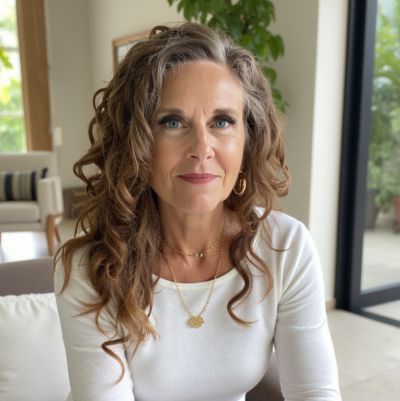
Elizabeth is a Master Certified Life and Health Coach with over 20 years of experience, dedicated to helping women in midlife thrive through holistic health and wellness. Her personal journey began with a desire to reduce her own breast cancer risk, which evolved into a mission to guide women through the complexities of midlife health, from hormonal changes to mental clarity and emotional resilience.
Elizabeth holds certifications from prestigious institutions such as The Life Coach School, Precision Nutrition, and the American Council on Exercise, as well as specialized training in Feminist Coaching and Women’s Hormonal Health. Her approach is deeply empathetic, blending her extensive knowledge with real-life experience to empower women in their 50s and 60s to build sustainable health habits that last a lifetime.
Recognized as a top voice in women’s health, Elizabeth speaks regularly on stages, podcasts, and webinars, inspiring women to embrace midlife with energy, confidence, and joy. Her passion is helping women regain control of their health, so they can fully engage in the things that matter most to them—whether that’s pursuing new passions, maintaining strong relationships, or simply feeling great in their own skin.