
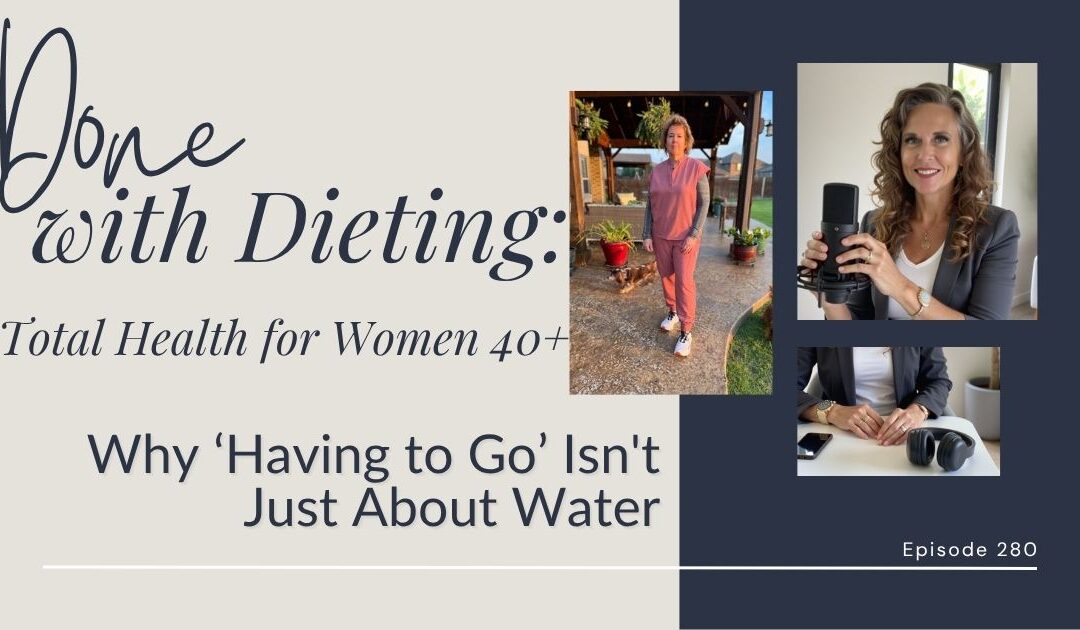
Chris has been a nurse for years. She's sat through every anatomy class, every OBGYN rotation, every training on the female body that nursing school offers. And she still didn't know that what she was experiencing, for years, had a name.
It started small. Needing to go more often. A feeling of pressure she couldn't quite place. She explained each one away: she was drinking more water, she was losing weight, her body was just changing. Every explanation made sense on its own. None of them were the real one. The real one was pelvic organ prolapse, and by the time a doctor finally said the word out loud, she'd already been living with it for years.
Then the shame rolled in. Chris told her coworkers she needed a hysterectomy. That was true. It wasn't the whole story, and she kept the rest to herself for a long time, telling no one but her husband and her coach. In this episode, she talks about what that silence cost her, why "having to go" all the time is so easy to write off as nothing, and what she wishes someone had told her years earlier.
This conversation isn't really about prolapse. It's about how often women, even women trained to notice symptoms in other people, miss the signs in their own bodies because nobody ever taught them what to look for or gave them permission to ask.
The Listener Takeaway: Why This Episode Matters
Chris did everything women in midlife are told to do. She stayed on top of her exams, she asked questions, she took care of herself. It still took years for anyone, including her, to name what was actually happening in her body. If you've been quietly explaining away a symptom that doesn't quite add up, this episode is your permission to stop guessing and start asking directly. Not next year. At your next appointment.
Are you loving the podcast, but arent sure where to start? click here to get your copy of the Done with Dieting Podcast Roadmap (formerly Total Health in Midlife) Its a fantastic listining guide that pulls out the exact episodes that will get you moving towards optimal health.
Take the Quiz: Why Do Your Healthy Habits Keep Falling Apart? If you've ever wondered why you know exactly what to do but still can't seem to stick with it, this quiz was built for you. In about 3 minutes, it identifies your specific pattern: the real reason your follow-through keeps breaking down, and what to address first. Your results are delivered straight to your inbox.
I am so excited to hear what you all think about the podcast – if you have any feedback, please let me know! You can leave me a rating and review in Apple Podcasts, which helps me create an excellent show and helps other women who want to get off the diet roller coaster find it, too.
Watch or Listen to the Episode:
WHAT YOU'LL LEARN
- Why constantly "having to go," or occasional leakage, can be an early sign of pelvic organ prolapse and not just a hydration or aging issue
- How losing weight can lower estrogen, and why that matters for pelvic floor support
- Why even women in medicine are never taught about pelvic floor health, and what that gap costs them
- Why shame keeps women from telling anyone, even the people closest to them, and what finally changed that for Chris
RESOURCES
- Episode 279: Chris's full transformation story, from her first appointment to over 100 pounds lost
- Episode 116: Perimenopause & Acupuncture with Michelle Kapler, on advocating for yourself at the doctor's office (elizabethsherman.com/michelle-kapler)
- Episode 221: Menopause, Sleep, Stress & Recovery, on what's actually driving symptoms beyond food and exercise (elizabethsherman.com/221)
- Episode 281 (coming next week): pelvic floor specialist Dr. Mary Alice Vetter joins the show
- Take the Free QUIZ to see what's getting in your way
Full Episode Transcript:
2280: Part 2 of Chris's Story- Why "Having to Go" Isn't Just About Water
Chris: [00:00:00] I got really mad at my body because, um, I blamed her for putting me in this situation. And, I had to work through that a little bit because, um, really she was doing the best she could with what sh- with what I was giving her.
I mean, I was treating her like crap, and she was doing the very best she could with what I gave her, which I didn't give her much, and then now I was mad at her because she turned on me. Well, you know, how I treated her, she should've turned on me. So it took me a little bit to, to work through that and to, um, to accept that- This is where I'm at, and this is what I need to do.
Elizabeth: Welcome to the Done with Dieting Total Health for Women over 40 podcast, the podcast for women who are done with the start over cycle and ready for [00:01:00] a way of taking care of themselves that actually works.
Hey, everybody. Welcome back to the Total Health in Midlife podcast. I am your host, Elizabeth Sherman, and I am really glad that you are here with me today. Now, if you caught last week's episode with my client, Chris, you already know her story. She came to me to lose weight. She'd been on a diet since she was about 11, and one night, she ate herself sick, signed up for my program, and everything changed from there. In our work together, she has lost over 100 pounds. She threw away her scale, she bought a bathing suit and wore it in public, and more than any of that, she started to actually like who she was, which, if you heard her say in her own words last week, lands very differently than hearing me say it.
If you haven't listened to that episode yet, go back and do that first. It'll make this one hit a little bit different. Because [00:02:00] today, we are picking up in the middle of that story. While Chris was doing all of that work, while she was losing weight and learning to take care of herself and showing up differently, her body sent her a signal that she didn't recognize.
She was a nurse, and yet she still did not recognize it, and she needed surgery on top of it. For a lot of women, that would be the moment where everything fell apart, where the progress stops, the old habits come back, and the whole thing unravels. But that's not what happened with Chris.
What did happen is worth hearing, especially if you've been dismissing symptoms that you can't quite explain. So let's get into it. Here's Chris.
Elizabeth: So you're a nurse. Mm-hmm. And you recently were diagnosed with a prolapsed bladder.
Chris: Okay.
Elizabeth: Um, yeah.
Chris: Okay. Yeah. Um, so [00:03:00] you know, with losing weight,
My journey was all about trying to get as healthy as possible with losing some weight, eating better, and also taking care of myself, um, which, I was pretty proactive with going to doctor's visits and stuff but, um-
I was, it was, I was trying to do the whole package. So I started having, um... I started feeling like I was having a lot of urinary frequency and a lot of urinary urgency, but I had also increased my water,
so I was thinking, "Well, it's just because I'm drinking so much water," um, and then as I was losing weight, um, my body started kind of feeling different because I'm losing weight. So I didn't know if, all these things were just going because my body was changing. I was also in perimenopause at the time so, that stuff's going on.
And I was of course making excuses like we do. [00:04:00] You know, oh, this is because I'm drinking too much water. This is because I'm losing so much weight I feel like this. , I... It was my yearly time to go to my doctor, and I recently had changed doctors, and she was really good. And so I told her what was going on and she's like, "I don't think it's because you're losing weight, and I don't think it's 'cause you're drinking a lot of water. I think something else is going on."
Um, and so she- Referred me to a GYN ur- urologist because of the, uh, urinary issues and stuff. And she goes, "I think you need to go see a specialist just to see what's going on." So I have to give her a lot of credit because she's the first one that actually said there might be more stuff going on.
And she did mention, you know, "You might be having some prolapse issues." And I was like... it kind of upset me a little bit because I'm like, how can I be having a prolapse issue? That's, like, for [00:05:00] women that are way older than me, like, in their 80s. Um, and so I was thinking there's no way it could be that, and then I was getting, a little stressed about it.
But I went ahead and made an appointment, to go see the specialist and stuff. And, um, when I went in to have that, um, exam, uh, it's a pretty thorough exam, and at that time, he told me that I did have, in fact, a prolapse. Um, and at that time, when I first... This was last year. Um, I first... It was like a two to three, and he told me different, um, options that I had. Um, there's three, three options, and, um, I could do nothing and it would just progressively get worse. Um, I could try a pessary ring, um, and that does not fix it, it just is a Band-Aid.
It just helps hold everything up in place during the day. It's a ring that you [00:06:00] have to, uh, put in and remove at the end of the day. So in the morning you put it in, you remove it at the end of the day. Or you could have surgery to repair. So when I left that office, um, I was very devastated. Um, I was ashamed.
Um, and I was Um, embarrassed. Um, I mean, I just, I couldn't wait to get out of that office because I just wanted to cry. I was on the verge of crying, and as soon as I got to my car, I did cry. Um, because, prolapse can be caused... Well, 50% of women that have had vaginal deliveries will have some kind of prolapse in their life, and I've had two babies.
Um, but also, I was so overweight that can also contribute to prolapse, which I was. And then be- Well, at this time you weren't overweight. No, but before I was- Right ... to cause it. Um, yeah, I had... At this time I was probably down, at that time I think I [00:07:00] was down about 80 pounds. I had lo- been lo- had lost.
And I did not know it, the doctor told me that, um, your fat cells have a lot of estrogen in them. So losing all that fat, I also lost a lot of estrogen, and estrogen is what helps support your pelvic floor. It gives it s- more strength. So losing a lot of estrogen makes your pelvic floor, uh, weaker. Um- And then also I was going through perimenopause.
So, it was a lot of stuff going on at the same time. And, um I just I went into a huge, um, blaming myself. It's because I let my health go so bad, and I gained so much weight. I didn't exercise, so I had no core strength, which goes hand-in-hand with pelvic floor strength. Um, you know- I blame myself 100% that I did this to myself.
And [00:08:00] the doctor also did tell me that this did not happen overnight, and he was asking me if any of my previous doctors had ever said anything when they do Pap smears, 'cause I was very religious on doing my Pap smears. Nobody had ever mentioned it, and he's like, "Well, you have had to have had prolapse for a few years.
It just slowly gets worse and worse and worse as time goes on, especially if you don't do anything." Um, I did not know, not saying that that's an excuse either. Um, but in hindsight, especially being a nurse, I wish I would've asked. But, in nursing school, when I went to nursing school, we never learned anything about that.
Like, I mean, you do your OBGYN rotation to learn, not once did they ever talk about your pelvic floor, not once. You learn all this other stuff, but never, never really discussed that or brought it up that it can prolapse or anything like that. Um, so I've learned a [00:09:00] lot since my diagnosis. Um, so I did decide to try the pessary ring.
Um- You did
Elizabeth: not like that.
Chris: I did not like that at all. No, I didn't. Um, they say you either hate it or love it, and I hated it. Um, they told me to give it two weeks, um, before I decided. I couldn't, I couldn't, I couldn't do the two weeks. I hated it so bad. It made me feel so... It just demeaned me so much.
Um, I did not like having to get up in the morning and put something in, and then it just, the whole day, all I did was think about that thing being in me, and it just stressed me out. Um, I kept worrying, what if it falls out? Um, and then at the end of the day, having to take it out. And I threw it away. I was like, "I'm, I'm just not doing this. I just can't do it." And, I've been on, or I am on several support groups, um, for prolapse, and a lot of women love it, and a lot of women have used it for six, seven, eight [00:10:00] years.
So everybody's different. Just because I hate it doesn't mean somebody else... For me, personally, I hated it. So, um, I did not wanna do that So I hem hawed around a little bit, like, what do I do now? Because now I only have two options, do nothing or surgery. And you know how bad I hated to even think about surgery, but, um, I went back to the doctor and told him how much I hated the ring.
And so he rechecked me to see how things were going, and I had actually progressed. Because I'm very active, so I was still doing, like, l- with li- lifting weights and stuff like that, and I had not, um, learned how to do it correctly where you don't put pressure on your pelvic floor, which now I have.
But at the time, I was just doing stuff, trying to keep, [00:11:00] improving my health. But, um, some of the things I was doing, I was not helping my pelvic floor whatsoever. I was hurting it. So at that time, um, my bladder prolapse was a full three, uh, my cervix was a two, and now my rectum was involved, and it was a one.
So everything had progressed some. And I was also starting to, um, have a little bit of constipation issues because of the rectum starting to prolapse. And I was thinking, because I was starting to have that, and I was like, I eat so many vegetables, I drink so much water. Why am I having constipation?
That, you know, um... And it's because of the rectum was starting to get involved. I could not tell that except for with constipation. Um, a lot of women that were at my stages have a lot of pain. I had no, no pain. I had a lot of discomfort. Um, I was starting to have more discomfort, like [00:12:00] when I was sitting, I could feel like there was bulging there.
Um, and of course, my urinary issues were getting worse. Um- And, I like to go hiking. I like to do that kind of stuff. So it was playing a part in I couldn't go on long hikes without having to figure out, well, where can I go to the bathroom? Where can I stop? Um, am I gonna make it? Do I not drink anything?
Don't drink anything beforehand. Don't drink anything on this hike. And, because I'm gonna have a bathroom issue. So it was starting to really, um ... and work too, a lot of people know nurses don't go to the bathroom a lot because we don't have time. It's a known thing.
Um, so am I gonna be at work and have to go to the bathroom, and I can't get to a bathroom because I'm in the middle of doing something, where I can't just w- you know, you just can't sometimes walk away. So it was really starting to put a hinder... It was hindering my [00:13:00] life. It was getting in the way of my abilities of what I wanted to do and what I wanted to achieve.
And so I decided to go ahead and have surgery. And it was a hard decision, y- because, am I doing the right thing? Am I not doing the right thing? Um, I really didn't wanna have that downtime because I had to take six weeks off, I didn't want the downtime. Um-
Elizabeth: Not only because of your fitness but, and your health, because you were having really great progress, but also because it was an inconvenient interruption of your life, yes?
Chris: Yes, exactly. Yes. Yes.
Elizabeth: Damn body getting in the
Chris: way- I know ... of
Elizabeth: my life.
Chris: And I did. I got really mad at my body because, um, I blamed her for putting me in this situation. And, I had to work through that a little bit because, um, really she was doing the best she could with what [00:14:00] sh- with what I was giving her.
I mean, I was treating her like crap, and she was doing the very best she could with what I gave her, which I didn't give her much, and then now I was mad at her because she turned on me. Well, you know, how I treated her, she should've turned on me. So it took me a little bit to, to work through that and to, um, to accept that- This is where I'm at, and this is what I need to do.
Um, I wanted to keep moving on in my journey. Um, and I needed to take a pit stop and, and fix this so that I could keep moving forward. And because I didn't want it to hinder me even more, which it would have. It would have continued to get worse and worse and, um, to the point where, I might not have been able to hike anymore.
I might not have been able to lift weights. I might not have [00:15:00] been able to, just do normal stuff, because of how it was progressing. So I went in and had the surgery Um, which was a lot more than what I was expecting. I mean, the doctor was great. He told me exactly what he was gonna do.
Um, I just... I thought, um, that I was gonna get through it, like, no problem. Like, he wanted me to spend the night one night. I did not wanna spend the night. He told me, "You definitely are gonna wanna spend the night." But I was think- I'm gonna go in there, have the surgery, I'm gonna feel fine, and I'm gonna go home.
That was not the case at all. I was so thankful I spent the night. I was so thankful, um, because it, it was a little bit more to it. Um, so he actually did, um, a hysterectomy, um, and removed my uterus because my uterus is what was falling, which was what was pushing on my bladder and everything else, pushing it down.[00:16:00]
So we needed to take out my uterus, um, to get that out of the way. And then my cervix he also removed, and my fallopian tubes because they're... I didn't need them. He did leave my ovaries because those, uh, were not causing any issue, um, and I don't have any ovarian cancer in my history so... And they're still producing some estrogen, which I needed.
So he... it was done vaginally. Um, so he did do that and then, um, he fixed my bladder where, he put some tacks, I guess you'd wanna say, just to tack it back up into place where it's supposed to be. And then, uh, the vagina wall on both sides, he, um, really reinforced it, um, because the skin had gotten very, um, loose and soft and thin because of the prolapse pushing on it.
[00:17:00] So he reinforced it, kind of... reinforced the walls on both sides, the rectum side and the bladder side. Um, and so- when I woke up, um, I had a lot, a lot of thigh pain. That's where all my pain was, was in my thighs, which I was surprised.
Um, I was thinking it would be more in my, um, pelvic area, but the pain was actually referring to my thighs. And my blood pressure had dropped quite a bit, so they couldn't give me any pain medicine for a while, um, because they couldn't... They didn't want it to drop any more.
Um, so it took several hours before, uh, my blood pressure got somewhat normal, high enough I guess, so that they could start giving me some meds.
Um, and it's funny because of me being a nurse, I didn't wanna act like I was somebody seeking pain medicine because I see it all the time. But I was like, "You guys need to give me something stronger. You need to give me something [00:18:00] IV, um, because I'm in so much pain right now. We need to get on top of it so that then I can, be okay."
And I had a really good nurse and she, um, she called the doctor and got me some morphine, thank goodness, and that helped so much. Yeah. So- I only needed one dose and I was good.
Elizabeth: So I know that, you felt a lot of shame around getting the prolapse in the first place. And so, you know, I w- I wanna commend you for coming onto a podcast and actually talking about it.
Yeah. Because if I had suggested this when you were going through the surgery or even before, you would have said, "There's no way in hell that I'm admitting that I have prolapse," right?
Chris: Right, because I told no one. Um, I mean, you were the only one that knew, and my husband. Um, at work I just told everybody I needed to get a hysterectomy.
That's all I told them. All my friends, that's all I told them. [00:19:00] Because I was very ashamed, um, embarrassed- Um, over the whole thing. I just, I... Yeah, it was, it was hard. Yeah. I didn't wanna tell nobody.
Elizabeth: And so what made you want to share this information with folks?
Chris: Well, I, I think a lot of it is that as I've been going through healing and going through this process of getting over all the surgery and I started talking a little bit with people, a little bit, and I was shocked at how many people were like me.
They had no idea about... And I mean, most of my friends are in the medical field. They are nurses and... I even had one was like, "Well, what do you mean you have a prolapse? I've never heard of that. What are you talking about?" Um, and I think... And then also following these, self groups and stuff like that where so many women are [00:20:00] ashamed and, uh, embarrassed and nobody talks about it.
Nobody... it's kind of like a, a dirty little secret, that if this happens to you, it's because you did something wrong, you didn't take care of yourself, and don't let anybody know. Don't go tell anybody. Uh, a lot of women don't go get help for it. Um, and a lot of women end up in like depends because of it, because they're too ashamed to go to the doctor and- I was like, I don't want somebody to feel like how I felt. I don't want somebody to be naive and not know or to start having these issues and then, be ashamed and be embarrassed and just live with it. Don't go get help and just end up with their life being so much less because they can't leave the house or they can't, you know, they have to wear diapers or that kind of stuff.
There's a huge industry on [00:21:00] adult women diapers, so I just wanna tell women that when, when they go to doctors and when they go get their Pap smears, to be an advocate for themselves and to ask, to say. 'Cause when, when I went in for my Pap smear, they would do my Pap smear and say, "Okay, we'll give you your results.
You're good. Go on." Never mention anything, never talk about my pelvic floor, never... Nothing. And of course, I didn't either. I did not ask. But now, in hindsight, I wish I would've said, "Hey, what's going on with my pelvic floor? How's my pelvic floor doing? Do I have any kind of prolapse?" Because I did have two kids.
I, I do have this going on or I have that going on. Um, and be proactive and ask the questions. And if you go to a doctor that doesn't want to answer, then you need to find a different doctor. There's some great doctors out there, and unfortunately there's some not so great. [00:22:00] But you need to be an advocate for yourself because with, um, prolapse, if you can catch it early enough, you catch it soon enough, you can actually do exercises and, uh, different therapy if you work with pelvic floor therapists, um, where they can- where you can reverse some of it.
Mine, at the point, was at the point that I was not able to reverse it. But if you catch it when you're, at a stage one, you can. Even a stage two, you can, you can reverse it if you work with the right pelvic floor therapist and, um, strengthen your core, learn how to breathe the right way, um, without putting pressure on your pelvic floor.
There's so many things you can do if you know-
Elizabeth: Yeah ...
Chris: if you have that information.
Elizabeth: Well, and for the listener who's listening right now and wanting to learn more about the pelvic floor, next week we're gonna have, um, your pelvic floor [00:23:00] specialist on the podcast so you can pick up that episode. Yes.
Chris: Yeah. Yes.
Yeah. Mary Alice is great. Um, I started working with her four weeks after surgery, and she has made huge difference in my life also, because she's teaching me how to be active again and do it the right way and where I'm still protecting and strengthening my pelvic floor and core. And I can still be as active as I want, but I'm doing it the right way so I don't hurt myself again.
Yeah Definitely. Yeah
Elizabeth: All right. Thank you again for Chris for coming on the show and talking about something that most women don't talk about at all, even with their closest friends. Now, here's what I want you to walk away with from this episode. Chris is a nurse. She knew her body. She was paying more attention to her health than she ever had before, and yet [00:24:00] she still didn't know what she was experiencing had a name or that it was something that she could ask her doctor about directly.
And that's not a gap in her knowledge. That's a gap in what we get told. So here's the one thing she's asking you to do. At your next appointment, ask about your pelvic floor. Ask if there's any sign of prolapse. You might get a clear answer. You might get a doctor who moves past it very quickly, in which case we wanna invite you to push.
Either way, you ask the question. Chris had no idea this was possible for her, and she didn't have anyone to ask it for her, and she wants you to have a different experience than she did. If this episode made you think of someone, a friend, a sister, someone you know who's been dealing with symptoms that she can't quite explain and hasn't brought up with her doctor, send it to her. You don't need to say [00:25:00] anything, just send it. And if you want to understand what's actually getting in the way of your own health right now, not just the physical piece, but the whole picture, go to elizabethsherman.com/quiz.
It's a free quiz, and it'll show you exactly where to start. Next week we are gonna hear from the pelvic floor specialist who worked with Chris after her surgery. And if anything in today's episode felt familiar, that conversation is gonna give you language and next steps you can actually use with your own doctor.
That's all I have for you today. Have an amazing day. I'll see you next time. Bye bye.
Hey, before you go, if today's episode resonated with you, I wanna invite you to take a free quiz I created called Why Do Your Healthy Habits Keep Falling Apart? Because here's the thing, if you've been stuck in the starting over cycle, it's not a willpower problem. It could be something a little bit deeper than that, like your systems.
And this quiz will show you exactly which part [00:26:00] of your system is getting in the way. It takes about three minutes, and you can find it by going to elizabethsherman.com/quiz. I'll see you there.
Enjoy the Show?
- Don’t miss an episode, follow the podcast on Spotify and subscribe via Apple Podcasts or RSS.
- Leave me a review in Apple Podcasts.
- Join the conversation by connecting with me on Social!



Elizabeth is a Master Certified Life and Health Coach with over 20 years of experience, dedicated to helping women in midlife thrive through holistic health and wellness. Her personal journey began with a desire to reduce her own breast cancer risk, which evolved into a mission to guide women through the complexities of midlife health, from hormonal changes to mental clarity and emotional resilience.
Elizabeth holds certifications from prestigious institutions such as The Life Coach School, Precision Nutrition, and the American Council on Exercise, as well as specialized training in Feminist Coaching and Women’s Hormonal Health. Her approach is deeply empathetic, blending her extensive knowledge with real-life experience to empower women in their 50s and 60s to build sustainable health habits that last a lifetime.
Recognized as a top voice in women’s health, Elizabeth speaks regularly on stages, podcasts, and webinars, inspiring women to embrace midlife with energy, confidence, and joy. Her passion is helping women regain control of their health, so they can fully engage in the things that matter most to them—whether that’s pursuing new passions, maintaining strong relationships, or simply feeling great in their own skin.