
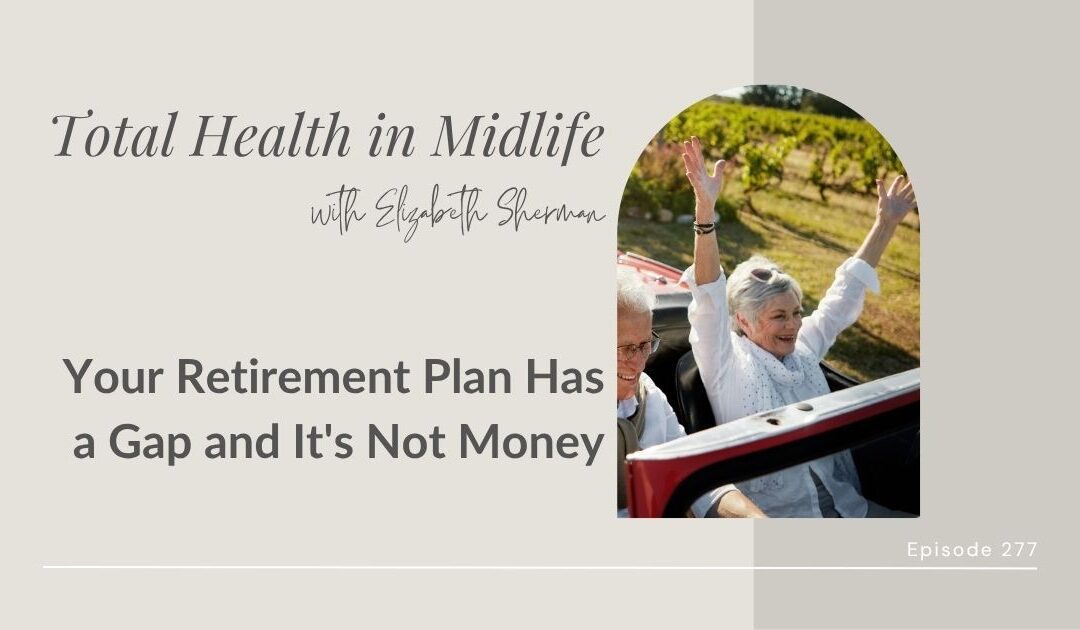
When a room full of financial advisors was asked when they planned to prioritize their health, the most common answer was the same one their clients give about saving for retirement: when things slow down. Elizabeth was in that room. And that answer is exactly why she was there.
In this episode of Total Health in Midlife, Elizabeth shares the framework she brought to that room, called the Health-Wealth-Time framework, and why the gap most women never see coming is not in their savings account. It is in the body they are going to show up with when they finally have the time and money to live the life they spent decades building.
This is not a scare tactic. It is a mirror. Because the retirement you are picturing, the trips, the grandkids, the energy to actually say yes to things, does not happen automatically. It is built now, in the small decisions you are making today about whether your health is a priority or a someday.
Elizabeth also shares two women from her own life whose retirements looked nothing alike, and what the difference between them actually came down to.
The Listener Takeaway: Why This Episode Matters
Most women in midlife are not ignoring their health because they don't care. They are deferring it because everything else feels more urgent, and health doesn't send an invoice until much later. By the time the bill arrives, the window to build the body you wanted to retire into has gotten a lot smaller.
This episode gives you a concrete framework for understanding the real cost of that pattern, and a clear next step for figuring out what is actually getting in your way. Not the surface answer. The real one. Because the retirement you are picturing is worth protecting, and the time to protect it is now.
Are you loving the podcast, but arent sure where to start? click here to get your copy of the Done with Dieting Podcast Roadmap (formerly Total Health in Midlife) Its a fantastic listining guide that pulls out the exact episodes that will get you moving towards optimal health.
Take the Quiz: Why Do Your Healthy Habits Keep Falling Apart? If you've ever wondered why you know exactly what to do but still can't seem to stick with it, this quiz was built for you. In about 3 minutes, it identifies your specific pattern: the real reason your follow-through keeps breaking down, and what to address first. Your results are delivered straight to your inbox.
I am so excited to hear what you all think about the podcast – if you have any feedback, please let me know! You can leave me a rating and review in Apple Podcasts, which helps me create an excellent show and helps other women who want to get off the diet roller coaster find it, too.
Watch or Listen to the Episode:
WHAT YOU'LL LEARN
- Why "I'll get to it when things slow down" is the most expensive sentence in the room, and what it is actually costing you in ways that don't show up until it's much harder to fix
- How the Health-Wealth-Time framework shifts across every stage of life, and which lever most midlife women are quietly running on empty without realizing it
- What the compounding cost of small health deferrals actually looks like over time, and why it is never one big decision that gets you, it is a thousand small ones that became the default
RESOURCES
- Elizabeth Sherman's Speaking page
- Take A Free Quiz & learn what is keeping you from applying the health habits that you know you could be doing.
Full Episode Transcript:
277: Your Retirement Plan Has a Gap and It's Not Money
[00:00:00]
Elizabeth: Okay, close your eyes for a second. Actually, don't if you're driving. But I want you to picture this. You're retired. You finally have the time. Now, what does that look like? . Now, for most women I ask, it's travel, it's grandkids, it's picking up something that you never had time for before, like pottery or tennis or painting, paddleboarding.
It's waking up without an alarm and actually feeling rested. It's your life, finally, on your terms. Nobody pictures the doctor's office. Nobody imagines that the bulk of their retirement is gonna be managing prescriptions or scheduling appointments or sitting in waiting rooms and navigating a body that can't do what they want it to do.
And yet, for a lot of women, that is exactly what happens. Not because they didn't work hard enough, and not because they didn't deserve better, but because health was always the thing that [00:01:00] was going to get handled later, when things slowed down, when there was more time. I know what that looks like up close.
I sat in a hospital room at age 33 watching my mom, and I saw my own future staring back at me if I didn't do something about it. And I made a decision that day that changed everything. This episode is that conversation. Now, it's not about fear. It's about holding up a mirror and asking, the retirement that you are picturing, are you actually building towards it?
Let's talk about that
Welcome to the Total Health in Midlife podcast, the podcast for women over 40 who want peace with food, ease in their habits, and a body that they don't have to fight with.
. So this morning, I was at the beach with my dog Coco, and she was doing this thing that she always does where she runs straight into the [00:02:00] water and completely ignores me.
She is totally in her element. And I'm standing there with my feet in the sand watching her. The sun is just starting to come up over the water, and I had this thought, like, I almost didn't have this. Because for years I have lived two minutes from the beach, one of the most beautiful beaches in Mexico, and I rarely went.
I always told myself that I was too busy. I had too much to do. That it's right there, I could go anytime, and so I didn't, or I would get there eventually when things slowed down. Does that sound familiar? I moved to Mexico nine years ago. Nine years. And for a big chunk of that time, I was so focused on everything else, work, building my business, clients, keeping up with all of it, that I was walking past one of the best things in my life every single [00:03:00] day without stopping to use it.
Now, my puppy, Coco, she changed all that. She needs a walk every single morning. She needs 30 minutes of structured playtime, and the beach is right there, so we go. And now it is the most precious thing that I look forward to every single day. I also have started paddleboarding on the weekends and snorkeling.
I'm even learning how to windsurf. I'm not telling you this to brag about my environment or where I live. I'm telling you this because it was here and available to me, and I wasn't doing it.
I almost missed it. And I kept putting those things off. I kept putting myself last, telling myself there would be a good time to do it later Yeah. So welcome to the Total Health in Midlife podcast. I am your host, Elizabeth, and I [00:04:00] am really glad that you're here with me today, because today we are talking about something that I think is one of the most important conversations women in midlife are not having with themselves, and it starts with a question that I want you to actually sit with for a second.
What does your retirement look like in your head? Not the financial part, we already know about that piece, but the life part. I'm talking about the trips that you've been putting off, the grandkids that you wanna be present for, fully present, not watching from a chair while they're playing in the middle of the, the living room.
The hiking, the dancing, the energy to actually do the things that you've spent your whole life saying that you'll do when you finally have the time. Most of us have a version of that picture. We've been working towards it for decades. What I wanna talk [00:05:00] about today is what it actually takes to get there.
Because the retirement that you're picturing, it actually requires your health, and your health is something that you're either investing in right now, today, or you're not. And that decision, even when it doesn't feel like a decision, is costing you more than you realize. Now, a few weeks ago, I got on a plane and flew to Cleveland to give a talk to a room full of financial advisors, which, if you know me, is actually a little funny, because I am a health coach and I live in Mexico.
I spend my mornings on the beach with my puppy, Coco. And somehow, I ended up standing in front of a group of people whose entire job it is to help other people build wealth, talking to them about their bodies. But here's why it makes sense. Before the talk, the event [00:06:00] organizer sent out a short survey to everyone in the room.
One of the questions was, "When will you prioritize your health?" And the most common answer was, "When things slow down. When the quarter is over. When the kids are launched. When the business is stable. When I have more time. When life cooperates a little more than it does right now. When things slow down." I want you to notice something about that answer, because those financial advisors in that room spend their entire careers watching clients make the exact same excuses, mistakes with their money.
They're waiting. They're saying that they'll start saving seriously once things settle down. Once the mortgage is paid, once the salary goes up, once the timing is better. And every advisor in that room knows [00:07:00] what that kind of waiting costs. They've watched it play out with thousands of clients. They understand compounding.
They understand that time is the one thing that you cannot get back, and that every year that you wait is a year of growth that you're leaving on the table. They know that this is about money. They say it to their clients constantly. And then someone asked them about their health, and they gave the exact same answer their clients give about retirement planning.
When things slow down. That is the room that I was standing in, and that is what my talk, which I called Half-Ass Your Health and Win, was all about. Now, the premise is simple. You can work hard your whole entire life, you can save diligently, make smart decisions, build something real, and none of it, none of it, [00:08:00] will give you the retirement that you're picturing if your health is gone when you finally get there.
Now, that is not a scare tactic. It's just math. And it's the same conversation that I wanna have with you today. I wanna tell you about two women who are in my life, because they are the reason this conversation matters to me personally. The first is my mom. My mom did everything right. She worked hard.
She raised her family. She put everyone else first, the way that women of her generation were taught to do, the way that a lot of us were taught to do. She deferred herself constantly. There would be time for her later. Now, she was diagnosed with breast cancer in 1994. She went through treatment, she fought it, and she came out the other side and spent years on medication that [00:09:00] was supposed to help her stay clean.
And then one day, her arm broke. The cancer had moved into her bones. Nine months later, she was gone. She was only 63 years old. My mom never got a retirement, not a single day of it. The life that she had been working towards, the time that was supposed to finally be hers, she never got there. I was sitting in her hospital room near the end, watching the machines, listening to the nurses talk in a low voice about bone density and medications, and I kept thinking, "She was supposed to have more time than this."
Now, I wanna be really careful here, because I am not telling you that my mom caused her cancer. I'm not saying that if she had eaten differently or exercised more that she would have survived. Cancer is complicated. The relationship between [00:10:00] lifestyle and disease is complicated, and I am not gonna pretend anything else.
What I am saying is this: my mom's illness was my wake-up call. Sitting in that room, I started asking myself questions I had never asked before, not just about what to eat or how to move, but about what I was building, what I was working towards, whether the version of the future I had in my head was actually something I was taking care of or just something I was assuming would show up.
Because here is what I know now. After years of working in health and doing deep work on my own beliefs about my body, I may not be able to prevent my own cancer, but I can make my body as strong as resili- I can make my body as strong and as resilient as possible so that if something does happen, I am in the best possible position to face it.[00:11:00]
That is the part that I can control, and I intend to control it. Now, the second woman I wanna tell you about is my Aunt Terese. Now, she is 83 years old. She's my mom's sister. She drives herself wherever she needs to go. She lives alone. She has friends. She has a social circle. She reads, like, novels. She travels.
She is sharp, she is engaged, and she is active in things that she cares about. She is not extraordinary. She did not run marathons. She did not do... She is not some wellness icon. She just kept her health, and because of that, she still has her life. When I think about what I want my future to look like, it is not a number in a retirement account.
It is mornings at the beach with Coco. It's paddleboarding on weekends. It's being present, [00:12:00] physically present, for the people that I love. It's being the Aunt Terese in someone else's story. And here's the question that I wanna leave you with before we go any further. You already have a picture of what you want your retirement to look like, the trips, the grandkids, the energy, the freedom.
That picture is already in your head. The question is, which woman are you building toward, whether you realize it or not? Because both paths start here. Both of them start with the choices that you are making right now today about whether your health is something that you are investing in or something that you're going to get to later when things slow down. Now here's the framework that I brought into that room in Cleveland. I call it the health, wealth, time framework, and once you see it, you cannot unsee it. Now, there are three different levels
It's called the health, wealth, time framework, and once you see it, you just cannot unsee it. [00:13:00] Now, there are three levers. There's health, there's wealth, and there's time. And across every stage of your life, those three levers are going to shift. You rarely have all three at top capacity at once. The question is what you do with what you have when you have it.
Think about when you were young, in your 20s, maybe teenager years. You had time. You had health. You could eat whatever you wanted, stay up late, skip the gym for a month, and bounce back. Your body was forgiving in a way that it no longer is. And most of us had very little money, at least money of our own.
We might have had our parents' money, but we were building. We were trying to figure it out. So we spent our health and our time freely because we had plenty of both, [00:14:00] and we figured wealth would come later. And so for many of us, it does. It comes in the career years, the building years, the years where you're raising kids, you're growing professionally, you're taking on more, and you're managing more, and you're carrying more.
The money starts to come. You start to save it. You start to gain wealth. The stability starts to come. But something shifts quietly in the background. At that point, time gets scarce, and your health is actually a big question mark. It starts running on a smaller budget than you probably realized. Nothing collapses.
Nothing's dramatic about it, but the workouts get easier to skip because of time, right? The sleep gets shorter. The stress gets louder. The food gets more convenient and less intentional. And every time you think [00:15:00] about doing something about it, there's something more pressing, something that needs you more, something that feels a little bit more urgent than going for a walk or eating a vegetable or getting eight hours of sleep.
And you tell yourself that you will get to it later when things slow down. Here's where that gets important. Once retirement arrives, for the first time in decades, those levers shift. You now have lots of time on your hand, at least during the day or the week, and you might have accumulated your wealth.
You've worked for this, and you've waited for this. But then there's this third lever, which is a wild card, your health. That's been on the back burner for a number of years, and that is when the bill comes due. Now, I'm not talking about catastrophic illness necessarily. [00:16:00] I'm talking about the slower things, the knees that start to make hiking harder than it used to be, the energy that does not show up the way that it used to, and the medications that are now part of your monthly budget, the doctor's appointments that start eating into your calendar that you finally cleared out for yourself.
The retirement that you pictured was active, it was engaged, and it was you fully present doing the things that you spent decades saying that you would do when you had the time. But the body that showed up with the retirement is the body that you built during the years that you were too busy to think about it.
And it feels like a punishment, but it's not. It's just how it works. And the reason I'm telling you all this, again, is not to frighten you. Like, this is n- uh... Like, scaring is not something that I do. [00:17:00] But it is because this is still a decision that you can write and make right now. Whatever age you are, whatever shape your health is in today, the lever is still in your hand.
The financial advisors in that room understood this concept immediately because it is exactly what they tell their clients about money. You cannot wait until retirement to start building. The account you show up with at sixty-five is the account that you built during all the years that you were too busy, too stretched, do something else to prioritize it.
Health works exactly the same way. You are building something right now, whether you are thinking about it or not. The only question is, what? So let's go back to that survey answer that I talked about at the top of the episode for just a second.
When will you prioritize your health? When things slow down? [00:18:00] I wanna be honest with you about something. When I read that answer from the room in Cleveland, my first reaction was not judgment, it was recognition. Because I've said that probably more times than I can count. And if you are a high-achieving woman in midlife, I would bet that you have, too.
It's not a lazy answer and it's not a cop-out. It's what happens when your life is genuinely full and your capacity is genuinely stretched and something has to give. And health, because it does not send an invoice, because it does not have a deadline, because it does not show up at your door demanding attention the way everything else does, health is the m- al- health is almost always the thing that gives.
So you skip the workout, and quite honestly, that's fine. One skipped workout does not mean anything. It doesn't amount to a problem. [00:19:00] Your body is not keeping score over a missed Saturday morning exercise session. But here's what actually happens. You skip it because you're tired, and that's a completely legitimate reason.
But then in a few days, something else comes up and you skip it again, and before long, skipping becomes easier and easier. It becomes what you do, and it's not a decision anymore. It becomes the default. It's the path of least resistance, the thing that happens automatically when life gets loud, which is always, right?
And each individual skip feels small. It feels justifiable. Because honestly, it is. But once you add them up, add up six months of skips, or a year, or five years or 10, and what you have is not a series of reasonable decisions. What you [00:20:00] have is a decade of compounding cost that you never saw coming because you were always looking at one Tuesday at a time Now, this is not about discipline.
I wanna be super clear about that. I do not believe that the inability to apply what you know is a problem with your character. I do not think that you are lazy or unmotivated or bad at this if what I have just said is something that you do. I think your life is set up in a way that makes it genuinely hard to prioritize yourself, and that every time you defer your health, it feels like the responsible choice because something else always needs you more.
But what are we responsible to? Who are we responsible to? Because that version of you that shows up at retirement, the version that has or does not [00:21:00] have the energy, the mobility, the health to actually live the life that you are building towards, that version is being decided right now in these small moments, in the Saturday morning skips, in the I'll get to it when things slow down.
There's a saying that says, "The best time to plant a tree was 20 years ago. The second best time is now." I love that saying because it does not ask you to feel bad about the past 20 years. It's not shaming you for the past. It's just pointing at the present and saying, "You can still make a decision today."
Not when things slow down, and not when the kids are launched or the quarter is over or life suddenly starts to cooperate, but now, because things are not going to slow down. I think you already know that. Life does not suddenly get less [00:22:00] full. The demands do not disappear. The window you are waiting for is not coming in the form that you're imagining.
What changes is what you decide to do inside the life that you already have, and that starts with getting honest about what is actually getting in your way. Not the surface answer, but the real one, which is exactly what the next part
Which is exactly what I wanna talk about next. So the framework that I brought into that room in Cleveland
Oh, fuck
So let's come back to that picture that you have in your head about the retirement that you are currently working towards, the one that isn't on a spreadsheet or an account balance, but - actually your life. The trips that you have been putting off, the grandkids that you wanna get down on the floor with and play and not just observe them from the couch.
The hiking, the dancing, the pickleball, the energy to say yes when something good is in front of you. Like, that picture is [00:23:00] real, and it's worth protecting, but it doesn't happen by accident. It doesn't show up just because you worked hard and saved well and waited long enough. The version of you that gets to live that retirement is being built right now in the choices that you are making today about whether your health is a priority or a someday.
My mom followed the rule book. She worked hard. She deferred herself. She waited for later. She never got there. My Aunt Terese is 83 and driving herself around, living independently, living on her own terms, still fully in her life. I know which one I am building towards, and I think that you do, too. That gap, the part that is hard, is not the knowing piece.
It's not the information. You already know that your health matters. You have known that for a really long [00:24:00] time. The gap is between knowing it and actually doing something about it consistently inside the real life that you have, not the calmer, quieter, more cooperative version that you're waiting for.
And that gap has a reason, a specific reason, and it's probably not the one that you think. Now, most of the women that I work with assume that the problem is motivation or time or not having the right plan. But when we actually look at what is going on in her life, it is always almost something else. A pattern in how she responds to stress or how she handles a disruption, or a belief that she's carrying about what she deserves or what is even possible for her at this stage of life. That pattern has a name, and once you know what it is, you stop trying to fix it with the wrong thing, with a diet. [00:25:00] If this conversation landed for you today, and you are sitting there thinking, "Yes, I can see this.
I just cannot seem to get myself to do anything about it consistently," I want to help you to take the next step. Go to elizabethsherman.com/quiz. It's a free quiz that takes about three minutes, and it's designed to identify your specific pattern, the real reason your follow-through keeps breaking down, and what to address first.
Your results go straight to your inbox. And it's not a personality test. It is not a quiz that tells you to eat more vegetables. But rather, it's a diagnostic, and it shows you exactly where your system is breaking down so that you stop spinning your wheels trying to fix something that is not actually the problem.
You have a vision for your future, and you deserve to actually get there. Go to elizabethsherman.com/quiz. [00:26:00] Thank you so much for spending this time with me today. I hope you have an amazing day. I will see you next week. Bye bye.
Hey, before you go, if you are someone who says, "I know exactly what I should be doing, I just don't do it," hey, if that's you, I made something for you. It's a free three-minute quiz that gets underneath that exact problem. Not to give you more information, but to show you the specific reasons your follow-through keeps breaking down, because it's not the same for everyone.
And once you can see your pattern clearly, everything else seems to change. Head to elizabethsherman.com/quiz. It's free, it's fast, and it's honest
Enjoy the Show?
- Don’t miss an episode, follow the podcast on Spotify and subscribe via Apple Podcasts or RSS.
- Leave me a review in Apple Podcasts.
- Join the conversation by connecting with me on Social!


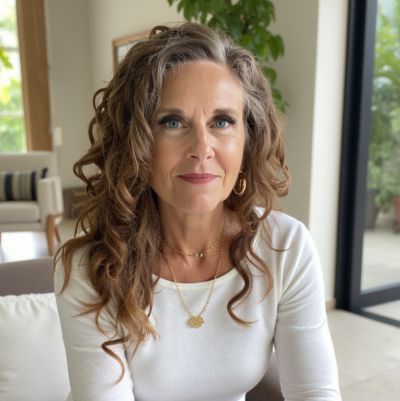
Elizabeth is a Master Certified Life and Health Coach with over 20 years of experience, dedicated to helping women in midlife thrive through holistic health and wellness. Her personal journey began with a desire to reduce her own breast cancer risk, which evolved into a mission to guide women through the complexities of midlife health, from hormonal changes to mental clarity and emotional resilience.
Elizabeth holds certifications from prestigious institutions such as The Life Coach School, Precision Nutrition, and the American Council on Exercise, as well as specialized training in Feminist Coaching and Women’s Hormonal Health. Her approach is deeply empathetic, blending her extensive knowledge with real-life experience to empower women in their 50s and 60s to build sustainable health habits that last a lifetime.
Recognized as a top voice in women’s health, Elizabeth speaks regularly on stages, podcasts, and webinars, inspiring women to embrace midlife with energy, confidence, and joy. Her passion is helping women regain control of their health, so they can fully engage in the things that matter most to them—whether that’s pursuing new passions, maintaining strong relationships, or simply feeling great in their own skin.