
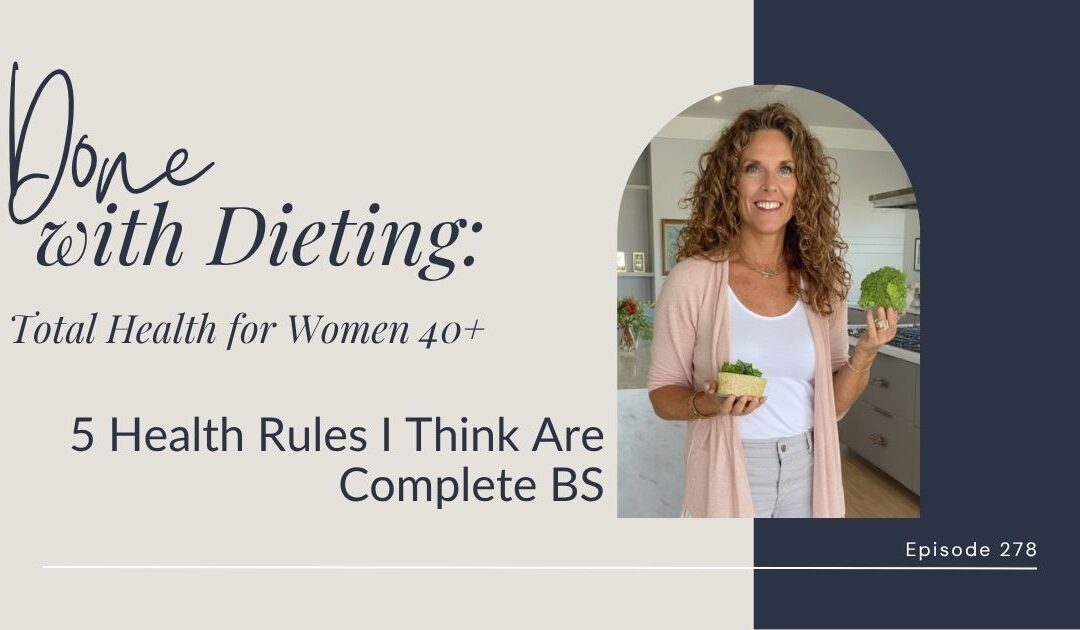
You have probably been following the same health rules for decades. Eat less, move more. Hit your calorie goal. Keep your body guessing. And if none of it is working the way it used to, you have likely been blaming yourself. This episode is here to tell you the rules are the problem, not you.
In episode 278, Elizabeth Sherman calls out five of the most persistent health myths still circulating in midlife wellness spaces, and makes the case for why each one is actively working against women in their 40s, 50s, and 60s. These are not fringe ideas from obscure corners of the internet. These are the rules most of us absorbed before we were old enough to question them, and they are still showing up in articles, on social media, and in the advice women give each other every single day.

This is not a gentle reframe. Elizabeth names the specific rules, where they came from, why they fall apart for midlife women, and what to think about instead. If you have ever done everything right and still felt like your body was not cooperating, this episode is going to explain a lot.
By the end of this episode, you will have a clearer picture of what has actually been getting in your way, and a more honest starting point for what to do next.
The Listener Takeaway: Why This Episode Matters
Most women in midlife are not struggling because they lack information. They are struggling because they are working from a set of rules that were never designed for their bodies, their hormones, or their lives. This episode gives you permission to put those rules down, not as a shortcut, but because they have been misdirecting your energy for years. When you stop trying to make broken rules work, you free up a lot of capacity to focus on what actually does.
The relief in this episode is real and immediate. But it also points to something deeper. Knowing which rules to let go of is a start. Understanding why the right behaviors still do not stick, even when you know what they are, is where the real work begins. That is exactly what Elizabeth walks you through in the free resource linked below.
Are you loving the podcast, but arent sure where to start? click here to get your copy of the Done with Dieting Podcast Roadmap (formerly Total Health in Midlife) Its a fantastic listining guide that pulls out the exact episodes that will get you moving towards optimal health.
Take the Quiz: Why Do Your Healthy Habits Keep Falling Apart? If you've ever wondered why you know exactly what to do but still can't seem to stick with it, this quiz was built for you. In about 3 minutes, it identifies your specific pattern: the real reason your follow-through keeps breaking down, and what to address first. Your results are delivered straight to your inbox.
I am so excited to hear what you all think about the podcast – if you have any feedback, please let me know! You can leave me a rating and review in Apple Podcasts, which helps me create an excellent show and helps other women who want to get off the diet roller coaster find it, too.
Watch or Listen to the Episode:
WHAT YOU'LL LEARN
- Why the 1200 calorie rule is an arbitrary number that has nothing to do with your actual body, your size, your hormones, or your activity level
- How eat less, move more oversimplifies the hormonal and metabolic reality of midlife, and why chronic restriction can work directly against the results you are chasing
- What exercise is actually for at this stage of life, and why using it to burn off food is costing you more than it is giving you
- Why body size is one of the least useful health measures you have access to, and what to pay attention to instead
RESOURCES
- Take the free quiz to find out what is getting in your way
- 8 Habits That Healthy People Do and Why They Don't Stick (free guide)
Full Episode Transcript:
5 Health Rules I Think Are Complete BS
[00:00:00]
Elizabeth: We all grew up with a very specific set of rules about how to take care of our bodies. Eat this, avoid that. Do more of this, push harder at that. And for most of us, we followed those rules, at least some of the time, because they were everywhere. They were prevalent. They were in magazines, in gyms. We heard them from trainers, from our mothers, from the culture we were swimming in before we even knew that we were swimming in it.
But here's what nobody told us: a lot of those rules were never based on solid science. Some of them were never designed for women's bodies who have hormones to begin with, and certainly not our bodies at this stage of life. And a few of them, I'm just gonna say, are complete nonsense that somehow became conventional wisdom.
So today, we are gonna talk about which ones specifically drive me crazy, [00:01:00] where they come from, and what to think about instead. Stay tuned
Welcome to the Total Health in Midlife Podcast, the podcast for women over 40 who want peace with food, ease in their habits, and a body that they don't have to fight with.
Hey, everyone. Welcome back to the Total Health in Midlife podcast. I am your host, Elizabeth Sherman, and I am super glad that you are here with me to help me debunk a bunch of rules that we have about health. So I was scrolling through my Instagram feed the other day and I saw a post from a fitness account that said women should be eating 1,200 calories a day to lose weight.
And I just sat there for just a second because I have been hearing that same number since I was probably, I don't know, 14 years old. 14. And here it is, decades later, still showing up in my feed like it's new information. [00:02:00] And it got me thinking about all of the other health rules that are still circulating out there, the ones that women my age, women your age, have been following for most of our adult lives, rules that we never really questioned because they were just part of the ether. They were just part of the assumptions. They sounded scientific, or because a trainer told us, or because we read them in a magazine in 1984, and they just kind of stuck. Here is what I wanna say about those rules. A lot of them are wrong.
And not kind of wrong, not slightly outdated, but wrong in ways that are actually making it harder for you to feel good in your body right now. And I'm not talking about obscure advice from some random corner of the internet. I'm talking about the rules that are [00:03:00] still being shared, still being recommended, still show up in articles written by people who should know better.
Things that we don't even question. Rules that are parroted. The rules that you probably s- are still following at least a little bit because they are so baked into the way that we think about our health that we don't even notice them anymore. So today, I wanna call out five of them specifically, and I wanna tell you where they came from, why they don't hold up, and what to think about instead.
And not because I want you to feel like you've b- been doing anything wrong, you haven't, b- but because
And not because I want you to feel like you've been doing everything wrong, because you haven't. You have been doing exactly what you were told, and that's part of the problem. These rules were not designed for a woman in her 40s, 50s, or 60s. They were not designed for a body navigating hormonal shifts or a life that is genuinely demanding or a nervous system that [00:04:00] has been running at full capacity for the past 20 years.
They were designed for a much simpler picture of how the human body works, and that picture left out most of what was actually matters at this stage of our lives. So let's go through them, and I think by the time that we're done, you are going to feel a lot less like something is wrong with you and a lot more like you've just been working with the wrong information So let's start with the 1,200 calorie rule because this one has been around so long that most of us just accept it as fact.
Where did 1,200 calories come from? It showed up in diet culture decades ago as a kind of floor, the lowest number of calories that a woman could eat and still technically be getting enough nutrients to function. And somewhere along the way, it [00:05:00] stopped being a floor, and it started being a target, a goal, the number women were supposed to hit if they ever wanted to even possibly think about losing weight.
And I want you to think about how absurd that actually is. Now, I am... I don't know how much I weigh, but I think I'm around 160 pounds. I walk every day. I do strength training. I live an active life. My neighbor might be 110 pounds, mostly sedentary and dealing with a thyroid condition. Are we supposed to be eating the same number of calories?
Because that is what the 1,200 calorie rule is telling us, that every woman, regardless of her size, her muscle mass, her activity level, her age, her hormones, her health history should be eating the same amount of food. That is not nutrition. [00:06:00] That is a random number that got repeated so many times that it started to sound like science.
Here's what actually determines how many calories your body needs. Size matters. A bigger body requires more energy to run than a smaller one, the same way a larger engine uses more fuel. How much muscle you carry on your frame matters because muscle burns more calories at rest than fat does. How active you are matters, and I don't mean just your workouts.
I mean whether you are on your feet all day or you're sitting at your desk. Your age matters because your metabolism does shift over time, though not as dramatically as diet culture would have you believe. And your hormones matter, especially right now when estrogen and [00:07:00] progesterone are doing whatever they are doing on any given day None of that gets captured in a single number.
None of that shows up when you plug your information into MyFitnessPal and it spits out a calorie target. That number is a calculation based on averages and assumptions, and it has no idea what is actually happening inside your body. Now, I wanna be careful here because I do think that there is valuable information in tracking food, but only in a very specific way.
Logging what you eat for a week or two to get a sense of your patterns, to notice where the gaps are, to understand what you're actually eating versus what you think you're eating, that kind of awareness can be really super useful. I've done it myself, and I recommend it to clients. What I do not think is useful is logging every single bite of food for [00:08:00] months on end, trying to stay under a number that a computer assigned to you, and then feeling like you failed on the days where that number turned red.
That is not information. That is just another rule to break and feel bad about. Your body is not a calculator. It is not running a simple equation where calories in minus calories out equals your weight. If it were that simple, every single woman who has ever eaten 1,200 calories a day would have reached her goal weight and stayed there.
We both know that is not what happens. What your body actually needs is enough food to support your energy, your sleep, your mood, your ability to function well in your real life. What that looks like is going to be different for you than it is for the woman next to you. And no app, no rule, no number on someone, no ru- blah- No app, no rule, and no [00:09:00] number someone made up decades ago can tell you what that is.
The second rule that I wanna talk about is eat less, move more. And now this one is a little bit more complicated because I am not gonna stand here and tell you that calories don't matter. Of course, they do when it comes to weight management. The basic principle of energy balance is real. If you are consistently eating significantly more than your body is using, that is going to show up somewhere.
But here is where the rule falls apart. Eat less, move more treats your body like a simple math equation, a simple machine. Put in less fuel, run the engine harder, get a smaller result. And if you were to... And if you were a car, that would work perfectly, but you're not a car. You are a woman in midlife with a [00:10:00] hormonal environment that is shifting in ways that affects everything, your metabolism, your sleep, your stress response, your ability to recover, and your hunger signals, all of it.
And when you take that woman and you tell her to eat less and move more, here's what often happens. She cuts her food down significantly because if someone... because if some is good, then more must be better, right? She adds more cardio on top of an already full week, but then she gets tired, and she's hungry, and she's stressed about hitting her numbers, and her body reads all of that as a threat.
Chronic restriction, meaning eating well below what your body actually needs for an extended period of time, is a huge stressor Your body does not know you are trying to lose weight. It knows it is not getting enough fuel, and it is [00:11:00] working harder than usual, and it responds accordingly. Your cortisol goes up, and elevated cortisol, which is your primary stress hormone, is one of the most reliable blockers of weight loss in women at this stage of life.
It affects where your body stores fat, it disrupts your sleep, and it makes you hungrier, particularly for carbohydrates and sugar, because your body is trying to get quick energy any way that it can. So you end up in this situation where you are doing everything the rule says to do. You're eating less, you're moving more, and the scale is not moving, or it is moving so slowly that it does not feel like it's worth what you are putting yourself through.
And then you blame yourself. You think that you are not trying hard enough, or that you cheated too many times, or that there's something wrong with your body, your body is [00:12:00] just broken. Your body is not broken. The rule is just not accounting for what is actually happening inside of it. And there is another piece to this that I think gets missed completely.
Not all calories do the same thing in your body. A meal built around protein, vegetables, and healthy fat affects your hunger, your energy, and your blood sugar very differently than the same number of calories coming from processed carbohydrates or alcohol. The quantity matters, yes, but so does the quality, and so does the timing, and so does what else is going on in your life that day, week, or month.
A slogan cannot hold all of that. What I want you to take from this is not that you should eat whatever you want and never think about it. What I want you to take away is the idea that [00:13:00] if eat less, move more has not been working for you, then that is not evidence that you are doing it wrong or that you need more discipline.
It is evidence that the rule is too simple for the situation that you're actually in. Your body at fifty or fifty-five or sixty needs a completely different approach than your body did at age thirty-two. The hormonal context is different, and the recovery needs are different, and the stress load is probably different.
And a four-word slogan was never going to be able to account for any of that Okay, so this next one makes me a little crazy, and I say that with love because I know exactly why so many women still believe it. If you were working out in the early 2000s, you probably know the name Tony Horton. He was the trainer behind P90X, which was everywhere for a while.
And one of the things [00:14:00] that he was very convincing about was this idea of muscle confusion, the idea that you needed to constantly vary your workouts, do something different every single day to keep your body guessing, because if you did the same thing repeatedly, your body would adapt and stop responding.
And it sounds plausible, right? And there is a lot of logic to it. It is kind of right. So a lot of women took that idea and ran with it, and some of them are still running with it 20 years later, jumping from program to program, switching things up constantly, never settling into one routine because they are worried that their body is going to start to figure it out and stop working Here's the thing, your body does not need to be confused.
Your body needs to be challenged, and those are not the same thing. Progressive overload, meaning gradually increasing the demand that you are placing [00:15:00] on your body over time, whether that's more weight, more reps, better form, more range of motion, that is what actually creates change. You do not need a completely different workout every Tuesday to make that happen.
You need to show up consistently and ask a little more of yourself over time. That's it. But what I wanna take this ev- but I wanna take this even further because I think that for women at this stage of life, the more important question is not, how do I keep my body guessing? The more important question is, what do I actually want my body to be able to do?
Because here is what I hear from women in my world. They want to be able to carry their groceries in from the car in one trip. They want to be able to get up off the floor without making a sound that concerns everyone else in the room. They wanna travel, to walk around [00:16:00] a city for hours, to climb stairs without their knees complaining.
They wanna be able to lift a 40-pound bag of dog food or swap out a five-gallon water jug by themselves. I live in Mexico, and we use those large bottles, and I want to be able to change that thing without asking for help every single time. Those are real goals. Those are specific physical things that matter in my life daily.
And when my client gets clear on what she actually wants her body to be able to do, then the next question of what exercise to do actually becomes a lot simpler. Do something that supports those goals. Do something that you are actually going to show up for. Because here's what I know for certain, a woman who has been doing the [00:17:00] same workout she genuinely enjoys three or four times a week for the past two years is in better shape than a woman who has been cycling through every new program that promises to confuse her body into results.
Consistency with something you like will always win over variety for variety's sake. Find the thing that you will actually do, and then do it regularly. Ask a little bit more of yourself over time. That's the rule
Now, this next one is closely related to eat less, move more, but it deserves its own conversation because I see it show up in a very specific way, and it looks like this. She has a big dinner out on Saturday night, maybe a few glasses of wine, dessert, and the works. And on Sunday morning, she gets up and adds an extra 30 minutes to her workout or she [00:18:00] pushes harder than usual because she is trying to balance the books, right?
The calories in versus calories out books. Or she thinks about going for a walk after dinner specifically to offset what she just ate. Or she skips her rest day because she had an indulgent week and she feels like she needs to make up for it. That is using calories to manage... That is using exercise to manage calories.
And I want to tell you this clearly, that at this stage of life, it doesn't work the way that you think it does, and it costs you more than it gives you. Here's the math problem with it. The number of calories burned during exercise is almost always lower than we think it is. A solid 45-minute workout might burn 250 to 300 calories.
That dinner out was probably closer to 800. The math does not work in our favor here, and [00:19:00] trying to make it work means that we're either overtraining, under-recovering, or both. Ask me how I know. Overtraining for women in perimenopause or menopause is not just ineffective, it's actively counterproductive.
It actually raises cortisol. It disrupts our sleep. It breaks down muscle tissue faster than it can be rebuilt, and it makes us exhausted and irritable in a way that makes every other healthy behavior harder to maintain. But the bigger problem is not even the physiology. The bigger problem is what it does to our relationship with exercise.
The moment exercise does... The moment exercise becomes the thing that you do to earn food or to pay for your choices, it becomes a punishment, and nobody keeps showing up for punishment, at least not long term, not when life gets hard [00:20:00] and you already feel depleted. Exercise at this stage of life has to have a different job.
We need it to manage stress, which as we just talked about, is one of the most important things that you can do for your hormonal health right now. It builds and maintains muscle, which protects your metabolism and your physical independence as you age. It supports bone density, which matters more every year after the age of 40, and it improves your sleep, your mood, and your energy in ways that nothing else quite replicates.
That is an enormous job, and that is a job worth showing up for, but it cannot do that job and also function as a calorie calculator. So you have to pick, and I would like to make the case that letting exercise do what it actually is good at and find a different way [00:21:00] to think about food, and that will get you going so much further than trying to burn off the weekend ever will Now, this last one is one that underlies all the others, because if you trace most of the rules that I've been talking about back to their source, they all lead to this one, and that is the belief that the size of your body tells you something meaningful about your health.
And I wanna be honest with you about something. I am not immune to this. I threw away my scale when we moved here to Mexico, partly because I did not wanna deal with moving it, and partly because I knew that whatever the number was that showed up on it was going to affect my mood in a way that had nothing to do with how I actually felt.
I look in the mirror sometimes, and my first thought is not a kind one, because I've been conditioned my entire life to believe that my body should [00:22:00] look a certain way: smaller, tighter, younger, more like it did 20 years ago. And then I ask myself, you know, who decided that? Who decided what a 57-year-old woman's body is supposed to look like?
Because I can tell you, it was not a 57-year-old woman. It was not someone who has lived in a body through perimenopause, through hormonal shifts, through decades of stress and recovery and real life. It was a culture that has been profiting from women's dissatisfaction with their bodies for so very long, and it has been so effective that most of us absorbed the message before we were old enough to even question it.
Here is what I actually believe about body size and health. When you are eating in a way that supports your energy, sleeping well, moving in a way that feels good and builds strength, managing your stress, paying attention to how your body feels [00:23:00] day to day, your body will find the size that is right for it. For some women, that means losing weight. For some women, it means gaining a little. And for some women, it means staying roughly where they are, but feeling completely different in the body that they already have. But when you make size the goal, you put yourself in a very frustrating position because size is not something that you can directly control.
You cannot decide to wake up ten pounds lighter through effort alone. What you can control is what you eat, how you move, how much you sleep, how you manage the stress in your life. Those are the levers. Those are the things that actually move. And the measures that tell you whether those things are working or not are not a scale. They are in how your energy holds up through the afternoon, whether [00:24:00] you're sleeping through the night, whether your cravings are manageable or feel completely out of control, whether your mood is relatively stable or all over the place, whether you feel strong and capable in your body or like you are running on empty most of the time.
Those are your biomarkers. Those are the things worth paying attention to. And when those are moving in the right direction, your body composition tends to follow. Not always dramatically and not always quickly, but it does follow. The size of your body is not a report card about what a good woman you are.
It is not a measure of how hard you are trying or how much you care about your health. It is one data point among many, and it is probably the least useful one that you have access to So here's where I wanna land with all of this. You have spent most of your adult life following rules about food and exercise [00:25:00] that honestly you did not write, rules that showed up in magazines and fitness videos, in well-meaning advice from people who were themselves just repeating what they had been told, rules that were built for a generic body at a generic age in a s- much simpler picture of how health actually works.
And we all followed them. Of course, we did, because they sounded credible and because everyone around us was following them, too. And because when they did not work, the message you received was that you were the problem, that you did not try hard enough, that you were not consistent enough, that you did not want it badly enough.
That was never true. The rules were not built for you. Seeing that clearly matters. Knowing which rules to let go of is genuinely useful, and I hope today gave you some of that. But I [00:26:00] also know from years of working with women exactly like you that knowing is rarely the part that is missing. You probably already knew somewhere in the back of your mind that 1,200 calories was not the answer.
You probably already suspected that punishing yourself with extra cardio after a big weekend was not moving the needle. You probably already sensed that your body at age 55 needed something different than it did at 35. Knowing has not been your problem for a really long time The part that is harder to sort out on your own is why the behaviors that would actually help you still do not stick, even when you know what they are, even when you genuinely want to do them, even when you have tried more than once.
That is exactly what I put together in my free guide, The Eight Habits That Healthy People [00:27:00] Do and Why They Don't Stick. Now, this is not a list of things to add to your already full plate. It is the eight foundational behaviors that I work on with every single client, and the ones that actually move things, and more importantly, it walks you through why each one tends to fall apart so that you can stop wondering what is wrong with you and start understanding what is actually getting in the way.
You can grab it at elizabethsherman.com/habits. I'll put that link in the show notes so that you do not have to remember it right now, because the goal here is not to just stop following the wrong rules. The goal is to build something that actually works in your real life with your real schedule, in your real body, at this specific stage of your life.
And that starts with understanding why the good intentions keep falling apart. That's the work, and you do not have to figure it [00:28:00] out alone. Thank you so much for spending this time with me today. I will see you in the next episode. Have an amazing day, and I'll see you next time. Bye-bye.
Thank you for joining us on today's episode. If you're feeling overwhelmed by all the health advice out there and looking for something that's straightforward, my Eight Basic Habits That Healthy People Do guide and checklist is just what you need. It breaks down essential habits into simple, actionable steps that you already know how to do.
By following these habits, you'll set yourself on a path to better health, surpassing most people that you know. To get your free copy, just click the link in the show notes or go to elizabethsherman.com/habits. It's an easy start, but it could make all the difference in your health journey. Grab your guide today and take the first step towards a healthier you
Enjoy the Show?
- Don’t miss an episode, follow the podcast on Spotify and subscribe via Apple Podcasts or RSS.
- Leave me a review in Apple Podcasts.
- Join the conversation by connecting with me on Social!


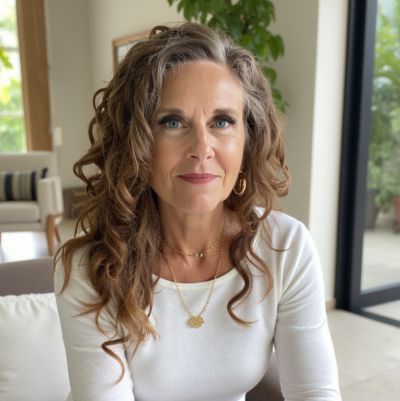
Elizabeth is a Master Certified Life and Health Coach with over 20 years of experience, dedicated to helping women in midlife thrive through holistic health and wellness. Her personal journey began with a desire to reduce her own breast cancer risk, which evolved into a mission to guide women through the complexities of midlife health, from hormonal changes to mental clarity and emotional resilience.
Elizabeth holds certifications from prestigious institutions such as The Life Coach School, Precision Nutrition, and the American Council on Exercise, as well as specialized training in Feminist Coaching and Women’s Hormonal Health. Her approach is deeply empathetic, blending her extensive knowledge with real-life experience to empower women in their 50s and 60s to build sustainable health habits that last a lifetime.
Recognized as a top voice in women’s health, Elizabeth speaks regularly on stages, podcasts, and webinars, inspiring women to embrace midlife with energy, confidence, and joy. Her passion is helping women regain control of their health, so they can fully engage in the things that matter most to them—whether that’s pursuing new passions, maintaining strong relationships, or simply feeling great in their own skin.