
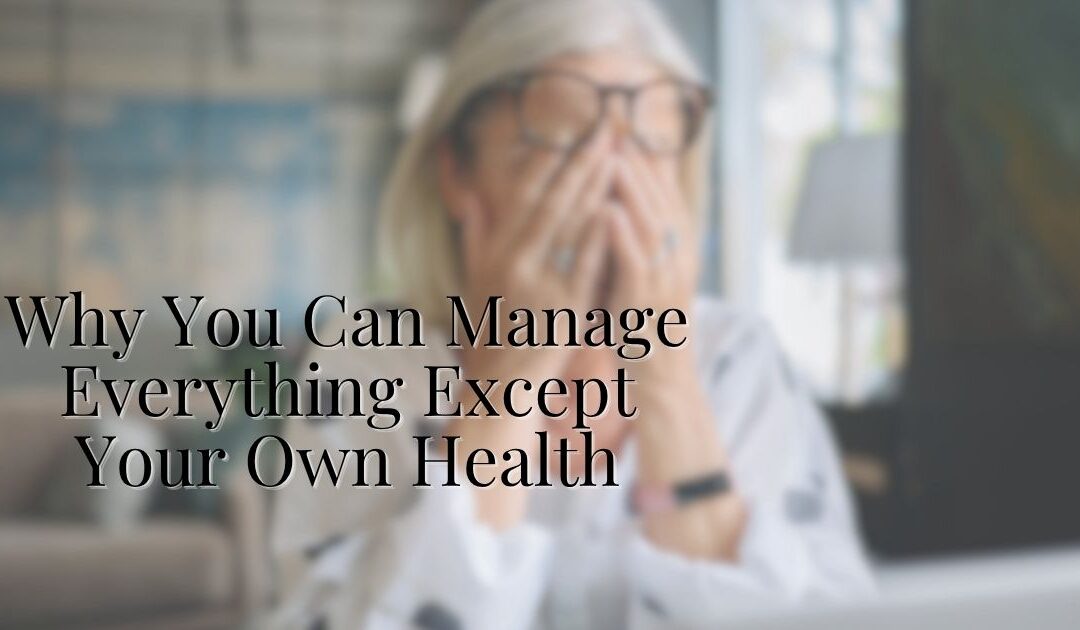
A capable woman's health habits break down because she's spent years absorbing responsibility for other people's problems, until there's no capacity left over for her own.
TL;DR
- Health habits are usually the first thing to go when you're carrying more responsibility than you have capacity for.
- Overfunctioning means solving problems that were never actually yours to solve in the first place.
- Your nervous system treats “one more thing” as a threat, whether that thing is a client emergency or your own doctor's appointment.
- Notice how many of this week's yeses you gave automatically, before you'd checked whether the task was actually yours.
- Adding one more health habit to an already full plate won't fix this. Naming what's filling the plate will.
The Reason You Can Handle Everything Except Your Own Health
You can run a team of twelve, close a deal after your kids are asleep, and remember which of your direct reports has a sick parent this month. You also haven't been to a dentist in two years, your workouts live in a calendar you don't open, and dinner most nights is whatever survives the drive home.
If you're waiting for that to start making sense, I want to save you the wait. You've spent years absorbing responsibility for other people's problems, their deadlines, their moods, their logistics, until there's no capacity left over for your own. That's what happens when the responsibility you're carrying exceeds what any one person has room for.
What Overfunctioning Actually Looks Like
Overfunctioning doesn't look like failure from the outside. It looks like the person everyone counts on: the one who remembers what the babysitter needs to know, who catches the tension on the team before it becomes a real problem, who fields the call nobody else wants to take, and who says “I've got it” before anyone finishes asking.
Picture an operations director running a team of forty, who also keeps a running list in her head of everyone else's open items: her assistant's, her boss's, her sister's. She'll tell you she's organized. What she's actually doing is carrying a second, unpaid job: tracking and solving problems that were never hers to solve, layered on top of the ones that are.
That second job doesn't show up on a calendar. It shows up as the reason her own health keeps sliding to next week.
Overfunctioning doesn't look like failure. It looks like the person everyone else relies on, right up until her own health quietly falls off the list.
The Capacity Math
Time management culture will tell you the fix is a better calendar. The real constraint is capacity: how much responsibility a person can carry before the system carrying it starts to fail.
Research on the invisible half of running a household and a career, the planning, anticipating, remembering, and monitoring, finds this work falls disproportionately on women, even in dual-income households where the physical chores are split evenly. That planning work carries its own tax: more stress, lower wellbeing, and less bandwidth left over for anything else (Reich-Stiebert et al., 2023).
Layer chronic stress on top of that, and the body keeps a running tab. Researchers call it allostatic load: the cumulative wear on a system that never fully gets to stand down (Guidi et al., 2021). Your body doesn't ask whether the demand came from a board meeting or a broken dishwasher. Capacity is capacity, and it's finite for everyone, including the person who's never once said “I can't handle this.”
Your body doesn't distinguish between the deadline that isn't yours and the doctor's appointment you canceled to make room for it. Capacity is capacity.
Curious where your own capacity is actually going this season, versus where you assume it's going?

Why Your Health Is the Thing That Goes
When capacity runs out, something has to give. It's rarely the client deadline. It's rarely your kid's school pickup. Those have someone else's name attached: a specific person who will notice if you don't show up.
Your own health doesn't carry that same social weight. No one calls when you skip your own checkup. Nothing breaks visibly when you eat standing at the counter for the third night running. So it's the first thing that gets quietly moved to “later,” and later rarely arrives.
This shows up clearly in caregiving research. People under sustained time pressure and emotional strain consistently report neglecting their own health, not from indifference, but because there's genuinely nothing left after everyone else's needs are handled (Baik et al., 2026). The same mechanism plays out for anyone overfunctioning at work or at home. You've been solving everyone else's problems first for so long that you stopped checking what your own body actually needed.
There's also a cost to carrying unfinished obligations that has nothing to do with the hours they take. Research on attention and task-switching shows that an unfinished commitment, a promise you made, a problem you're still quietly tracking, keeps drawing on your mental bandwidth even after you've moved on to something else (Leroy, 2009). If you're holding three other people's open loops in the back of your mind, there's less of you actually present for your own workout, your own meal, your own sleep, even when you're technically off the clock.
You've been solving everyone else's problems first for so long that you stopped checking what your own body actually needed.
Seeing This Clearly Isn't the Same as Changing It
Naming the pattern doesn't automatically undo it. Knowing that you're overfunctioning doesn't make it easier to say no to the next ask, especially when saying yes has been the thing that made you reliable, promotable, and needed for the last twenty years.
If overfunctioning shows up hardest in your closest relationships specifically, a partner, adult kids, aging parents, that's its own conversation, one I get into in Episode 243, High-Functioning Co-Dependency.
What follows is a way to see the pattern clearly, not a boundary-setting script to implement on your own this afternoon.
How to Recognize Overfunctioning Before It Costs You Your Health
- Today: Notice one moment you said yes before you'd finished hearing the whole ask. Just notice it. Don't change anything yet.
- This week: Before you agree to solve something, ask yourself one question first: is this actually mine to carry?
- This week: Track what falls off your list the moment things get hard. If it's always the same thing, your workout, your appointment, your own meal, that's data, not a coincidence.
- Next week: Take the free quiz to see the fuller pattern: where your capacity is actually going, versus where you assume it's going.
A Quick Capacity Audit
Sit with these. No need to fix anything yet, just answer honestly.
- Of the last five things you agreed to handle, how many were technically someone else's to solve?
- When did you last say no to something you had every right to say no to?
- What's the most recent health commitment you canceled to handle someone else's problem instead?
- Whose problem are you currently carrying in your head right now that isn't actually yours?
What Happens Once You Can See It
You didn't get here because you're bad at this. You got here because you've spent years being excellent at everyone else's problems, and excellent has a cost nobody mentions until the bill comes due.
Seeing the pattern clearly is not the same as knowing how to change it. That gap is where most capable women get stuck.
Seeing this clearly is the first move. Figuring out where your specific capacity is actually going, and what's realistic to shift first, is what the quiz is built to help you see. If you'd rather listen than read, Episode 285 covers this same pattern in more depth, including where it tends to show up first.

Take the Free Quiz
Find out what's actually running your capacity. Click here to take the Quiz
Frequently Asked Questions
Work comes with external deadlines and other people watching. Your own health rarely has either, so it's the first thing to go when your capacity runs out.
Overfunctioning means consistently taking on responsibility for problems, decisions, or emotional labor that were never actually yours to carry, often so automatically it stops feeling like a choice.
Competence at solving other people's problems doesn't come with a matching budget of time or energy for your own. The more reliable you are for everyone else, the less capacity is left over for you.
They're related but not identical. Being at capacity means you have no bandwidth left. Burnout is often what happens after that condition goes unaddressed for long enough.
Saying yes has likely been the thing that made you reliable, promotable, and needed for years. Saying no can feel like risking that identity, even once your capacity has already run out.
Everything else on your list has someone else's name attached to it. Your own health rarely has an external deadline or a person waiting on it, so it's the easiest thing to quietly postpone.
For most of your life, being needed and being valuable have felt like the same thing. Putting yourself first can feel like breaking a rule you never consciously agreed to. Rebuilding that trust in yourself is its own skill, one I write about in the Skill of Self-Trust.

Elizabeth is a Master Certified Life and Health Coach with over 20 years of experience, dedicated to helping women in midlife thrive through holistic health and wellness. Her personal journey began with a desire to reduce her own breast cancer risk, which evolved into a mission to guide women through the complexities of midlife health, from hormonal changes to mental clarity and emotional resilience.
Elizabeth holds certifications from prestigious institutions such as The Life Coach School, Precision Nutrition, and the American Council on Exercise, as well as specialized training in Feminist Coaching and Women’s Hormonal Health. Her approach is deeply empathetic, blending her extensive knowledge with real-life experience to empower women in their 50s and 60s to build sustainable health habits that last a lifetime.
Recognized as a top voice in women’s health, Elizabeth speaks regularly on stages, podcasts, and webinars, inspiring women to embrace midlife with energy, confidence, and joy. Her passion is helping women regain control of their health, so they can fully engage in the things that matter most to them—whether that’s pursuing new passions, maintaining strong relationships, or simply feeling great in their own skin.