
You made a plan on Sunday. It looked good on paper. By Wednesday it was gone, and you spent the rest of the week wondering what is wrong with you.
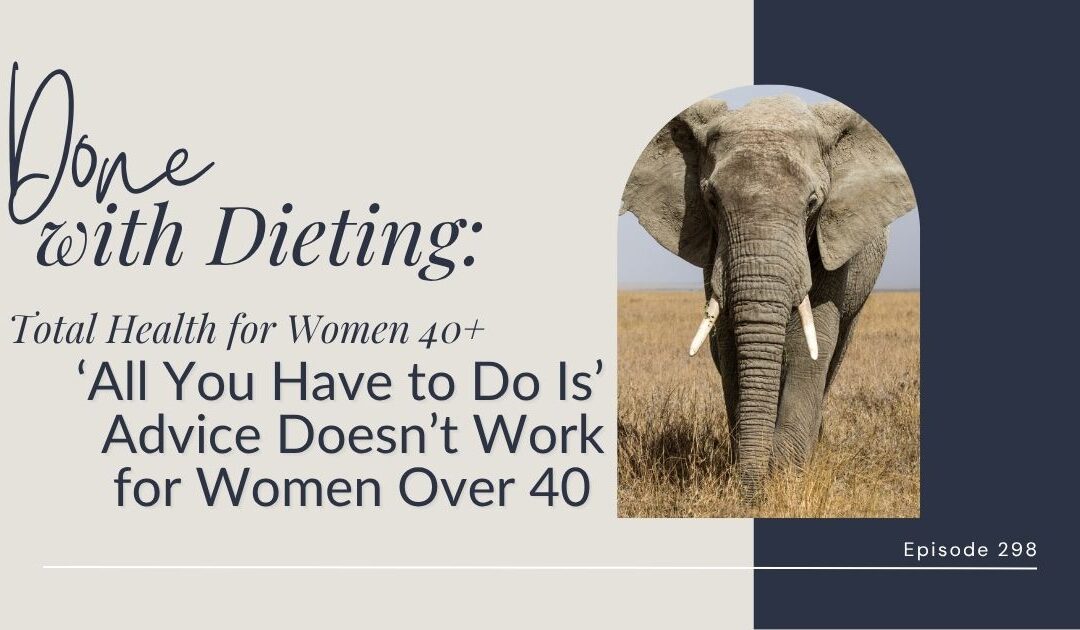
I just got back from vacation on an African Safari, where I watched an elephant walk into a giant baobab tree in Tanzania and strip it of bark and wood. We saw other big trees the elephants had destroyed, and elephant footprints pressed right into the tire tracks of the dirt road. I couldn't stop thinking about it, because it showed me exactly why so many women in midlife can't stick to their health plans. It also reminded me of a framework from the book Switch by Chip and Dan Heath. This is the first time I'm teaching it on the podcast.

In this episode, I explain why your emotions drive your behavior much more than you think. I also explain why "all you have to do is" advice leaves out most women over 40, and why an open slot on your calendar doesn't mean you have room for one more thing. I share how I struggled to get back to work after the trip, and the small changes I made to my exercise clothes and my Sunday salad prep so my mornings and lunches take almost no thought.
There's one question I ask after a day that didn't go to plan, and it works better than any habit tip you can google. I also share the story of a client who told me she should be able to do this on her own, and what it cost her to wait three years to ask for help.
The Listener Takeaway: Why This Episode Matters
When you skip the walk or reach for the wine at the end of a long day, it's easy to decide you're lazy or that you just didn't want it enough. This episode gives you a more accurate explanation. You were tired or overwhelmed, and your plan didn't account for how you'd feel at 6 PM on a Thursday. Once you see that, you can stop spending your energy on self-criticism.
You'll also leave with a question that points you toward a specific change you can make this week, like laying out your exercise clothes or prepping your lunch ahead of time. And if you've been telling yourself you should be able to handle this alone, you'll hear why getting help sooner means you start making progress sooner.
Are you loving the podcast, but arent sure where to start? click here to get your copy of the Done with Dieting Podcast Roadmap (formerly Total Health in Midlife) Its a fantastic listining guide that pulls out the exact episodes that will get you moving towards optimal health.
Take the Quiz: Why Do Your Healthy Habits Keep Falling Apart? If you've ever wondered why you know exactly what to do but still can't seem to stick with it, this quiz was built for you. In about 3 minutes, it identifies your specific pattern: the real reason your follow-through keeps breaking down, and what to address first. Your results are delivered straight to your inbox.
I am so excited to hear what you all think about the podcast – if you have any feedback, please let me know! You can leave me a rating and review in Apple Podcasts, which helps me create an excellent show and helps other women who want to get off the diet roller coaster find it, too.
Watch or Listen to the Episode:
WHAT YOU'LL LEARN
- Why you can follow your plan for days and then drop it at 7 PM, and what you were feeling right before you did
- Why "all you have to do is" advice doesn't work for women over 40 who are carrying a full plate at home and at work
- The one question to ask after a skipped walk, an extra glass of wine, or a night of scrolling, so you can find a fix that fits your actual week
- Why trying to figure this out alone for years keeps so many women stuck, and what a free 30-minute diagnostic call can help you see
RESOURCES
- Switch: How to Change Things When Change Is Hard by Chip and Dan Heath
- Free 30-minute diagnostic call with Elizabeth:
- 181: Reducing Friction - If the exercise clothes packs and Sunday salad prep in this episode got you thinking, this one walks through more ways to make healthy habits easier to do.
- 286: How Running on Empty Wrecks Your Ability to Stick to Your Health - This goes deeper on what happens to your follow-through when you're depleted, which is exactly when your plan falls apart.
Full Episode Transcript:
298 - ‘All You Have to Do Is’ Advice Doesn’t Work for Women Over 40
Elizabeth: [00:00:00] So you made a plan, you wrote it down, and then by midweek it was just all forgotten and abandoned. And then you spent the rest of the week telling yourself, "Gosh, I should have stuck with it. Why didn't I?" But what if you couldn't have possibly stuck with it? Now, I just got back from a trip to Africa, where I watched an elephant walk into a giant tree called a baobab tree and just tear it apart.
First it was the bark, and then it was the wood, and then later on a dirt road, I saw these elephant footprints pressed right into the dirt road, and I really haven't been able to stop thinking about it.
Because that elephant explains why we don't walk after work on a day that we said that we were going to. It explains the glass of wine and scrolling on the couch. And once you see it, you can stop asking, "What [00:01:00] is wrong with me?" And you'll ask a much better question instead. So today, I am teaching you a framework that I learned years ago, and I realized that I never shared it on this podcast.
And by the end, you'll know exactly what to ask yourself on the days that your plan just falls apart. So stay with me for this one
Welcome to the Done with Dieting Total Health for Women over 40 podcast, the podcast for women who are done with the start over cycle and ready for a way of taking care of themselves that actually works.
Hey, everyone. Welcome to the Done with Dieting podcast, the podcast for women who are over 40 and who want to take better care of their health. I am your host, Elizabeth Sherman, and I am so super glad that you are here. Now, I just got back from a safari in Africa, and I cannot stop thinking about the elephants.
They are just so cool. So we were in [00:02:00] Tanzania, and we saw a lot of them really up close. We saw one elephant walk up to this giant tree called a baobab tree and step right into the hollow at the trunk of the base, and it stood there, and it just stripped the tree of all of its resources. First it was the bark, and then it was the inside of the tree, just pulling it apart.
And that wasn't the only tree. Everywhere we drove, we saw these huge, massive trees that the elephants had just destroyed. Some were hollowed out, and some were just stripped of their bark. Some had other... Others had already collapsed from being ravaged. It was just so overwhelming. These trees had been there for such a long time, like hundreds of years, and elephants could do that much damage.
Then one day, I noticed the footprints in the road. We were [00:03:00] driving on this dirt road, the kind that's used for guides so that they can get through the park easily, and pressed right into the tire tracks were these just enormous elephant footprints.
They were big and round. And the elephants go where they wanna go, whether there's a road there or not. And I kept thinking about my clients, and honestly, about me as well. Generally, all of us humans. Because here's what happens. You make a plan, so you're gonna go for a walk after work, and you're going to skip the wine.
And on paper, it makes total sense. Then, the evening shows up, and you're wiped out, and all of a sudden the plan gets abandoned. And by the next morning, you're telling yourself, "Oh, you are so weak or undisciplined. You should have stuck with it." So today, I am teaching you a framework that I learned [00:04:00] years ago that bridges the gap between these two topics: elephants and your health.
Stick with me. And I've never taught this on the podcast before, and I'm excited about it because when we were in Africa, I just happened to remember this analogy. And the main thing that I want you to take from this is that your emotions drive your behavior much more than you think. And so once you see this relationship, you can stop spending your energy being mad at yourself, and you can start working with what's actually going on So let me tell you where this idea comes from.
I read this book years ago called Switch: How to Change When Change Is Difficult, and the authors are Chip and Dan Heath, two brothers. It's about why change is so hard and what can make it easier. And when I was in Africa, I realized that I never had taught this topic on the podcast before, so [00:05:00] today is the first time.
Now, the Heaths break the behavior into three different parts. There's an elephant, a rider, and a path. Now, the elephant is your emotional side. It's the part of you that feels tired or stressed or bored or overwhelmed. Your elephant, your emotional side, wants comfort, and it wants it now. Now, the rider is the one that sits on top of the elephant.
The rider is your logical and rational brain. It's the planner. She's the one who says, "I'm gonna walk every day at 5:30," and puts it on the calendar and makes a goal. She can see where you want to end up, and she's good at making a plan to get you there. Now, the path is your environment. It's everything around you, your schedule, your friends, your family, your kitchen, where your workout clothes are, [00:06:00] and how many other people need something from you at 5:30 when you're supposed to be walking.
A path can make the right thing easy, or it can make it a whole lot harder. Now, picture that rider trying to steer an elephant that weighs several tons. She can get it to turn, maybe for a little while, but when the elephant decides where it's going, like into the brush, she is not in control.
It is going to go wherever it wants to go. And this is where so many of us get stuck. We put all of our energy into the rider, thinking that as humans, we are logical, that we're rational, that we need better plans, better goals. Then we're confused when the elephant walks right through them. So we're gonna walk through all three parts, and I'll probably spend the most time on the elephant because that's the part that we tend to [00:07:00] underestimate.
And I'm keeping this about us, women in their 40s and older who are juggling a lot and trying to take care of our health on top of it. So here's what the elephant looks like in real life. You make a plan, and maybe it's a walk after work, maybe it's skipping the wine on your weeknights, but then your day happens.
You had back-to-back meetings, and you ate lunch standing at the counter, if you ate at all, and then someone needed something from you every 20 minutes. And then by 6:00, you are just over it. You're overwhelmed, you're bored, or maybe you're just done. And here's the part that many of us miss. You don't even notice it.
You don't think, "I'm completely worn out." You just find yourself in the kitchen with the pantry door open, wondering, like, "How did I even get here?" If you notice in the moment at all. Or maybe it's pouring a glass of wine or sitting on the couch with your phone, [00:08:00] scrolling, and all of a sudden, an hour is wasted.
Maybe you sat in the car in the driveway for 10 minutes, too tired to go inside, let alone change into your walking shoes. That is the elephant. It's feelings-based. It wants relief, and it generally gets what it wants. For some of us, it's food. For others, it's a glass of wine. For some, it's mentally shutting down and vegging out in front of the TV or a computer game.
And for a lot of us, it's staying up way too late. Now, one version of this is what's called revenge bedtime procrastination, and it happens when your whole day belonged to somebody else, so you stay up until midnight because it feels like it's the only time that feels like yours. You know that you're gonna be tired tomorrow, but you do it anyway.
Then comes the part that hurts the most. And the next morning, you look back and you judge yourself. "I said I was gonna [00:09:00] walk, or go to bed on time, or not eat. Why didn't I just do it? I should have stuck to the plan.
I could have stuck to the plan." You think that you should have, but you weren't lazy or undisciplined. Honestly, you were just exhausted and overwhelmed, and you couldn't do the thing that you said that you would do. And so at 6:00 that night, with how you felt, that walk was never gonna happen. You just can't see that with 20/20 hindsight.
All you see is that you didn't follow through, and so you start criticizing yourself, and that feels awful. And when you feel awful, that's discomfort of pain that the elephant wants relief from even more. Having an elephant doesn't mean that something is wrong with you.
We all have one. It's a big part of how we as humans make decisions, and it's so much [00:10:00] stronger than we give it credit for. We think that because we are human, we are able to use our brains to think and create these elaborate plans, that we will always do rational or non-emotional things. Think back to that huge tree that I mentioned.
It was massive. They can grow up to 40 yards around. This tree had been standing there for a very long time, maybe 200 years, and an elephant walked right up to it and just tore it to shreds. When your elephant decides, it goes through whatever is in the way to get what it wants.
That includes the plan that you made thinking it through on Sunday. That includes the one that you wrote in your planner that looked so good and doable. So the next time you don't follow through, ask yourself, "What was I feeling when I decided not to?" [00:11:00] instead of, "What's wrong with me?" Now, that's where we wanna start.
Next, let's talk about the rider. Now, this is the rational part of your brain that sees the goal and understands the steps that you need to take in order to get to that goal. Now, remember, the rider is your planner, and she's really good at it. If you're probably listening to this podcast, I'm guessing that you're really good at making plans.
You can sit down and map out your whole week. You're gonna walk at 6:00 AM on Mondays and Wednesdays. You're gonna meal prep on Sunday afternoon. No wine on the weekends. Make sure you're in bed by 10. And it all looks pristine on paper, and it makes total sense. So when it falls apart by midweek, you can't figure out why.
You knew what to do. You wrote it all down. It should have worked. So what happened? Part of the [00:12:00] answer is the advice that we've been given. You've heard it a thousand times, "All you have to do is," and I'm putting that in air quotes, "all you have to do is get up earlier. All you have to do is plan your meals.
All you have to do is say no." I want you to notice who says that. A lot of the loudest voices are men in this health and fitness area who have support at home. Someone else is handling dinner and the dentist appointments. They have quiet mental space. For them, all you have to do is really can be that simple, and most of us don't have that support.
We have a lot to keep track of and very little quiet space. And then you look at your calendar and see an opening. Thursday at 5:30 is empty, so you think, "I can just fit in a walk right there." The [00:13:00] logic works. The time is technically there, so you should be able to do it, right? Except an empty slot on your calendar isn't the same as having room in your life.
On that same day, you're also thinking about your mom's doctor appointment, the email from your boss that you haven't answered, what you're going to make for dinner, and the text from your daughter that you read this morning and still haven't replied to. You carry all of it into that 5:30 slot.
The calendar doesn't show any of it, and the plan doesn't include the bad night of sleep either. It doesn't include the friend that needed you or the all-hands-on-deck meeting for the client emergency at 4:15. The rider made that plan from what she could see from her vantage point, an open spot on a Thursday.
She can't see how tired you'll be when you get there. [00:14:00] She's not accounting for life. So when a plan like that falls apart, go back and look at what you left out, your real Thursday. Your rider did her job. She just didn't have all the information because she's not a psychic able to tell the future So let me give you an example from my own life, because I'm not exempt from any of this.
When I got home from Africa, I did not feel like working at all. I had been away. I'd seen just these incredible things, and now I was back at my desk, and getting back to work felt really super hard. And I know how this goes, so I had planned for it. I was expecting it.
I didn't put anything big on my list for those first few days. I gave myself easy things to do. The rider did her job, and yet I still [00:15:00] procrastinated. I was not feeling it. I wasn't motivated. I would sit down to work and end up scrolling social media instead. The plan was easy. It made sense, and my elephant just was not interested in following the plan.
And I'll be honest, in the moment, it really didn't feel like that big of a deal. It felt like I just wasn't getting anything done. And that's how the elephant works. You don't always see it happening. Now, here's what I didn't do. I didn't call myself lazy or unmotivated. I didn't try to force myself through a full day of work, because I've been here before.
I've seen the pattern. Coming back after time away is just part of my process. It takes me a while to get into the swing of things again. So I gave myself time and space, and then I asked myself a [00:16:00] different question. Not, "Why can't I just do this?" But instead I asked, "What can I do? What would move the dial?"
What could I do right now that would make some kind of difference in my business, even if it's a small one? The answer wasn't a huge push. It was doing some passive action that I had been putting off instead of doing massive action. It was busy work that I had been avoiding for the months before. It was nothing exciting, but things that needed to get done.
Mindless enough to keep me engaged so that eventually, I got moving again. Here's what I want you to notice. It wasn't a big win. I wasn't productive the way that I normally measure it, but it was movement, and it was something that my elephant would go along with, and that was enough for those f- first few days.[00:17:00]
Now think about your own life. The same thing happens with your health. You come back from a vacation, maybe it's a sick week, a family emergency, or a brutal stretch at work, and your plan is there. Your elephant just isn't on board. You can fight it, sure. Or you can ask, "What could I do right now that's small enough for my elephant to go along with?"
Now, that question gets you moving, but beating yourself up doesn't. So now let's talk about the third part of the framework, which is the path. The path is your environment or your situation. It's what's around you when the elephant is tired and the rider's plan is absolutely no help. You've probably read the habit advice already.
Put your gym clothes by the front door. Fill your fridge with vegetables. You can Google all of that in about four seconds. And for [00:18:00] sure, it helps. I'm not gonna lie. When your environment is set up to support your goals, it makes the struggle a lot less difficult. Following the plan, following the healthy plan is how we make it easier, but it doesn't solve for the problem of free will.
For many, it doesn't solve the problem entirely, not because the advice is bad, but because it isn't built around their life. So here's the question I ask instead. When I'm at a point where I've made a plan and I'm at the point where I'm deciding not to follow the plan, I ask myself, "What could I have done to make this easier?"
And so I ask it after a day that didn't go the way that I expected it to. And I don't do it to beat myself up. I'm looking for the thing that was in the way. What could have made it [00:19:00] easier for me to follow the plan?
And so let me show you how this has played out for me. I wanted to exercise first thing in the morning. This was years ago that I figured this out. So what I started doing is laying out my exercise clothes the night before, and then when I woke up in the morning, I would change into them the minute I woke up.
Now, that mattered because I used to have two barriers. I had to get up off of my couch when I was drinking coffee, and number two, I had to go change my clothes. By making this change, I now only had one barrier, which was getting my butt up off the couch and going to my exercise space. That really helped, but I wasn't done.
Only recently, probably within the past two years, I used to keep my exercise clothes in separate drawers. Kinda makes sense, right? All of my tops are in one, my sports bras are in [00:20:00] another, and then my shorts were in a third. So I'd still be digging around going from one to the next, trying to figure out what I had and what went together.
But now when I fold my laundry, I put them together in packs. So with each pack, I have one bra, a top, and shorts that go together, and then I stack them in my drawer. So in the morning, I reach in and pull out one pack. That's it. So now I can just grab one pack and then get dressed. It's so super simple. No decisions, no searching, no thinking. I do the same thing with lunch. On Sundays, I prepare everything for my lunch during the week, and when lunchtime comes, I open up the fridge and I just dump it all into a bowl.
It's done in about two minutes. So I want you to notice what I did in each of those cases. I didn't try to feel more [00:21:00] motivated. What I did was I took the decisions out of it so that my tired elephant had almost nothing to push against. What I mean by that is I made the healthy choice the easy choice.
That's what a good path does. It works on the days that you feel great, and it works on the days that you're completely wiped out. And that second part is what matters, because those are the days that the plan usually falls apart. So I wanna invite you to think of one thing that you keep not doing, and then ask yourself, "What could I do to make this easier?"
So I wanna tell you about my client. We did a little work together about three years ago, but she wasn't sold on coaching. And she said to me, "This makes total sense what we're doing, but I should be able to do this on my own." So she went and she tried to do it on her own, [00:22:00] and then three years later she was in the same spot.
She realized that she needed more support. Now, here's what I want you to know about her. She knows all the things. She knows what to eat and how to plan it, and so the rider is not the part that's stuck. So what is getting in her way? Part of it is her capacity. She has a lot going on, like most of us do.
And part of what we're working on with her is her emotions. She's learning to tune into her body and notice what she's feeling. Then she's learning to stay with the uncomfortable feelings without trying to solve them by eating or by checking out. That is the elephant work, and it's really hard to see on your own because from the inside, it just looks like I just didn't do what I said I was gonna do.
And that's why a second set of eyes can really, really [00:23:00] help. So let's talk about that thought for a minute. I should be able to do this on my own. I totally get this. It sounds reasonable. I mean, you're smart, and you handle a lot of things in your life. Of course, you think that you can figure this one out, too, and you can.
But here's what I tell my folks who say this to me: "I should be able to do this on my own." Yes, but you're not. And I'm not saying that to knock you. You have been trying. You've been trying probably more than once. If it were working, you wouldn't still be asking why it isn't. So you have two choices. You can either get help, or you can keep fighting with yourself.
Think about what those three years cost my client. Three years of learning what was actually in her way. Three years of practice sitting with a hard feeling instead of eating through it. [00:24:00] Three years of making progress towards her goal. She can't get those years back, but she's started now, and she is making progress, and that's the part that I want you to hear.
Waiting doesn't make this easier. It delays your progress. So if there's something that you've been telling yourself, you should be able to handle this alone, ask yourself two questions. How long have I been trying? And what has it gotten me so far? Now, if any of this sounds like you, I would love to talk to you.
I offer a free 30-minute diagnostic call. You can sign up at elizabethsherman.com/diagnostic. And on that call, we figure out what's actually getting in your way. We talk about what a normal day looks like for you and where your plans usually fall apart. You don't need to come with a plan. Come with whatever is happening.
Maybe your schedule [00:25:00] has no room in it. Maybe your elephant is wiped out by six o'clock every single night. Either way, you will leave knowing more about what's going on than you did before. And I want you to hear this. Needing help does not mean that you failed. You made your plan on your own with only what you could see at the time.
Your rider does not have the whole picture. That's all that happened. A second person can see what you can't see from the inside. So go to elizabethsherman.com/diagnostic and pick a time. I'll also make sure that that link is in the show notes. Take 30 minutes on a lunch break and see if that's what works.
It's free, and it takes only 30 minutes. And I promise you, I have seen everything. I will not judge you for any of it. I know how much that you've been carrying. The link is in the show notes, too. [00:26:00] So I keep thinking about that elephant standing inside the massive baobab tree. It wasn't angry, and it wasn't trying to cause damage.
It was just doing what elephants do. It wanted something, and it went out, and it got it. Again, that's your emotional side. It's big and strong, and it's not trying to ruin your life. It's just trying to feel better. So here's what I want you to take with you. Your emotions drive your behavior much more than you think.
When you don't follow through, start by asking the question, "How was I feeling?" And then ask, "What could I have done to make this easier?" You've got a rider who can make a plan. Now give your elephant a path that's easy to walk. And if you need help with any of that, you know where to find me. Go to elizabethsherman.com/diagnostic.
So thank you for joining me today on the [00:27:00] Done With Dieting podcast. Have an amazing day, and I will see you next time. Bye-bye.
Hey, thanks for tuning in today. If what we talked about is landing and you're ready to figure out what's actually getting in your way, I would love to invite you to a free diagnostic session with me. It's 30 minutes long, just us, looking at where your specific weight keeps breaking down and where you need support applying what you already know.
You'll leave with a clear picture of what's driving it and what would actually help next. No shame, no macros, no pretending you have infinite capacity, and certainly no lecture about trying harder. Go to elizabethsherman.com/diagnostic to grab your time. I would love to see you on the call
Enjoy the Show?
- Don’t miss an episode, follow the podcast on Spotify and subscribe via Apple Podcasts or RSS.
- Leave me a review in Apple Podcasts.
- Join the conversation by connecting with me on Social!


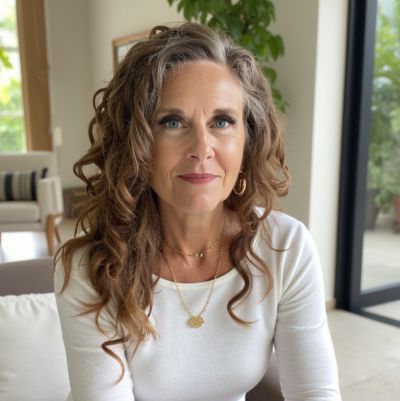
Elizabeth is a Master Certified Life and Health Coach with over 20 years of experience, dedicated to helping women in midlife thrive through holistic health and wellness. Her personal journey began with a desire to reduce her own breast cancer risk, which evolved into a mission to guide women through the complexities of midlife health, from hormonal changes to mental clarity and emotional resilience.
Elizabeth holds certifications from prestigious institutions such as The Life Coach School, Precision Nutrition, and the American Council on Exercise, as well as specialized training in Feminist Coaching and Women’s Hormonal Health. Her approach is deeply empathetic, blending her extensive knowledge with real-life experience to empower women in their 50s and 60s to build sustainable health habits that last a lifetime.
Recognized as a top voice in women’s health, Elizabeth speaks regularly on stages, podcasts, and webinars, inspiring women to embrace midlife with energy, confidence, and joy. Her passion is helping women regain control of their health, so they can fully engage in the things that matter most to them—whether that’s pursuing new passions, maintaining strong relationships, or simply feeling great in their own skin.