

Women avoid vacation photos not because they are vain, but because they are waiting for a body they may never have — and that wait is quietly costing them years of documented memories.
TL;DR
- Know: Hiding behind the camera is a coping strategy. It has a real cost.
- Know: "I'll get in photos when I look better" is a plan that rarely arrives on the timeline you imagined.
- Do: Learn two or four poses that work for your body. This is a skill, not a talent.
- Do: Aim for body neutrality — not body love. Neutral means: my body is here, it is enough for a photo.
- Avoid: Waiting. Every trip you sit out of is a memory you don't exist in.
I have lived in Puerto Morelos, a small beach town on the Riviera Maya, for nine years. In that time, I have watched thousands of vacationers pass through — families, couples, groups of women celebrating milestone birthdays, solo travelers working up the nerve to do something they always said they would do.
And I notice something that happens on almost every beach, at almost every restaurant, in almost every group photo.
One woman offers to take it.
She is not behind the camera because she loves photography. She is behind the camera because if she is behind it, she cannot be in front of it. And if someone does point a camera in her direction before she can get out of the way, she has a line ready: I don't like getting my picture taken.
She says it like it is a personality trait. Like she was born this way.
But here is what I know about that: she was not. There is a version of her — not that long ago, in the scheme of things — who ran toward the camera. Who made a face, or struck a pose, or squeezed into the frame because she wanted to be in it. We see this in children constantly. Nobody has to talk a six-year-old into being in a photo. They are already there, already mugging for the lens, already asking to see themselves.
Something changed. It was not her personality. It was a belief she picked up somewhere along the way: that her body needed to be a certain way before it was acceptable to be documented.
And now she is on vacation in one of the most beautiful places on earth, and she is behind the camera, and everyone else is in the photo.
That is what I want to talk about today.
You Are Not in Your Own Photos. Here Is What That Actually Costs.
Pull up the photos from your last vacation. How many of them include you?
For most women who avoid cameras, the answer is: almost none. A few blurry background shots. One group photo where she is on the edge, partially cropped. Maybe a photo someone took before she could get out of frame.
Her kids are documented. Her husband is documented. The sunset is documented. She is not.
The plan has been: I will get in photos when I look better. That plan is years old for many women. And the part she does not quite say out loud yet is this: she has started to wonder if "when I look better" is going to arrive on the timeline she imagined.
Every trip you sit out of is a memory you don't exist in. Not because you weren't there — but because you were waiting.
The grief here is real, even if she has not named it that. The future moment when she wants to remember this trip and she is not in it. The kids who will look back at family photos and find her mostly absent. She has thought about this. It scares her a little.
This is not a vanity problem. It is a math problem. Time is passing. The avoidance has a cost.
Not sure what is getting in the way for you specifically? The quiz can help you see it more clearly. Take the quiz here.

"I Don't Take Good Pictures" Is Not What You Think It Is
When I started my online business about ten years ago, I had to show up on camera. I needed to take selfies. I needed to produce videos. It was deeply uncomfortable, and I was terrible at it.
I Googled "how to take a selfie." That is a true sentence.
What I did not know — what most women do not know — is that you take somewhere between ten and fifty photos before you get one you like. I thought women just held up their phone, took one picture, and posted it. That is not how it works. Taking photos well is a skill. It has techniques. It involves angles, lighting, where the camera is positioned relative to your body, and whether the person holding the phone knows what they are doing.
Most unflattering photos are a photographer problem or a posing problem — not a body problem. That distinction matters.
I have had multiple photos taken of me on the same day where in one I thought I looked great and in another I looked nothing like myself. Same body. Same day. Completely different photo. The difference was the photographer, the angle, and the light.
What she is actually doing when she says she does not take good pictures is picking her body apart. It is probably not her face. It is her upper arms, her stomach, her hips, her knees. And she believes that if she loses weight, this problem gets solved.
It will not. Women who have lost significant weight still take unflattering photos. There will always be someone who catches you mid-bite at a party. There will always be a bad angle. Losing weight does not teach you how to pose. It does not make you like cameras. The belief that it will is doing a lot of work, and it deserves a closer look.
Three Steps Toward Getting Back in the Frame
These are not rules. They are options. You choose which ones make sense for where you are right now.
Step 1: Do the honest accounting
Pull up photos from your last two or three vacations. Count how many you are actually in. Not as an exercise in shame — as an honest look at what this pattern has cost you over time. This is information. You get to decide what to do with it.
Step 2: Separate the photography problem from the body problem
Most women have never been taught how to be photographed. There are two or four poses that tend to work well for most bodies: angling slightly rather than facing the camera straight on, positioning yourself so the camera is at eye level or slightly above, knowing where to put your hands. These are learnable. A short video search before your trip is a reasonable starting point.
Also: give the photographer some guidance. Ask for photos from slightly above. Move to where the light is better. You are not being difficult. You are solving a solvable problem.
Step 3: Try body neutrality on for size
Body positivity — the idea that you should love your body — can feel genuinely out of reach for many women. I do not promote it as a goal, because for some women it is too far from where they are standing to be useful.
Body neutrality is different. It is not love. It is: my body carried me here. My body let me take this trip. My body is functional and present, and that is enough to be in this photo.
I have spent years living somewhere that has normalized bodies of all sizes for me because women here simply do not have the option to cover up — it is too hot. That shifted something for me over time. You may not have that same environment. But you can start practicing the thought: my body is a good body regardless of its size, and it deserves to exist in photos of my life.
Body neutrality is not loving your body. It is: my body got me here. That is enough for a photo.
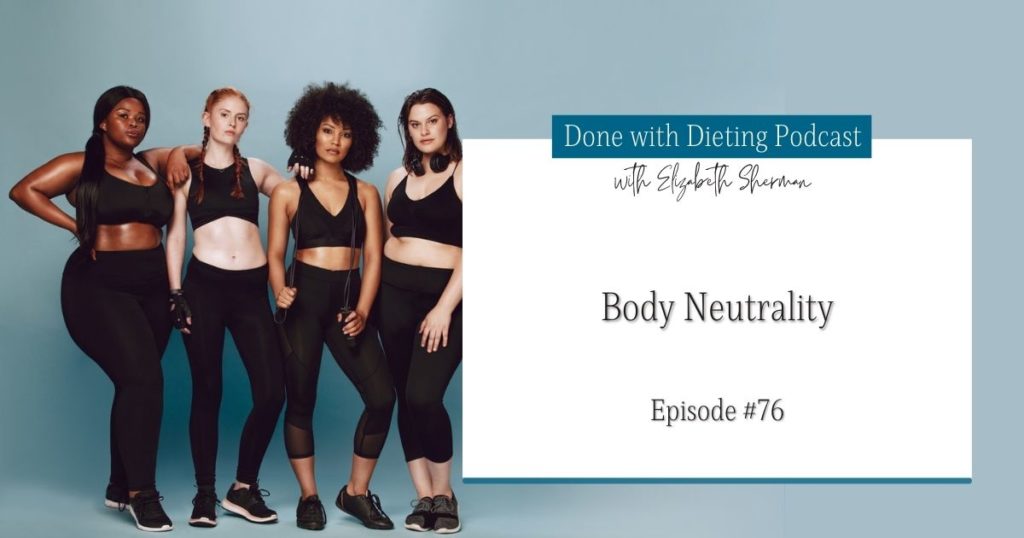
If this is landing for you, my podcast episode on body neutrality goes deeper. Listen here.
What to Do Instead: A Practical Swap Guide
| She avoids… | She could try instead… |
| Handing her phone to someone else before the camera comes out | Saying: "Can you take one of all of us?" and standing in the frame |
| Positioning herself at the back or edge of every group photo | Asking the photographer to shoot from slightly above — more flattering angle for everyone |
| Reviewing every photo immediately and deleting the ones she hates | Letting the photos sit for 24 hours before reviewing — perspective shifts |
| Refusing to be in photos unless she feels ready | Trying body neutrality: "My body got me here. That is enough for this photo." |
| Waiting for weight loss to solve the photo problem | Learning two or four poses and testing them before the trip |
Your Starting Point: Three Micro-Actions
| Today | This Week | This Trip |
| Pull up photos from your last vacation. Count how many you are actually in. | Watch one short video on posing for photos. Practice two or four positions in a mirror. | Choose one moment. Hand someone your phone. Let them take the picture. |
The Question Worth Sitting With
At the end of your life, how much time do you want to have spent thinking about and hating your body?
That is not a rhetorical question. It is worth an honest answer.
Your family does not see your body the way you see it. They see you. They want you in the photos. Your kids want documentation that you were there. Not a thinner version of you. Not a more confident version of you. You, on this trip, in this body, right now.
Your family wants you in the photos. Not a thinner version of you. Not a more confident you. You, on this trip, in this body, right now.
Seeing this clearly is a starting point. It is not the same as being able to close the gap alone, especially if the body image piece has been with you for a long time. That is worth knowing.
If you want to start somewhere concrete, the guide below is a good first step.
The Habits Healthy People Do guide walks you through the eight habits that actually move the needle — and why they tend not to stick. It is free. Download it here.
Frequently Asked Questions
Offering to take the photo is a way to avoid being in it. It is a coping strategy, not a character trait. Most women who do this have a version of the same belief underneath it: my body needs to change before it is acceptable to be documented. That belief is worth examining.
Start with the photography mechanics: learn two or four poses that tend to work for most bodies, understand how angle and lighting affect photos, and give the photographer simple guidance. Comfort in front of a camera is a skill that builds with practice, not a feeling that arrives when you lose weight.
Lens distortion, flat lighting, an unflattering angle, and a photographer who did not know what they were doing can all make photos look nothing like you look in person. This is a real phenomenon. The photo is often not an accurate representation of how you appear in three dimensions.
Body positivity asks you to love your body. Body neutrality asks you to simply acknowledge that your body is functional and present — it carried you here, it allows you to take this trip, and that is enough for a photo. For many midlife women, neutrality is a more achievable and sustainable starting point than love.
Perimenopause and menopause bring body changes that many women find difficult: shifts in weight distribution, skin changes, changes in how clothes fit. Research shows that body dissatisfaction tends to increase during this period. It is also, paradoxically, the period when many women begin to care less about external validation and more about how they feel. Both of those things can be true at the same time.
The first step is noticing that the wait is happening — and asking whether the thing you are waiting for has arrived on the timeline you expected. If "when I lose weight" has been the plan for several years, it is worth asking what you have missed in the meantime and whether you want to keep waiting.
Angle your body slightly rather than facing the camera straight on. Ask the photographer to shoot from eye level or slightly above. Put one hand on your hip or in a pocket to create space between your arm and your body. Turn slightly sideways. These are not tricks — they are how most professional photos are taken.
You do not have to love your body to be in a photo. You only have to decide that your presence in the memory matters more than your discomfort in the moment. That is a much smaller ask. Start with one photo on one trip and see what happens.
Evidence & Attribution
[1] Fredrickson, B.L. & Roberts, T.A. (1997). Objectification Theory: Toward Understanding Women's Lived Experiences and Mental Health Risks. Psychology of Women Quarterly, 21(2), 173–206. https://pubmed.ncbi.nlm.nih.gov/
[2] Tiggemann, M. & McCourt, A. (2013). Body appreciation in adult women: Relationships with age and body satisfaction. Body Image, 10(4), 624–627. https://pubmed.ncbi.nlm.nih.gov/23973393/
[3] Fardouly, J., Willburger, B.K., & Vartanian, L.R. (2018). Instagram use and young women's body image concerns and self-objectification. Psychology of Women Quarterly, 42(3), 332–343. https://pubmed.ncbi.nlm.nih.gov/
[4] Tribole, E. & Resch, E. (2020). Intuitive Eating: A Revolutionary Anti-Diet Approach (4th ed.). St. Martin's Essentials. https://www.intuitiveeating.org
[5] Liechty, T. & Yarnal, C. (2010). Older women's body image: A lifecourse perspective. Ageing & Society, 30(7), 1197–1218. https://www.cambridge.org/core/journals/ageing-and-society

Elizabeth is a Master Certified Life and Health Coach with over 20 years of experience, dedicated to helping women in midlife thrive through holistic health and wellness. Her personal journey began with a desire to reduce her own breast cancer risk, which evolved into a mission to guide women through the complexities of midlife health, from hormonal changes to mental clarity and emotional resilience.
Elizabeth holds certifications from prestigious institutions such as The Life Coach School, Precision Nutrition, and the American Council on Exercise, as well as specialized training in Feminist Coaching and Women’s Hormonal Health. Her approach is deeply empathetic, blending her extensive knowledge with real-life experience to empower women in their 50s and 60s to build sustainable health habits that last a lifetime.
Recognized as a top voice in women’s health, Elizabeth speaks regularly on stages, podcasts, and webinars, inspiring women to embrace midlife with energy, confidence, and joy. Her passion is helping women regain control of their health, so they can fully engage in the things that matter most to them—whether that’s pursuing new passions, maintaining strong relationships, or simply feeling great in their own skin.