
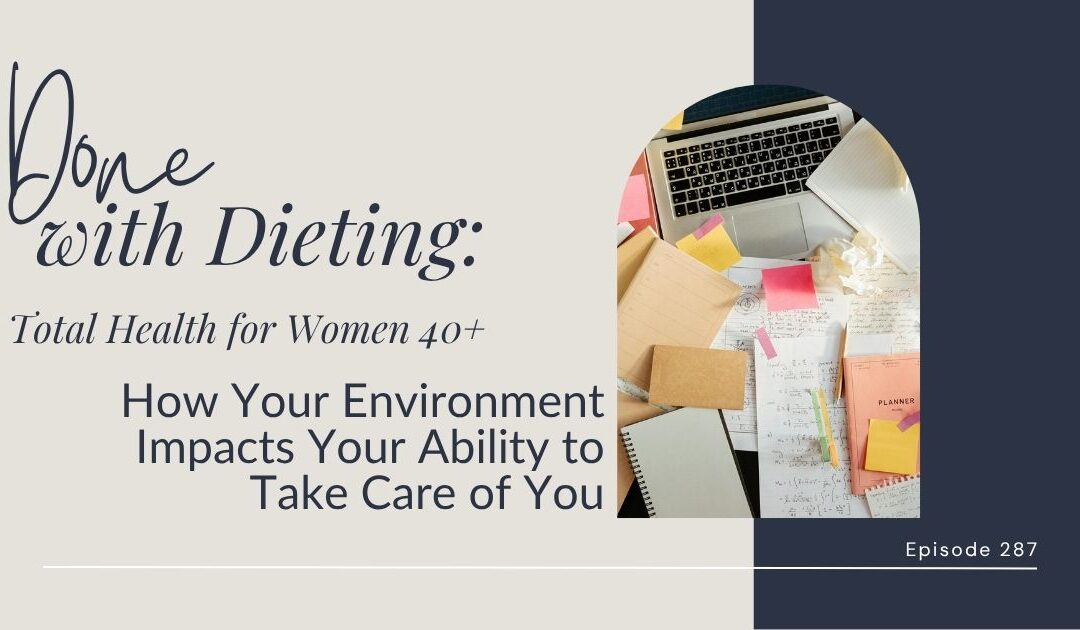
You start Monday with a plan. Eat the vegetables, take the walk, get to bed at a decent hour. And by Thursday it's come apart, and you're standing in your kitchen at night wondering what is wrong with you that you can't just do the thing you already know how to do. If you've been quietly deciding that you're the problem, this episode is going to hand you a very different place to look.
Elizabeth opens with a client who couldn't manage to drink water all day, until she changed one small thing about her setup and the problem disappeared without her trying any harder. From there, she gets into a story about an entire city that dropped its smoking rate sharply without making a single person quit. The thread running through both is the one almost no health advice will tell you: your surroundings are shaping what you do all day long, whether you're paying attention to them or not.
Then she walks through the places this actually shows up in your life. The food within arm's reach and the clutter and noise you've stopped noticing. The partner who comes home with pizza the night you planned to cook, the friend you only ever see over a bottle of wine, the mother you love best over a big plate of food. The schedule that runs you into the ground for everybody but you. This is the layer women are least likely to examine, because we've been taught that our health is a personal responsibility, so when it slips, we point the finger inward.
The honest part, and the reason this episode matters, is that you can't really see your own environment from the inside. It's too familiar. The very things making this hard are the ones you'll walk right past. This episode helps you start seeing them, and points you toward the quickest way to find out which one is costing you the most right now.
The Biggest Problem Midlife Women Face With Healthy Habits
The biggest reason healthy habits fall apart in midlife is not a lack of effort. It's environmental friction. Most women have been taught to treat their health as a private, personal responsibility, so when follow-through breaks down, they assume something is wrong with them specifically. In reality, a woman's environment shapes her health behavior far more than she realizes, across her physical space, her closest relationships, and the structure of her days. When the food that's easiest to reach is the food that undermines her, when the people she loves are tied to eating and drinking and sitting, and when her whole schedule is built around everyone else's needs before her own, no amount of trying harder overrides those conditions for long. The friction is real, it's structural, and it can live in different places for different women. That is why two women with the same knowledge and the same intentions can have completely different results.
What You Can Do Right Now
The first real step is to stop assuming the problem is you and start looking at the conditions you're operating inside. Notice what's within arm's reach in your kitchen at nine at night. Notice whether your space is calm or whether there's a low hum of clutter and noise wearing on you all day. Notice who in your life is connected to the habits you're trying to change, and whether the way you bond with them is built around food, alcohol, or sitting still. Notice how much of your day belongs to other people before any of it belongs to you. You are not looking for things to fix in a single afternoon. You are looking clearly, maybe for the first time, at the setup you've been trying to be healthy inside. And because your own environment is genuinely hard to see from the inside, the fastest way to find your specific pattern is to take the free quiz, which names where your follow-through is actually breaking down and sends the result straight to your inbox.
The Listener Takeaway: Why This Episode Matters
If you've spent years believing you're the reason your health keeps sliding, this episode offers something closer to relief than another plan. You are not missing some amount of grit that everyone else was handed. You've been trying to run your health inside a life that was quietly working against you, and no one ever told you that the setup was fair game to question.
When you stop treating your follow-through as a character flaw and start treating it as a set of conditions you can actually see and change, the whole thing gets lighter. You get to keep the people you love and still take care of yourself. You get to change your surroundings instead of waging war on yourself every single day. And once you can see clearly which piece of your environment is costing you the most, you finally have somewhere useful to start.
RESOURCES
Are you loving the podcast, but arent sure where to start? click here to get your copy of the Done with Dieting Podcast Roadmap (formerly Total Health in Midlife) Its a fantastic listining guide that pulls out the exact episodes that will get you moving towards optimal health.
Take the Quiz: Why Do Your Healthy Habits Keep Falling Apart? If you've ever wondered why you know exactly what to do but still can't seem to stick with it, this quiz was built for you. In about 3 minutes, it identifies your specific pattern: the real reason your follow-through keeps breaking down, and what to address first. Your results are delivered straight to your inbox.
I am so excited to hear what you all think about the podcast – if you have any feedback, please let me know! You can leave me a rating and review in Apple Podcasts, which helps me create an excellent show and helps other women who want to get off the diet roller coaster find it, too.
Watch or Listen to the Episode:
WHAT YOU'LL LEARN
- Why an entire city's smoking rate dropped sharply without anyone being told to quit, and what that has to do with your water and your walk
- The three layers of your environment quietly deciding how hard your healthy habits feel, and which one women almost never look at
- Why changing your social environment can feel like abandoning the people you love, and what to do with that fear instead of ignoring it
- The reason what's in your fridge might be telling you a much older story than you think
- Why you genuinely can't assess your own environment from the inside, and what actually helps you see it clearly
RESOURCES
- Free Quiz: Why Do Your Healthy Habits Keep Falling Apart?
- Episode 283: Your Diet History (companion episode in this series, referenced when we talk about what's stocked in your fridge)
- Episode 285: Your Capacity (companion episode in this series, referenced when we talk about the life built around everyone else)
- Episode 265: "Just Do It" and Why We Don't (the overview episode that introduces all five pillars, including environment)
- Episode 269: The 5 Things Quietly Wrecking Your Health Habits in Midlife (this is where Elizabeth introduces the Total Health Systems Audit, the natural next step after this episode)
- Episode 267: Why Putting Yourself Last Is Making Your Health Worse (goes deeper on the structural layer, the life built around everyone else)
Full Episode Transcript:
287 - Pillar 5: Environment
Elizabeth: [00:00:00] So does this sound familiar? You start Monday with a plan, and by the end of the week, it's come apart and you are standing in your kitchen at night wondering what is wrong with you that you can't just do the thing that you already know how to do. So I wanna tell you about an entire city that cut its smoking rate way down without making a single person quit.
Nobody got a lecture. Nobody had to want it more. The city changed just one small thing, and thousands of people changed what they did, and not one of them had to fight themselves to do it. That story is going to explain something about you, why your follow-through keeps slipping, and why it has almost nothing to do with how hard you're trying.
And by the end of today's episode, you are gonna see the thing that's been sitting right in front of you quietly getting out of your-
And by the end of this episode, you are gonna see the thing that's been sitting right in front of you quietly getting in your way for years. So stay with me.
[00:01:00] Welcome to the Done with Dieting Total Health for Women over 40 podcast, the podcast for women who are done with the start over cycle and ready for a way of taking care of themselves that actually works.
Hey, everyone. Welcome back to Done with Dieting: Total Health for Women Over 40. I am your host, Elizabeth Sherman, and I am so glad that you are here with me today. Thank you for tuning in. So I wanna start today by telling you about a client of mine. So she was a dental hygienist
So I wanna start today by telling you about a client of mine. She was a dental hygienist. She came to me because she wanted to feel better in her body, and one of the things that she kept getting stuck on from my eight habits that healthy people do was that she really was struggling to up her water intake.
Now, if that's you, you are in good company. It's one of the most common things that I hear. You know that you should, you mean to, you intend to, and then the day just gets away from you, and at 4:00 in the afternoon you realize that you've had half a cup of coffee and maybe a sip of water. But here's what was [00:02:00] going on with her specifically.
Because she was a dental hygienist, she wore a mask through much of her shift. All day, patient after patient, the mask stayed on, and every time she wanted a drink, she had to take off her mask, find her glass, take a sip, and put the whole thing back on. So it was just easier if she didn't, not because she didn't care and not because she didn't know that water matters.
She skipped it because pulling the mask off 30 times a day was a pain in the butt, and she was busy. And so it just never happened. So we didn't sit around talking about how badly she wanted it or her barriers or obstacles or anything like that, her mindset. We just looked at her actual day, and here's what she did.
She bought a water bottle with a straw. She could slip it right up under the edge of her mask without taking the entire thing off, and just like that, she [00:03:00] was drinking water all day long. Nothing about her changed. She wasn't a different person on Tuesday than she had been on Monday. She didn't try harder.
She changed one small thing about her setup, and the behavior she'd been fighting with for months just happened on its own without her having to think about it. Now, I want you to sit with that for a second because it's the whole reason for today's episode. We spend so much of our lives believing our health comes down to us, how badly we want it, whether we can make ourselves do the thing when we're tired and stretched thin.
And when we can't make ourselves do the thing, we decide the problem is us, that we are the ones who are broken. But a lot of the time, the reason it's hard is sitting right there in your setup, in your environment, in the conditions you live inside every single day, the ones that you've never stopped to look at because nobody ever [00:04:00] told you that they counted.
And so that's not a flaw in you. You have just been trying to run your health inside of a life, inside of circumstances that were quietly working against you. And so that's what I wanna talk about today, your environment. And I don't just mean your kitchen, although that is part of it, and we will get there.
I mean the whole setup for your life, and how much what you've been calling a personal failing is really just a setup that was never built to support you in the first place. So let me show you what I mean. I wanna name something that you probably already know about yourself.
You are not confused about what to do. You've read the articles. You know you're supposed to move your body, and eat your vegetables, and get to bed at a decent hour, and drink the water. If knowing were the problem, you would have solved this a long time ago. You are a capable woman. You handle hard [00:05:00] things every single day that would flatten other people, and yet here's this one area where you can't seem to be reliable with yourself.
So you start strong on Monday, but then by the end of the week it's come apart and you can't figure out why applying the work won't hold when you want it so badly. So you land where most of us land. You decide that it's you, that you are missing some amount of whatever it is that other people have, a gene.
That some of you... That if you were just a little bit more on top of it, you would be able to keep it together the way everyone else obviously does. And so I wanna offer you a different place to look, because what if the reason it keeps falling apart has almost nothing to do with how hard you're trying?
What if it's sitting in your surroundings, in the way that your days are built, the people around you, [00:06:00] the space you move through, the schedule that runs you from the minute you wake up until the-
The schedule that runs you from the minute you wake up until you drop into bed at night. That water bottle story is the whole idea of today's episode in the smallest and clearest form that I could give you. That's where we're headed. I want to walk you through where this friction actually lives so that you can start to see it in your life clearly, because you can't change something that you can't see.
So let me tell you about something that I watched happen years ago, because it changed how I think about all of this. Now, I used to live in Austin, Texas, and for a while I sat on the Mayor's Council for Physical Health. So I had a front row seat when the city passed a rule that said you couldn't smoke within 15 feet of a building entrance.
You couldn't stand right outside the door with a cigarette anymore. If you wanted to smoke, you had to take [00:07:00] yourself 15 feet away from the doorway. Now, nobody made smoking illegal. You could still smoke in your own home. You could still smoke in your car. Every smoker in that city still had every right to light up whenever they wanted.
Not one thing changed about whether a person was allowed to smoke or not, and smoking rates dropped sharply. And not because people suddenly found more resolve or that that law made them realize that smoking was bad for them. Not because they woke up one morning caring about their lungs more than they had the day before, either.
They quit or they cut way down because the city made it a little bit inconvenient to do it out in the open. That's it. You had to walk away from the door. You had to stand off by yourself. And it turned out [00:08:00] that small amount of hassle, that little bit of friction, was enough to change what thousands of people did.
I think about that... I think about that a lot. Here were people fighting an actual addiction, one of the hardest things there is to quit, and what moved the needle wasn't a lecture or more information or someone telling them that they should try harder. It was a change in the environment around them. The setup shifted, the behavior followed, and nobody had to white-knuckle their way through it. So think about what that means for you and your water and your walk and your vegetables and your bedtime. If moving a doorway 15 feet can change what thousands of people do with a cigarette, imagine what the setup of your own life is doing to you right now quietly every single day without you ever even noticing that it's happening.
That's the real [00:09:00] thing that I want you to take in today. Your environment is shaping your health all the time, whether you're paying attention to it or not. So let's start with the most obvious layer, the one that you can actually see, your physical environment, the rooms that you move through in your house, the space that you live in, the stuff that's around you all day.
Start with the kitchen because that's where everyone seems to start when we're talking about health. You've probably done a version of the kitchen pantry clean-out at some point. You tossed the stuff that you didn't wanna keep eating, you bought new good groceries, and you filled the fruit bowl. And that all helps.
When the food that's easy to grab is food that's good for you, you eat better without much effort. When the only thing in the house at 9:00 at night is a sleeve of cookies, of course you're gonna eat the cookies. And now this isn't a [00:10:00] personality flaw or a character issue. It's what's within arm's reach, what's available.
But your physical environment goes way past the pantry. I want you to think about clutter. If you're living in a space that's crammed and messy and there's stuff on every surface, that is a low hum of stress running in the background of your brain all day long. It's a drain on you, even when you're not thinking about it.
A space that is calm and clear and quiet supports you in a way that's hard to describe until you've felt the difference. Noise, physical noise does the same thing. A house that's loud from morning until night wears on your nervous system, and a worn down nervous system reaches for the quick comfort every single time.
And then there's what's outside your front door. Do you have sidewalks? Is it safe and pleasant to [00:11:00] go for a walk? Or do you have to get in the car and drive somewhere just to move your body? Is there a gym close by, or is the nearest decent option a 40-minute drive away? Is good food easy to get to, or is the closest grocery store a gas station?
None of that is about how much you want to be healthy. It's about how much your surroundings are helping you or fighting you. Now, here's where I wanna slow down, because this is where things get a little interesting. When you look in your fridge and you don't love what you see, it's easy to think that that's a kitchen problem.
Buy better, plan better, and you'll be fine. But a lot of the time, what's stocked in there has less to do with your kitchen and more to do with your history around food, the rules that you absorbed about what you're allowed to eat, [00:12:00] the way that you learned to shop and eat and think about your own hunger going all the way back.
That's a whole separate thing, and I did a whole episode on it. It's episode 283 on your diet history. If what I'm describing is landing, you might wanna go back and listen to that one, too, because your fridge might be telling you a much older story than you realize. But for today, just notice the physical setup, the room, the noise, the distance between you and the thing that you're trying to do
Okay, so the physical stuff is the easy part because you can see it and you can move around it. The next layer is a little bit harder, and it's the one that almost nobody wants to look at. It's your social environment, the people that you surround yourself with, that you work with, that you live with, the people that you love, the people that you've built your whole life around.
So start with your [00:13:00] partner if you have one. You decide that you're going to make the roast chicken and vegetables tonight. You've got it all planned out. You've got it bought. Everything is ready to go. And then they walk in the door at 6:00 PM with a pizza because they knew that you had a long day, and they were trying to be nice.
Now you're standing in the kitchen with your good intentions, a hot pizza, and I don't have to tell you how any of that usually goes. That's not a willpower moment. That's your social environment walking through the door. I had a client, and she came to me wanting to get healthier. She was super smart, motivated, and doing the work, and it took us a while to see it, but her husband was quietly working against her the entire time.
And not on purpose, at least we don't think he was doing it on purpose. But he'd bring home the exact snacks that she told him that she couldn't keep in the house. He'd get a little cool [00:14:00] when she wanted to go for a walk instead of sitting on the couch after dinner with him. Her getting healthier was shifting something in the relationship, and some part of him was pushing back on it, and she had no idea that was even happening until we started to dig in and notice it. She just thought she kept failing. And it goes past your partner, too. I want you to think about your friends. Do you have people in your life you only ever see over a bottle of wine?
People where the whole way you connect is going out and eating too much or sitting at a bar or parking a, or parking it on the patio at- People where the whole way that you connect is going out and eating too much, or sitting at a bar, or parking on the patio all afternoon and not moving. Because if that's how you bond with someone, then changing your health starts to feel like it might cost you that friendship.
Like, what are we even gonna do together if we're not doing that? Who am I to these people if I'm not the one who [00:15:00] orders another round of drinks? I had a client whose main connection with her own mother with food. That's how they loved each other.
That's how they showed love. Big meals, seconds, the two of them eating together past the point of full because that was the closeness that they shared. So when this woman wanted to change how she ate, it wasn't just about deciding new foods. It felt like she was pulling away from her mom, disconnecting.
This is the part I don't wanna skip past because it's the real reason that this layer is so incredibly hard. When the way that you eat and drink and spend your time is braided into your closest relationships, then changing your health can feel like you're abandoning the people that you love, like you're becoming someone they don't recognize, someone who's no fun anymore, someone who thinks [00:16:00] she's better than them now.
The fear is real, and I'm not gonna sit here and pretend that it isn't. But here's the other side of it. When you keep doing the thing that's hurting you just to stay close to somebody, you are abandoning yourself, quietly, a little bit at a time, but in a way that really adds up. And you can feel that, too, even if you've never said it out loud. I'm not telling you to cut people off. That's not it at all. I'm telling you that the people around you are part of your environment, same as your kitchen. And if you've never let yourself look at that honestly, it's worth taking a look at now Now there's one more layer, and this is the least visible of all because it's not a thing that you can actively point to.
It's the shape of your life, your schedule, your commute, who you're taking care of, how your [00:17:00] days are actually built hour by hour. So let's go back to my dental hygienist client for a second. Remember, the thing standing between her and drinking water wasn't that she didn't want to. It was the mask and the glass and the 30 tiny little interruptions a day it took to make happen.
We changed the setup, and the behavior followed. That's the structural layer in its smallest form. The way something is arranged either makes the good choice easy or it makes it an obstacle. Now blow that up to the size of your entire life. Take the gym. If a place that you work out is right on your route home or next door and it has a shower and everything you need, you go because it's easy.
It's built into the path that you're already on. But if getting there means driving across town [00:18:00] in the opposite direction, hauling a bag and rearranging your whole evening, you're probably not gonna wanna go. And it's got nothing to do with how much you care about your body or how much you think exercise is important.
It becomes the friction. You're tired, and the setup asks too much of you. Or let's look at your job. If you work somewhere that makes it okay to take a sick day when you're sick, where the message is, "Go home and rest and come back when you're better," you will do that, and you will recover faster. But if you work somewhere that quietly rewards the person who drags herself in and powers through it, you don't rest because you are a superwoman for coming in when you're sick.
So you push, and you pay for it. And it's not you being bad at boundaries. That's the structure that [00:19:00] you're living inside. And here's the big one for many of us. Your whole life is arranged around everybody else first, everyone else's schedule, everyone else's appointments, everyone else's needs, and they get slotted before yours.
And you take whatever's left, which most days is nothing. You're running around from the second your feet hit the floor, and by the time there's a gap where you could take time for yourself, you are exhausted and running on empty
Now, when you look at all that, it's easy to call it an environment problem. My life is just set up wrong. But a lot of the time, the reason that your life is built around everyone else's runs deeper than just a calendar. It's tangled up with how much you're carrying and why you feel like you are the only one who has to carry it, and what happens inside [00:20:00] you when you try to put yourself on the list.
That's its own conversation. And I gave it a whole episode. It's episode number 285, talking about capacity. If the part about running on empty for everyone else just hit you somewhere, go listen to that one. Now, for today, stay with the structure, the schedule, the commute, and the setup of your days.
So let me pull this all together. Your environment is shaping your health way more than you've probably given it credit for. What's within reach in your kitchen, the noise, the clutter. There's a sidewalk outside your door. The person who walks in with the pizza, the friend you only ever drink with, the mother you love best over a plate of food, the schedule that runs you into the ground for everybody but you.
All of it, all day, quietly deciding how hard or how [00:21:00] easy the thing that you're trying to do is going to be. I wanna be really clear about what I'm not saying here. I'm not saying that this is your fault. You didn't build most of this on purpose. And I'm not saying the people in your life are the bad people, because they're not.
Your partner is not a villain. Your mom loved you the way that she knew how. This was never about pointing a finger at yourself or anyone else. It's just about noticing. Noticing clearly what you're actually living inside so that you can stop calling it a personal failing and start treating it like what it is.
It's your setup, and there's real good news buried in that. Your setup is something that you have a lot more say over than you think. You can't will yourself into being a better person, but you can change your conditions. And when you do, the behavior comes right along with it, the same way it [00:22:00] did for my client with the water bottle. Here's the honest part though. You can't really see your own environment from inside of it. It's the water we swim in, so it feels very normal to you. So much so that it's just the way things have always been, that the very things making this hard are the ones that you will walk right past because you really stopped noticing them years ago. But you kind of need another set of eyes, someone outside of it who can look at your whole setup and point to the thing that you can't see because it's been sitting right in front of you the whole time. That's exactly what the Total Health Systems Audit is designed to do. So if you take one thing out of today, let it be this: when you know exactly what to do and still can't get yourself to do it, that is almost never about you not wanting it enough. Sometimes it's about the [00:23:00] setup or the circumstances that you're trying to do it inside of. Change the setup and doing gets a lot easier. Now, I told you about the Total Health Systems Audit, and it's where we look at your whole environment together and find the thing that you can't see on your own.
But that's a bigger step, and you might not be there yet. So if you're interested, let me give you the small step first. I have a quiz. It's called the Why Do Your Healthy Habits Keep Falling Apart? And it takes about three minutes to do. Think of it as a pre-audit, a quick way to start getting some clarity before you and I ever talk.
Now here's what it does. If you are the woman who knows what she should be doing and just can't seem to make herself do it, the quiz looks at where your follow-through is actually breaking down and names the specific pattern that keeps tripping you up. It's not a generic answer. It's your [00:24:00] pattern, and it lands right in your inbox after you take it so that you can sit with it, read it, and digest it.
You can find it at elizabethsherman.com/quiz, and I'll put the link in the show notes so that you don't have to go hunting for it. Again, it's elizabethsherman.com/quiz. Go take it. See what it tells you because you have spent long enough believing that the problem is you, and I would love for you to start seeing what's really been getting in your way.
That's all I have for you today. Have an amazing day, and I will talk to you next time. Bye-bye.
Hey, before you go, if you are someone who says, "I know exactly what I should be doing, I just don't do it," hey, if that's you, I made something for you. It's a free three-minute quiz that gets underneath that exact problem. Not to give you more information, but to show you the specific reasons your follow-through keeps breaking down, because it's [00:25:00] not the same for everyone.
And once you can see your pattern clearly, everything else seems to change. Head to elizabethsherman.com/quiz. It's free, it's fast, and it's honest
Enjoy the Show?
- Don’t miss an episode, follow the podcast on Spotify and subscribe via Apple Podcasts or RSS.
- Leave me a review in Apple Podcasts.
- Join the conversation by connecting with me on Social!


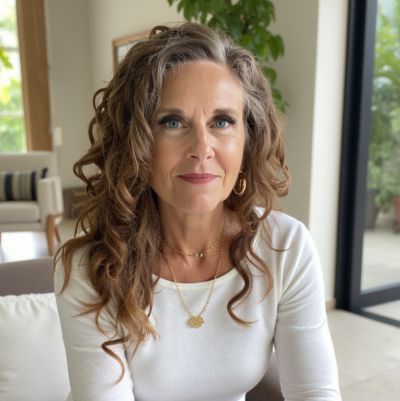
Elizabeth is a Master Certified Life and Health Coach with over 20 years of experience, dedicated to helping women in midlife thrive through holistic health and wellness. Her personal journey began with a desire to reduce her own breast cancer risk, which evolved into a mission to guide women through the complexities of midlife health, from hormonal changes to mental clarity and emotional resilience.
Elizabeth holds certifications from prestigious institutions such as The Life Coach School, Precision Nutrition, and the American Council on Exercise, as well as specialized training in Feminist Coaching and Women’s Hormonal Health. Her approach is deeply empathetic, blending her extensive knowledge with real-life experience to empower women in their 50s and 60s to build sustainable health habits that last a lifetime.
Recognized as a top voice in women’s health, Elizabeth speaks regularly on stages, podcasts, and webinars, inspiring women to embrace midlife with energy, confidence, and joy. Her passion is helping women regain control of their health, so they can fully engage in the things that matter most to them—whether that’s pursuing new passions, maintaining strong relationships, or simply feeling great in their own skin.