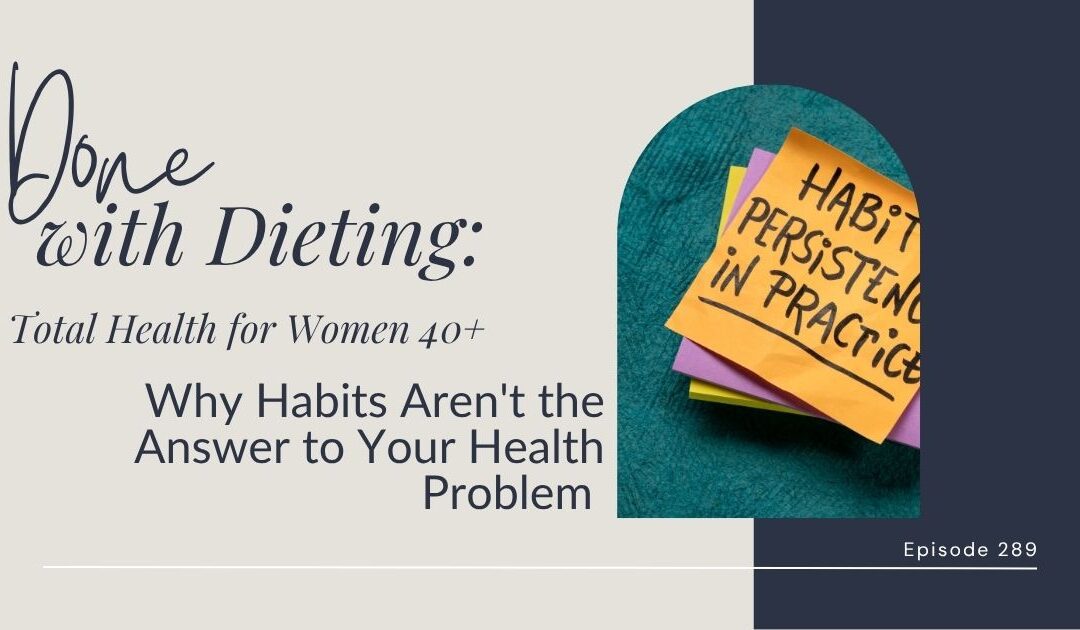
You've cleaned out the pantry. You've laid your workout clothes out the night before. You've followed the plan, more than once, and it still hasn't held. If you've ever wondered why healthy habits don't stick, even when you're doing everything the experts tell you to do, this episode explains exactly why.
In this episode, Elizabeth Sherman breaks down a framework she's used with clients for years, adapted from Neuro-Linguistic Programming's Logical Levels of Change, that explains why some changes hold for good and others quietly fall apart. Most diet and fitness advice only ever touches the top three layers of that framework: environment, habits, and skills. This episode goes underneath that, into the layers that actually decide whether change is permanent.
You'll hear the full story of Elizabeth's client Chris, who lost a hundred pounds and still spent years afraid she'd revert back to her old patterns, the way every previous diet had ended. What let that fear go wasn't another habit. It was a shift much deeper than that.
This episode is for any woman in midlife who feels like she knows exactly what to do for her health and still can't get it to hold. By the end, you'll understand the real difference between protecting a plan and simply becoming someone whose healthy choices take care of themselves.
The Listener Takeaway: Why This Episode Matters
If you've spent years believing that lasting health just requires a better habit or a cleaner kitchen, this episode offers real relief: nothing has been wrong with your effort. You've likely just been working at the layer of change that was never built to hold on its own.
By the end, you'll have language for something you've probably felt for years but never had a name for: the difference between managing a health plan you're constantly defending and simply living as the healthy version of yourself. That distinction alone can lift years of quiet dread about reverting back to old patterns.
Are you loving the podcast, but arent sure where to start? click here to get your copy of the Done with Dieting Podcast Roadmap (formerly Total Health in Midlife) Its a fantastic listining guide that pulls out the exact episodes that will get you moving towards optimal health.
Take the Quiz: Why Do Your Healthy Habits Keep Falling Apart? If you've ever wondered why you know exactly what to do but still can't seem to stick with it, this quiz was built for you. In about 3 minutes, it identifies your specific pattern: the real reason your follow-through keeps breaking down, and what to address first. Your results are delivered straight to your inbox.
I am so excited to hear what you all think about the podcast – if you have any feedback, please let me know! You can leave me a rating and review in Apple Podcasts, which helps me create an excellent show and helps other women who want to get off the diet roller coaster find it, too.
Watch or Listen to the Episode:
WHAT YOU'LL LEARN
- Why building better habits and cleaning up your environment hasn't been enough to make your health changes last, and what's actually missing underneath them
- The six-layer framework, adapted from NLP's Logical Levels of Change, that explains why some changes stick for good and others fall apart
- The identity shift that let Elizabeth's client Chris stop fearing she'd revert back to her old patterns after losing 100 pounds
RESOURCES
- 8 Habits That Healthy People Do, and Why They Don't Stick (free guide): elizabethsherman.com/habits
- Episode 279: 100 lbs Down: A Client Story: elizabethsherman.com/279
- Episode 287: How Your Environment Impacts Your Ability to Take Care of You (elizabethsherman.com/287) - This is the episode that brought the layers framework back to Elizabeth's mind. Go deeper on the layer most people start with and stop at.
- Episode 260: 8 Habits & Why They Don't Stick (elizabethsherman.com/260) - The original breakdown of the 8 habits behind today's free guide, and why knowing them isn't the same as doing them.
- Episode 222: Learning to Trust Yourself with Dawn Ledet (elizabethsherman.com/222) - A deeper look at the beliefs layer from today's episode, and how self-trust gets rebuilt after years of "falling off track."
Full Episode Transcript:
289 - Why Habits Aren't the Answer to Your Health Problem
Elizabeth: [00:00:00] Habits are all the rage right now. Everyone says build the habit, stack the habit, and you are set for life. Or so we're told. Now, I believed that, too, back when I first started personal training and coaching. I thought if I could just get someone to lay their clothes out the night before or clean out their pantry, the rest of their health would automatically take care of itself.
Now, here's the problem. Some of you have done exactly that. You have tried. You have built the habit. You've followed the plan, and it still hasn't held. Maybe you've done it more than once. Maybe you're doing it again right now, and some part of you is already bracing for it to fall apart the way that it always has.
Now, if that's you, there's very likely something happening underneath the habit that no one has told you about, [00:01:00] a reason certain changes stick for good and others that just don't, no matter how hard you work at them. Today, I am working you through exactly what that is. Stick around
Welcome to the Done with Dieting Total Health for Women over 40 podcast, the podcast for women who are done with the start over cycle and ready for a way of taking care of themselves that actually works.
Hey, everyone. Welcome to the Done with Dieting podcast, the podcast that has total health for women over the age of 40. I am your host, Elizabeth Sherman, and thank you so much for spending this time with me today. So I wanna start out with something that confused me for years. When I first started coaching, when I first started getting myself healthy, I was obsessed with habits and my environment.
Like, truly obsessed. I would walk a client through cleaning out her pantry, [00:02:00] getting rid of anything that made overeating easy, and stocking her fridge with real food that she would actually reach for. I'd have her lay out her workout clothes the night before or leave her sneakers by the front door so that the next morning she didn't have to think about it.
She just had to move. And it would work for a while, but then something always seemed to happen. A stressful week, a fight with her partner or her kid, and the whole thing would just fall apart. And not slowly either. It would be rapid fire, like she had never done any of it at all. I had one client who quit smoking for 20 years, like 20 years, and then out of nowhere she picked it back up like no time had passed.
I remember sitting with that and thinking, "This does not [00:03:00] make sense." If habits are the whole story, if it's just about building the right routine and setting up your environment so that the healthy choice is the easy choice, then once you've built it, it should hold, right? Like, it shouldn't just vanish the second that life gets hard.
But it does, over and over with client after client. And for a long time, I thought that it meant that I hadn't found the right system yet, that if I could just build a better habit, a smarter environment, something that would actually hold this time, then I would get it right Here's what I know now that I didn't back then.
There is a whole other layer of change happening underneath your habits and your environment, and if you skip it, the habit and the environment will never stick. You can do them, [00:04:00] but it will feel performative, and as a result, it's likely that it will all fall apart. Now, today, I'm walking you through six layers of change, from the easiest to shift all the way down to the one that actually holds everything else in place.
It's a framework I first came across through neuro-linguistic programming courses that I took years ago, and I've adapted it over time to fit the way that I coach my clients and actually see change happening in real women's lives. And by the end of today's episode, you are gonna understand why cleaning out your pantry and buying new sneakers isn't the same thing as becoming a person who doesn't diet or a person who identifies as healthy or takes care of her body.
And you're gonna hear about one of my clients who spent years afraid that she would revert back to her old habits, no matter how much progress she had made, [00:05:00] until something deeper shifted inside of her. So let's get into it. Now, here's what today's episode is gonna do for you. I'm gonna show you exactly why some changes stick and some changes don't, and it has nothing to do with how hard you're trying.
Now, if you've ever done everything right, you've cleaned your kitchen, you've built a new routine, you stuck with it for months, and then watched it all disappear the second things got hard, I want you to know that wasn't a failure of effort. There is a reason for that, and it's more specific than most of us realize.
Now, here's the thing about being a woman who's good at almost everything. You run a household, and you manage a job, and some weeks, you hold it all together almost by yourself, and then health becomes the one place where you feel like you just can't get it right, where you start over every Monday and quietly wonder, "What is wrong with [00:06:00] me?"
When everyone else seems to have this nailed? So I need to tell you that there is nothing wrong with you, but there is a layer of this that you've probably never taken a look at or anyone has told you to take a look at it. And once you see it, you will understand why some things that you've tried held for a season but then fell apart, and why other changes, once you made them, you never needed to pay attention to it again.
That's what we're getting into today. Six layers starting at the surface and going all the way down to the one that actually decides whether any of it sticks. So I wanna walk you through this framework the way that I actually think about it, because I've made some changes to it over the years, and this isn't something that I invented.
Again, it's adapted from neuro-linguistic programming, specifically what's called the logical levels of change. [00:07:00] I took a few courses years ago. I'm not certified in it, but this framework stuck with me once I heard it, and it gave me this light bulb moment of, oh my gosh, now I understand. Now I understand why habits don't stick for everybody, why they haven't stuck with me in the past. And so what I've done with it is I've actually reshaped it over time to match what I actually see happening in my clients' lives.
So here's what I want you to do. I want you to picture a pyramid, and the pyramid has six different layers on it.
They're all stacked one on top of the other. Now, those things that are at the top of the pyramid, those are the easiest to change, however, they're not especially sticky. The ones at the bottom layer are the hardest to change, but once they take [00:08:00] hold, then everything above it then all of a sudden makes sense. Now, that's exactly backwards from how most of us approach our health. At the very top, we have our environment. This is, for the most part, your physical space. For example, your kitchen, your fridge, what's on your counter, what your house looks like, what's in your gym bag.
It's the easiest layer to change because you can walk into your kitchen this afternoon and throw out every trigger food in the house, and it takes an hour. Now, environment is a little bit more complicated than that because it also extends to your community and your friend group.
Below that, we have our habits and behaviors. Now, these are the things that you repeat. So things like taking your vitamins or exercising on your way home from [00:09:00] work or brushing your teeth right before you go to bed
Still, they're pretty changeable. You can build a new habit in a matter of weeks, and best practices for building new habits is to peg one habit to something that naturally occurs. So an example of that might be when I come home from work, I immediately put on my exercise clothes and get up and go exercise.
Now, below that layer, so we're on layer number three, is skills. Now, this is what you actually know how to do. Can you cook a meal that isn't frozen? Can you read a menu at a restaurant and know what crispy or creamy is gonna do to your body? Can you exercise safely without a trainer standing over you?
Can you tell the difference between being sore and being hurt? Skills take a little bit longer to build than habits, but they are [00:10:00] still learnable. Now, here's the thing about environment, habits and behaviors, and skills.
They all take free will I wanna give you an example.
So let's say that you come home from vacation. You come home from vacation, and there is nothing in your refrigerator that sets you up for success. And so you have built this habit of bringing your lunch to work every single day. But because you don't have anything in your refrigerator, that habit immediately goes away.
Now, you do have the skill to go to a restaurant and order something healthy. You know where you should go and what you should order, but all of that takes free will. That's why environment, habits, behaviors, and skills aren't the answer to everything when it comes to our health. Now, the fourth layer down [00:11:00] is beliefs and values.
Now, this is where it gets a little bit stickier, because beliefs don't feel like beliefs. They feel like facts. What you believe about your body, about food, about exercise, about whether you're the kind of person who can be trusted with your own choices, most of that got installed a long time ago, and it doesn't announce itself as an opinion.
But it feels true. Below that, below beliefs, is identity. This is the layer where you finish a sentence of I am. I am someone who exercises. I am someone who eats when she's hungry, not when she's stressed. I am someone who follows through on what she says she's gonna do for herself. Or on the other side, I am someone who's always been bad with food.[00:12:00]
Identity is the story that you tell yourself about who you are, not just what you do. And then at the very bottom, underneath identity, is purpose. Why you are here on this earth, what your life is for underneath every single role that you play.
Purpose is the thing that matters. The layers at the top are easy to move, but they don't hold everything up. They can seep down because that's ultimately how I started. You can rearrange your kitchen and build a new morning routine, and if nothing underneath has shifted, it's gonna slide right back the moment that life gets hard, right?
Because environment takes work to maintain. But the layers at the bottom, they are really hard to reach. Once you identify as something [00:13:00] or someone, having someone else shift that takes a lot of work They take real work to shift, and once they do move, everything above them reorganizes on its own. You stop having to manage your environment and defend your habits because they're no longer propping themselves up.
They are a result of who you already are. So let's slow down a little bit here, because the top three layers, environment, habits and behaviors, and skills, are almost everywhere in the diet industry.
Almost every diet program, every fitness app, and every wellness quiz on the internet uses these three functions completely. And that's not a criticism about them. It's just where the industry decided to stop, and there's a really good reason for that, because all of [00:14:00] those things can be communicated through doing.
It's really easy to tell you what to do in your environment, what to do to build habits, and what to do in order to create skills. So start with environment. This is your physical space that you're operating in every day. So like I said, your kitchen, your fridge, what's in arm's reach? What is around you?
What's on your counter at night? And when I coach a client on environment, we're talking about getting rid of whatever feels tempting, whatever makes the unhealthy choice the easier one, and setting up the kitchen so that the healthier choice is the easier thing to do. It's about reducing friction to make the healthy thing, the thing that we want to be doing, the easier decision.
And so when she's tired [00:15:00] and not in the mood to think or to function, it's just like, "Here, eat this," and it becomes so much easier. So things like stocking the fridge with vegetables that she actually likes, putting them at eye level instead of in the crisper drawers where produce goes to die, making sure that you have protein that's already prepped, and that something is in the freezer that doesn't require a decision, and snacks that don't set her up to failure.
Now, that is real work, and it matters, but it's also work that you can finish in an afternoon. Now, habits are next. This is where we start pegging one action to another so the next right thing becomes automatic, where you don't have to think about it, instead of a decision that you have to make from scratch every single day.
You lay out your workout clothes the night before, and then when you get up in the morning, you change into them. And the rule is that you put them on first [00:16:00] thing in the morning before your coffee, before your phone, so that there's less resistance to actually going out and exercise.
So you keep your sneakers by the front door instead of in the back of your closet so that when you get home from work, there is no five minutes of hunting for them, and there isn't a window of opportunity for your brain to talk you out of it.
These are small mechanical changes. They're real and they're repeatable, but still just a routine sitting on top of whatever is underneath it. And I think that that is the hardest part about habits. Because once the cue is gone, once the habit gets disrupted, then the result gets disrupted from it as well.
Now, the third layer is skills. Now, this one gets skipped over a lot when it comes to health, but it is a real layer, and I think it's a lot bigger than people think. Can you actually [00:17:00] cook? Do you have knife skills? Can you look at a restaurant menu and know that crispy, fried, seared, and grilled are telling you something very different from creamy or buttery?
Can you do a squat without wrecking your knees, or lunges? Can you run or walk fast without hurting yourself? And do you know how to build a workout for yourself instead of needing someone else to hand you one? We saw this play out in real time during the pandemic when gyms were closed, and suddenly so many people who had been showing up to classes for years had no idea how to move their own bodies without someone telling them what to do.
That is a skills gap, and it's something that you can build at any age once you know what's actually missing. Now, here's what all three of these layers have in common. They are teachable. They [00:18:00] fit in a course. And you can build a 21-day challenge around them. You can sell an app subscription, put them in a nice looking PDF, and every one of them is important and worth doing.
I'm not telling you to skip them. I am not throwing shade at them. But none of them on their own explain why you can do all of this and still watch it fall apart the second life gets difficult. Now for that, we have to go a couple layers deeper. Now the next layer down, we get into beliefs and values, and this is where the work gets a lot harder to see because beliefs don't show up labeled as beliefs.
They show up as facts. For years, I told people, only half joking, that Elizabeth and sweat don't belong in the same sentence. I said it like it was just a fact about [00:19:00] who I was, not something that I had decided, not something that I had picked up somewhere along the way.
It was just true. The same thing with food. I believed I was someone who just- Needed to eat a lot of cookies, that I was not someone who could have just one the way that some people can't just have one drink. I said it about myself constantly, and everyone around me nodded along because it sounded like I was just being honest with myself.
But it wasn't. It was a belief that I had been treating as a personality trait. I didn't start working with clients at this layer until I added life coaching to what I already knew about nutrition and training. Up until that point, I could hand someone a meal plan and a training schedule all day long, and none of it touched what was actually running underneath all of it.[00:20:00]
Here's how you can tell the difference between a fact and a belief, because it's genuinely confusing from the inside. A fact is true for everyone. Gravity doesn't care what you think about it. But a belief only feels true for you or for people who grew up with the same messages that you did. If someone else can hold the opposite view and function just fine, what you're looking at isn't a fact.
It's a belief. So take chocolate is delicious or I just like to eat a lot. Some women genuinely don't struggle with food that way. Some do not like chocolate. Now, I don't know who these people are, but they do exist. That doesn't mean that they're stronger or better. It just means that what feels like a fact about your appetite, your likes, your dislikes, is actually a belief [00:21:00] that you picked up somewhere at some point, probably a long time before you had any say in it.
Same with Elizabeth and sweat don't belong in the same sentence. Plenty of women who look nothing like athletes love how movement feels in their bodies. So that sentence was never a fact about me. It was a belief, and I'd been repeating it for so long that it started to run the show.
This is why the belief layer is harder to shift than habits or skills. You can't just decide to think differently the way that you can decide to lay out your clothes the night before. Beliefs feel like the water that you're swimming in, not like something somebody handed to you.
But once you can see them as beliefs instead of facts, you've already loosened their grip a little bit, and that's the doorway into the next layer down. Now we get to identity, and [00:22:00] this is different from beliefs in a very specific way. Beliefs are what you think is true. Identity is who you are, and over time, identity can change.
Saying, "Exercise is good for me," is a belief. Saying, "I am a runner," or, "I am someone who exercises," is an identity. Identity lives in how you show up in the world day after day without having to reconsider the question first
What I think is important about beliefs versus identity is that when we have truly embodied something, like I am an exerciser or I am a runner or I am a healthy eater, we no longer have to feel like we are proving ourselves to ourself or to others. So I wanna share a story about my client, Chris, [00:23:00] because her story shows this better than I could ever explain it in the abstract.
Now, if you listen to episodes number 279 and 280, you know Chris's story. For years, her pattern was to stop and buy way more food than she needed, bring it home, and eat through the evening long after everyone else in the house had gone quiet and her own body had had enough. As we worked together, she lost 100 pounds.
I know. It's just incredible. Real, sustained, hard-earned change. But here's what almost nobody saw from the outside. The entire time that we worked together, even as the weight came off and stayed off, Chris carried a fear that had nothing to do with failing and everything to do with reverting, waking up one day where she started, buying too much food again, and eating alone at night to quiet something that she didn't have words for.
Now, [00:24:00] that fear made sense because every diet that she had ever tried before had ended exactly in that same way. She'd do the program, get results, and then slowly, predictably slide back to where she had started. So some part of her assumed that this would end the same way all the others had, and this was a long time into her progress, after she had lost 80, 90 pounds.
The fear didn't loosen because she found more resolve or a better meal plan. It loosened because something changed underneath the plan entirely. Now, at some point, actually most recently, Chris stopped saying, "I'm on a plan," and started saying, "I am an exerciser now. I am a healthy eater." Recently she came to me and she said, "I just love walking.
It's what I do [00:25:00] She stopped thinking of herself as someone managing an eating problem and started believing plainly, "I am not an emotional eater anymore." Present tense, not something in progress. That's the whole shift right there. When Chris saw herself as someone protecting a plan, the plan was always one bad week away from falling apart because plans are fragile.
You have to defend them. You have to keep choosing them over and over, especially on the nights when choosing them is the very last thing that you wanna do. But once she was able to see herself as an exerciser, as a healthy eater, as someone who simply is no longer an emotional eater anymore, she wasn't defending anything.
She didn't have to prove herself. She was just being herself. And you don't have to talk yourself into [00:26:00] being who you already are. Maybe you know this feeling yourself. Maybe you've hit a goal before and spent the whole time waiting for the other shoe to drop, bracing for the version of you that always slides back eventually.
That bracing makes complete sense. It's a sign that the shift hasn't happened at this layer yet, and that some part of you is still identifying as someone who does this rather than someone who used to. The question underneath had changed. It was no longer, "Can I stick to this?" It was, "Who am I?" And by then, she already had an answer.
And so this is the layer that most health advice can't touch because you can't put become a different person in a 21-day challenge. It just doesn't work that way. It's the layer that decides whether your habits are [00:27:00] something that you're constantly having to upkeep or just something that you naturally do because of who you've already become.
And so underneath identity is one more layer. It's purpose. And I wanna be honest with you about this one because, like, I coach on identity. I coach on beliefs, skills, habits, environment directly all the time. Purpose is a little bit different. It's quieter, it's more personal than the other five layers, and something that you feel your way into rather than something that I can hand you a framework for, at least at this point.
Here's why so many women in midlife feel completely lost when it comes to purpose. For years, maybe even decades, you have been defined by roles: mother, wife, employee, daughter. These roles gave you a built-in answer to who you are, so you never really had to ask the question directly. [00:28:00] Then the roles started shifting.
Kids grow up and leave. A marriage changes or ends. A career winds down or gets restructured out from under you. And suddenly, you're standing there without the roles that used to answer the identity question for you by default, and purpose feels like an enormous unanswerable thing. But here's the thing, when we have purpose, we can get rid of all of those other pieces, our job, our circumstances, our house, but our purpose never changes.
It's kind of like our beacon of where we're headed. And what I've also noticed is that a lot of women in this position that we're talking about don't actually know what kind of food they truly like, what music genuinely moves [00:29:00] them, what books they'd pick up if nobody was watching, what they'd do with a random Saturday afternoon where no one was around that belonged entirely to them.
And not because they're shallow or indecisive. Because they've spent so many years deferring to everyone else's preferences that their own have gotten buried a long time ago. That's why purpose can't be chased the way that you would chase a habit or a skill. You can't sign up for a purpose boot camp and come out the other side knowing why you're here on this earth.
Purpose just surfaces. It shows up once you've done enough of the identity work to actually know who you are outside of every role that you've ever played. And so once you know that, purpose isn't something that you have to go find. It's just there underneath everything else, quietly telling [00:30:00] you why you're here, and basically telling you your next move.
And I wanna be really clear about one thing before we move on. I don't think that the purpose of any of our lives is to be the healthiest woman in the room. That's never what this layer is about or what I do. What I believe is that health is the foundation that lets you carry out whatever your actual purpose is with a lot less friction along the way. And so here's where I want to leave you. Most of your effort so far has gone into your kitchen and your routines, cleaning out the pantry, building a new morning habit, and that work is real.
It matters. It is important. I'm not taking that away from anyone. But on its own, it was never gonna hold because that's simply not where change settles in for good. It settles in underneath at the level of [00:31:00] what you believe about yourself and who you actually say that you are. I want you to think about my client Chris again.
She could have stayed at that surface level forever, buying the right groceries, following the meal plan, showing up to her workouts, saying the right things to herself in the mirror,
And still spent every single day bracing for the version of her that always came back. What actually let her exhale wasn't another habit. It was the moment that she stopped seeing herself as someone on a plan and started seeing herself as someone who simply is an exerciser, who's a healthy eater, who simply isn't an emotional eater anymore.
The plan disappeared because there was nothing left to prove. And that's the real difference between seeing yourself as a dieter and seeing yourself as a healthy person. A dieter is always either on a [00:32:00] plan or off one, always one bad week away from starting over, forever cycling. A healthy person isn't managing anything.
She is just living, the same way that you don't manage brushing your teeth or locking your front door. It's simply what you do because of who you are. Here's what I want you to sit with this week. It's not a new habit to add and not another routine to build. It's just a question. When you think about your own health right now, which layer are you actually operating from?
Are you still defending a plan, or have you already started becoming someone else? You may not have an answer yet, and that's totally okay. Seeing the layer that you're stuck at is not the same thing as knowing how to move down into the next one.
That part takes real work, and it's something that sometimes we need help with. It's not [00:33:00] work that you're meant to figure out entirely on your own, but seeing it clearly is where every real shift I've ever watched a client make actually started. So thank you for spending this time with me today. I know that there's a lot of places that you could be pointing your attention to, and I do not take it lightly that you have chosen to spend it here with me today. Now, if you want a place to start putting any of this into practice, I have a free guide called Eight Habits That Healthy People Do and Why They Don't Stick.
It walks you through the habits that actually matter, the ones I see hold up again and again with my own clients, and more importantly, it names the specific reasons those habits seem to fall apart for so many of us. If you've been listening today, you already know that that has less to do with the habit itself and more to do with what's happening underneath it, the layers that we just talked about.
So you can grab the guide at [00:34:00] elizabethsherman.com/habits, and it only takes a few minutes to read. If this episode gave you a new way of thinking about your own health or about anyone in your life who's been trying to hold onto a plan through sheer effort for years, I would love it if you shared it with her.
That's how this show grows, one person telling another person who needs to hear it. That's all I have for you today. Have an amazing day, and I will see you next time. Bye-bye.
Thank you for joining us on today's episode. If you're feeling overwhelmed by all the health advice out there and looking for something that's straightforward, my 8 Basic Habits That Healthy People Do guide and checklist is just what you need. It breaks down essential habits into simple, actionable steps that you already know how to do.
By following these habits, you'll set yourself on a path to better health, surpassing most people that you know. To get your free copy, just click the link in the show notes or go to elizabethsherman.com/habits. It's an [00:35:00] easy start, but it could make all the difference in your health journey. Grab your guide today and take the first step towards a healthier you
Enjoy the Show?
- Don’t miss an episode, follow the podcast on Spotify and subscribe via Apple Podcasts or RSS.
- Leave me a review in Apple Podcasts.
- Join the conversation by connecting with me on Social!


Elizabeth is a Master Certified Life and Health Coach with over 20 years of experience, dedicated to helping women in midlife thrive through holistic health and wellness. Her personal journey began with a desire to reduce her own breast cancer risk, which evolved into a mission to guide women through the complexities of midlife health, from hormonal changes to mental clarity and emotional resilience.
Elizabeth holds certifications from prestigious institutions such as The Life Coach School, Precision Nutrition, and the American Council on Exercise, as well as specialized training in Feminist Coaching and Women’s Hormonal Health. Her approach is deeply empathetic, blending her extensive knowledge with real-life experience to empower women in their 50s and 60s to build sustainable health habits that last a lifetime.
Recognized as a top voice in women’s health, Elizabeth speaks regularly on stages, podcasts, and webinars, inspiring women to embrace midlife with energy, confidence, and joy. Her passion is helping women regain control of their health, so they can fully engage in the things that matter most to them—whether that’s pursuing new passions, maintaining strong relationships, or simply feeling great in their own skin.