
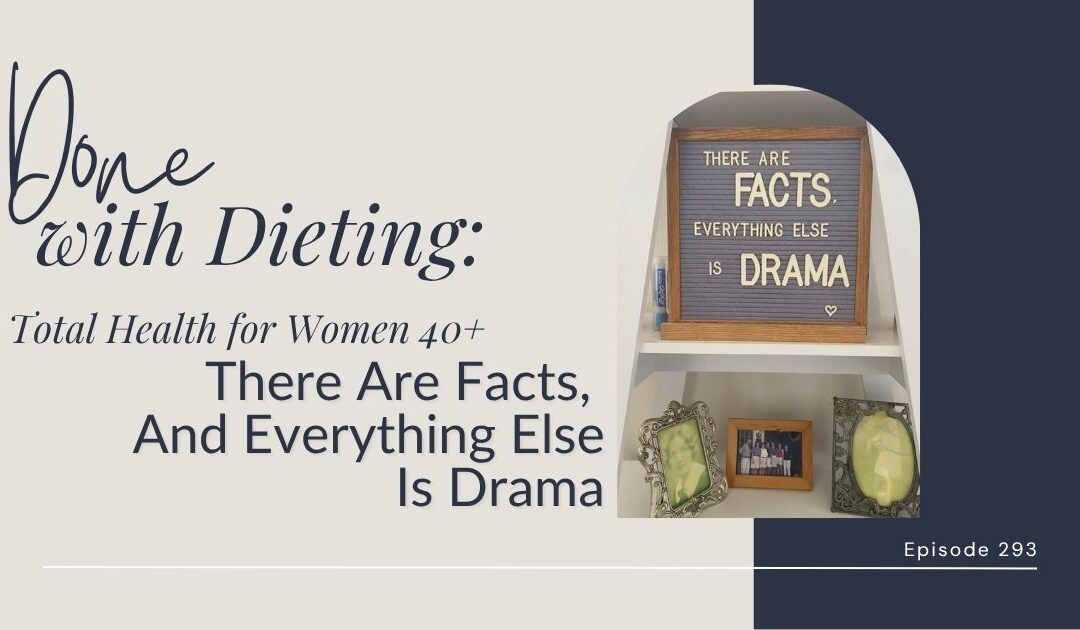
There's a sign in Elizabeth's office. It says there are facts, and everything else is drama. She looks at it almost every day, and in this episode, she's finally putting it into words.
Here's the idea. Your brain is a story making machine. When you don't have all the facts about something, your brain doesn't sit comfortably with the not knowing. It fills the gap with an explanation, and it hands you that explanation like it's the truth. Elizabeth walks through a wild real-life example of this happening to her and her husband Gary on House Hunters International, and how a total stranger built a confident, completely wrong story out of almost nothing.

Then she brings it home to the place most women in midlife actually live this pattern: the scale that won't move, or the jeans that don't fit the way you expected, even when you've been doing everything right. The number is a fact. What you decide it means about you, that's the story. And there's a whole set of real, physical conditions behind that number, hormones, digestion, water retention, your own biology, that you don't have access to and never chose.
There's also a pizza oven, a Neapolitan pizza obsession, and a full meltdown over a mechanical issue that had nothing to do with anyone's worth as a person. By the end of this one, you'll have two simple tools you can use the next time your mind starts spinning about your body, your relationships, or anything else you don't have the full picture on.
The Listener Takeaway: Why This Episode Matters
Most of what you've been carrying about your health, the shame about a number, the frustration with your body, the quiet belief that you're the one doing something wrong, was never a fact. It was a story your brain built to fill a gap. This episode gives you a way to see that in real time, and a real place to put your energy instead.
Seeing the story clearly is real relief. But it's not the same as knowing what your specific body, running on your specific conditions, actually needs. This episode leaves you with a way to catch the story and a clear next step if you're ready to understand what's underneath it.
Are you loving the podcast, but arent sure where to start? click here to get your copy of the Done with Dieting Podcast Roadmap (formerly Total Health in Midlife) Its a fantastic listining guide that pulls out the exact episodes that will get you moving towards optimal health.
Take the Quiz: Why Do Your Healthy Habits Keep Falling Apart? If you've ever wondered why you know exactly what to do but still can't seem to stick with it, this quiz was built for you. In about 3 minutes, it identifies your specific pattern: the real reason your follow-through keeps breaking down, and what to address first. Your results are delivered straight to your inbox.
I am so excited to hear what you all think about the podcast – if you have any feedback, please let me know! You can leave me a rating and review in Apple Podcasts, which helps me create an excellent show and helps other women who want to get off the diet roller coaster find it, too.
Watch or Listen to the Episode:
WHAT YOU'LL LEARN
- Why your brain automatically fills in a story anytime it doesn't have the full facts, and why that story usually isn't kind
- What's actually behind a scale number or a pair of jeans that don't fit the way you expected
- Why advice that worked for someone else's body might not work for yours, and why that's not a failure on your part
- The two tools Elizabeth uses to catch herself the moment a fact turns into drama
RESOURCES
- Free Diagnostic Call
- 53: Measuring Progress - Elizabeth breaks down exactly why the scale can be the last thing to move, and what to track instead so you're not left feeling like you're failing.
- 215: Preparing for Plateau - A deeper look at why a plateau is proof your body is working, not a sign that something's wrong, with a real client story about trusting the process through a six-week stall.
Full Episode Transcript:
293: There Are Facts, And Everything Else is Drama
Elizabeth: [00:00:00] So there's a sign in my office that says, "There are facts, and everything else is drama." It's right there. I look at it every day. Now, in today's episode, I am gonna tell you why I love it, what it represents for me, and how it explains why my husband almost lost his mind over pizza. But here's why you absolutely need to listen to this episode right now.
If you've ever stepped on the scale, seen a number that you didn't like, and instantly started a spiral of guilt, shame, or feeling like you're failing, you are completely missing the facts, and you're living in the drama. Today, I am pulling back the curtain on the sneaky trick your brain plays every single time your health routine doesn't go exactly as planned.
And if you tune out now, you're going to keep fighting a battle with your body that you were never meant to fight. So do not miss this episode. Stick around because learning this one [00:01:00] framework is going to unlock a level of emotional freedom that you didn't even know was possible.
Welcome to the Done With Dieting Total Health for Women over 40 podcast, the podcast for women who are done with the start over cycle and ready for a way of taking care of themselves that actually works.
Hey, everyone. Welcome back to the Done with Dieting podcast, the podcast for total health for women over the age of 40. Now, I am your host, Elizabeth Sherman, and I am really glad that you are here with me today. And I wanna talk about something that happens to almost every single woman that I work with, and honestly, it happens to me, too.
You do something different for your health, you walk more, you cut back on the wine, you change how you're eating, and you wait for the results that you were expecting because of that change, right? But then it doesn't show up, at least not in the way that you expected it to. [00:02:00] Maybe the number on the scale barely moves, or maybe your jeans still feel tight in the exact same spot that they did last month.
And in that second before you've even had a chance to think about it, your brain hands you an explanation, and usually it's not a very kind one, right? You must not be doing it right. You don't have what it takes. There's something wrong with you. Everyone else seems to have figured this out, so what is wrong?
Now, here's what I want you to know before we go any further. That explanation that your brain just handed you, that's not a fact. It's a story. And most of us can't tell the difference between the two, especially when it comes to our own thoughts and life. Now, today I wanna teach you how to spot that exact moment, the moment where a fact or data, something [00:03:00] real and tangible, something that you could actually measure or point to, turns into a huge story about the situation at hand.
Now, this matters more than it might sound like it does, because every single time you take a result that you don't like and turn it into proof that something's wrong with you, with someone else, or something has gone wrong in the world, you chip away at the one thing you actually need for any health change to stick.
You chip away at your own trust in yourself. And once that trust is gone, it doesn't really matter much what plan you're on. You will walk away from it the second things get hard, because some part of you already believes that you're gonna fail anyway. So I wanna give you a different way to think about all of this.
And to start us off, I've got a story for you about my husband, of all people, [00:04:00] and pizza, that is going to make this whole idea click in a way that I hope just lingers for you. And then I'm gonna show you exactly what to do with it the next time your body doesn't do what it's expected to do. So let's get into it Now, I have a sign in my office, again, right here.
And if you're watching me on YouTube, you can see it. For those of you who can't, it's one of those little boards where the letters slide in and out so that you can change whatever it is that you want whenever you want to see it. Now, mine has said the same thing for years now.
It says, "There are facts, and everything else is drama." And I look at it every day, and it provides me with just a ton of calm. Because here's how our brains work. When we don't have all the information about something, our brain doesn't just sit there comfortably not knowing. [00:05:00] Our brain hates gaps in stories.
If there are gaps that we don't have the information about, your brain will fill in the gaps with the most likely or logical solution for it. It writes an explanation and hands it to you like it's the truth. That explanation in between the gaps is our story that we tell ourselves, or in other words, the drama.
And most of the time, it's where we end up living. We don't end up living in the facts, but rather in the story that we made up to cover the gaps. So that's what this episode is about, and I want to help you catch yourself in that exact moment, the moment that a real fact about your body turns into a story about what's happening.
Because once you can see the difference, you get to decide which one you wanna believe. And so [00:06:00] I wanna start out with a real example of facts versus stories that we tell ourselves because I think it's easier to spot when it's not about you.
So when we first moved to Mexico, my husband Gary and I were on House Hunters International, and yes, I will put the link to the episode in the show notes so that you can watch it. If you've ever watched that show, you pretty much know the format. They follow you around while you look at three different places and decide where to live.
Now, we did the show because we had moved to Mexico, and we were looking for a place to rent. Rent, not buy. And the reason we were renting is actually pretty simple if you knew the actual facts. We knew we wanted to live here, near Cancun and Playa del Carmen, but we hadn't lived here full time yet. It was kind of a crapshoot in, you know, guessing, like, is this the place for us?
We wanted to try it out for a while before we made a decision [00:07:00] that big and invest in a property that we were quite honestly uncertain of in an exact location that we were uncertain of. And so renting just made sense for us, and that's it. That is the whole reason. Now, when the episode aired, Gary made the mistake a lot of people make He read the comments online, and one person, someone actually in our own community, had worked out in their own head, worked out the explanation for why we were renting instead of buying.
Their theory was that we had sold our house before we moved, and we had come out underwater on it, that we couldn't actually afford to buy anything, that we were basically in financial trouble, and we could only afford to rent. Now, none of that was true, not one piece of it. But here's what gets me [00:08:00] about this every single time I like to think about it.
That person didn't have any of the real facts. They didn't know us. They didn't know our finances. They didn't know that we'd made a completely intentional choice to rent first. All they had was one piece of information, that we were renting instead of buying, and a gap where the reason should have been for them.
And instead of leaving that gap alone, their brain just came up with a reason like it was a fact and that it was the truth, with a story that sounded believable enough that they typed it out and actually posted it to our neighborhood Facebook group. That's what I mean when I say the brain is a story-making machine.
It doesn't need a lot to work with. Give it one fact and an empty space, and it will build you a whole explanation, complete with a [00:09:00] reason, with judgment, and usually some kind of verdict about the people who were involved. And the person doing it will believe their own story 100%. They're not lying on purpose.
It makes perfect sense to them, and they think that they have figured something out. Now, here's the part I want you to sit with. If a total stranger can do that about someone else's life with almost no information at all, imagine what your own brain is capable of doing about your own life, where you're the one filling in the gap every single day.
So let's bring this home to your actual life, because I know why you're actually here. You decide to do something different. Maybe you start walking 10,000 steps every day, no excuses. Maybe you change how you're eating, or you cut back on sugar, or you stop pouring that second glass of wine most nights of the [00:10:00] week.
You do it for two weeks, maybe three, maybe a month, and then you check in. You step on the scale, or you pull on the jeans that you've really wanted to fit into, and you're expecting to see some kind of payoff for what you've been doing, because you feel like you have been sacrificing. And sometimes it's there, and sometimes it isn't.
The scale barely moves, or it moves in the wrong direction entirely. The jeans fit exactly the same way that they did a month ago, maybe even worse. And right there in that second, your brain does exactly what that stranger on the internet did to myself and my partner.
It takes the one fact it has, the number and the fit of the fabric, and it fills in the rest with a story You did something wrong. There must be something wrong with your body. You're not trying hard enough. [00:11:00] Other women can figure this out, and you can't. Something is broken in you. Now, here's what I need you to actually hear.
The number on the scale is a fact. It is data. The way that your jeans fit today are also a fact. But what that number or that fit means about you or about your worth, about whether you're capable of getting healthy, that part is not fact at all. The explanation of why that happens, that's a story, too, because we don't have visibility into the inner workings of our bi- bi- into the inner workings of our biology.
And because we don't have all the facts, your brain came up with a plausible explanation or a story to fill in the gap exactly like it did with our house. And just like with the house, there's a whole set of real facts sitting underneath that number that, quite honestly, [00:12:00] you do not have access to. Your hormones shift week to week, sometimes day to day.
Where you are in your cycle or in perimenopause or in menopause changes what your body is holding onto. Digestion also plays a part. So does water retention. So does how much sodium you had yesterday, how you slept, how stressed your week has been. Your biology, the specific one that you were born with and the one that you're living in right now, now at this stage of your life, is running a thousand processes that you can't see and did not choose, and that is not an excuse.
It's just the truth. Your body is operating under real physical conditions, measurable conditions, and most of them never showed up on a scale readout or in a waist or in-
And most of them never f- and most of them never show up on a scale readout or how a waistband feels on any given day. Now, I talk about this with my clients as conditions, not character, not effort, but rather conditions, [00:13:00] circumstances. Two women can do the exact same walk, eat the same dinner, get two completely different results on the scale that same week because their conditions are not the same.
They have different hormones. They have a different gut profile. The different... They have different stress loads, different everything, right down to how much salt was in the soup that they had for lunch. Neither of them did anything wrong. They're just running different biology, and biology does not care what the scale was supposed to say.
So when the result doesn't show up the way that you expected it to, that's almost never proof that something is wrong with you. It's far more likely that you're looking at one single number and asking it to represent your entire body when your body is actually working with 100 different moving parts, and you have no way of seeing where you're standing.
The [00:14:00] number is real. The fit is real. But the meaning that you're attaching to it, the verdict about your worth or your ability, that part you're making up. Same as the person on the internet that made the story up about me and Gary being broke. They just had less information than you have right now, and you already know your number isn't the full picture.
You just haven't been treating it that way. So at the beginning, I mentioned about that pizza story. Let me tell you the whole story now because it's a perfect example of everything we just talked about. Now, my husband, Gary, he retired just a little bit over a year ago, and one of the things that he has picked up in retirement is making Neapolitan-style pizza.
We'd gone to Naples, Italy, a few years back partly so that we could eat the real thing, and he came home determined to make it himself. He bought a proper pizza oven, [00:15:00] researched dough recipes, and immediately got to work. In the beginning, he was a beginner. The pizzas were inconsistent.
He'd have a really great pizza, and then the next one would be just a flop, and he could not figure out why. He was talking to different people, and as a result, he was changing a bunch of things all at once: the flour, the water temperature, how long the dough proofed, the oven temperature, all of it, all at the same time.
So when a pizza came out wrong, he really had no idea which of the variables caused it, and he started making it mean something about him. He'd say things like, "I'm just not good at this. I'm never gonna be able to, you know, be able to make pizzas. I should just quit." And I finally talked him into changing just one thing at a time and treating the whole project like an experiment instead of [00:16:00] something that he had to get great at.
And in that moment Something shifted for him. He started seeing himself as a scientist instead of a failure. Now, he's been making pizza for a year or longer, but even last week when the oven had a heating problem and the pizza came out wrong, he had a full meltdown about it, like it meant something about him.
It didn't. The oven actually had a mechanical issue that he had never experienced before. Now, here's the part that I really want you to hear. When Gary goes looking for help online, the pizza forums are full of people who don't live anywhere near us. They live in different climates with different humidity levels, different water, and maybe even different ovens.
Their advice might be completely true for them and still not work here because our [00:17:00] conditions are not their conditions, and that's exactly what happens to you with health advice. A guru, a program, a friend who swears by something, they're telling you what worked in their body, their hormones, their stage of life.
And when you try it and it doesn't land the way that they promised, that's not you failing. That's just a mismatch between their conditions and yours. It was never a verdict on you. It was information about the gap between their body and yours. And this isn't just a health thing. This shows up everywhere in your life.
So let me give you one more example quick because I bet that you've lived this one too. Let's say that you text a friend of yours, nothing big, just a normal message, right? And she does not text you back, not that afternoon, not that evening, [00:18:00] maybe not even the next morning. The fact is simple. You sent a message, and you have not gotten a reply yet.
But that's not where your brain stops, is it? It starts building. Maybe she's upset with me. Did she seem irritated with that thing I said to her last week? Maybe she's pulling away from the friendship and this is the first sign.
By the time a full day has passed, you've got a whole narrative running, and somewhere in it, you're the one who did something wrong. Meanwhile, she just got busy, or her phone died, or she saw the message and meant to answer and got pulled into her kid's homework or forgot a deadline and genuinely forgot.
That's me. Nothing about the friendship changed. Nothing happened between you two at all, but you built an entire story off of one fact, a message [00:19:00] with no reply yet. And the exact same way you do with a number on a scale or a pair of jeans that don't fit right. Your brain doesn't care what the topic is.
Give it a gap and it will fill it every single time. So here's what I actually want you to do the next time you catch your mind spinning, whether it's about your body or any other drama that you have going on in your life. The first tool, and this is the one that I want you to lean on the most, is to physically write out all your facts.
When you notice yourself building a story, stop and write down only what you actually know to be true. Not what you think you know or what you have an educated guess about what happened. Not what you're assuming, only facts Let me show you what that looks like with the scale. [00:20:00] Let's say that you step on it and it says a number that's a little bit higher than you expected.
Now, here's what the facts list would actually say: "I weighed myself this morning at 7:00. The number was", the number. "This number is higher or lower than last time I weighed myself." That's it. Those are the only facts that you have. Everything else, "I'm failing, I did this to myself, I can't be trusted, I'm never gonna get this, this is too hard, this isn't working," none of that is a fact.
That is the whole story, and you just watched yourself write it. Same thing with the jeans. The fact is, these jeans fit a little bit tighter than they did a few weeks ago. That's the whole fact. Not, "I've let myself go." Not, "Nothing I do works." [00:21:00] Just, "They fit tighter today." When you force yourself to write down only what's real, something really interesting starts to happen.
You run out of facts fast.
There usually isn't much there, and that gap, the space between the two facts that you actually have and the giant story that you are about to believe, becomes one really obvious story once it's sitting on paper in front of you. It's a lot easier to talk yourself out of a story when you can actually see how little it's actually built on.
The second tool for when the facts list alone doesn't quite settle you down, because sometimes it doesn't, especially if the story is a familiar one, that's when... When that happens, ask yourself this question: "How might someone else in my exact position look at this situation?" Not a stranger with no context, but someone standing [00:22:00] exactly where you're standing, same week, same effort, same body going through the same stage of life.
If a woman just like you, and let's say it's me, did everything that you did this week and got the exact same result on the scale, what would you or she or me actually think was going on? You probably wouldn't decide that she's a failure. I know I wouldn't. You'd probably think her body is just doing something this week, hormones, water, who knows, and it'll shift again.
You'd give her the benefit of every doubt you refuse to give yourself. I want you to try it out sometime. Say it exactly like that. "If my friend walked 10,000 steps a day for three weeks and the scale didn't budge, would I tell her that she's a failure, or would I tell her that bodies don't always respond on schedule [00:23:00] and she should keep going?"
You already know which is true, right? You just have to actually ask yourself the question instead of skipping straight to the verdict. That question works because it pulls you out of your own head for just a second and lets you borrow a little bit of the compassion that you already have, you just usually spend it on other people instead of yourself.
Now, between those two tools, the facts list and the outside vantage point, you've got a real way to catch yourself the next time facts turn into drama. You write down what's true, and if that's not enough, you ask, "How would this look from a step outside of myself?"
Either one will start pulling you out of the story and back into what is actually true. So let's bring this all the way back around. Most of what you've been carrying about your health, the shame about the number, the frustration with your body, the quiet [00:24:00] belief that you're the one doing something wrong, most of that was never a fact. It was a story your brain built to fill a gap, the same way that stranger built a story about Gary and me being broke, the same way you build a story when a friend doesn't text you back fast enough.
Your brain doesn't know the difference between a real threat and an unanswered question. It just fills that space up every single time, and it usually fills it with something that makes you the problem. The piece you can actually start using today is the facts list. Next time you catch that spiral starting, whether it's the scale, the jeans, a issue with your partner, your friend, your kid, whatever it is, stop and write down only what's real.
You'll be surprised at how short that list actually is and how much of what you were about to believe wasn't on it at [00:25:00] all. Do this enough times and something starts to shift. You stop treating every disappointing result as proof of who you are, and you start treating it as information, the same way Gary eventually learned to treat a pizza that didn't turn out right.
Not a verdict, just data. That shift alone will change how you talk to yourself, and it'll change how much of your energy goes into shame instead of actually trying to figure things out.
But I wanna be honest with you about something because I don't wanna leave you with only half of the picture. Seeing that you're telling yourself a story is a real skill, and it is also an important one. It'll bring you a lot of relief on its own, but it doesn't answer the other question, the one underneath it.
If the number or the fit really is telling you something, what is it actually telling you? What is going on with your hormones, with your digestion, your [00:26:00] stress load, the specific conditions your body is running on at this exact stage of your life? That is a different skill entirely, and it's not one that you're gonna find on a forum built for somebody else's body in someone else's kitchen running on someone else's conditions.
Catching the story is step one. Understanding your own conditions well enough to know what to actually do about them, that's step two, and most women never get help with that part. They read another article, try another plan, and end up back in the same spiral for a few weeks later because no one ever sat down and looked at their actual hormones, their actual stress load, their actual life, and helped them figure out what their body specifically needs.
Now, that's where I come in. If any of this hit home today, the scale, the jeans, the story that you've been telling yourself about your own body, I wanna invite you to do something about it instead of [00:27:00] just nodding along and closing the app. I offer a free diagnostic call. It's 30 minutes long, just you and me, no pitch, no pressure.
We look at what's actually going on in your body and your life right now and the real conditions behind whatever result that you've been stuck on so that you can stop guessing and start understanding what your body actually needs. You can find the link to grab a time in the show notes. Go to eshermandev.wpengine.com/diagnostic.
You have spent enough time collecting stories about what your body is or isn't capable of. This call is a chance to trade a few of those stories for something real, a clear picture of what's actually happening with you specifically at this stage of your life.
That's all I have for you today. Thank you so much for spending this time with me. I will talk to you soon. Have an amazing day. I'll talk to you later. Bye-bye. Hey, thanks for tuning in today. If what we talked about is landing and you're ready to figure [00:28:00] out what's actually getting in your way, I would love to invite you to a free diagnostic session with me. It's 30 minutes long, just us, looking at where your specific weight keeps breaking down and where you need support applying what you already know.
You'll leave with a clear picture of what's driving it and what would actually help next. No shame, no macros, no pretending you have infinite capacity, and certainly no lecture about trying harder. Go to eshermandev.wpengine.com/diagnostic to grab your time. I would love to see you on the call
Enjoy the Show?
- Don’t miss an episode, follow the podcast on Spotify and subscribe via Apple Podcasts or RSS.
- Leave me a review in Apple Podcasts.
- Join the conversation by connecting with me on Social!


Elizabeth is a Master Certified Life and Health Coach with over 20 years of experience, dedicated to helping women in midlife thrive through holistic health and wellness. Her personal journey began with a desire to reduce her own breast cancer risk, which evolved into a mission to guide women through the complexities of midlife health, from hormonal changes to mental clarity and emotional resilience.
Elizabeth holds certifications from prestigious institutions such as The Life Coach School, Precision Nutrition, and the American Council on Exercise, as well as specialized training in Feminist Coaching and Women’s Hormonal Health. Her approach is deeply empathetic, blending her extensive knowledge with real-life experience to empower women in their 50s and 60s to build sustainable health habits that last a lifetime.
Recognized as a top voice in women’s health, Elizabeth speaks regularly on stages, podcasts, and webinars, inspiring women to embrace midlife with energy, confidence, and joy. Her passion is helping women regain control of their health, so they can fully engage in the things that matter most to them—whether that’s pursuing new passions, maintaining strong relationships, or simply feeling great in their own skin.