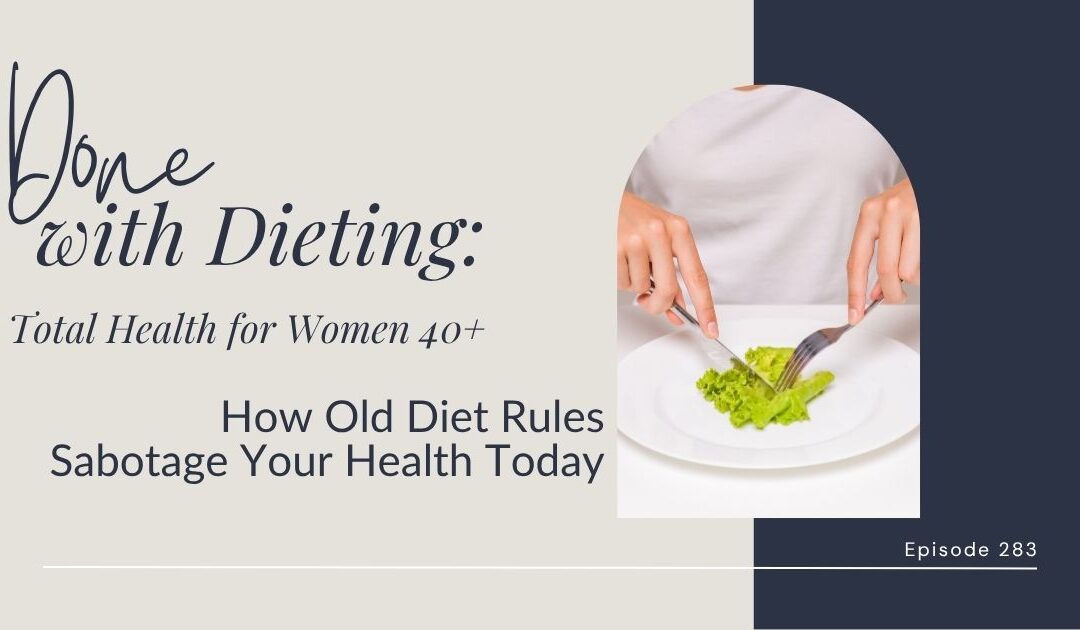
You know what to do. You could probably teach it. You know to eat more vegetables, get to bed earlier, and move your body most days. And you still end up standing in your kitchen at nine o'clock at night, arguing with yourself about whether you're allowed to have the chocolate. If that scene feels a little too familiar, this episode is for you.
Here's the part nobody tells you. The reason you can't do the thing you already know how to do has nothing to do with how much willpower or discipline you have. It's that you're carrying a long list of food rules you never actually chose. Somebody handed them to you when you were young, before you had any way to question them, and they've been running quietly in the background ever since.
In this first episode of the pillar series, Elizabeth walks through where that second voice in the kitchen came from, why decades of dieting taught you to treat your own hunger as the enemy, and why knowing everything about nutrition has never once been enough to change what you do at night. She makes a claim that gets a little bit of pushback: if you're eating for any reason other than hunger, that's emotional eating, and there is nothing wrong with it. She also names the way exercise quietly turned into the thing you do to pay off what you ate.
This one leaves you seeing your own pattern clearly, maybe for the first time. Because once you understand whose voice is doing the arguing at nine o'clock, the whole thing looks different.
The Listener Takeaway: Why This Episode Matters
If you've spent years believing you're the problem, that you're the woman who just can't get it together around food, this episode hands you a different explanation and a lot of relief. What's been running your eating isn't a character flaw and it isn't a lack of discipline. It's a set of beliefs that got planted in you before you could read, and that have never resolved on their own in all the years since.
That matters because these patterns don't burn themselves out. If you're in your fifties and still hiding the wrapper, still doing the math on Sunday about Monday, that same voice will be running at seventy-five if nothing changes. Seeing it clearly won't fix it overnight. But it changes everything about what you do next, because now when the argument starts, you know whose voice that is, and you know it isn't yours.
Are you loving the podcast, but arent sure where to start? click here to get your copy of the Done with Dieting Podcast Roadmap (formerly Total Health in Midlife) Its a fantastic listining guide that pulls out the exact episodes that will get you moving towards optimal health.
Take the Quiz: Why Do Your Healthy Habits Keep Falling Apart? If you've ever wondered why you know exactly what to do but still can't seem to stick with it, this quiz was built for you. In about 3 minutes, it identifies your specific pattern: the real reason your follow-through keeps breaking down, and what to address first. Your results are delivered straight to your inbox.
I am so excited to hear what you all think about the podcast – if you have any feedback, please let me know! You can leave me a rating and review in Apple Podcasts, which helps me create an excellent show and helps other women who want to get off the diet roller coaster find it, too.
Watch or Listen to the Episode:
WHAT YOU'LL LEARN
- Why a woman who actually trusted her own body wouldn't be standing in the kitchen arguing with herself in the first place
- Where your food rules really came from, and why so many of them contradict each other yet still feel mandatory
- The reason knowing everything about nutrition never turns into doing it, and why more information won't fix it
- How exercise quietly became a debt you pay off after eating, and what that does to your sleep, your cravings, and your mood
RESOURCES
- Take the quiz: Why Do Your Healthy Habits Keep Falling Apart? In about three minutes it shows you your specific pattern, the real reason your follow-through keeps breaking down, and what to look at first. Results go straight to your inbox.
- Episode 233: How to Eat Without Rules
- Episode 254: How to Trust Yourself Around Food Again in Perimenopause
- Episode 256: Fearing Hunger: How Dieting Trained You to Overeat
- Blog Post: Why Your Diet History Is the Real Reason You Can’t Stay Consistent
Full Episode Transcript:
283: How Old Diet Rules Sabotage Your Health Today
Elizabeth: [00:00:00] So here's a thought that I wanna put in your head before we even start. The next time that you're standing in your kitchen at night arguing with yourself about whether you're allowed to have the chocolate or not, I want you to notice something: that you're arguing with yourself, that there are two versions of yourself inside your brain, the one who wants it, and the one whose whole job is to talk you out of it.
And you've had that argument so many times that you have stopped noticing how strange it is that it's happening at all. Like, a woman who trusted her own body would not be standing there negotiating over a cookie. So where did that second voice come from, the one with all the rules? Because you weren't born with it.
Nobody comes into this world already at war [00:01:00] with herself over chocolate. Today, I am gonna show you exactly where it came from and how old you were when it decided to take up residency. I'm gonna tell you why knowing everything that you know about food has never once been enough to make you do the, quote-unquote, right thing, and I'm gonna tell you the truth about what actually has to change because I promise you, I promise, it is not the chocolate.
If you have ever wondered why you know exactly what to do and still cannot get yourself to do it, this is the one to stay for. So let's get into it
Welcome to the Done with Dieting Total Health for Women over 40 podcast, the podcast for women who are done with the start over cycle and ready for a way of taking care of themselves that actually works.
All right, so picture this. It's [00:02:00] night, the house is quiet, everybody else has gone to bed, and you are standing looking in your pantry. You already told yourself that you were not gonna do this tonight. You meant it this morning, and you meant it this afternoon after lunch.
You swore that you would not need it tonight, and yet here you are. You're not hungry. You know that you're not hungry because you had dinner two hours ago, and you are not the least bit hungry, and yet somewhere in there you know
You had dinner two hours ago, and you are not the least bit hungry. And somewhere in there, you know that too. But you want it. You want the ice cream or the chips or the wine or that little bowl of chocolate that never quite stays little. Or those few squares of chocolate that never stay just, like, one or two.
And you're standing there having the same conversation that you've had 100 times. "I shouldn't. I know I shouldn't, but I want it. But I've been good all day. I deserve [00:03:00] it. No, put it back. Just go to bed." And you stand there So welcome to the Done With Dieting podcast. I am your host, Elizabeth Sherman, and I am so glad that you are here with me today.
Thank you for spending a little bit of your day with me wherever you are listening to, wherever you are listening from. So I wanted to start you off in that kitchen because I think for many, you know exactly the moment that I'm talking about. You've lived it. Some of you lived it last night, or you might be living it tonight.
And here is what I want you to notice. I don't want you to notice the chocolate. I want you to notice the conversation that is going on in your head, the argument, that back and forth, "I shouldn't, but I want to," that tug. The whole debate that you're running in your own head at night when everything is quiet, by yourself, [00:04:00] over a cookie or a granola bar or whatever it is.
That argument is what I want to talk about today because that argument is telling you something, and it almost... Because that argument is telling you something, and almost none of us ever stop long enough to hear what it's actually saying. So here's the part I really want you to sit with. A woman who trusted her own body would not be standing there arguing.
I want you to think about that. A woman who really trusted herself would not be arguing. If you trusted yourself, if you trusted your own hunger and your own ability to make a call and live with it, you wouldn't need the debate at all. You would know whether you wanted the thing, and you'd have it or you wouldn't, and either way, you would go on with your night.
There would be no negotiating, no bargaining with yourself in the dark over whatever that thing [00:05:00] is. The fact that there's an argument at all tells you something got crossed somewhere. At some point, you stopped being able to just decide, and now there are two of you standing in that kitchen, the one who wants the thing and the one whose entire job is to talk you out of it.
So I wanna talk today about where that second voice came from because you weren't born with it. Nobody comes into this world arguing with herself over chips. And this matters a whole lot more than one cookie at night. This is the same thing that has you knowing exactly what you should be doing for your health And still not doing it.
You know what to eat. You know you should move your body and get to bed earlier. You could probably tell me a few things. And you still cannot get yourself to actually do [00:06:00] the thing. You already know what to do. I wanna be clear about something before we go even a step further, because I know where your mind goes with this.
You think the reason that you're standing in that kitchen losing the argument is that you don't have enough willpower, that if you were just a little bit more disciplined, a little bit tougher, you would win every single time That was never it, and by the end of this episode, I want you to understand why.
So let me back up out of the kitchen for just a minute and look at the bigger picture, because that argument over chocolate is only one very small piece of it. Think about how much you already know. You know what a serving of protein looks like. You know that vegetables are good for you and that you should probably eat more of them.
You know that walking counts as exercise. You know that being on your phone until midnight is [00:07:00] probably wrecking your sleep. You've read the books, you listen to podcasts like this one. You've listened to a lot of them.
You've watched the videos, you've read the internet, you've sat through the free webinar at 8:00 on a Tuesday when you were tired and just wanted to go to bed instead. Your friend calls you and tells you that she wants to eat better, and you can tell her exactly what to do. You give her great advice. You mean it, and you're probably right, and she takes it and she tells you that it helped.
And then you hang up the phone, and then you go stand in your own kitchen at 9:00. Ask me how I know. That right there is the gap. You have the information. You can teach it. You could probably teach it better than some of the people getting paid to teach it, and yet you cannot get yourself to do the thing that you already know how to do.[00:08:00]
Now, I have been coaching women for about 20 years now, and I wanna tell you what I have almost never seen. I have almost never sat down with a woman who didn't already know what to do. It happens occasionally, but it's pretty freaking rare. Mostly, what's sitting across from me is a smart, capable woman who could recite the whole thing back to me and who is exhausted and confused about why none of it sticks.
And so today, I am not gonna hand you more information. I'm not gonna give you a list. I'm not gonna tell you five things to try this week. If more information was what you needed, you would have solved this a really long time ago because you have been collecting information about your own health for probably 30 years now.
You are not missing any information. You are missing something [00:09:00] else entirely, because when you understand what's actually running the show at night, a lot of things start to make sense. The binging, the Monday mornings, the way that you can be so disciplined at work and so completely at war with yourself at night over a bag of chips Now, none of that is a personality trait or a character flaw, and there's a reason for it.
So I wanna go back to that second voice for a second, the one in the kitchen whose whole job is to talk you out of the chocolate. That voice has rules, like a lot of them. Carbs are bad. Well, some carbs. Not fruit, but maybe some fruits. Bread is definitely bad. Fruit is fine, but not too much fruit or tropical fruit because of the sugar.
Now, fat used to be bad, and now fat is good, [00:10:00] but not that kind of fat. It's the healthy fat that we're supposed to be eating. But don't eat after 7:00, and don't eat before noon. Eat six small meals, but no, now we're supposed to eat two big ones. Sugar is definitely poison. You should probably be getting 100 grams of protein per day.
You should be counting something, and if you're not counting something, you're probably overdoing it or underdoing it. If you sat down and wrote out every single rule that you carry about food, you would fill probably those journals that are empty, and you would notice that half of them contradict the other half, and you would still somehow feel like you're supposed to be following all of them at once.
Now, here's the question I want you to actually sit with. Where did we get all of these rules? Not where did you read them, but where did they originally come [00:11:00] from? Which ones did you choose? Because I don't think that you actually chose any of them. I think that they were handed to you. Somebody in your life said something to you about your body, and you were young enough that you believed her.
It might have been your mother standing in the mirror talking about her own thighs. It might have been your mother talking about yours. Maybe you had a grandmother or an older sister who was thinner than you and everyone noticed. Maybe it was a boyfriend in high school who made a joke. Maybe it was a kid on the bus in sixth grade who found the one thing to say that you still hear in your head 40 years later.
Maybe nobody said anything at all, and you just read the magazines that were sitting on the coffee table. 10 pounds by summer. What he really notices. 50 [00:12:00] ways to be smaller. You absorbed all of it before you had any way to evaluate it or filter it out. You were 9 or 11 or 14. You didn't have the ability to say, "Hey, wait a minute.
Hold on. That's a strange thing to tell a child." You just took it in the way kids take everything in, and it became true. And a lot of you were put on a diet. Some of you were put on a diet when you were a little girl. Somebody decided that you needed to lose weight before you were old enough to have any say in it.
There were foods in your house that you were allowed to eat, and foods that you certainly were not allowed to eat, and the ones that you weren't allowed to eat were the ones that were tasty, the ones that you wanted. So you got sneaky about it. You ate cookies in your room. You ate [00:13:00] standing up in the kitchen with the light off so no one would know.
You ate fast before anyone could see you eating it, and you learned two things that have stayed with you your entire life. You learned that wanting that food was shameful, and you learned that the only way to have it was to hide. That's 50 years ago now for some of you, and you're still eating standing up in the kitchen with the light off or eating quickly so that no one sees you.
Here's what I want you to see. You have been living inside a set of rules that you did not write. You've been following them, breaking them, feeling terrible about breaking them, and then going back to following them again for decades now. And in all that time, almost nobody stops to pull one of those rules out and look at it and ask the simple question: Is this [00:14:00] true?
Was it ever true? I wanna show you what all those rules have done to you over the years. Not what they did to your weight, what they did to your relationship with yourself and your relationship with food. Every single rule you absorbed was built on one idea underneath it. The idea is this: your body cannot be trusted, that something else knows you better than you.
That's the message. Every diet that you've been on told you the same thing wrapped up a little bit differently. Don't listen to yourself. Listen to us because we're experts. Here's when to eat, here's how much to eat, here's what to eat. Follow the plan and don't ask questions, because if you were capable of running this on your own, you would not be here, would you?
Think about what that does to a person over 30 or 40 [00:15:00] years. You get hungry at 3:00 in the afternoon, and instead of thinking, "Huh, I'm hungry, I should probably eat something," you think, "I already had lunch, I can't eat right now. I shouldn't be hungry. I need to wait. What is wrong with me?" You want something sweet after dinner, and instead of thinking, "I want something sweet," you think, "Why can't I control myself?"
You're tired and you don't wanna work out, and instead of thinking, "I'm tired. Maybe I need some rest or to do something differently than I planned," you think, "I must be just lazy." Do you see what happened there? Every message your body sent you got translated into evidence against you. Hunger becomes a problem.
Cravings become a weakness. Wanting something became proof that there's something wrong with you in s- something wrong with you, and something that, uh- Wanting something became proof that there's something wrong with you that isn't wrong with other women. You have been taught [00:16:00] for your entire life that the signals coming from inside your own body are the actual enemy.
And when you can't trust the thing inside of you, you have to reach for something outside of you, so you reach for a rule because at least the rule doesn't change. At least the rule can't be wrong. The rule is safe. And that's how a hungry woman ends up standing in her kitchen consulting a set of instructions in her head that she has memorized that she got from a magazine in 1987 instead of just asking herself what she wants to eat.
And this right here is the whole thing. This is why knowing has never turned into doing, because you are not making a choice. You're having a fight in your own head. Every time you sit down at the table or open up the cupboard, you look at a menu- Or look at a menu. You're not simply going through the process of deciding what to eat.
You're stepping into a courtroom. There's a rule on one side, and th- there's, there's a rule on one... There's a rule [00:17:00] on one side, and then there's your body and what it wants and needs on the other. And you have already decided decades ago that your body is an unreliable witness. So even when you win, you still lose.
You put the chocolate back, and you go to bed feeling proud of yourself for about a night, and then you feel hollow because what you actually did was override yourself again. And then you're going to have to override yourself again tomorrow, and the day after that, and forever because the wanting doesn't go anywhere, and eventually it starts to feel like deprivation.
And when you lose, you really lose because now you didn't just eat a piece of chocolate, you broke a rule. You proved the thing that you already believed about yourself, and that is exhausting. It's exhausting in a way that's hard to explain to somebody who's never [00:18:00] lived inside of it. And I wanna say this really clearly because I don't think you've heard it enough.
You have wisdom inside of you. Your body has wisdom. You do. Every human being does. Your body has been trying to talk to you your whole entire life. It tells you when it's hungry, and when it's had enough, and when it's tired, and when something is wrong. Now, you didn't lose that. It's still in there. You were just taught very early and very thoroughly not to listen
So let's go back to that kitchen one more time because I wanna look at what you were actually doing in there. You knew the chocolate had sugar in it. You knew you weren't hungry. You knew if someone had stopped you and quizzed you, you would have been able to tell everything that there is to know about why someone shouldn't be eating a bunch of chocolate at 9:00 at night on top of a dinner that she already ate. You already knew [00:19:00] all of it, but you ate it anyway.
So can we stop pretending information was ever going to fix this? That rules would ever fix this? You didn't eat the chocolate because you were confused about nutrition. You ate it because you wanted it, and you wanted it for reasons that have nothing to do with what is on the label. Maybe you were tired.
Maybe you had been managing other people's needs since 6:00 in the morning, and that was the first quiet moment that you had had all day, and you wanted something that was just yours. Maybe you were lonely. Maybe you were bored. Maybe you always eat something at 9:00 because you have always eaten something at 9:00 every night for the past three years, and your body knows what time it is, and it expects it.
Maybe it just tasted good, and you wanted to [00:20:00] taste it. You wanted some pleasure. Now, I say this to women all the time, and I usually get a little bit of pushback, so let me say it carefully. If you're eating for any reason, any reason other than hunger, you're eating for emotional reasons. Now, I know a lot of you just, like, bristled because you decided that you are not an emotional eater. We think emotional eaters are women who cry into a pint of Ben & Jerry's after a breakup, and that's not you. You just like a little something at night. But eating because you're tired is still emotional eating.
Eating because you're bored is still emotional eating. Eating because it's the only 10 minutes of the day that belong to you is emotional eating. Eating at a birthday party because it's a birthday party and you're celebrating and there's cake and [00:21:00] everyone's happy, that is also emotional eating. And here's the part that I need you to actually hear.
There is nothing wrong with any of that. I wanna be really clear that I have no judgment about emotional eating. Honestly, there's none. Eating for reasons other than hunger is one of the most human things that there is. We eat at weddings and funerals and holidays. We eat to celebrate and to comfort and to connect.
Food is pleasurable. It's supposed to be, and that is not a design flaw in you. I'm not the one judging you for it, but someone is. Diet culture judges you for it, and it has been judging you for so long that you took over the job yourself, and so now you judge yourself, too. You do it now without any help. And here's the strange thing that [00:22:00] judgment does. It makes the food more powerful, not less. Diet culture took ordinary food and gave it moral character.
This one's good, this one's bad. And the second something is bad, the second, it becomes forbidden. It becomes like a beacon. You want it even more. It has a charge on it that it has never had before somebody told you that you couldn't have it. Some of what you're craving in that kitchen is the chocolate, and some of what you're craving is the forbidden, the lack of rules, the you can't tell me what to do.
So let me ask you something. What if a brownie was no more good or no more bad than a piece of broccoli? What if they were just food? What if you were allowed to want it? [00:23:00] Like, I want you to really think about that for a second. Because if you were anything like the women that I work with, some part of you got really super uncomfortable with that statement, and we're gonna come back to why.
So I wanna say something about exercise here, because the same thing happened to your body and movement just a little bit more quietly. You beat yourself up about this one constantly. You start walking again, and you do great for, like, two weeks, and then a work trip happens, or your mother gets sick, and it falls apart, and you decide that the problem is that you can't stick with anything.
But look at what exercise actually became for you. It became the thing that you do to pay for what you ate. You have a bigger dinner than you meant to, and before you've even put the plate in the sink, you're thinking, "Okay, I just need to exercise a little bit longer tomorrow. I'll [00:24:00] do an extra day this week, or I'll go harder."
You eat the chocolate, and you get on the treadmill on Saturday to try to cancel it out. That's a debt that you're carrying. You're not moving your body because it feels good to move your body. You're moving it to settle up the eating debt. Nobody sticks with a punishment.
Nobody. You don't have a consistency problem. You have a relationship with exercise that was built around paying off a debt that you were never supposed to owe, and there's something happening in your body underneath all of that. When you overeat, your body is already working hard to deal with that overeating, that indulgence.
When you go ahead and add a hard workout on top of it as penance, now your body is dealing with two things at once, and what happens [00:25:00] is your sleep gets worse. Your hunger signals get louder and a little bit stranger. Your mood drops. Your cravings come back stronger. The very thing that you did to fix it made it worse.
So yes, exercise is tangled up in all of this as well, but for most of the women I work with, food is where the real damage lives. So here's what I need you to understand before we finish today. This did not start recently, right? It didn't start when you turned 40 and things got difficult. It didn't start with perimenopause or having a desk job or the year you were so busy that you stopped...
It didn't start with perimenopause or the de- It didn't start with perimenopause, or getting a desk job, or the year that you were so busy that you stopped cooking for yourself. Those things just made it more obvious. They didn't create it. This started when you were a lot younger. Somebody told you that your body was a problem, and you believed her because you were 8 and [00:26:00] she was your mother.
Or you were 12 and it was a magazine, or 15 and it was a boy, and that belief went in and it stayed. And here's the thing about beliefs like that: unfortunately, they do not expire. They don't work themselves out over time. Nobody wakes up at 52 years old and discovers that the thing that she absorbed at 9 quietly dissolved on its own while she was sleeping.
Look at the evidence. You are a grown woman. You've raised children, or run a department, or built something from nothing. You have buried people that you loved. You have handled things that would flatten most people, and you are still standing in your kitchen at night with the light off. You are still doing the math on Sunday about what you'll fix in your diet on Monday.[00:27:00]
You are still apologizing to nobody in particular after you eat a piece of chocolate. You are still counting up what you ate and what you'll owe and work off. 40 years. 40 years of the same argument with yourself. So I wanna ask you the question that I ask my clients, and I want you to answer it honestly in your head right now.
If nothing changes, what does this look like when you're 75? Are you still standing there? Are you still hiding the wrapper? Are you still eating in secret? Are you still telling yourself that next week you'll be better? Because that's what this habit does. That's where we are going. It doesn't burn itself out.
It's been running for 40 years, and it has not gotten quieter. It's just gotten so familiar that you've stopped hearing it. And I wanna [00:28:00] be really precise with you about what actually has to change here, because it's not what you think. It's not the chocolate, because it was never about the chocolate. You could throw out everything in your cupboard tonight, and the voice would still be there in the morning telling you that you messed up.
What has to change is the one thing that you've never stopped to examine. The rules that you didn't write, the belief that your body is wrong, the certainty planted in you before you could read that wanting something means that there's something wrong with you.
That's what's running in your health right now. Not your discipline, not your character, but something someone else handed to you a very long time ago that you never agreed to carry. Now, I've been talking about diet history today because it's where this shows up the most obviously. But it isn't the only place [00:29:00] where we fail to apply what it is that we know. For some of you, it isn't really the old rules at all. It's that you stopped hearing your body entirely, or you've got nothing left in the tank by the time that you get home because you spent the whole day on everyone else. Or you're living inside a schedule and a house, and you have a group of people that make taking care of yourself nearly impossible, and you've been blaming yourself for doing something the room is doing. You can't see this from inside. That's not a knock on you. Nobody can see it from inside. You've been standing inside your own pattern for so long that it looks like the air you breathe.
So I made a quiz. It's called Why Do Your Healthy Habits Keep Falling Apart? And it does one thing. It shows you where your follow-through is actually breaking down. [00:30:00] Now, it's not a generic answer. It's yours, uniquely yours. The specific place where the wheels come off for you and what to look at first. It takes about three minutes to take this quiz, and the results go straight to your inbox.
To take the quiz, go to elizabethsherman.com/quiz. That's elizabethsherman.com/quiz. And I will make sure to put the link in the show notes too so that you don't have to remember it. Pick it tonight while this is still sitting with you.
And look, I'm not gonna tell you that understanding this fixes it. It doesn't. You can see the whole thing clearly and still find yourself in the kitchen with the cupboard open. But it's different when you know what you're looking at because now when the argument starts, you know whose voice that is, and it isn't yours.
That's all I have for you today. Have an amazing day, and I will talk [00:31:00] to you next time. Bye-bye.
Hey, before you go, if you are someone who says, "I know exactly what I should be doing, I just don't do it," hey, if that's you, I made something for you. It's a free three-minute quiz that gets underneath that exact problem. Not to give you more information, but to show you the specific reasons your follow-through keeps breaking down, because it's not the same for everyone.
And once you can see your pattern clearly, everything else seems to change. Head to elizabethsherman.com/quiz. It's free, it's fast, and it's honest
Enjoy the Show?
- Don’t miss an episode, follow the podcast on Spotify and subscribe via Apple Podcasts or RSS.
- Leave me a review in Apple Podcasts.
- Join the conversation by connecting with me on Social!


Elizabeth is a Master Certified Life and Health Coach with over 20 years of experience, dedicated to helping women in midlife thrive through holistic health and wellness. Her personal journey began with a desire to reduce her own breast cancer risk, which evolved into a mission to guide women through the complexities of midlife health, from hormonal changes to mental clarity and emotional resilience.
Elizabeth holds certifications from prestigious institutions such as The Life Coach School, Precision Nutrition, and the American Council on Exercise, as well as specialized training in Feminist Coaching and Women’s Hormonal Health. Her approach is deeply empathetic, blending her extensive knowledge with real-life experience to empower women in their 50s and 60s to build sustainable health habits that last a lifetime.
Recognized as a top voice in women’s health, Elizabeth speaks regularly on stages, podcasts, and webinars, inspiring women to embrace midlife with energy, confidence, and joy. Her passion is helping women regain control of their health, so they can fully engage in the things that matter most to them—whether that’s pursuing new passions, maintaining strong relationships, or simply feeling great in their own skin.