You know the feeling. Something is actually working. The scale moved, your sleep got better, you can run further than you could a month ago. And then, without anything going wrong, it just stops feeling like a big deal.
That's not you losing your grip. That's not the plan failing. That's dopamine doing exactly what it's built to do, and this episode breaks down the mechanism behind it: why the first time you hit a marker feels enormous and the tenth time barely registers, even though the accomplishment didn't shrink.
This is also the episode where we get honest about program hopping. Not as a discipline problem, but as a chemistry problem. New feels exciting because it's new. Repeating something that's working doesn't manufacture the same hit, and if you've spent years reading that quiet feeling as proof something's broken, you've been working from bad information the whole time.
By the end, you'll understand why the mundane stretch of any health change isn't a warning sign, and why what you do in that stretch, when nobody's clapping and there's no new result to post, is actually the part that determines whether any of it sticks.
The Listener Takeaway: Why This Episode Matters
If you've ever quietly wondered whether something is wrong with you because you can't stay excited about a habit that used to feel thrilling, this episode gives you a different explanation. Not a character flaw. Not a discipline gap. A predictable shift in your own chemistry that happens to everyone, in every kind of change, health or otherwise.
Understanding why the drop happens doesn't automatically make it easier to sit inside. But it does mean you can stop treating a quiet week as proof you're failing, and start recognizing it for what it actually is: the part of the process that was always going to come.
Are you loving the podcast, but arent sure where to start? click here to get your copy of the Done with Dieting Podcast Roadmap (formerly Total Health in Midlife) Its a fantastic listining guide that pulls out the exact episodes that will get you moving towards optimal health.
Take the Quiz: Why Do Your Healthy Habits Keep Falling Apart? If you've ever wondered why you know exactly what to do but still can't seem to stick with it, this quiz was built for you. In about 3 minutes, it identifies your specific pattern: the real reason your follow-through keeps breaking down, and what to address first. Your results are delivered straight to your inbox.
I am so excited to hear what you all think about the podcast – if you have any feedback, please let me know! You can leave me a rating and review in Apple Podcasts, which helps me create an excellent show and helps other women who want to get off the diet roller coaster find it, too.
Watch or Listen to the Episode:
WHAT YOU'LL LEARN
- Why a plan that's genuinely working can suddenly start to feel like it stopped
- The real reason program hopping feels so productive while it quietly keeps you stuck
- How to tell if you're someone who mistakes boredom for a sign the plan is wrong
- What's actually happening in your body between the excitement of week one and the flatness of week six
RESOURCES
- Free quiz: find out specifically what's getting in the way of your habits sticking
- 8 Habits That Healthy People Do and Why They Don't Stick
- Episode 70: River of Misery — the emotional middle of any habit change, for when this episode's chemistry makes sense but the mundane stretch still feels hard to sit inside.
- Episode 34: When Motivation Fades — goes further into what to actually do once you recognize the dip this episode names.
- Episode 20: Growth in the Plateau — a real client story of a six week plateau and what she built by staying in it instead of quitting.
Full Episode Transcript:
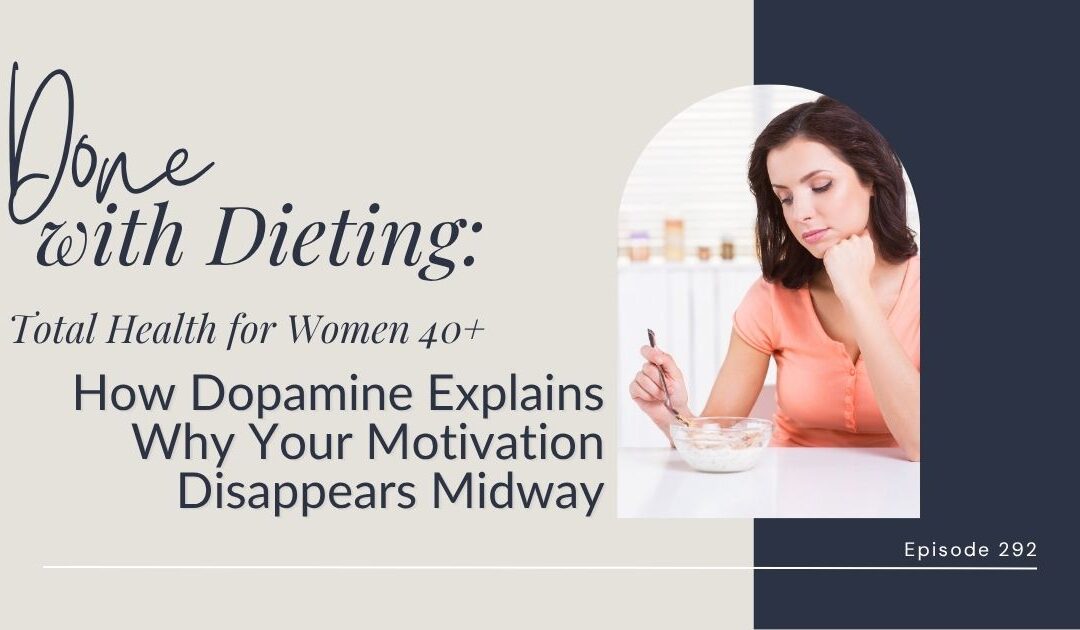
292: How Dopamine Explains Why Your Motivation Disappears Midway
[00:00:00]
Elizabeth: So I realized something recently, and I wanna see if this happens with you too. So somewhere around week three, week six, or week 12 of starting a new habit or behavior, whatever the week it happens to be for you, something you're doing that's actually working starts to feel like nothing. Like it's old hat, like it's not that big of a deal.
It's uninspiring, it's unmotivating, and the newness is gone, and you no longer get that little dopamine hit that tells you that you're doing it right, that your hard work is finally paying off. And your brain starts telling you quietly, without asking, that it's boring or maybe even that all the effort that you're putting into it isn't working anymore.
But it is working. What changed isn't the plan, it's your brain chemistry. Today, I am breaking down the actual reason good habits stop seeming to work, and why staying in [00:01:00] that flat stretch anyway is where the real change is actually getting built. So stick around. This one might explain more of your last 10 years of starting over than you would expect
Welcome to the Done with Dieting Total Health for Women over 40 podcast, the podcast for women who are done with the start over cycle and ready for a way of taking care of themselves that actually works.
Hey everyone, welcome back to Done with Dieting, the podcast for total health for women over 40. I am your host, Elizabeth Sherman, and I am super glad that you are here with me today. So I wanna start out because a few weeks ago, I gave a talk to a corporate wellness initiative that I'd said yes to months earlier.
For days before, I was living inside it. I was honing the presentation, I was editing the slides, I was running my lines in my head while I made coffee, and again on my long walk in the afternoon. And that [00:02:00] kind of prep has nothing to do with being unprepared.
It's what caring looks like from the inside, right? Then the talk happened, and it went well. I could actually feel it going well while I was up there talking to the audience, and afterwards my phone just lit up. A screenshot of notes someone had taken, a message from a woman telling me that a specific line I'd said was staying with her, and I was so on cloud nine.
I was so excited, and the feeling was the kind where you can't sit still, and you don't really want to. But then a few days later, everything was over. The walking on clouds, the feeling like I was successful, like I was on top of the world. I was back at my desk, and something felt not so much off, but just flat, a little hollow in a way that didn't really line up with anything that had actually gone wrong, because nothing [00:03:00] had gone wrong.
The talk had landed. People were still saying really nice things about it, but they had moved on. The high for me was gone, and in its place was this quiet, nagging sense that something just wasn't right. I caught myself picking my phone back up more than once that day, half hoping that there would be another message waiting, that another opportunity moving forward would pop up.
But there wasn't a new opportunity, and if there had been, I'm not sure that it would've actually touched what I was actually feeling in the moment. And so this got me thinking about something a little bit bigger than just the feeling that I was having and the feeling that we get after a win. Why does it feel like something broke or isn't right even when nothing has gone wrong?
Why does the drop after a win feel so much like [00:04:00] failure when nothing about the win actually failed? Now, that question is what this episode is all about. Not necessarily speaking gigs specifically, but the flat stretch that shows up in the middle of any real change, the one where the thing that used to feel exciting, whether it's weight loss or sleeping better or whatever it is, that starts to feel mundane.
Now, you know this one. It's the third week after a new hairstyle and nobody's noticed, so you stop noticing too. It's the scale that dropped two pounds and then just sat there. It's the sleep that's actually decent now, so decent that you've almost forgotten what bad sleep felt like, which means that you stopped registering it as a win.
It's the strength that you built that let you carry your own suitcase without asking for help, and now carrying your own [00:05:00] suitcase is just what you do. Your brain reads all of that as something going wrong, but it isn't. But you need to understand why it feels that way before you can stop treating the quiet stretch like proof that something's wrong and that you need to stop, that you're failing.
So let's talk about what's actually happening in your body when the win stops feeling like a win, and why the thing that you've been chasing to fix it, more or new, is the exact thing that's kept you stuck. Now, here's the distinction that matters. Winning is hitting the mark. Growth is what actually produces the good feeling underneath it.
Now, most of the time, we treat them like they are the same thing, and the first time they might be. They usually are.
The first time that you do something, hitting the mark and growing into [00:06:00] something new happen at the same moment, and that's why it feels so big. You're not just accomplishing something, you're becoming someone slightly different than you were before you did it. The 10th time you do that same thing, you are still winning.
You are still hitting the mark. But the growth already happened back on day one or day two, and your brain knows it. So the feeling fades even though the accomplishment didn't get any smaller. It just stopped being new and shiny. This isn't you being ungrateful or broken in some way that makes you unable to appreciate your own progress.
This is dopamine doing exactly what it's built to do. Dopamine doesn't fire because something is good. It fires because something is new or because you're making measurable progress towards something that you want. The first time carries both. The [00:07:00] 10th time carries neither, because you already know how it ends, and you've already arrived.
So your brain, which is alread- so your brain, which is only trying to conserve resources and pay attention to what actually needs attention, quietly reduces its response to something it now treats as old hat. Think about the scale for just a second, since that's usually where this shows up first.
Start any new way of taking care of yourself, and the number tends to move in the first couple weeks. Your water weight is coming down and your sleep improving enough to shift everything else with it. That early drop feels substantial. You get on the scale expecting it to tell you something new, and for a while it does, but then it stops moving dramatically.
So instead of a two-pound loss, you're only having a half-pound loss, even though you're still doing everything you were doing before, and stepping on the scale stops paying off the way that it used [00:08:00] to. Now, that's not your body failing you. That's the same mechanism at work. The early drop was new information.
Every check-in after that is just confirming what you already know, and confirmation doesn't fire the same way that discovery does. Now, you're just human. That's not a flaw in you. That's the system working exactly as it's designed.
Now, a brain that got just as excited about the hundredth rep as the first one would be a brain that never learned anything. Kind of like a dog, right? Because everything would feel equally urgent all the time, and exciting. The fading isn't the problem, it's the proof, the mechanism that it's doing its job.
Now, here's where it turns into a trap, though. Once you know, even without realizing you know it, that new things produce that hit and repeated things don't, you start chasing new. A new program, a new protocol [00:09:00] some influencer swears by that fixed everything for her.
And not because the old one stopped working, but because the old one stopped being exciting, and somewhere along the way, your brain started reading exciting as working and boring as broken. That's why program hopping feels so productive when you're doing it, and does so much actual damage over time.
Because every new start gives you a fresh hit of novelty, which feels like momentum, but you're not building anything. You're just resetting the novelty response over and over and over again, and mistaking the reset for progress. And it costs you more than the time or the money that you spent starting over again.
Every single time you abandon something that was actually working because it stopped feeling exciting, you teach yourself something underneath it, that boring means broken, and that you can't be [00:10:00] trusted to stay with something once the newness wears off. Now, that lesson adds up. It's part of why the next new thing has to work harder and harder to win you over, and why eventually nothing feels like it's gonna stick.
So let me ask you something, and I want you to actually sit with it instead of answering too fast. Are you someone who needs something new to stay engaged? Not new as in a huge overhaul, but new as in different enough to notice. A different app, a different fitness program whose moves haven't started to feel familiar yet.
Look around your house for a second if you want proof. A drawer of supplements that you tried for six weeks and then just abandoned. A few journals from different tracking systems, each one filled in for about two and a half weeks before it gets set- Thrown in the pile.
A clo- a closet with workout gear from more than one [00:11:00] approach, none of them abandoned because they actually failed. Think about your relationship with plans in general, not just health plans.
Do you finish things, or do you get about 70% the way in and start quietly looking around for the next thing even while you're currently doing the existing one? Is there a version of you that reads 12-week program and feels a small drop in your stomach around week nine, not because it stopped working, but because it stopped being interesting? Here's another way to check. Think about the last time something in your health routine started to feel boring. Not hard, just boring.
What did you do with that feeling? Did you sit in it? Or did you take it as information, as a sign that this plan must be the wrong one, and then go looking for something that would give you that early excitement back? Because here's the thing about [00:12:00] boredom.
It doesn't actually mean that anything is wrong. It just means that the newness wore off. But if you've spent years reading boredom as proof that something isn't working, as your cue to start over somewhere else, you've been working from bad information the whole time.
And not because something's wrong with your stick-to-it-iveness, but because nobody ever told you what boredom actually is. Now, none of this means that you're incapable of sticking with something. It just means that you've spent years mistaking the feeling of newness for the feeling of something that's working, and mistaking the absence of that feeling for something being wrong.
That's an easy thing to confuse when nobody ever separates the two of them for you. And again, this isn't a flaw for you to fix right now. I'm not gonna hand you a five-step plan to become a person who loves repetition. I just want you to notice, honestly, whether this [00:13:00] is you and your profile, whether the thing that's ended a dozen well-built plans in your life wasn't that they had failed, but that they stopped feeling new and you mistook that for failure.
Now, let me show you where this actually plays out, because it's not theoretical. In my own life, in the last couple of years, it's been in my business. The first time someone asked me to speak on their podcast or talk to a company about health, it felt like a huge win. It was so exciting. I would tell my husband, and then I'd sit with it for days.
I'd announce it on Instagram, and I'd be half in disbelief that someone wanted to hear what I had to say. Now, those invitations happen regularly enough that I don't always tell anyone right away. It's something that just happens. Some weeks I say yes to two or three without much fanfare at all, and that doesn't mean that they stopped mattering.
Every single one is still a real opportunity, a gen- still a genuine win that I worked towards. It's just quieter now because I'm not new at this anymore, and my brain has stopped treating [00:14:00] it like it's something amazing. I used to prepare for weeks. Now I prepare the way that I'd prepare for any regular part of my work because that's what it's actually become, a regular, valuable part of my work, not a rare event that I have to brace myself for.
Health works exactly the same way if you slow down enough to notice it happening in real time. And I want you to think about strength training.
Maybe it's the first time that you move up to the next set of weights. I mean, that's a moment. You notice it. You might even say something out loud to whoever's around you. Or the first time that you catch a flash of actual muscle in your arm in a mirror that you weren't even trying to flex in. That is a huge deal.
The 50th time you lift that same weight, though, it's not really a moment anymore because you've done it. [00:15:00] It's just what you do. It is your new normal. But you're still strong. You didn't lose anything. The accomplishment became your baseline, and that's not a downgrade. A baseline is actually a bigger deal than a moment.
A moment happens once. A baseline is something that you carry into every single day after it Or let's take running for an example. The first time that you make it a full mile without stopping to walk, you probably wanna tell everyone. It's so exciting. A few weeks later, you're running that same mile without thinking about it, so you push to two miles instead, and eventually, two miles becomes the thing that you don't even think about either.
Each new distance gets its moment, and then it quietly becomes your new normal for you. Ask a woman who's been running for [00:16:00] years what mile three feels like, and she probably will be like, "I don't know. It feels like mile three." And not because it stopped being impressive, but because it stopped being new and noteworthy, which is a very different thing.
Now, I'm in the middle of one of these right now, and actually, it's with sleep. For reasons that are unimportant to the context of this episode, my sleep has been genuinely good lately. I wake up rested, my Apple Watch reports that my scores are in the high 90s and a very high category, and I'm not tossing and turning at 3:00 in the morning the way that I used to, unless there's a pet involved.
And I've already caught myself starting to take it for granted, forgetting how recently I would have given my arm for almost anything like a night like the ones that I'm having right now, waking up feeling super relaxed. Now, if you'd told me a year ago [00:17:00] that good sleep would eventually start to feel unremarkable, I would've never believed you.
I would have taken unremarkable immediately. Now that I have it, some mornings, I barely register it at all. Now, here's what all of these have in common. Each one started off as a massive win, and each one became background, and that's not you losing the thread or getting complacent or taking your own progress for granted in some careless way.
That's what it actually looks like when something graduates from a win to your new normal. The size of the feeling was never a reliable measure of how much that thing mattered. So let's talk about boredom directly because I think it gets treated like a problem when it's actually just a feeling. Now, boredom is real.
It's not comfortable, and I'm not gonna sit here and tell you that it [00:18:00] feels good because, quite honestly, it doesn't. But it's not a warning sign either. It's not proof that something has gone wrong with your plan, your body, or you. It just exists, and we can use it for good. Boredom is a feeling showing up the way feelings do without needing to do anything beyond what it is.
In a health context, boredom usually shows up as restlessness, an itch to blow up a plan that's actually working just to feel something different again. Every single one of the journeys that we just talked about, the speaking, the strength, the running, the sleep, has a stretch in the middle where the internal or external celebration just seems to peter out.
Nobody's clapping for the 50th podcast interview the way that they clapped for the first. Nobody's commenting on your arms two years [00:19:00] in the way that they did at month two. The applause thins out, and if you've been relying on it, that thinning feels like something mediocre or unimpressive. But here's what's actually happening in that stretch.
This is where who we are gets built, not where it falls apart. Anyone can keep going when the winds are big and loud and coming fast. That part doesn't require much from you. Your brain does most of the work because the dopamine is doing most of the work. The real test isn't whether you can show up on the day the scale drops or the day someone tells you how great you look.
It's whether you can show up on the days when nothing is happening, when the wind is quiet or invisible or just not there yet. That's not about the winds, and it's not about some unbroken streak either. It's about [00:20:00] what you do when no one is clapping, when there's no screenshot to save, no number on the scale telling you that you're right to keep going.
It looks incredibly unremarkable from the outside. The same walk you took yesterday, the same plate you made without thinking too hard about it. Nothing to post, nothing that would make a good before and after. Just you doing the thing again for reasons that have stopped being exciting and started being just who you are.
Whether you keep showing up like that without the hit, without anyone watching, is the actual thing that determines whether this sticks. That's not a small thing to ask of yourself, but it's also not a mystery or a personality trait that some women have and others don't. It's a stretch that you can learn to move through the same way that you've moved through every other uncomfortable stretch in your life [00:21:00] that you didn't think that you would survive at the time.
So here's what I want you to take from all of this. The mundane stretch isn't a sign that something is wrong.
It's not your body failing or you losing not moving forward. It's the part that was always going to come in every single change that you've ever made or ever will make. The applause was never gonna last forever. It wasn't built to. That's true of the speaking gig that I opened this episode with, and it's true of every plateau, every stretch of decent sleep that eventually stops feeling remarkable.
None of it means something broke. It just means the newness did what newness always does. It passes. And here's the part I actually care about most. This is where self-trust gets built. It does not get built in the exciting week, nor does it get built in the compliment or the [00:22:00] number on the scale. It gets built in the quiet stretch, the boring days when nobody's watching and nothing is confirming anything.
That's the actual proof. Not that you can keep going when everyone is cheering you on, that's easy, but that you can be trusted to show up when no one is. Here's what I won't pretend, though. You can hear all this, nod along, recognize every single bit of it, and still find yourself in the middle of your own plateau, flat stretch, whatever you wanna call it, three weeks from now wanting to quit.
That doesn't mean this episode didn't land or that you weren't paying attention. Seeing the pattern clearly and being able to stay inside of it when it's your actual life, your actual week where nothing feels like it's working, those are two very different things. And understanding why the drop happens doesn't automatically make the drop easier to sit in.[00:23:00]
That's not failure on your part either. It's just the honest truth about the gap between knowing what to do and actually applying it and living inside of it. Knowing why doesn't buy you the follow through. It just means that the next time you find yourself wanting to quit for reasons that you can't quite name, you'll at least recognize what you're standing inside of.
So thank you so much for spending this time with me today. This one has been sitting with me for a few weeks now.
I hope it gave you a little bit more compassion for whatever flat stretch or plateau that you're in right now, health or otherwise. If you wanna know specifically where your own plateau tends to show up and what's actually getting in your way when the excitement fades, take the free quiz at elizabethsherman.com/quiz.
I'll also put that in the show notes. It takes a few minutes, and it'll show you exactly what's [00:24:00] getting in your way. That's all I have for you today. Have an amazing week, and I will talk to you next time. Bye-bye.
Hey, before you go, if you are someone who says, "I know exactly what I should be doing, I just don't do it," hey, if that's you, I made something for you. It's a free three-minute quiz that gets underneath that exact problem, not to give you more information, but to show you the specific reasons your follow-through keeps breaking down, because it's not the same for everyone.
And once you can see your pattern clearly, everything else seems to change. Head to elizabethsherman.com/quiz. It's free, it's fast, and it's honest.
Enjoy the Show?
- Don’t miss an episode, follow the podcast on Spotify and subscribe via Apple Podcasts or RSS.
- Leave me a review in Apple Podcasts.
- Join the conversation by connecting with me on Social!



Elizabeth is a Master Certified Life and Health Coach with over 20 years of experience, dedicated to helping women in midlife thrive through holistic health and wellness. Her personal journey began with a desire to reduce her own breast cancer risk, which evolved into a mission to guide women through the complexities of midlife health, from hormonal changes to mental clarity and emotional resilience.
Elizabeth holds certifications from prestigious institutions such as The Life Coach School, Precision Nutrition, and the American Council on Exercise, as well as specialized training in Feminist Coaching and Women’s Hormonal Health. Her approach is deeply empathetic, blending her extensive knowledge with real-life experience to empower women in their 50s and 60s to build sustainable health habits that last a lifetime.
Recognized as a top voice in women’s health, Elizabeth speaks regularly on stages, podcasts, and webinars, inspiring women to embrace midlife with energy, confidence, and joy. Her passion is helping women regain control of their health, so they can fully engage in the things that matter most to them—whether that’s pursuing new passions, maintaining strong relationships, or simply feeling great in their own skin.