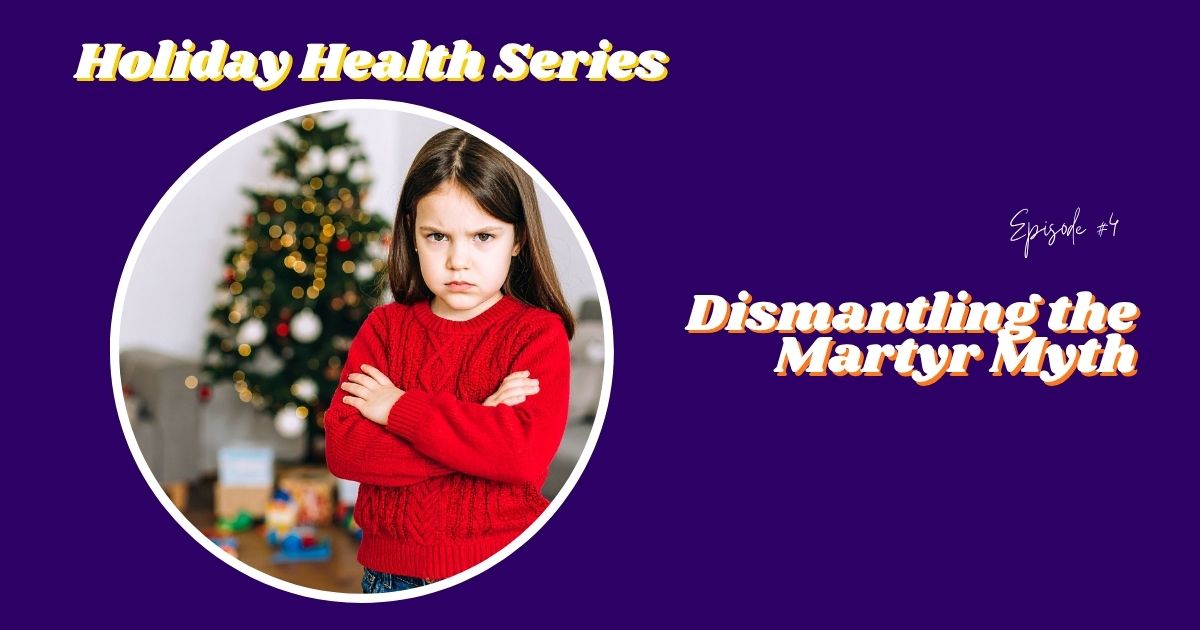
In this episode of Total Health in Midlife, Elizabeth Sherman pulls back the curtain on one of the biggest reasons women end the holiday season feeling exhausted, resentful, and disconnected from themselves: the Martyr Myth.
If you’ve ever found yourself doing everything for everyone else—wrapping the gifts, cooking the meals, organizing the schedule—while telling yourself, “It’s just easier if I do it,” this episode will hit home. Elizabeth explains why high-achieving women so often fall into this role, how over-functioning quietly destroys your health, and why taking your hands off the wheel (even a little) might be the most healing thing you do this year.
With a mix of humor, tough love, and compassionate truth-telling, she’ll show you how to stop running on fumes and start reclaiming your energy, boundaries, and self-respect. Because you can’t keep calling exhaustion “love” and burnout “tradition.”
This is part one of Elizabeth’s 4-part Holiday Health Series, helping midlife women feel good in their bodies, enjoy the season without guilt, and step into January energized instead of depleted.
The Biggest Problem Midlife Women Face Regarding Holiday Burnout
Most women in midlife carry the invisible load of making the holidays happen for everyone else. From meal planning and gift buying to emotional management and conflict prevention, they do it all—and believe they don’t have a choice. This constant over-functioning creates chronic stress, hormonal imbalance, fatigue, and emotional burnout.
The root issue isn’t lack of willpower—it’s the belief that “no one else can do it right.” Over time, this mindset trains everyone around you to under-function, leaving you overworked and unseen. You think you’re being helpful, but your body and nervous system are paying the price. The result is a cycle of exhaustion, resentment, and poor health that repeats every holiday season.
To break the pattern, you must understand that control has a cost. Every “I’ll just do it myself” moment erodes your energy, immune system, and ability to rest and recover. Recognizing this is the first step toward reclaiming your time, your well-being, and your sanity.
WHAT YOU’LL LEARN
- Why the “holiday martyr” mindset keeps women trapped in exhaustion—and how to finally step out of it
- How over-functioning and people-pleasing create chronic stress and physical symptoms in midlife
- Simple ways to let go of control without letting everything fall apart
- What it looks like to model real leadership and love through delegation and boundaries
- How to enter January proud, not punished
What You Can Do Right Now
Start by noticing where you’ve taken on responsibility that doesn’t belong to you. Choose one low-risk task to delegate—something that won’t ruin Christmas if it’s done imperfectly. When someone else does it, resist the urge to hover, correct, or redo it. Every time you stay quiet and let them learn, you retrain your family to participate instead of depend.
Then, carve out space for you. The Feel Good Holiday Playbook gives you the structure to protect your health, energy, and peace of mind during this busy season. It’s not about restriction—it’s about rhythm. A simple plan to help you stay grounded, eat in a way that feels good, and actually enjoy the holidays without starting over in January.
The Listener Takeaway: Why This Episode Matters
If you’re tired of waking up on January 2nd feeling puffy, depleted, and frustrated, this episode will help you see exactly why that happens—and how to stop it. You’ll understand that the choice to “do it all” is still a choice, and you have the power to make a different one.
This episode reminds you that letting go isn’t failure—it’s freedom. You don’t need to prove your worth by how much you give. When you stop being the holiday martyr, you make room for rest, joy, and real connection. Because this season, you don’t have to do it all. You just have to choose you.
RESOURCES
- Feel Good Holiday Playbook
- Episode 1 – Holiday Food and Body Triggers
- Episode 2 — The Invisible Load and Boundary Setting
- Episode 3 – Bare Minimums
- Episode 4 — Dismantling the Martyr Myth
- Episode 243 — The High-Functioning Co-Dependent with Sara Fisk
- Episode 123 — How People Pleasing Impacts Your Health
- Episode 127 — Best Supporting Actress in Your Life
Are you loving the podcast, but arent sure where to start? click here to get your copy of the Total Health in Midlife Podcast Roadmap (formerly Done with Dieting) Its a fantastic listining guide that pulls out the exact episodes that will get you moving towards optimal health.
If you want to take the work we’re doing here on the podcast and go even deeper, schedule an I Know What to Do, I'm Just Not Doing It strategy call—and start making real, lasting progress toward feeling better, having more energy, and living with confidence in your body. click here to to book your call today.
I am so excited to hear what you all think about the podcast – if you have any feedback, please let me know! You can leave me a rating and review in Apple Podcasts, which helps me create an excellent show and helps other women who want to get off the diet roller coaster find it, too.
WATCH, LISTEN TO, OR READ THE EPISODE:
LISTEN HERE:
Full Episode Transcript:
HHS-4: The Martyr Myth
Elizabeth: [00:00:00] Be honest. How many times have you promised yourself that this holiday season would be different, that you would slow down, you would take care of yourself and actually enjoy the season, and then before you know it, you’re back in that same old role, the one who does everything for everyone while quietly just falling apart and resenting everything inside you tell yourself that you don’t have a choice, that if you don’t do it.
Well, who’s going to that? If I delegate it, that they will mess it up. It’ll just be easier if you handle it yourself. But here’s the thing, it’s actually not easier and it’s costing you your energy, your peace, and your health. And every year that you keep running this same pattern, it’s just gonna get harder to crawl out of.
So in this episode, I want to ask you something that no one else will.
Are you really ready to [00:01:00] keep being the woman who saves the holidays for everyone else, or are you ready to finally save yourself? Because you don’t have to wake up on January 2nd feeling depleted, resentful, and desperate for a do-over. There’s actually another way to do this one where you still show up, you still care.
You still create magic, but you don’t lose yourself in the process. So let’s talk about how to dismantle the martyr myth and start choosing you.
Welcome to the Total Health and Midlife Podcast, the podcast for women over 40 who want peace with food, ease in their habits, and a body that they don’t have to fight with.
Elizabeth: Hey everyone. Welcome to the Total Health and Midlife podcast. I am Elizabeth Sherman, your host, and I am so super excited that you are here with me today and you are listening to the fourth installment of the Holiday Health Series.
so let me ask you this [00:02:00] question. How do you wanna feel after the holidays are over on January 2nd? Do you wanna wake up tired? Maybe a little puffy? Your pants are snug with
a sense of dread about having to get back on track. Of course, not looking at the leftover cookies on the counter and thinking, I can’t believe I have to start all over again. Maybe your body feels a little achy because you haven’t moved in weeks, your sleep’s been wrecked, and honestly you are just done.
Or do you wanna open your eyes on January 2nd feeling like. Yeah, that was good. We had a really good holiday. I had fun. I took care of myself, and I don’t need to undo anything. You have no regrets. You feel proud, energized, you enjoyed the parties, the food, the people, and you didn’t lose yourself in it.
You’re ready to keep going. That’s what we’re talking about today. Because the [00:03:00] truth is, is that most women, especially women like us in midlife, we end up in the first scenario, not because we don’t know what to do, but because we spend six weeks running ourselves, ragged doing everything for everybody else, saying yes.
When we’re already maxed out, staying up late wrapping gifts or baking, just one more batch, then we wonder why we feel resentful, exhausted, and like we need to complete a do-over once the new year hits. This is my fourth installment of the four part Holiday Health series, and today we are gonna dismantle what I call the martyr myth.
We’ll talk about why so many of us slip into this role, why it’s hurting our health, and how you can start making different choices this year. You don’t need to listen to all four episodes in order, but they do tie together beautifully and they will give you the tools to [00:04:00] actually enjoy the season without falling apart in the process.
So it starts out innocently enough, doesn’t it? Like you love the holidays, of course you do. You love creating memories. You want your family to feel cozy, that magical feeling. The smell of cookies, the twinkle lights, the perfect gift that makes someone look at you and say, how did you know? In the beginning, it feels good.
You want to do these things. You’re building your family, your home, your traditions. Maybe you’re trying to prove something to your mother, to your in-laws, maybe even to your husband or yourself, that you can do it, that you’re capable.
You can hold it all together, make it look beautiful and make it look easy, and you are good at it. You’ve got systems. Now, which stores have the best deals? When to start the cookies, how to wrap a [00:05:00] gift so that it looks like Martha Stewart herself stopped by your living room.
Every year you refine it just a little bit more. You get better, and there’s a sense of pride in that, in the competence. And then one day without realizing the whole thing starts to shift. It’s no longer for fun. It feels more like an obligation because somewhere along the way it stopped being shared.
You became the only one who knows how to get everything done. You can’t ask your partner for help because they’re just going to do it wrong, right? And the kids forget it. They’ll make a mess. And deep down, if you’re honest, part of you likes being the one who knows how to fix everything. You like being needed.
You like being the hero, the one who swoops in and saves Christmas morning from disaster. Of [00:06:00] course, you’d never say any of that out loud, but it’s true. You want to feel special, revered. You want your family to see how much you care, but now you don’t feel special. You feel tired. You feel taken for granted.
Maybe even a little bit invisible. You’re running around while everyone else is sitting by the fire watching elf and you’re thinking, of course they can relax. They don’t have to do anything. And underneath the exhaustion is this low grade resentment. You love them. Of course you do, but you also kind of hate that.
No one notices all that it takes to make it all happen, and that’s the trap of the murder myth. You have built a machine that runs on your effort and everyone around you has learned to let it. You believe that you don’t have a choice. [00:07:00] You tell yourself they need me. I’m supposed to do this. This is my role, it’s my responsibility.
But that belief that you don’t have a choice is actually what’s keeping you stuck. So let’s talk about what’s really happening here. What you’re doing actually has a name, and it’s called over-functioning. Over-functioning is when you take on more responsibility than is actually yours to take on. You.
Step in before someone else has the chance to figure it out, to fix it or fail. You anticipate everyone else’s needs before they even know and have them, and on the surface it looks admirable, right? You’re dependable. You’re the star. You’re organized. You’re the one that people count on.
They tell you how important you are, the things that you’re doing. How could I ever [00:08:00] survive without you? But underneath that shiny exterior, it’s exhausting because you have built a life where everything depends on you doing it. Now, here’s the uncomfortable truth. You didn’t mean to do this. None of us do.
It starts out as love. You’re helping, you’re supporting. You just want things to go smoothly. But every time your husband forgot to buy the right type of flower and you just did it yourself, you reinforce the message that I will take care of it. Every time your kids left a kitchen in the mess and you cleaned it up, instead of teaching them, you said.
You don’t have to worry. Mom’s got it. And so little by little you trained everyone around you to rely on you. That’s what over-functioning is. It’s high functioning codependency. It’s people pleasing in [00:09:00] disguise. It’s doing for others what they’re perfectly capable of doing themselves. Because you cannot stand to watch it go wrong and look, I get it.
You think if I don’t do it, it won’t get done right, or it’ll be chaos. They will suffer, I’ll suffer as a result. You tell yourself it’s just easier this way. Easier in the short term has become harder in the long term because now you are doing everything and no one around you knows how to step up. The irony is that all that caretaking, all of it came from love and responsibility.
It’s actually created the very thing that you resent a house full of people who under function. Who wait for you to handle it because you’ve always done it and you won’t let them do it. People who [00:10:00] see you as endlessly capable, but not necessarily as a human. And I wanna be crystal clear on this. This isn’t about blame, this is about awareness.
Because once you start to see it, you can change it. So here’s the part that no one likes to hear. When you keep living this way, when you over-function year after year, the cost isn’t just your time or your sanity. It actually has health implications too, because all of that stress, it doesn’t just evaporate when the tree comes down, it builds up in your body.
The late nights, the skipped workouts, the, I’ll just grab something quick, dinners and the extra wine because it’s the only quiet moment that you get. That’s not just holiday indulgence, that’s your nervous system begging for a break. When you’re constantly on alert managing everyone else’s happiness, your [00:11:00] body doesn’t know the difference between wrapping gifts at midnight and running from a tiger.
Your stress hormones stay high. You wake up wired but tired. You crave sugar and caffeine to keep going, and then you wonder why you can’t sleep. And the cruel part is that you probably just tell yourself, it’s just for now, I’ll start again on January, but January then rolls around and you’re running on fumes.
You’ve gained a few pounds. Your clothes feel tight, your mood is low, and you start the new year already behind. If you keep doing this, it doesn’t magically get better next December. It becomes a tradition. The tradition of burnout, and I’m going to say this with love, but also some tough truth. If you wanna stay in control, that is fine.
You can, you are capable, you will make it work. You always do, [00:12:00] but you don’t get to complain that you’re exhausted and no one is helping because at this point you are choosing it. That’s the trade off control. Or peace. You can’t have both. Now, I know that sounds harsh, but this is where the real decision lives.
You either keep proving how capable you are, or you start proving that your wellbeing matters too. Because the truth is no one is going to hand you your time back. No one is going to say, Hey mom, you’ve done enough. Go take a nap. That’s your job. That’s the boundary that you have to set. And until you do this cycle of doing too much eating or drinking to cope, crashing into January, promising to do better will just keep repeating itself.
Like one of those holiday movies that plays on Loop [00:13:00] on Sundays. So what’s the way out of this? You have a choice to make. You can keep controlling everything and keep paying for it with your peace, your energy, and your health. Or you can decide that this year you are going to do it differently. And listen, I get it.
Letting go of control sounds lovely in theory, but in practice it is brutal.
It’s watching your husband hang the lights unevenly and fighting the urge to fix them. It’s seeing your kid wrap a gift, like it survived. A small explosion and smiling. Anyway, it’s knowing the dishwasher is loaded, wrong, and. Walking away, you start small, low risk delegation. Let someone else pick up the paper plates.
Let your teenager plan one side dish. Let your partner be in charge of the stocking stuffers. Even if [00:14:00] that means everyone gets a weird flashlight from Home Depot. And here’s the important part, when they mess it up and they will, you have to zip your lip. Don’t hover, don’t correct. Don’t redo it. After they walk away, they will never learn to help.
If every attempt gets met with, nevermind, I’ll just do it myself. This is how we untrain the people that we’ve trained to under function. We let them figure it out. We let them fail. We make peace with imperfection because this isn’t really about paper plates or light strands. It’s about leadership, real leadership, the kind that models responsibility and balance and humility, the kind that says, I trust you enough to let you try.
Letting go isn’t failure. It’s love, and when you stop doing everything, [00:15:00] you are not just freeing yourself, you’re giving everyone else the opportunity to grow up a little bit. And that is a gift not just for you, but for your family too. So this season, practice the art of good enough. A good enough dinner,
good enough decorations, good enough gifts, because good enough is what creates space for you to breathe. Your family might not notice the intricately designed holiday tablescape, but they will remember the energy that you brought to the holidays and that space, that’s where your energy, your joy, and your health come back.
So here’s my challenge for you. If you are tired of feeling like the woman who does it all and gets nothing back, but exhaustion, this is your moment. Stop choosing Murderdom. Start choosing yourself. You can [00:16:00] keep running the same play, doing everything for everyone else, resenting it, and then calling it tradition.
Or you can decide that this year the tradition changes because here’s the truth. You don’t need anyone’s permission to take up space in your own life. You don’t have to earn your rest. You don’t have to prove your worth through baked goods or gift receipts. You just have to make the decision that you are done abandoning yourself in the name of being helpful.
And yes, it is totally uncomfortable. It’s going to feel awkward at first to say no, to delegate, to do less, but that discomfort is a sign that you are growing because the alternative is keeping things exactly as they are. Is a guarantee that come January you will be right back where you’ve always been worn down, frustrated, and starting over.
So if you [00:17:00] are ready to do this differently, to actually take care of yourself during the holidays instead of just surviving them, then I want you to grab my feelgood holiday playbook. This isn’t a diet or a detox. It’s a simple structure that helps you to create space for you. It’s filled with practical tools, reflection prompts, and quick strategies to help you enjoy the holidays without losing control or sacrificing your health.
It’s going to help you to find your rhythm again, to eat in a way that feels good to rest, to move, and to show up for yourself even when life gets busy. You don’t have to wait until January to start over. You can start right now today by deciding that your health and peace matter as much as everyone else’s joy.
So that when you wake up on January 2nd, you’re not saying, Ugh, I need a reset. You’re saying, that was the first holiday I’ve ever gotten through without [00:18:00] abandoning myself. I feel great. That’s the new tradition.
This season, you don’t have to do it all. You just have to choose you. Now, if this episode hit home and resonated. And you’re ready to start protecting your time, your energy, and your health. Go download the feel good holiday playbook. It’s your step-by-step plan to stay grounded, take care of yourself, and still enjoy the season.
And if you want to go deeper into this work, check out the related episodes in the show notes, episode number 243 titled The High Functioning Codependent with Sarah Fisk. Episode number 123, how People Pleasing Impacts Your Health. And Episode 127 titled Best Supporting Actress in Your Life. They will help you to see how connected your emotional patterns are to your physical [00:19:00] wellbeing.
Thank you for spending this time with me today.
I will see you next week for our regularly scheduled. podcast episode. That’s all I have for you today. Have an amazing week. Don’t forget to go grab your copy of the Feel Good Holiday Playbook by going to elizabeth sherman.com/feel-good-playbook, and make sure that you go back and listen to the other episodes of the Holiday Health Series.
If you haven’t done that before. That’s all I have for you. Have an amazing day. Bye bye.
The holidays can bring up a lot old patterns, food, noise, stress, expectations. Look, I’m not here to tell you to skip the stuffing or say no to cookies, but if you want to feel good come January and not bloated, burned out, and full of regret, you are going to want the feel good holiday playbook if you’re craving something different this year, something that feels more intentional, more peaceful, more you.
I want you to [00:20:00] go check out the Feelgood Holiday playbook. It’s not a plan, it’s a lifeline. Get your copy at elizabeth sherman.com/feelgood-playbook and let’s make this season different.
Enjoy the Show?
- Don’t miss an episode, follow the podcast on Spotify and subscribe via Apple Podcasts or RSS.
- Leave me a review in Apple Podcasts.
- Join the conversation by connecting with me on Social!



Elizabeth is a Master Certified Life and Health Coach with over 18 years of experience, dedicated to helping women in midlife thrive through holistic health and wellness. Her personal journey began with a desire to reduce her own breast cancer risk, which evolved into a mission to guide women through the complexities of midlife health, from hormonal changes to mental clarity and emotional resilience.
Elizabeth holds certifications from prestigious institutions such as The Life Coach School, Precision Nutrition, and the American Council on Exercise, as well as specialized training in Feminist Coaching and Women’s Hormonal Health. Her approach is deeply empathetic, blending her extensive knowledge with real-life experience to empower women in their 50s and 60s to build sustainable health habits that last a lifetime.
Recognized as a top voice in women’s health, Elizabeth speaks regularly on stages, podcasts, and webinars, inspiring women to embrace midlife with energy, confidence, and joy. Her passion is helping women regain control of their health, so they can fully engage in the things that matter most to them—whether that’s pursuing new passions, maintaining strong relationships, or simply feeling great in their own skin.