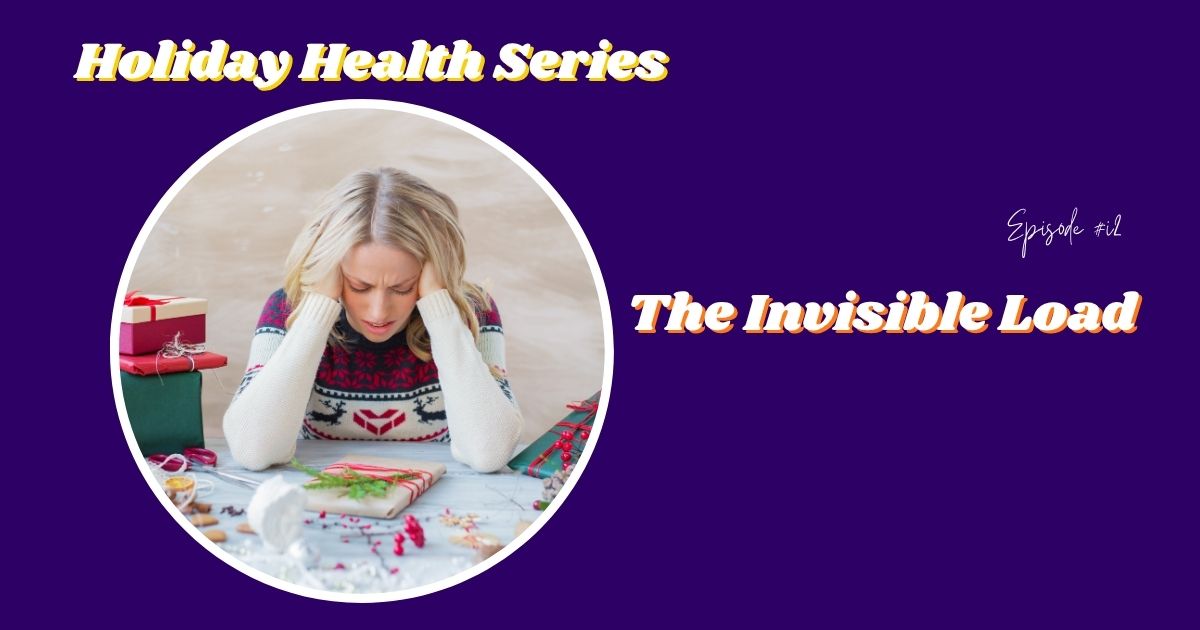
Between shopping lists, social calendars, and endless wrapping paper, it can feel like the entire weight of the holidays rests on your shoulders. You’re not imagining it — that invisible load is real, and it’s costing you more than just sleep.
In this episode of Total Health in Midlife, Elizabeth unpacks why so many women feel responsible for making the holidays “magical” for everyone else — and why that pressure leaves them exhausted, resentful, and off track with their health by January.
You’ll learn how cultural conditioning, people-pleasing, and “scope creep” quietly chip away at your energy and self-care, plus the one mindset shift that can help you reclaim calm and joy this season. This episode will show you that boundaries aren’t selfish; they’re the key to your sanity and your health.
If you’ve ever sworn you’d “do less next year” but somehow ended up doing even more, this conversation is your turning point.
The Biggest Problem Midlife Women Face Regarding the Invisible Load
Midlife women often carry an invisible mental checklist that runs nonstop through the holiday season: buying gifts, cooking, planning events, and managing everyone else’s happiness. This unspoken expectation — that they should be the “magic-makers” — is deeply ingrained in our culture. The result is a chronic sense of obligation, stress, and guilt that prevents them from enjoying the holidays or caring for their own well-being.
This invisible load doesn’t just lead to exhaustion — it directly affects physical health. Lack of sleep, emotional eating, skipped workouts, and over-drinking become coping mechanisms for the overwhelm. Over time, these small daily choices compound into burnout, hormone imbalance, and that “I feel off but can’t pinpoint why” feeling so many women describe. Recognizing the invisible load for what it is — unpaid, unnoticed labor — is the first step to reclaiming your energy and peace of mind.
WHAT YOU’LL LEARN
- Why women feel solely responsible for creating holiday joy — and how cultural conditioning keeps that cycle going.
- The hidden connection between stress, overeating, and midlife fatigue.
- A simple boundary-setting exercise that helps you find your “bare minimum” — and actually stick to it.
What You Can Do Right Now
Start by writing down everything you think you have to do this holiday season — from decorating to baking to shopping. Then, ask yourself: What’s truly required, and what’s optional? This process separates what’s essential from what’s nice-to-have, so you can focus your time and energy on what actually matters.
Make these decisions when you’re calm, not when you’re in panic mode. Keep that list somewhere visible and refer back to it whenever “scope creep” shows up — when someone asks you to do one more thing, or when you catch yourself volunteering out of guilt. Boundaries set from clarity, not chaos, are what protect your peace and your health.
The Listener Takeaway: Why This Episode Matters
The holidays don’t have to leave you frazzled, burned out, and starting over in January. When you create boundaries and honor your limits, you’re not taking away from anyone else’s experience — you’re adding to your own. You show up more present, less reactive, and more connected.
The invisible load doesn’t disappear overnight, but this episode will help you see that you have a choice. And every time you choose calm over chaos, rest over perfection, and presence over performance, you’re creating a future where you wake up on January 2nd feeling proud — not like you need a do-over.
RESOURCES
- Feel Good Holiday Playbook
- Episode 1 – Holiday Food and Body Triggers
- Episode 2 — The Invisible Load and Boundary Setting
- Episode 3 – Bare Minimums
- Episode 4 — Dismantling the Martyr Myth
Are you loving the podcast, but arent sure where to start? click here to get your copy of the Total Health in Midlife Podcast Roadmap (formerly Done with Dieting) Its a fantastic listining guide that pulls out the exact episodes that will get you moving towards optimal health.
If you want to take the work we’re doing here on the podcast and go even deeper, schedule an I Know What to Do, I'm Just Not Doing It strategy call—and start making real, lasting progress toward feeling better, having more energy, and living with confidence in your body. click here to to book your call today.
I am so excited to hear what you all think about the podcast – if you have any feedback, please let me know! You can leave me a rating and review in Apple Podcasts, which helps me create an excellent show and helps other women who want to get off the diet roller coaster find it, too.
WATCH, LISTEN TO, OR READ THE EPISODE
LISTEN HERE
Full Episode Transcript:
HHS-2: The Invisible Load
Elizabeth: [00:00:00] Alright, so let me ask you something. Why is it that when the holidays roll around, suddenly you become the project manager of Christmas? Like you are the only one who knows what to do. You’re the one buying the presents, wrapping them, decorating the house, planning the meals, juggling the calendar, and somehow everyone else just shows up and enjoys the magic that you create.
Meanwhile, you’ve got a million balls in the air. You’re stressed, exhausted, and maybe even eating or drinking more than you want to, just to take the edge off. And the thing is, is that half the time. No one even notices all of the work that you’re putting in. If you’ve ever ended the holiday season feeling frazzled, resentful, and promising yourself, next year, I’m gonna do less.
And you find yourself right back in the same spot. I want you to keep listening because today we are talking [00:01:00] about the invisible load of the holidays, why it always falls on women, how it’s affecting your health, and more importantly, what you can do differently this year so that you can actually enjoy yourself without burning out.
So stick with me because by the end of the episode you’ll see a way to step into January calm, proud, and free from this exhausting cycle.
Welcome to the Total Health and Midlife Podcast, the podcast for women over 40 who want peace with food, ease in their habits, and a body that they don’t have to fight with.
Hey everyone. Welcome to the Total Health and Midlife Podcast. I am your host, Elizabeth Sherman, and I am so super glad that you are here. So I’ve been in the health space now for close to 20 years, and every single year I’ve watched the same thing happen. My clients work so hard all year round, making progress with their health.
Feeling [00:02:00] stronger, maybe even finally getting into a rhythm with food or exercise, and then bam, the holidays hit, and suddenly it’s like all of those good intentions, all of those great habits that they’ve accumulated, get pushed to the side and the season takes over. And by January she’s frustrated and telling herself, okay, I, I just need to start over at the beginning.
I don’t want that for you. That’s why I created this holiday health series. These episodes are here to help you, not just make it through the season, but to actually thrive despite all of the demands on your time, your energy and attention.
You don’t need to listen to them in order, but together they will give you the tools to create a calmer, more peaceful holiday and one where you enjoy yourself and don’t feel like you need a do-over when the new year rolls around. Now, the first episode dropped last week about holiday food [00:03:00] and body triggers, and I’ll be releasing two more over the next two consecutive weeks.
Each one covers a different piece of the puzzle, and my hope is that by the time that we ring in the new year, you will feel grounded, confident, and proud of how you navigated the season. Now, today’s topic is one that hits home for just about every woman I know. The invisible load. You know what I’m talking about too, right?
The endless mental checklist. Who needs gifts, what food needs to be cooked, which parties are coming up? Whether you have enough wrapping paper, if the house looks festive enough, it’s the stuff that no one even seems to notice, but somehow you’re in charge of all of it. And if you feel like it’s all on your shoulders, you’re not crazy.
You’re definitely not alone either. So let’s dive into this juicy topic. So let me ask you, why does it always seem to fall [00:04:00] on you? Now it’s not an accident. We grew up in a culture that taught women to be magic makers. Right? From the time that we were little girls, we were shown commercials of moms setting the holiday table, arranging the perfect decorations, pulling the Turkey out of the oven while everyone else just shows up and enjoys, like think about a Norman Rockwell painting.
The message here was clear. If the holiday is going to feel special, it’s up to mom, and that conditioning runs deep. It’s so automatic that most of us don’t even pause to ask, do I actually want to do any of this? I’ll bet that question doesn’t even cross your mind, and instead you just feel this heavy sense of responsibility, like it’s your job to make sure that everyone else has the most magical holiday ever.
And so you [00:05:00] pile it all on. You buy the gifts, not just for your kids or your partner, but for the extended family, the teachers, the neighbors, the work party gift exchange. You are the one baking cookies for the school fundraiser Planning meals for your in-laws and making sure that there’s a centerpiece on the table that looks just right.
Meanwhile, your partner, he’s maybe running to Costco at the last minute or plugging in the string of lights that you’ve already honk. And because you never stop to ask if you even want to do it.
You don’t notice the trade-offs until much later, until you’re spent in the moment. You just feel stressed. You stay up late wrapping gifts or baking, or you skimp on sleep, you skimp on workouts and you find yourself grabbing cookies or pouring another glass of wine to take the edge off. And then when it’s all over, you’re left wondering, was that even [00:06:00] worth it?
Because here’s the part that really stings, like no one else truly sees how much thought and effort that you’ve put in the hours you spent picking the perfect gift, the way you made sure the table looked festive. The juggling act of fitting everything into the calendar and at best. You might get a quick thanks, mom, but most of the time it seems to just go unnoticed and that’s when the resentment sets in after the fact.
When you’re tired and frazzled and you think, why did I even bother? They didn’t even notice the centerpiece or the way I decorated the table this year. You promise yourself that next year you will scale back. You’ll do less, you’ll make it easier on yourself. But then the holidays roll around again and that voice is in your head and starts whispering.
[00:07:00] Oh, but the kids love it when we do this. It’s not that much more work. It won’t be the same if I don’t. And so it starts all over again. The invisible load creeps back in and the cycle repeats. This is exactly why it matters to pause and look at the pattern. Because when we’re stuck in obligation mode, not choice mode, we sacrifice our health without even realizing it.
We sacrifice rest, we sacrifice calm, and we sacrifice our own joy. And isn’t that the whole point of the holidays in the first place? To feel joy, to connect, to be present? If you’ve ever ended the season feeling like you gave and gave only to be left tired and underappreciated, I want you to know that there are so many women who feel the same way.
You’re following a script that was handed to you, but the good news is that you [00:08:00] don’t have to keep running that same script. So let’s talk about what carrying all this actually costs you, because it’s not just about being a little tired or needing an extra cup of coffee to push through the day. It shows up in so many sneaky ways that honestly, most of us don’t even connect the dots until.
Much later. First, there’s the obvious one. There’s the exhaustion. You stay up late to wrap gifts or to make something for the office potluck, and then the next morning you drag yourself outta bed groggy already behind. And because you’re already running on empty, you’re more likely to grab whatever food is easiest and available.
Cookies on the counter. Done a handful of nuts or Chex mix while you’re prepping dinner, why not you tell yourself that it’s just a bite here or there, but it does add up. And then there’s the wine or the extra cocktail at the party. It’s [00:09:00] not that you’re drinking every night, but when you’re frazzled and stressed, it’s easy to use a glass of wine as a reward or a way to take the edge off.
Feel relief. Again, it doesn’t feel like a big deal in the moment, but over the course of the season, it leaves you feeling sluggish and more stressed, not less, and of course there’s sleep or really the lack of it. You think I’ll just stay up a little bit later and get this one more thing done, or I’ll just get up a little earlier tomorrow and catch up.
When you cut corners on the rest and recovery that your body needs, your body pays the ultimate price. You feel more irritable, less focused, and your cravings spike. And suddenly you’re not just tired, you’re in a cycle of stress, poor sleep, and overeating, and you don’t even realize how you got there.[00:10:00]
This is called scope creep. It’s that little voice that says it’s just one more thing. It’s not that big of a deal. I’m already doing these things. One more tray of cookies, one more errand, one more night of staying up late. It doesn’t feel like a big deal in the moment, but all of those, just one more things add up to a mountain, and here’s the thing, when you’re in it, you don’t notice it.
You’re in survival mode just trying to keep all the balls in the air, but then after the holidays are over, it hits you. You are completely wiped out. Your genes feel tighter. You’re craving sugar like crazy because you’re eating it more and you’ve trained your body to crave it. You’re irritated with your partner and you might even feel a low level resentment towards your family.
And that promise that you made to yourself last year, [00:11:00] I’m not going through this again, starts to sound really super familiar. That’s the real cost. It’s not just the late nights or the overeating, it’s the burnout that follows it.
It’s the way that you wake up on January 2nd, feeling like you need a do-over, like you need to detox or jump on a diet just to get back to normal. And if you’ve ever been there, you know how discouraging it feels because you’ve worked so hard earlier in the year to build routines to feel stronger and to take care of yourself.
And it can feel like all of that progress just went out the window. But here’s the truth. It’s not that you failed. It’s not that you lack discipline or willpower. It’s that the invisible load took over the scope creep one. And when you’re stretched that thin, of course you’re going to grab a cookie, pour a glass of wine, or skip your workout ’cause you [00:12:00] don’t have time.
So if you’ve ever felt like, why can’t I just hold it together through the holidays, I want you to hear this. It’s not you. It’s the system that we’ve all been raised in. And the good news is, is that you can change the system. So how do we stop this cycle? It really comes down to one skill. And I know this isn’t gonna sound very sexy, but it’s boundaries.
Now I wanna pause here because I know as soon as I say the word boundaries, a lot of women start to tense up. It feels harsh or selfish or like you’re letting people down. But I want you to consider this. Boundaries aren’t selfish and they aren’t about controlling other people. Boundaries done right are done from a place of true self-love and knowing your capacity.
Think of it this way. When you say yes to every single thing, you are not just saying yes to [00:13:00] baking a batch of cookies or wrapping another gift. You’re also saying no to yourself. Know To Rest, know to feeling calm, know, to having the energy to actually enjoy the season. Maybe no to exercising or having the energy to make yourself a healthy dinner.
And the truth is, most of the things on your holiday to-do list are optional. I know it doesn’t feel that way in the moment, but there’s difference between what’s required and what’s just a nice to have. Now the required things that might look like food on the table, some gifts for your immediate family, maybe putting up a tree, but all the extras, the coordinated wrapping paper, the hand decorated cookies, the perfectly styled centerpiece, the third holiday event in one week.
Those are enhancements. They’re optional. The trick is learning [00:14:00] to separate the two. And the best time to do this isn’t when you’re in the middle of panic mode with a million things flying at you. The best time to make these decisions is when you’re calm. so I encourage my clients to sit down before the season even starts and ask themselves.
What are my bare minimums? What absolutely has to get done in order for the holiday to still feel good enough? And then once that list is made, everything else goes into the optional pile. You can still choose to do some of those things if you want to, but you’re making the decision consciously. Not from guilt, not from obligation, not from fear of letting someone down.
And here’s the beauty of this approach. When you have that bare minimum list written down, you can go back to it when the frenzy hits because it will. You’ll be [00:15:00] tired, you’ll be stressed and someone will ask you to do just one more thing and instead of automatically saying yes, you can pause, you can check your list and remind yourself, Nope, that thing is optional.
I already decided and I don’t wanna do it. Let me give you an example. One of my clients, Sarah, used to host three separate Thanksgiving dinners every single year. Three. She would do one for her friends and neighbors the night before. One for her family on Thanksgiving Day, and then one for her partner’s family the day after.
Can you imagine the amount of work that that was? The shopping, the cooking, the cleaning, it was nonstop. And by the time it was all over, she was completely exhausted. And because she was so stressed and depleted, she’d find herself constantly snacking while she was cooking, while she was mindlessly [00:16:00] eating leftovers, eating while she was cleaning up in the kitchen and using food to just get through it.
When she and I started working together, we talked about this idea of bare minimums. We looked at her holiday season and asked what’s really required here? And you know what? She realized that she didn’t have to do all three dinners. She cut it down to just one and a half, one meal and allowing someone else to host her partner’s family meal.
And the difference was incredible.
She still had a lovely holiday. Her family was happy and it was actually really nice because they had a little less stress in their lives, but she wasn’t running on fumes either. She wasn’t resentful and she noticed something that was really interesting.
When she wasn’t stressed out and overwhelmed, a lot of the mindless eating just went away. She didn’t need to nibble her way through the [00:17:00] day anymore because she wasn’t constantly trying to soothe herself. And that’s the power of boundaries. They don’t just protect your time and your energy, they also protect your health.
And so the question for you is this, what would your bare minimums look like this year? What’s truly required for your holiday to feel good enough, and where can you give yourself permission to let go of the extras? Because when you do, you are not just giving yourself more space, you’re also giving yourself back the ability to enjoy the season, to sit down with your family without feeling on edge, to taste the meal that you’ve made instead of rushing through it.
To be present instead of running around like a stressed out event planner. Boundaries aren’t selfish. They are the thing that allows you to show up as the best version of yourself [00:18:00] for you and your family. I want you to fast forward with me for a second, so picture yourself on January 2nd.
Now, in one version of that morning, you wake up feeling groggy. Maybe you’ve been chronically staying up late trying to grab some alone time because you couldn’t get it during the day with everyone wanting something from you. The jeans that you pull on feel tight. You’re looking at your calendar thinking, I have got to do something drastic.
What am I going to do about this weight? How am I going to get it off the fastest? Should I cut out sugar, start exercising every day? Maybe even try that new diet trend my friends are talking about. You’re frustrated with yourself and you feel like you need a total do-over. Now picture the other version of January 2nd, you wake up calm, you’re a little tired because hey, it’s the holidays, but you don’t feel [00:19:00] wrecked.
You don’t feel bloated. Low energy or just ick. Your clothes fit the same as they did in November. You’re not dreading the scale or Googling how to detox. You feel proud of how you navigated the season and you gave yourself permission to enjoy, but you also didn’t let everything slide. You feel grounded, clear like you can head into the new year with momentum instead of regret.
Here’s the truth. First, that second version is not a fantasy. And second, it isn’t about having more willpower. It’s not about white knuckling your way through or saying no to every cookie that comes your way. It’s about the boundaries that you set right now, because what you do today is what creates your January 2nd self.
And I want you to remember this when that little voice pops up in your head, the one that [00:20:00] says. It’s just one more thing. It’s just one more batch of cookies, one more errand, one more late night. That voice is lying to you.
it’s those little just one mores that add up to the frazzled, resentful version of you. You also have another voice. The one that’s quieter, but wiser, the one that knows that you don’t actually want to start over again this next year, that you don’t wanna feel like you undid all the progress that you had worked for. That voice knows that you want more calm, more joy, and more presence. So here’s my challenge to you. Start listening to that voice. The one that says, enough is enough. The one that says, this year I’m doing it differently.
I’m simplifying because the choice is yours. I know it doesn’t always feel like it. Believe me, I get it. It feels like if you [00:21:00] don’t step up, the whole holiday will fall apart. But here’s what I want you to hear. It won’t. It really, really won’t. Your family will survive if you buy pumpkin pie Instead of making it from scratch, your partner will not crumble if you delegate part of the shopping.
He is capable and your kids, they will remember the moments that you were present with them. not whether the centerpiece matched the napkins. So which version of January 2nd do you really want to wake up to? The frazzled, depleted one or the calm, proud one.
It’s not about doing everything perfectly, it’s about drawing a line in the sand and saying, this year I am choosing me also. And that choice starts now. So let’s bring this full circle. I’m not proposing another diet or detox to get through the holidays. Honestly, diets during the holidays are just stupid.
They set you [00:22:00] up to feel deprived. And then when you eventually give in, because of course you’re gonna wanna have a cookie, at some point you feel like you failed. And that only fuels the all or nothing spiral. But here’s the thing, there is a middle ground. It’s not all brownies or broccoli.
It’s not white knuckling your way through or throwing your hands up and saying, screw it. I’ll start over in January. There is a way to enjoy the food, the drinks, the celebrations, and still feel good in your body, And that’s exactly why I created the feel good holiday playbook.
Think of it as a gift to your future self, the one that is gonna exist on January 2nd. It’s a simple, supportive plan to help you turn down the stress. Turn up the joy this season. Inside you’ll find a beautifully designed guide that walks you through creating your own holiday bare minimums plus strategies for handling food pushers, staying grounded during busy schedules, and [00:23:00] recovering quickly when things don’t go as planned.
There’s also a companion video series. There’s meditation, audios, and even email support. So that you don’t feel like you’re navigating this on your own. And let me be clear, this isn’t another restrictive meal plan or a 30 day holiday challenge. You don’t need that.
What you need is a rhythm. You need something realistic that helps you to stay steady, even when life gets chaotic.
Get the playbook at elizabeth sherman.com/feel-good-playbook, and I’ll also put the link in the show notes so that you can grab your copy there. The promise of this playbook isn’t that you will eat perfectly. It’s that you’ll go into January feeling more in control, calm. Proud and confident. You’ll know that you enjoyed yourself without completely losing your footing, and you won’t be staring at the scale on January 2nd, panicked [00:24:00] about how to undo the damage fast.
So if you’re ready to try something different this year, something that honors both your health and your joy, I would love for you to grab the feel good holiday playbook. It’s practical and it’s designed with you in mind because you deserve to feel good this season, not frazzled, not guilty, not like you need to hit reset in the new year. So that’s all I have for you today. Have an amazing week. Go grab your copy of the Feel Good Holiday Playbook by going to elizabeth sherman.com/feel-good-playbook, and make sure that you tune in next week for the third installment of the Holiday Health Series. That’s all I have for you. Bye-bye.
The holidays can bring up a lot old patterns, food, noise, stress, expectations. Look, I’m not here to tell you to skip the stuffing or say no to cookies, but if you wanna feel good come [00:25:00] January and not bloated, burnt out and full of regret, you are going to want the feel good holiday playbook.
If you’re craving something different this year, something that feels more intentional, more peaceful, more you, I want you to go check out the Feelgood Holiday playbook. It’s not a plan, it’s a lifeline.
Get your copy at elizabeth sherman.com/feel-good-playbook, and let’s make this season different.
Enjoy the Show?
- Don’t miss an episode, follow the podcast on Spotify and subscribe via Apple Podcasts or RSS.
- Leave me a review in Apple Podcasts.
- Join the conversation by connecting with me on Social!



Elizabeth is a Master Certified Life and Health Coach with over 18 years of experience, dedicated to helping women in midlife thrive through holistic health and wellness. Her personal journey began with a desire to reduce her own breast cancer risk, which evolved into a mission to guide women through the complexities of midlife health, from hormonal changes to mental clarity and emotional resilience.
Elizabeth holds certifications from prestigious institutions such as The Life Coach School, Precision Nutrition, and the American Council on Exercise, as well as specialized training in Feminist Coaching and Women’s Hormonal Health. Her approach is deeply empathetic, blending her extensive knowledge with real-life experience to empower women in their 50s and 60s to build sustainable health habits that last a lifetime.
Recognized as a top voice in women’s health, Elizabeth speaks regularly on stages, podcasts, and webinars, inspiring women to embrace midlife with energy, confidence, and joy. Her passion is helping women regain control of their health, so they can fully engage in the things that matter most to them—whether that’s pursuing new passions, maintaining strong relationships, or simply feeling great in their own skin.