

You already know what to do. Eat better, move more, get enough sleep, stop picking at food at night. So why does follow-through keep falling apart — even when you're motivated, even when you really mean it this time?
In this episode of Total Health in Midlife, health and life coach Elizabeth Sherman makes the case that for most midlife women, the problem has never been discipline. It's been a misdiagnosis. When you keep applying the wrong solution to the wrong problem, trying harder doesn't help — it just adds a layer of shame on top of an already exhausting cycle.
Elizabeth walks through the real, concrete barriers that quietly undermine healthy habits in midlife: under-recovery, overloaded capacity, unrealistic expectations, and the perfectionism that makes experimentation feel like failure. She shares the story of a recently divorced client whose nighttime eating looked like a willpower problem on the surface — but whose actual issue started hours earlier, with a skipped lunch and an empty house.
If you've ever ended the day standing in the kitchen, exhausted, wondering why you can't just get it together — this episode is going to reframe the whole thing. The reason your habits keep falling apart is not you. And once you see why, you can actually start to fix it.
The Biggest Problem Women Face Regarding Healthy Habits and Consistency
For women in perimenopause and menopause, the struggle to maintain healthy habits is often misattributed to a lack of willpower, motivation, or discipline. But the real barrier is something far more systemic: women in midlife are frequently trying to sustain health habits inside conditions that were never designed to support them. Chronic under-recovery, overfull schedules, hormonal shifts that affect sleep and mood, and the accumulated invisible labor of managing households, careers, and aging parents all create a friction level that no meal plan or fitness app can overcome on its own.
The compounding effect is significant. When a woman skips meals during the day because she's too busy, works through lunch, and comes home depleted, her body's demand for quick relief — through food, scrolling, or wine — isn't a character flaw. It's a predictable physiological and psychological response to a day that asked too much and gave too little back. Yet because women have been culturally trained to interpret every health struggle as a personal failure, they double down on discipline instead of examining the conditions driving the behavior in the first place.
Perfectionism plays an equally powerful role. Many high-achieving women in midlife have spent decades organizing themselves around external expectations, and they bring that same all-or-nothing thinking to their health. When a single missed workout or off-plan meal feels like evidence that the whole effort has failed, sustainable habit-building becomes nearly impossible. Midlife health — especially with shifting hormones, changing metabolism, and higher stress loads — requires experimentation, self-trust, and flexibility. Perfectionism blocks all three.
What You Can Do Right Now
The most immediate shift is diagnostic: stop treating your health struggles as a discipline problem and start treating them as a conditions problem. Before you add another rule, program, or Monday morning reset, ask what was actually happening in the hours or days before the habit broke down. Was you under-slept? Did you skip meals? Was your schedule overloaded? Were you running on depletion before the "failure" even happened? Naming the actual trigger is the first step toward addressing it — and it's a very different conversation than telling yourself you need more willpower.
From there, the practical lever most women can pull immediately is protecting recovery. Not in a dramatic overhaul-your-life way, but in small, specific ways: taking an actual lunch break instead of eating over a keyboard, building even a 10-minute decompression window between work and the evening, or eating a real meal instead of grazing through the pantry. These aren't sexy solutions. But they address the actual problem — depletion — instead of putting a stricter plan on top of an already exhausted system.
The Listener Takeaway: Why This Episode Matters
If you've been stuck in the starting-over cycle — motivated on Monday, derailed by Thursday, frustrated with yourself by the weekend — this episode offers something most health content doesn't: a real explanation. Not a new plan, not a pep talk, not another reminder to be more consistent. An actual explanation for why smart, capable women who know exactly what to do keep struggling to do it. And that explanation is not that something is wrong with you.
The patterns Elizabeth describes in this episode are learnable, workable, and changeable. Women who felt like they had no self-control have learned to trust themselves around food. Women who thought consistency was impossible have found ways to follow through that fit their actual lives — not some idealized version of it. That's the shift this episode is designed to create: from self-blame to clarity, and from trying harder at the wrong diagnosis to finally addressing the right one.
Are you loving the podcast, but arent sure where to start? click here to get your copy of the Done with Dieting Podcast Roadmap (formerly Total Health in Midlife) Its a fantastic listining guide that pulls out the exact episodes that will get you moving towards optimal health.
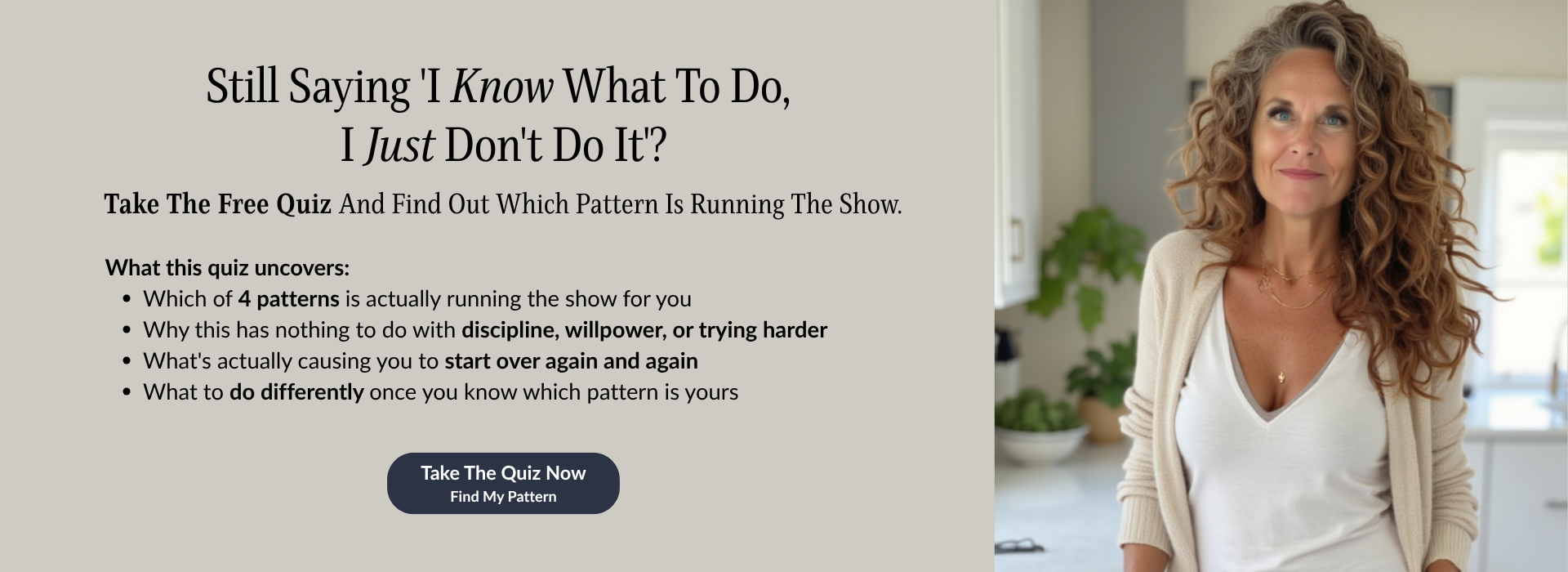
Take the Quiz: Why Do Your Healthy Habits Keep Falling Apart? If you've ever wondered why you know exactly what to do but still can't seem to stick with it, this quiz was built for you. In about 3 minutes, it identifies your specific pattern: the real reason your follow-through keeps breaking down, and what to address first. Your results are delivered straight to your inbox.
I am so excited to hear what you all think about the podcast – if you have any feedback, please let me know! You can leave me a rating and review in Apple Podcasts, which helps me create an excellent show and helps other women who want to get off the diet roller coaster find it, too.
Watch or Listen to the Episode:
WHAT YOU'LL LEARN
- Why "trying harder" keeps making things worse — and what's actually getting in the way of follow-through
- The under-recovery trap that most midlife women don't recognize until they're already running on empty
- How perfectionism disguises itself as high standards and quietly makes healthy habits impossible to sustain
- Why knowing exactly what to do isn't enough — and what the real gap between knowledge and action looks like in everyday life
- The specific pattern that turns one stressful day into a week of derailed habits (and how to interrupt it)
RESOURCES
- Take the Quiz — Why Do Your Healthy Habits Keep Falling Apart? Identify the specific pattern getting in your way
- Work with Elizabeth — Total Health Systems Audit:
- Subscribe to Total Health in Midlife: Available on Apple Podcasts, Spotify, and everywhere podcasts are found
Full Episode Transcript:
266 - Is Your Life Making Healthy Habits Impossible?
Elizabeth: [00:00:00] So what if the reason you still can't quote unquote get it to. Together has absolutely nothing to do with discipline. Like what if the problem is not that you're lazy, weak, too emotional, too inconsistent or missing whatever magical gene lets other women meal prep on Sundays and stop at one square of chocolate.
I need to tell you that after working with women in midlife for a really long time, I do not think the problem is what you think it is. I think a lot of very smart, very capable women are blaming themselves for patterns that actually make perfect sense once you see what's really going on. So if you've ever ended the day standing in the kitchen exhausted, picking it from wondering why you know exactly what to do and still aren't doing it.
If you've ever told yourself, I need to be more disciplined. If you've ever assumed that this should be easier now I want you to stay with me because in this episode, I [00:01:00] am gonna show you why your healthy habits keep falling apart, why trying harder has not worked yet, and what might actually be getting in your way.
And once you see it, you can't unsee it. So let's get started.
Welcome to the Total Health and Midlife Podcast, the podcast for women over 40 who want peace with food, ease in their habits, and a body that they don't have to fight with.
Hey everyone. Welcome back to the Total Health and Midlife Podcast. I am Elizabeth Sherman, and today I wanna talk about something that a lot of women carry quietly without ever saying the words out loud, which is the belief that if they could just get it together, if they were more disciplined, more consistent, less likely to fall apart by the weekend, then everything would finally click that they would eat the way that they're supposed to eat.
Stop eating mindlessly at night, [00:02:00] working out first thing in the morning, like they said that they were going to do. Go to bed in time, drink the water. Finally feel like one of those women who has life mastered and because that story feels true, they do what makes sense. They just try harder. They create more rules.
They download another diet. Workout program or meal plan, they have their little Monday morning, come to Jesus meeting with themselves for the 900th time and promise that this time this week it's really gonna work. And then it all continues and falls apart by Thursday after one stressful phone call with your boss or your sister about your parents or whatever it is.
They think, see, I knew it. I am the problem. And so I wanna offer you a different [00:03:00] explanation because after working with women in midlife for over 20 years, I don't think the problem is what you think it is. I think you have been trying very hard inside a life that was never set up to support follow through in the first place.
By the end of this episode, I want you to understand why your habits keep falling apart, why trying harder hasn't solved it, and why the reason is not you. So here's the thing about trying harder. Effort and effectiveness are not the same thing. You can be working very hard and still be pointed in the wrong direction.
It's like running faster when you're already on the wrong road. You're sweating, you're committed, and you're making terrible progress. That's what a lot of women are doing with their health. They're not sitting around waiting for motivation to descend from heaven. [00:04:00] They are thinking about it constantly.
They're reading about protein. They're listening to the podcast. They're following the influencers online. They're buying the leggings. They're starting over on Monday. Sometimes also on Tuesday, because Monday got away from them midday, and there is effort. Every single place that they're looking, they feel like they're doing all the things, but if the diagnosis is wrong, all that effort just turns into frustration because you're not making progress.
If you believe that the problem is that you need to be more disciplined, then every solution that you come up with is going to sound like more pressure, more rules, more restriction, more surveillance of yourself, and you'll keep applying force using the wrong tool.
None of this came out of nowhere. Women have been marinating in a particular message for decades. They're [00:05:00] told to just do it. Be consistent, no pain, no gain, stop making excuses. It's basically the emotional background music of modern womanhood. When that's all you hear, of course you start to believe that any struggle means that something has gone wrong inside of you.
A packed schedule becomes, I need to manage my time better depletion becomes, I need more willpower. The fact that you cried in the grocery store parking lot on a Wednesday afternoon becomes evidence that you need to get yourself together. That is the trap because once you decide that the problem is your character, that there is something fundamentally wrong with you, you stop getting curious about the actual conditions, making follow through difficult, and if you never identify the real reason something isn't working, you will keep doing the same thing and [00:06:00] being genuinely shocked when you end up face down in a bowl of popcorn and wine at night.
Then you wonder what happened. So if the problem isn't laziness or lack of discipline, well then what is it? Usually it's a combination of things working together, not one neat little problem that needs one neat little solution. It's more like you're tired, you're overbooked, you're expecting too much from yourself, and you keep assuming that if life feels difficult, then you must be doing it wrong.
That combination will take a woman down every single time. One of the biggest issues I see is under recovery, and I don't mean sleep, although sleep does matter for sure. I mean that a lot of women don't actually stop moving, stop doing. They work through lunch, they sit down at night, but they're not [00:07:00] resting.
They're just collapsed. They're still mentally on duty, still tracking what everyone needs, still trying to get ahead of tomorrow. So yes, technically they're on the couch, but their nervous system is not exactly at the spa. And there's a real difference between being horizontal and being restored. And when you don't get restored, you start to reach for relief.
Food, wine, scrolling, something crunchy and numbing and available. And not because there's anything wrong with you or you're bad, you're just tired and your body would like a little something for all it has endured. And then there's capacity, which is where capable women really get themselves into trouble.
They're the ones who can handle things. The ones that people count on. So when something gets added to the calendar, they think, sure, it's easy, [00:08:00] I can do it. And they're saying yes, based on how life feels right now or based on that one thing, not how life will feel when that thing actually arrives. So two weeks from now when everything looks different from today.
When you're feeling really hopeful and still have electrolytes in your bloodstream, then that week hits work, blows up, someone needs something. You're organizing things for a party. The dog has an issue, and now the workout schedule, the meal prep and the early bedtime, all crash right into one another and you cannot keep it together.
You don't do what you said you were going to do, and because nobody taught you to think in terms of capacity, you assume that the problem is your commitment, but it's not always commitment. Sometimes it's trying to fit a bunch of stuff into a short [00:09:00] timeframe. This one actually causes a lot of damage that if you were doing health right, it would feel easier than this, that if you found the right plan, the right morning routine, the right tracker, everything would click into place and become smooth and automatic.
But health is not easy just because you have information. Especially at this stage of our lives, especially not with stress, a body that doesn't respond the way that it did when we were 27, and a life where you're trying to squeeze self-care into the corners of an already full, very full schedule. And so when health feels harder than you think it should, that doesn't automatically mean that you're doing it wrong.
It may mean that the conditions that you're working inside haven't been accounted for. Now, these are not excuses, they're real conditions, real fatigue, real overload, real [00:10:00] friction. And when those conditions don't get named, the default conclusion becomes, I must be the problem. But you're not. You are a person responding in a predictable way to conditions that you're living in.
And that's not the same thing as failure. So let me make this concrete because I think it helps to see it in a real life example. So I recently got off a call with a woman who is newly divorced, and one of the things that she told me was that every day she works through lunch. Not occasionally, but every single day.
She used to take a break and go home for lunch. Sometimes she would sit outside and soak up the sun, have an actual pause in her day. Nothing huge, nothing dramatic. Just enough space to come up for air and remember that she was a person and connect with that [00:11:00] person, but now work is busier, life is different, and now she's quietly slipped into a routine where she just keeps going.
She just keeps doing noon, comes and goes. Maybe she grabs. Something out of her desk drawer, maybe it's a protein bar that she eats while clicking between screens and answering messages that she didn't ask for. They just keep coming and by the end of the workday, she is just not hungry, but she is completely spent.
That particular end of day feeling where your eyes are tired, your body feels heavy, and the thought of making one more decision makes you want to lie, face down in the kitchen and just pass out for a little bit. Then she comes home and now it's just her, which by the way is its own adjustment.
For years she cooked for her family. There was a reason to make chicken roast the [00:12:00] vegetables, deal with the whole nightly production and dishes. Now she walks in and there's really no momentum. No one is waiting for dinner except for the dogs. No one's asking what's cooking, no one to create any shape to the evening.
And because she's tired and she hasn't really eaten enough during the day and she doesn't feel like cooking. Not because she doesn't know how, she already knows what to do. That's what makes this so confusing and maddening. Like she knows a balanced meal would make her feel better.
She knows sitting down and eating an actual dinner would probably help her. Knowing and doing are very different things when you are exhausted and overwhelmed and running on fumes. So instead of making a meal, she grazes a little cheese while she's standing at the counter. [00:13:00] Maybe some crackers. Maybe some hummus.
She opens the fridge and she stares into it like it's going to answer her existential life problems, but then she closes it and then opens the pantry and finds something else. Nothing that she's eating is especially satisfying. It's not a meal, it's snacking. And because it's fragments, her body never quite gets the signal that dinner has happened.
She's eating, but she's not fed and nourished. And then there's the loneliness piece to that. And I don't wanna say that like. There's some sort of victim, you know, mentality there. I mean, plain, ordinary human loneliness that many women in midlife are struggling with right now. Even though they're her people in their lives, she just happens to be alone.
She lost some friends in her divorce, and so her [00:14:00] evening feels different. Now it feels quieter, a little flat. She does what a lot of us do when we're tired, restless, and we don't really wanna feel what we're feeling. She goes on social because she wants to connect. She sits there with her phone overstimulated and undernourished, and at the same time watching other people's vacations and happy couples photos, and women apparently doing Pilates at sunrise with washed hair and a will to live in a full face of makeup.
And then bedtime comes. But now she's tired in her body, but her mind is wired. And so she goes to bed and she tosses and she turns and she wakes up at 2:00 AM and
and her brain starts it's little overnight program. You should do better tomorrow. Why are you like this? You need to stop eating at night. You need to be more disciplined. [00:15:00] Then morning comes and she wakes up and she's exhausted and she already feels like she's behind. So she goes into the day depleted, which means when lunch rolls around, she's even less likely to take a break.
She feels foggy like she has to make up for not being at her best. And so again, she works through lunch and the cycle repeats. Now, if you only looked at this woman at eight 30 at night standing in the kitchen eating crackers and cheese and telling herself that she needs more discipline, you'd probably think that the problem was nighttime eating.
It's not the visible problem at night started when she didn't pause earlier in the day at noon. It started when she didn't eat enough. When she didn't take rest, When she kept pushing through fatigue, when she came home to an empty house with [00:16:00] no plan, no energy, and no emotional landing spot when she needed comfort and rest and probably connection and had built a life that wasn't giving her much of any of that.
So she doesn't need more discipline. She's not confused about the existence of vegetables. She's trying to function well while depleted, underfed, lonely, overstimulated, and completely maxed out and under those conditions, the body will almost always go looking for the fastest available form of relief.
And that does not mean that there's something wrong with her. That is a completely normal human response to a day that asks too much and gave back too little. Now underneath all of this, there is often one more thing, and it's sneaky because it can look like conscientiousness from the outside. [00:17:00] It's perfection.
Raise your hand if you identify. When most people talk about perfectionism, they frame it as having high standards, being driven and being caring about whatever it is that they're producing. In real life, s perfectionism is often a protection. It's a way that we use to avoid judgment, avoid being seen as sloppy, inconsistent, emotional, needy, or like someone who can't get it together.
A lot of women learn very early in their lives that there was a right way to be, and if they could just get close enough to that they could stay safe from criticism and judgment. So they armor up, they try to get it right. And when it comes to health, what that looks like is I have all the apps, I have the containers, I have the meal plan, and I have the step couch.[00:18:00]
I, the supplements are lined up like a tiny pharmacy, but inside it feels like constant surveillance and low grade disappointment because in the back of your mind, you are never doing your health habits good enough.
You're grading yourself, your quality of your person on them, and the bar keeps moving. So here's the real problem with perfectionism in the context of health. It makes experimentation almost impossible if everything has to be done correctly. You can never be a beginner. You can't gather information. You can't say, huh, that breakfast looked great on paper, but I'm starving by 10.
You can't notice that the workout that your friend swears by makes you wanna fake your own death. You can't admit that your body at 55 isn't responding the way that it did at 28, and that this is not a moral [00:19:00] failure. You just keep trying to force yourself to match the plan. But midlife health requires experimentation because everything has changed.
It requires paying attention to what actually works in your real life. It requires a judgment. It requires you looking at what foods keep you full. What kind of movement helps your mood instead of draining it? What can you actually sustain during the week when your bandwidth is gone and someone still wants to know what's for dinner?
Those aren't rule following questions. They're relationship questions, relationship with your own body, your own life, your own limits. If you're stuck in perfectionism, you often don't trust yourself enough to ask them. So you keep assuming that the answer lives outside of you, that someone else has the [00:20:00] information In the next diet, the next expert, the next woman on Instagram with the glass containers and the unshakeable will.
But your job isn't to obey perfectly, it's to learn about yourself. To connect with yourself. For a lot of women, it's not perfectionism alone either. It's a tangle, perfectionism plus depletion, plus an environment that works against them, plus emotional coping. plus a calendar. That would make anyone want to just check out.
That's exactly why generic advice hasn't helped up until this point, because generic advice assumes one simple problem. But if your struggle is a combination of things, a generic plan is going to work for about five seconds before real life rolls in and pushes it out of the way. There's a reason that all of this [00:21:00] has been so hard and that reason is not that there's something wrong with you.
There is no discipline, g contrary to what I thought. What looks like discipline in other women is usually a set of skills. Skills like noticing when you're getting depleted before you hit the wall, planning for your actual life instead of the imaginary ideal version where nothing ever goes wrong. It's about honoring your own capacity.
Course correcting without spiraling. Building enough self-trust that one off plan meal doesn't turn into three days of effort. Now, skills can be learned. That's the really hopeful part. If the problem were that you were lazy or defective, that would be terrible, terrible news. But if the problem is that you've been using the wrong diagnosis, living inside hard conditions [00:22:00] and relying on skills that nobody ever taught you.
That is a very different conversation because patterns that make sense can be worked with. I have seen women who thought they had no self-control to learn how to trust themselves around food. Women who thought that they were incapable of consistency, learn how to follow through in a way that actually fits their lives.
Women who thought they had to white knuckle everything. Learn to make decisions from a steadier place rather than depletion or guilt. You are not failing at something easy. You are dealing with patterns that have a real explanation, and once something has an explanation, we can solve it. We can work with it.
Now, if you've been listening to all this and thinking, okay, Elizabeth. What is actually getting in my way? That's exactly what I want to send you [00:23:00] next. I don't want you walking away from this episode with more self-awareness and then immediately using it to become a more enlightened version of mean to yourself.
I want you to stop guessing. I created a really short quiz for women who know what to do. They're just not doing it. It's called, why do your Healthy Habits Keep falling apart? Now, the quiz is 15 questions. Super simple. It takes three minutes or less. It's multiple choice, and when you finish it, it shows you the specific pattern that's most likely getting in your way.
Maybe it's that you're running on empty. Maybe perfectionism is running your show. Maybe your environment is full of friction and your routines aren't set up to support you. Or maybe it's a bunch of mixed tangled issues that are a little bit more complex, whatever the result is. The point is this, you get some clarity, and clarity is a very [00:24:00] different experience from shame because once you can actually see the pattern, you can stop blaming yourself.
For having one. So go take the quiz. Go to elizabeth sherman.com/quiz, give yourself three minutes, let it show you what's actually happening beneath the surface. There is a reason that this has been happening and the reason is not you. So go to elizabeth sherman.com/quiz. I'll also put the link in the show notes.
That's all I have for you today. Have an amazing day, and I will talk to you later. Bye-bye.
Hey, before you go, if you are someone who says, I know exactly what I should be doing, I just don't do it. Hey, if that's you, I made something for you. It's a free three minute quiz that gets underneath that exact problem. Not to give you more information, but to show you the specific reasons, your follow through keeps breaking down because it's not the same [00:25:00] for everyone. And once you can see your pattern clearly, everything else seems to change. Head to elizabeth sherman.com/quiz. It's free, it's fast, and it's honest.
Enjoy the Show?
- Don’t miss an episode, follow the podcast on Spotify and subscribe via Apple Podcasts or RSS.
- Leave me a review in Apple Podcasts.
- Join the conversation by connecting with me on Social!


Elizabeth is a Master Certified Life and Health Coach with over 20 years of experience, dedicated to helping women in midlife thrive through holistic health and wellness. Her personal journey began with a desire to reduce her own breast cancer risk, which evolved into a mission to guide women through the complexities of midlife health, from hormonal changes to mental clarity and emotional resilience.
Elizabeth holds certifications from prestigious institutions such as The Life Coach School, Precision Nutrition, and the American Council on Exercise, as well as specialized training in Feminist Coaching and Women’s Hormonal Health. Her approach is deeply empathetic, blending her extensive knowledge with real-life experience to empower women in their 50s and 60s to build sustainable health habits that last a lifetime.
Recognized as a top voice in women’s health, Elizabeth speaks regularly on stages, podcasts, and webinars, inspiring women to embrace midlife with energy, confidence, and joy. Her passion is helping women regain control of their health, so they can fully engage in the things that matter most to them—whether that’s pursuing new passions, maintaining strong relationships, or simply feeling great in their own skin.