
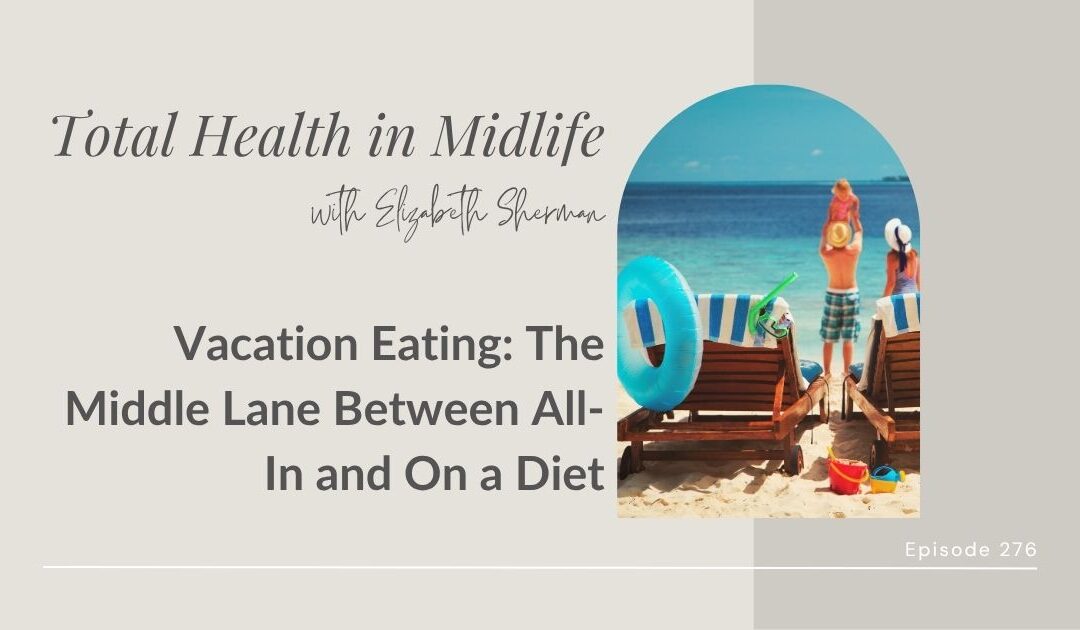
Most women leave for vacation in a good rhythm. They're eating well, feeling good, and fully intending to keep it going on the road. Then the airport happens. Then the hotel breakfast buffet. Then dinner out every night with no familiar guardrails in sight. By the time they land back home, they need days, sometimes weeks, just to feel like themselves again.
In this episode, Elizabeth breaks down why travel specifically derails healthy eating, and why it keeps happening even to women who have their health pretty well handled at home. The problem has nothing to do with caring or not caring. It has everything to do with the conditions that make your habits work at home not traveling with you.
Elizabeth shares stories from her own travel, including an Alaskan cruise early in her health journey where swollen feet and blisters from loose shoes were the physical receipt from a week of eating past what her body needed, and a trip to Italy where she and her husband were taking daily naps without realizing the low energy was connected to what she was eating. Each trip taught her something. And what she's learned adds up to a simple, practical approach that lets you actually enjoy the trip and come home feeling like yourself.
This episode is not about packing protein bars in your suitcase or skipping dessert in Rome. It's about finding the lane between eating everything in sight and being on a diet the whole trip. That lane exists. And once you know how to find it, travel stops being something you have to recover from.
The Listener Takeaway: Why This Episode Matters
You don't have to choose between having a good trip and feeling good when you get home. Those two things are not in conflict. But most women have only ever experienced one or the other, so it genuinely feels like a choice. This episode shows you why that pattern keeps repeating, what's structurally causing it, and what a different approach actually looks like in practice.
The goal isn't a perfect trip. It's coming home feeling like yourself. Not bloated, not behind, not already dreading Monday. Just back, rested enough, and ready to pick up where you left off. That's available to you on every trip you take from here forward.
Are you loving the podcast, but arent sure where to start? click here to get your copy of the Done with Dieting Podcast Roadmap (formerly Total Health in Midlife) Its a fantastic listining guide that pulls out the exact episodes that will get you moving towards optimal health.
Take the Quiz: Why Do Your Healthy Habits Keep Falling Apart? If you've ever wondered why you know exactly what to do but still can't seem to stick with it, this quiz was built for you. In about 3 minutes, it identifies your specific pattern: the real reason your follow-through keeps breaking down, and what to address first. Your results are delivered straight to your inbox.
I am so excited to hear what you all think about the podcast – if you have any feedback, please let me know! You can leave me a rating and review in Apple Podcasts, which helps me create an excellent show and helps other women who want to get off the diet roller coaster find it, too.
Watch or Listen to the Episode:
WHAT YOU'LL LEARN
- Why the women who feel most confident before a trip are often the ones who struggle most when they get home
- The one question to ask yourself before you leave that changes how every food decision on the trip feels
- Why the choice between "vacation mode" and white-knuckling it is a false one, and what's actually available in between
RESOURCES
Full Episode Transcript:
276: Vacation Eating: The Middle Lane Between All-In and On a Diet
Elizabeth: [00:00:00] So I have been coaching women for over 20 years now, and in that time, I have noticed some pretty consistent patterns in what actually derails people's health. And it's not the obvious stuff, but the things that sneak up on you, and travel is one of the biggest ones. It doesn't matter how solid your routine is at home, the moment that you get on a plane, something shifts.
And for most women, they come home from a trip feeling like they need to undo the whole week before they can move forward again. It doesn't have to be that way. In today's episode, I am going to show you what is actually causing that pattern and what to do about it next time, so that the next time you go on a trip, you come home and you feel like yourself and are ready to move forward. Not like you need an entire week to reset before you're even unpacked. So stay with me
Welcome to the Total Health in Midlife [00:01:00] podcast, the podcast for women over 40 who want peace with food, ease in their habits, and a body that they don't have to fight with.
Hey, everyone. Welcome back to the Total Health in Midlife podcast. I am Elizabeth Sherman, your host, and I am super glad that you are here with me today. So I wanna start today's episode by s- telling you a story. Years ago, years and years and years ago, Gary and I went on an Alaskan cruise when we first moved in together.
Now, this was very early in my health journey, like, really super early, and I was excited about it. Alaska, the glaciers, the whole shebang. It was stunning. His company was actually hosting the trip, and it was going to be amazing, and I remember the cruise ship had this dining room where every single item on the menu had a calorie count next to it.
I don't know if they still do that on [00:02:00] cruises. At the time, it was not something that was, that I was used to or that was popular. Calorie counts on menus sound really helpful, right? Except my brain immediately turned it into a math equation. I was doing mental calculations at every single meal. This many calories for breakfast, that many calories for lunch, and then we would go to dinner, and I would start adding everything up in my head.
And here is the thing about cruise ship food. The individual items seem really reasonable. There were these little petite fours. They were beautiful, and they were 100 calories each. 100 calories in my brain was like, it's nothing. So I would have one, and then I would have another, and then I would have a few more because it's just 100 calories, right?
And then suddenly, I had [00:03:00] eaten like, a massive amount of calories in petit fours, and we're not even talking about the main course yet. The dollar store works the exact same way, doesn't it? Like, everything is a dollar, so you throw things in your cart without really thinking, and then you get to the register, and it's like $47, and you're not even sure that you bought what you needed.
That's what was happening to me at every single meal, and by the end of the week, I was eating at every meal, not because I was hungry, but because the food was there, and it was included, and it was what we paid for. And so we ate all the things, every meal, every snack, every dessert. And when the ship docked in Anchorage, it was, like, 6:00 in the morning, and our flight home didn't leave until, like, 9:00 at night.
And so we had this entire day to fill, and we walked around. We killed some [00:04:00] time, and at some point we went into a restaurant, and I sat down, and I ordered food even though I wasn't hungry. I didn't want it. I just didn't know what else to do to fill my time. On the flight home, my feet swelled so much that my shoes gave me blisters.
Now, these were shoes that I had worn a thousand times. They were broken in, they were loose, they were comfortable shoes, and they gave me blisters because my feet were so swollen from a week of eating past what my body actually needed that they just... It was too much. Now, I don't tell this story to you to be dramatic.
I'm telling you because that is what happens when we go on vacation without any kind of plan for ourselves, and I'm not talking about a diet here or a meal prep [00:05:00] situation. I'm just talking about a basic sense of what we actually want from the trip, including how we want to feel when we get home. And so that is exactly what today's episode is all about.
Now, here's the thing I want you to understand before I go any further. Your eating doesn't fall apart on vacation because you stop caring about your health. It falls apart because every single thing that makes your healthy habits work at home is suddenly gone. Think about what your normal week looks like.
You have a kitchen stocked with food that you choose, that you bought, that you estimated what you're gonna eat. You have a grocery store that you know by heart. You know which aisle things that you buy are in, and you know the brands. You know what is going to be there. You have a schedule that's at least somewhat predictable, and you have a routine that you've probably built over time, [00:06:00] probably adjusted more times than you can count, that finally works reasonably well for you in your actual life.
And then you go on vacation. You leave, and none of that actually comes with you. So instead, you have a hotel room with a minibar and a coffee maker. You have restaurants that you've never been to, menus that you've never seen, portion sizes that you can't predict, and you have a schedule that belongs to the trip- Maybe not to you.
You are making food decisions from scratch at every single meal in an environment you have never navigated before. And so it isn't a willpower problem, and it is kind of a conditions, a circumstance problem. The conditions that made your habits possible at home don't exist on the road. So expecting yourself to behave exactly the same way is like expecting your GPS to [00:07:00] work when you've taken out the battery.
And here's the part that I find really interesting because I have seen this play out so many times with each of my clients. The women who go into a trip most confidently are often the ones who struggle the most when they get home. Let me explain. When I talk to my clients and I talk about the upcoming trip and I ask them, "What is gonna happen?
What are you worried about?" Or, "What boundaries are you a little concerned about navigating?" What I mean is those who are like, "Oh, it's gonna be a piece of cake. This is something that I'm not gonna have a problem with all... at all." Because if you are n- in a really good rhythm before you leave and you think that that rhythm is going to travel with you, it's not.
Imagine that you're feeling good, you're eating well, and you are moving your [00:08:00] body and everything is clicking, and so you think, "Well, why would I do anything differently? I've got this. This trip is not gonna be a big deal." I have had clients tell me that exact thing. They are telling me about their plan for their trip.
They're telling me that they're gonna use the hotel gym. They're telling me about all of the food that's gonna be available to them that they don't know about. They already looked at the menu for the restaurant. They're going to be first-
They already looked at the menu for the restaurant they're going to on their first night and found something that sounds good. They've packed their waddle- wa- they've packed their water bottle. They've got it handled. And then I ask them a question like, "Okay, so what time does your flight land?" And they'll tell me that, you know, it lands at 9:00 at night.
And I'll ask, "Okay, so what are you going to eat for dinner?" And sometimes I'll get a pause. Because the plan accounted for the version of themselves who is home, rested, and in their normal routine. It does not account for [00:09:00] the version of them who has been in airports since 6:00 in the morning, who's exhausted, who's hungry, and who is standing in baggage claim at 10:00 PM trying to figure out if the hotel restaurant is still open.
We make mistakes when our expectations don't meet reality, and the expectation that your healthy habits will just continue on vacation because they're working so well at home sets you up to be caught completely off guard the moment the trip doesn't go the way that you pictured it, which in my experience is most trips.
So when I talk to women about eating on vacation, there are usually two different camps. Camp one is the woman who decides that vacation is vacation, and that means that all bets are off. She eats everything. She drinks more than she normally would. She skips any movement that she would [00:10:00] normally do and figures that she'll just deal with it when she gets home, and she does deal with it when she gets home, for days afterwards, sometimes even weeks.
Now, camp two is the woman who white-knuckles the entire trip. She's negotiating with herself at every single restaurant. She's doing mental math at the breakfast buffet. She's skipping things she actually wants because she doesn't want to undo what she's worked for, and she gets home feeling virtuous, but at the same time, vaguely resentful, like she was present for the trip, but she didn't get to experience it.
Now, neither of those is what I want for you in any trip, because here's what I've noticed in both my own travel and in working with clients. A lot of women who go full vacation mode, who really do let everything go the moment that they board the plane, are not women who [00:11:00] don't really care about their health.
They are women who have been white-knuckling it home beforehand in between vacations. They've been following the rules, tracking things, avoiding things, earning things, and vacation feels like the only place the pressure is allowed to come off. So it doesn't just come off a little bit- It completely explodes.
I had a client, Linnea, and she described it to me as having two versions of herself. There was regular Linnea, who was diligent and capable and kept everything together, and then there was who she called her alternate personality, vacation Linnea. Now, vacation Linnea had no structure. She ate and drank whatever she wanted.
She stayed up too late and operated by an entirely different set of rules. Linnea and vacation Linnea were alm- Linnea and vacay Linnea were almost unrecognizable from each [00:12:00] other. And when I asked her about it, she said something that has really stuck with me even years later. She said vacation was the only time that she didn't have to be so incredibly regimented, and that told me everything.
Because if vacation is the only place that you get relief from your own rules, that is a sign that your rules at home might be a little bit too rigid. You have been running a framework that requires so much effort to maintain that the moment that you step outside your normal environment, the whole thing collapses.
Now, that doesn't mean that there's something wrong with you. That is what restriction does over time. And so when you've been telling yourself no for long enough, yes becomes very loud the moment the rules relax. And I really wanna be clear here. I am not suggesting that you should be on a diet on [00:13:00] vacation.
Nobody wants that. You are going somewhere to experience it, to taste the food that belongs to that place, to sit at a dinner table with people that you love and not be doing mental math for anything. That is a completely reasonable thing to want from a trip. What I'm suggesting is that there is a lane between those two options, a place where you can eat the gelato and not finish all of it if you don't want to, where you can have the wine at dinner and not need three glasses to feel like you finally have relaxed, where food is part of the experience without being the entire experience.
That lane exists, and it does not require you to be on a diet to find it Now, Gary and I went to Italy a few years ago, and it was genuinely one of the most beautiful trips I have ever [00:14:00] taken. The food was incredible, the wine was incredible, and we walked everywhere. We also took a lot of naps, like a lot of naps.
Middle of the afternoon, back at the hotel, just out cold. And at the time, I thought, "Well, we're just doing a lot. We're walking miles every day. We've been really busy at work. We're jet-lagged. This is just what happens on a big trip." And that might be true. But it wasn't until we got home that I started putting it all together.
I had barely eaten any protein the entire time that we were there. We were traveling in a region of Italy where protein isn't really big. It was mostly pastas. The meals were heavy on pasta and bread and olive oil, which of course is delicious, but I was not getting anywhere near what my body needed to actually sustain the amount of walking and activity that we were doing [00:15:00] every single day, and my body was telling me that really loudly in the form of needing to lie down every single afternoon.
I just wasn't listening because I didn't know, I didn't recognize that that's what it was saying. There was one lunch where I was really uncomfortable, and I don't mean uncomfortable like I had eaten too much. I mean the other kind of uncomfortable, where your digestion, which is what happens when we're on vacation, basically stops because you've been traveling for a week and your body is backed up and just not happy with you. It's totally normal. Now, I sat down at this restaurant and I looked at the menu, and I ordered lentil soup. Now, I wanna explain this. I don't particularly love lentil soup, and I'm not necessarily suggesting that this is something that you do.
I ordered it, not [00:16:00] because I wanted it, because what I really wanted was the pasta. But what I actually wanted underneath all of that, more than what I wanted in my taste buds, was to feel good in my body for the rest of the afternoon, for the upcoming days, and the lentil soup was what was going to get me there.
Now, that might sound like a small thing, but it wasn't, because for a long time, that kind of decision would have felt like deprivation, like I was missing out, sacrificing something, being responsible while everyone else got to enjoy themselves. In the moment, it didn't feel that way. It felt like I was actually taking care of myself.
There is a difference, and it took me a long time to be able to feel it. Here's what I've landed on after years of traveling. There is a real difference between tasting everything a place has to offer and eating everything just because [00:17:00] it's there.
Italy has incredible food, and I tasted a lot of it I had the wine and the pasta and the tiramisu. I also ordered the lentil soup at lunch because that's what my body needed that day. Both of those things can be true at the same time. Now, more recently, Gary and I were in Austin not long ago, and Gary loves pizza.
Well, who doesn't? But he has gotten into making it at home, and he really wanted to try a few highly rated pizza places in the city. And, you know, again, I love pizza, too, but at this point in my life, I could have pizza pretty much any time I want, right?
It's not a special occasion food for me anymore. So I had some, I enjoyed it, and I didn't need to finish it just because it was in front of me. Now, that shift from eating something because it's there to eating it because you actually want it, that is [00:18:00] not a dieting mindset. That's just learning to pay attention.
Food became a lot more enjoyable for me when it stopped being the main event and started being part of the experience. Italy was incredible because of the art and the history and the streets and the sitting outside with a glass of wine at 7:00 in the evening watching people walk by. The pasta was also part of that, but it wasn't all of it.
So here is the one thing that I want you to take into every trip that you take from this point forward. Before you leave, ask yourself this question: "How do I want to feel when I wake up in my own bed the morning after I get home?" Not, "How do I wanna feel at the end of the trip?" Not, "How do I want to feel the last night at dinner?"
But the morning after. When you are back in your own bed in your [00:19:00] own house and the trip is over, do you want to wake up feeling rested, even accounting for jet lag, do you want to feel like you enjoyed yourself without going so far overboard that you need a week to recover?
Do you want to feel like you actually tasted the place that you visited rather than just eating your way through it on autopilot? I wanna invite you to get specific about it, because vague intentions don't actually travel really well. When I do this before a trip, it changes every decision that I make along the way, and not because I'm consulting a rule book at every meal, but because I have a reference point.
When I am standing at a buffet at 9:00 in the morning trying to decide what to put on my plate, I'm not thinking about calories or macros or what I'm allowed to have. I'm thinking about how I want to feel that day. How is this food [00:20:00] going to make me feel on my excursions? How am I going to feel when I wake up at home when I get there?
That question is doing a completely different kind of work than a rule does. A rule tells you what you can and cannot have. It creates a line that you're either on the right side of or the wrong side of, and the moment you cross it, even once, even for something completely reasonable, your brain treats the whole thing as being blown, and you may as well eat everything in sight because you've disregarded the rule, right?
A question gives you direction. It doesn't tell you no. It asks you to check in. Do I really want this right now, or am I eating it because it's there and it's free and everyone else is having it? Those are genuinely different situations, and they deserve different answers. [00:21:00] This is what I mean when I say that you can have your own back on a trip without being on a diet Having your own back doesn't mean that you follow rules perfectly.
It means knowing what you actually want and making decisions that are at least loosely pointed in that direction. The morning after I got home from that Alaskan cruise, I did not feel the way that I wanted to feel. My feet were swollen. My body felt bloated. I was exhausted in a way that had nothing to do with jet lag, and I had not enjoyed the last couple days of that trip because I was so physically uncomfortable.
I didn't want that. I never want that again. But I had never stopped to ask myself what did I want before I left. So I had nothing to navigate by, and that question is the starting point. Everything else builds from there. [00:22:00] So let me tell you what needing a reset actually looks like, because I think we throw that phrase around without really sitting with what it costs.
So you get home, you're jet lagged, which is already its own thing, right? Your body doesn't know what time it is. You didn't sleep well on the plane, and everything just feels off. That's honestly just part of travel. There's not much that you can do about it. But then there's this other layer. You wake up that first morning, and you feel bloated.
Your clothes feel tighter than they did when you packed them. Your digestion is just a mess. You are tired in a way that is different from jet lag, the kind of tired that comes from a week of eating past what your body wanted and drinking more than you normally would and not sleeping well because your body was working overtime to process all of that, and you're already feeling behind.
You're sluggish. You don't have any energy Because [00:23:00] before you left, you were honestly in a good rhythm. You were eating well, you were feeling good, you had momentum, and now that momentum is gone, and you have to rebuild it from scratch. Except you're doing it while jet-lagged and bloated and looking at a refrigerator that has nothing in it because you've gone for...
you've been gone for a week, and you have a mountain of laundry. So the reset isn't one day. For a lot of women, it's four, five days, or even a week to get back to baseline. Sometimes it's even longer. I have worked with clients who left for a 10-day trip feeling great and didn't feel like themselves again for three weeks after they got home.
Three weeks. That's the actual cost of not having your own back on the trip, not the week that you were gone, the weeks afterwards. And here's what makes it even harder. When you are in that post-vacation recovery period, [00:24:00] your brain starts doing something really super unhelpful. It starts telling you that this is just who you are, that you just can't maintain anything, that you were doing well before the trip, but that was probably a fluke, and now you are back to square one, and you may as well start over next Monday.
But that story isn't true But it feels true when you are exhausted and uncomfortable and your routine is nowhere to be found. Nobody wants to come home to that, and you don't have to. The trip you just took should be something that you look back on with actual fondness, the food you ate, the places you saw, the time you had.
It should not be something that you are trying to recover from. You do not have to choose between having a good trip and feeling good when you get home. That is the thing I most want to leave you with [00:25:00] in this episode, not a list of foods to avoid at the airport, not a rule book about how many drinks you're allowed to eat at or drink at Just that one idea. The choice is not between enjoying yourself and taking care of yourself. Those two things are allowed to coexist at the same time. What makes that possible is not more willpower. It's not white-knuckling your way through a buffet or packing your suitcase with protein bars so that you never have to make a real food decision.
It is having a simple system that works when your normal structure disappears, because that is the only kind of system that's actually worth having. I put that system together in the Travel Success Playbook. My Travel Success Playbook walks you through exactly what you wanna do before you leave, how to navigate meals on the road without negotiating with yourself at every [00:26:00] single restaurant, and how to set yourself up so that when you wake up in your own bed the morning after you land, you feel like yourself.
Not perfect, just like yourself, like you want to, like the trip was something that happened to you in a good way, not something that you are still gonna have to recover from two weeks later. Now, you can find the Travel Success Playbook at elizabethsherman.com/travelsuccessplaybook. I will make sure to put that in the show notes.
And if you are not sure what's getting in your way with your health more broadly, not just on trips, but in your regular life, you might wanna check out my quiz, and it will show you exactly where your follow-through is breaking down and why. You can find the quiz at elizabethsherman.com/quiz. I'll make sure that that's in those show notes as well.
So thank you so much for spending this time with me today. I will see you next week. I will see you next week. Have an amazing day. I'll talk to you later. [00:27:00] Bye-bye.
Hey there. Thanks for tuning in to today's episode. Now, if travel seems to throw a wrench into your health habits and it throws you completely out of rhythm, whether it's vacation, work trips, road trips, family visits, or just eating your body weight in airport trail mix because nothing counts when you travel, right?
I created something to help. It's called the Travel Success Playbook, and it's a simple, compassionate guide to help you enjoy your trip, feel like yourself when you're away, and come home without feeling the need to start over when you get back. Inside, you will find planning tools, mindset shifts, checklists, a road trip section, and a short video series to walk you through the entire process.
You can grab your copy at the link in the show notes. Safe travels, and more importantly, take good care of yourself while you're getting there.
Enjoy the Show?
- Don’t miss an episode, follow the podcast on Spotify and subscribe via Apple Podcasts or RSS.
- Leave me a review in Apple Podcasts.
- Join the conversation by connecting with me on Social!


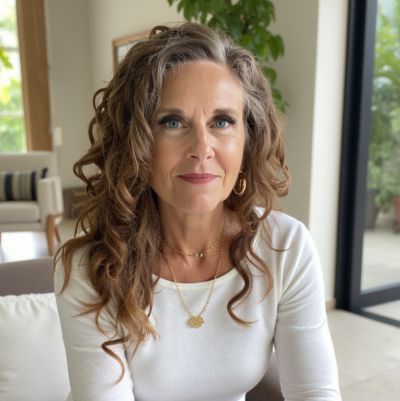
Elizabeth is a Master Certified Life and Health Coach with over 20 years of experience, dedicated to helping women in midlife thrive through holistic health and wellness. Her personal journey began with a desire to reduce her own breast cancer risk, which evolved into a mission to guide women through the complexities of midlife health, from hormonal changes to mental clarity and emotional resilience.
Elizabeth holds certifications from prestigious institutions such as The Life Coach School, Precision Nutrition, and the American Council on Exercise, as well as specialized training in Feminist Coaching and Women’s Hormonal Health. Her approach is deeply empathetic, blending her extensive knowledge with real-life experience to empower women in their 50s and 60s to build sustainable health habits that last a lifetime.
Recognized as a top voice in women’s health, Elizabeth speaks regularly on stages, podcasts, and webinars, inspiring women to embrace midlife with energy, confidence, and joy. Her passion is helping women regain control of their health, so they can fully engage in the things that matter most to them—whether that’s pursuing new passions, maintaining strong relationships, or simply feeling great in their own skin.