
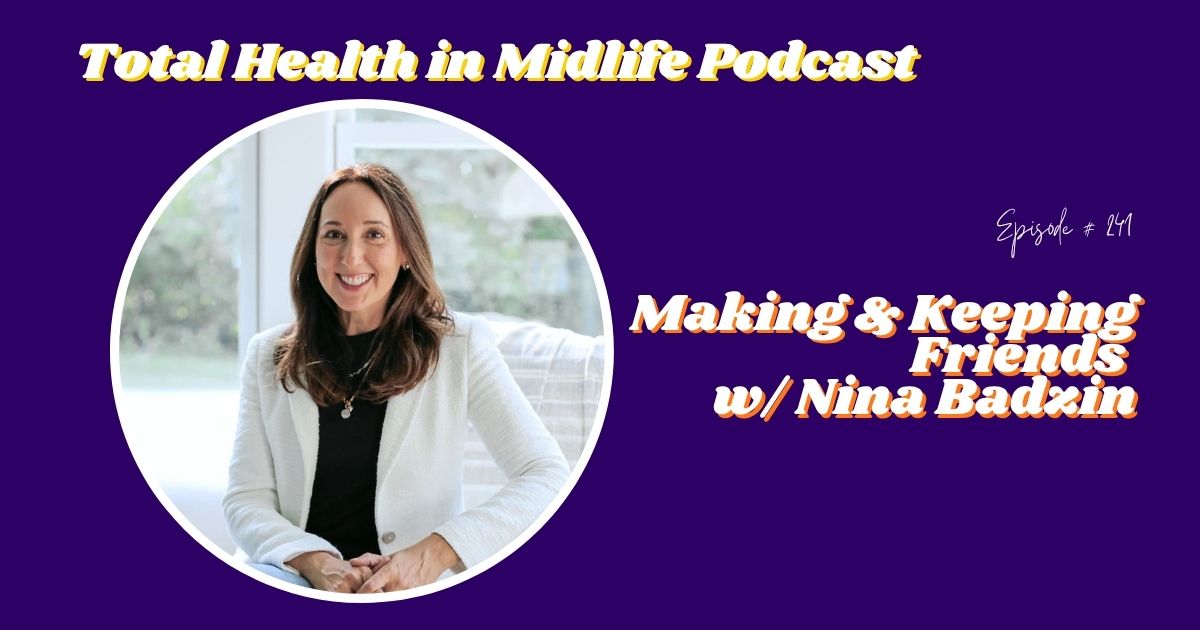
Making—and keeping—friends in midlife can feel surprisingly hard.
In this episode of the Total Health in Midlife podcast, I’m joined by Nina Badzin, writer and host of the Dear Nina podcast, to talk about the real stuff that comes up in adult friendships—like feeling left out, keeping score, and what to do when your once-close friends just… fade.
Whether you’ve ever wondered, “Is it just me?” or you’ve found yourself ghosted or burned out from being the one who always initiates, you’re not alone—and you’re not doing it wrong.
This episode is full of validation, fresh perspective, and practical tips to help you build stronger, more satisfying friendships, even if it’s been a while.
ABOUT NINA BADZIN
Nina Badzin is the host of the podcast, Dear Nina: Conversations About Friendship. She's a writer, teacher, and mom of four in Minneapolis who has been writing about friendship for over a decade. You can find her newsletter at dearnina.substack.com, join her Facebook group all about friendship at Dear Nina: The Group, and she’s on Instagram at @dearninafriendship.
Are you loving the podcast, but arent sure where to start? click here to get your copy of the Done with Dieting Podcast Roadmap (formerly Total Health in Midlife) Its a fantastic listining guide that pulls out the exact episodes that will get you moving towards optimal health.
Take the Quiz: Why Do Your Healthy Habits Keep Falling Apart? If you've ever wondered why you know exactly what to do but still can't seem to stick with it, this quiz was built for you. In about 3 minutes, it identifies your specific pattern: the real reason your follow-through keeps breaking down, and what to address first. Your results are delivered straight to your inbox.
I am so excited to hear what you all think about the podcast – if you have any feedback, please let me know! You can leave me a rating and review in Apple Podcasts, which helps me create an excellent show and helps other women who want to get off the diet roller coaster find it, too.
What You'll Learn from this Episode
- Why friendship often gets harder—not easier—as we age
- The difference between “reciprocity” and “keeping score” in adult friendships
- What to do when you’re always the one reaching out—or when a friend fades away
- How friendship fits into your total health—and why it’s not just “a nice-to-have”
Listen to the Full Episode:
Featured on the Show:
- Dear Nina: Conversations About Friendship podcast
- The Power of Friendships in Midlife – Previous episodes on friendship from Total Health in Midlife
- Danielle Bayard Jackson’s book "Fighting for Our Friendships" (mentioned in the episode)
Full Episode Transcript:
241 - Making and Keeping Friendships with Nina Badzin
Nina: [00:00:00] I think, of things we're afraid to bring to our friend. If you're upset with someone, if you're disappointed with someone, when you hold back from friends like that, asking for help. Being honest with things going on in your life and then being honest about your feelings about that person.
Mm-hmm. This is why the friendship stays shallow. Yeah, it, it lacks depth. Sometimes we feel we're not as close with people because we're not doing the things that bring you close to people, which is being authentic and honest, whether it's about the other person or not. Asking for help, giving help. It's the harder stuff of friendship.
Elizabeth: Welcome to the Total Health and Midlife Podcast, the podcast for women over 40 who want peace with food, ease in their habits, and a body that they don't have to fight with.
So have you ever found yourself wondering, why is friendship so dang complicated in midlife? You are not imagining it and you are definitely not the only one? Welcome to the Total Health in Midlife podcast. I'm your [00:01:00] host, Elizabeth Sherman, and we are diving headfirst into something that. Not talked about enough adult friendships, why they fade, how they shift, and what to do when it feels like you are the only one trying to keep them alive.
I am joined by the fabulous Nina Badzin the voice behind the Dear Nina podcast, where she answers real questions about friendship. And let me tell you, she does not shy away from the messy stuff.
If you've ever ghosted a friend and felt guilty, if you've been on the receiving end of the slow fade, or if you've wondered, is it weird to ask a new friend to hang out? This episode is for you. So we are talking about boundaries, expectations, and the grief of friendship that. No longer fits and how all of that affects our emotional and physical health in midlife because yes, this does impact your stress, your [00:02:00] sleep, and even your eating habits.
So whether you are craving deeper connection, feeling lonely, or just wanna feel a little less weird about your friendship struggles hit play. You will walk away feeling seen, heard, and maybe even a little hopeful. So let's get started.
Alright, everyone, welcome Nina to the show.
Nina, I am so excited to have you here. first of all, let's start with what you do, who you help, what we're gonna talk about today.
Nina: Okay. I have been writing about friendship, mostly adult friendship for over a decade. I started as an advice columnist for a website called the Her Stories Project. And what I really like to make clear.
To your listeners, to my own listeners, anytime I talk about friendship anywhere, I am not a therapist. I'm not a social worker. I am not a friendship coach. I'm not a life coach. I am a writer. I am a writer who ended [00:03:00] up on a friendship beat and then just stayed with it a long time, and it wasn't an accident that I ended up on that beat.
I have always, always loved the topic of friendship, and even when I was writing fiction, which is what I was doing before, doing more nonfiction and essays. That was always about friendship as well, and I attribute that to having grown up with parents, where friendship was really important. That was a huge piece of my parents' lives.
I saw how important it was to have friends around you. They made a lot of time for their friends. They encouraged friendship. And I got married really young, so I also think that maybe the great romance in my life. After being married. I mean, when I say really young, 23, I, when I say that, it makes it sound like I was 17.
I mean, it's a normal age, but it these days it is on the younger side. So, all right. Met my husband, senior year of college. We got married a little bit after that. And what would be the new relationships in my life? It would be friendship. And then final piece of that is I moved to Minneapolis. [00:04:00] Around that time, which is not a town that has a lot of transient people coming in.
It's a lot of people who grew up there, and it was the first time in my life that I had a pretty hard time making friends. I'm sure there were other times in my life where I had issues of being left out and things like this, like the normal adolescence and college and high school times when you have friendship issues.
But I didn't have deep friendship issues then of making friends because I grew up. Went to the same schools my whole life until college and then in college it was kind of easy. They make it easy in college to make friends. Yeah. So moving to Minneapolis was the first time I had to really push myself to be completely new, and so that taught me a lot of things too.
But now writing about friendship for over a decade, it was 2014 when I started. I've read everything, talk to a million people, and people write me anonymously all the time. And so the final piece is I have a podcast called Dear Nina, conversations about Friendship. And that has been going on for four years already.
So I've talked to lots of people, heard from lots of [00:05:00] people about every adult friendship issue you can imagine.
Elizabeth: Yeah. Well, and the way that I found you was I read Danielle Byerley Jackson's book, and then I sought out her podcast and saw that she was on yours, and that's how I got introduced to you.
Nina: Oh, that's great.
I love hearing that.
Elizabeth: Yeah. And so, you know, when you talk about struggles with friendship, like I'll be transparent with everyone here that this is something that is really new for me. Like I am one of those women who didn't really have a large friend group. I only had like one or two friends. And, you know, it, it's been difficult as I've gotten older because once you do get outta school.
It does become so much more challenging to make friends, and I've had a couple other folks on the podcast here. We've been talking about friendship, but I think it's so important for women in [00:06:00] midlife, because there's a lot of loneliness. There's a lot of, I feel like I'm on my
Nina: own. Yeah. I think the biggest piece that becomes an issue once you leave school is the issue of time and proximity.
So those are two huge factors in friendship, proximity, I would say Maybe is the top one, meaning you live near the person. So when you're in school or you're growing up and you have people in your neighborhood, you ride the bus perhaps, or you walk to school but you're, or you're in the same classrooms, you have lunch at the same time, it's all there for you.
You are near, physically, near this person and. College or even if you were living in an apartment building, perhaps when you're younger or when you're older, if you're in an apartment building, that might actually be a wonderful way to make friends. That's why people do these, retirement villages, if you think about it.
It's it's proximity. Makes it easy to be with people. And being with people is. So important. As we know, it's one of the most important things for your mental and physical health [00:07:00] all through life, is your social connections. There's a number of studies that show that, so I, it makes sense to me that as people age, it's important to not be isolated in these houses all by yourself, but to be around people when we're young.
We need to be around people 'cause we don't have the independence to just pick up and drive to a friend's house. It's being near people is huge and you can not have that much in common with somebody. But if it's easy to see them, you will end up being friends. Not if they're, I guess, horribly offensive to you, but if you have enough in common.
You don't have to have amazing chemistry to become friends with someone as long as they live or work, or somehow are close to you on a regular basis. The opposite also happens where you can have wonderful chemistry with somebody, but if they live far away from you, it's a hassle to see them. They have a really busy schedule.
You have a busy schedule, and you don't live near each other. There isn't enough good chemistry in the world to make that an easy friendship. Yeah, so proximity [00:08:00] is so important. That is, and time is related to proximity because. It takes time to get around to see people. So if you're already near each other, that helps.
And as we get older, we have less time for a period of time. Right. Later it seems like people have more time again, and then that they kind of wake up and go, oh, I, I don't have enough people to do things with.
Elizabeth: Yeah. Well, and I think, you know, going back to the proximity, I think that a lot of women struggle.
Midlife with, especially like around the empty nest period, struggle with friendship because I think something happens to us as we get older. We start to question like, what are my values and what is important to me and what is the purpose of my life and who do I want in my life? And. Where we had those, what I call friendships of convenience, which you're talking about proximity, which is [00:09:00] basically the parents of your kids' friends, right.
That you see, or people you worked with, colleagues or, yep, exactly. And now that you're kids are growing up and going away to school, you're like, oh, which of those friendships do I wanna keep?
none: Right.
Elizabeth: Yeah.
Nina: Some of them just fall away, whether you have made a decision about it or not, sometimes there's not a lot of decision making that goes into it.
It's just you're not on the bleachers anymore. Right? So, and you never maybe did see each other outside of those times. And I like to remind people that doesn't mean that those friendships are or were worthless, they. We're important for a certain time of life, and they don't all make it out of that time, but that's okay.
I hate to hear people speak negatively about that time. Like, oh, they, we weren't close. We were, those were shallow friendships. We need all kinds of people in our lives, and not every friend needs to be the deepest friend. Those people you sat around with at work and talked to during lunch or sat on the bleachers with for [00:10:00] 10 years, that was worth something that made those 10 years.
Better than they would've been if you were sitting by yourself.
Elizabeth: Yeah. Well, and as you were talking, I was thinking about how I used to have smoking buddies when I used to smoke years ago. And so I would go outside and smoke with people and we connected during that time that we were smoking together. And then I remember when I quit smoking, it was really.
A loss because then I didn't have that connection with those people anymore.
Nina: Oh, that's so interesting. When you talk about smoking, it makes me think about the phone and the way people would now, perhaps, instead of going outside to have a cigarette, they might just take a break on their phone, which is really like being by yourself.
it's so much more social smoking. I know it was not healthy. I'm not trying to advocate for No, no, no. Yeah. An unhealthy habit, but at least it was social as opposed to just. Going down a rabbit hole every time you have a break from life mm-hmm. Is just a dip into the phone. I mean, I do it too.
[00:11:00] This is without judgment. It's definitely a habit. Many of us have to take a break. It feels social, but it's like faux social.
Elizabeth: Yeah. I love that topic. I think I heard you say it on your podcast that, We are so connected now through the internet, through social, and yet we feel very disconnected at the same time.
Can you talk a little bit about that? Because clearly we're not having proximity through the internet, but what is it that's different about face-to-face versus.
Nina: Yeah. I love my online friends. I've, I had a blog a thousand years ago. I was on Twitter at, towards the beginning, so was early on substack even, which is the newer thing.
I feel I'm early on to things and so this is not to poo poo the internet or, or virtual friendships, but they don't require as much of you. It's easier, it's on your own time. You can respond when you feel it. 'cause there's this understanding that we're, we're on a different time zone or we live in different places.
That this friendship that is [00:12:00] happening online is different. We all seem to know that it is different in person, but as in-person stuff can fall away for people and they rely more on their online friends. I think the muscle of having to show up for people when it's not convenient for you gets a little.
Lazy. We atrophy. A huge part of in-person friendship is being inconvenienced. So while proximity, we were talking about, is a great thing to help foster friendships, it can't always be that easy. Sometimes you do have to, Be inconvenienced and go 30 minutes to see somebody, or you have to do something at a time that maybe isn't as good for you.
It's, it's somehow in between. What's a good time for you and a good time for the other person? These are things that sound really obvious about friendship, but if a lot of your friendships are online, you're not doing those things. You're responding. At your own leisure, at your own pace, your own time, and the other person isn't expecting you to do anything different.
You might get a little annoyed if someone doesn't text back promptly. Text is a little different because I think text [00:13:00] happens more with people in your current life. I'm thinking more social media messages and and things like this. It's not. like it's nothing. I, again, sort of like the bleacher friendships.
I think all connections are great and helpful and add to our lives. One of the biggest things we missed during COVID, what were not the online ones, that's kinda all we had, but were those extra connections. A lot of us stayed in touch with our closest, best friends. Maybe we talked on the phone or we zoomed with our closest friends, but those extra friendships kind of fell away.
Yeah, that was part of what made life so lonely during those times was we actually do need that outer layer of friendship. Those outer couple layers. Just having a couple close friends. Actually, hold on. I wanna correct myself that you don't need a group of friends. I don't wanna mistake anybody with that.
Having a couple close friends really is enough. You don't need a group, but you still need to have casual friends, is what I'm saying. You, that outer layer is. The, the meat of [00:14:00] life. You, you need that. You need those people that remind you of all the different interests you have. That not everybody has to be the closest friend.
I know we're sort of all over the place with that, but with the online friends, I think of that, like that outer layer. I'm not saying to get rid of it, but just don't mistake it For the inner inner layer.
Elizabeth: Yeah. let's come back to that. You brought up COVID and it made me think, have you seen a change in friendships due to COVID?
Nina: I think people realize how important it's to be involved in activities and hobbies and, and to keep that outer layer of friendship around and not just depend on one or two people to fill. All of your friendship needs. It's good to be in, involved in activities and get out of your house and do stuff. I really think people are tired of online stuff.
I also teach writing classes. I didn't mention that in my bio 'cause it's kind of not pertinent to what we're doing here, but [00:15:00] I. Moved them online for a while. During COVID, we had no choice, and then because I had them online, I got some students from outside the Twin Cities. They had classes, had all been in person before, and then it was hard to let go of them because I got attached to them.
They got attached to me. They liked the Twin Cities people. Maybe we had four or five in each of my writing classes from out of town. And so I let those classes drag on online a little longer than I should have because. Once I said no more online, that meant saying goodbye to these people. Finally, a couple of the in town people were like, Nina, we are done on Zoom.
We're done. Like we didn't sign up for this class just to write. We signed up for this class to be with people, to be with other, these aren't. Teenagers, these are women in their forties, fifties, sixties, seventies. They want to be with other people. They wanted to get out of the house and I mean, I'm talking 2022, they're like enough, let's get back in person.
So I had to say goodbye. I think that's one example, but I think that's going on a lot where people don't wanna do these virtual things as much. [00:16:00] They wanna, that's why Pickleball is so popular. I think that's a huge reason. that really picked up after COVID. It was, or maybe towards. I, I don't know exactly.
It's different in different towns. Everything comes later to Minnesota. so it's hard to say, but here it really got popular. It makes sense as a, a thing you could do outside and get out and be really social.
Elizabeth: Yeah. Okay. Okay.
it seems to me that people aren't having the same level of friendships. Like I feel like since COVI, there's more social anxiety and that people aren't getting together as much.
But I really liked what you said about having to, you didn't say the word sacrifice. Having to be inconvenienced by going out and doing something that a friend wants you to do, just because that's how you wanna show up for that friendship.
Nina: Yeah. I did a friendship challenge. I do one a month on my podcast, and it was a seemingly simple one.
Mm-hmm. But it was the one that people had the most [00:17:00] trouble with, and it was to ask a friend for a favor, oh and oh, it could be a little favor. It doesn't have to be as large as, take me to the airport please. Which is can be a big favor depending on where you live in proximity to the airport or not in proximity to the airport.
The
Elizabeth: time of day. Yeah. Right.
Nina: But it could be something like that, or it's something. There was any number of examples of a favor you could ask someone to do. And a lot of people said to me, well, I don't like to ask anyone for help. And I really push back and I say, is it because you are afraid they're gonna ask you for help?
I'm not saying anyone answered me, I was just. Saying this out loud is a possibility. I think that I, I don't have a study to prove it. That's just my common sense. I think sometimes people are afraid to ask for help a friend or asking a family member or anybody because they don't really want to be in debt to anybody.
'cause then someone might inconvenience you and ask you for help. And my challenge to that is yes, that that's how friendship works. [00:18:00] Sometimes you have to do things that are. Not convenient and
none: yeah,
Nina: that's how you build bonds. I help you. You help me. And it doesn't have to be tit for tat. I might help you five times and you help me once.
And this is how we live in community with people. We put ourselves out for others. That's how you bond with people.
Elizabeth: Yeah. You know, it's so funny, I have a girlfriend who, she actually started out as a client and we've built just this beautiful friendship together and we talk about once a month and recently we.
Got on our call and neither of it, it seemed awkward, and she was like, why is this awkward? And. It was because both of us had shit going on that we didn't want to burden the other one.
Nina: Oh, so interesting. I love this point. Yeah.
Elizabeth: Right. And finally, so you were holding back. Exactly. Yeah. And finally when we both let it out, we were like, but this is what friendship is about, is.
So many of us, I [00:19:00] think, feel like we can't burden the other person with all of the stuff that we have going on that we feel like we're constantly unloading. I. Yeah, I just wanted to bring that up because it just reminded me of that.
Nina: Yeah, I agree. It's a similar issue, not wanting to inconvenience somebody, not wanting to be the bummer, not wanting to like burden somebody with their issues and not wanting to bring up conflict.
That would be like the third piece of this puzzle, I think, of things we're afraid to bring to our friend. If you're upset with someone, if you're disappointed with someone, when you hold back from friends like that, asking for help. Being honest with things going on in your life and then being honest about your feelings about that person.
Mm-hmm. This is why the friendship stays shallow. Yeah, it, it lacks depth. Sometimes we feel we're not as close with people because we're not doing the things that bring you close to people, which is being authentic and honest, whether it's about the other person or not. Asking for help, giving help. It's the harder stuff of [00:20:00] friendship.
It's not all, you know, cute pictures on social media with picnic baskets and like braids and pretty dresses. That's what I'm picturing. I don't know if that comes through your algorithm. These are the things that the algorithm shows me sometimes that make people nuts. They're like, oh, I don't have friendships like that.
Well, most people don't have friendships that are picture perfect Instagram, where they, they have, you know, a, a ride to the airport. That's a beautiful friendship. That's beautiful right there.
Elizabeth: Well, and it's small deposits of building that friendship up. Yeah, it, so I have this concept within my coaching called the trust bank.
And so like even within self-trust, we create small deposits for ourselves so that we can start to build the skill of self-trust. And so whether we're talking about trust with ourselves or trust with another person, it's doing the same thing. It's creating small deposits of being vulnerable or. [00:21:00] in confiding or I know that you just had a podcast about when a friend,
Spills the guts on something that you didn't want them to share about. Yes. Lack
Nina: of discretion. Yes.
Elizabeth: Yeah. And that, that degrades trust
Nina: then. Yes. Yes. That's right. It's like a withdrawal that can happen. You know, we all make slip ups and that's what I love the bank metaphor too. that we make these deposits.
When you have enough deposits, you can take a couple withdrawals, you can make a mistake, and you can ask for forgiveness and. Should be fine. A reasonable person will mentally know without making an actual tally. This person's been a really good friend and everyone makes mistakes, and I'm really big on pushing people to forgive somebody who's asked for forgiveness because Lord knows we're gonna need it at some time.
So if, if you're really harsh on everybody and no one's allowed to make a mistake, you better not ever make a mistake 'cause you're not gonna get that in return.
Elizabeth: Yeah. Well, and even so, like. Putting deposits into this friendship knowing that there [00:22:00] might be a time when you can't deposit a lot into it because yes, you have other things going on.
Your parents need help, or your kid's in trouble or whatever, that you can't invest a lot of time and energy in that relationship, but you know that it's gonna be okay just because you have that history together.
Nina: Yeah. a couple of the deposit where you can, and not completely ignore it, but, and then be open with your friend.
This is a really rough time for me. explain what's going on and not just, oh, I'm busy. Explain what is going on, why it's weighing on you, why it's heavy, and how much you love them. And I'm really into like verbal stuff like that, how much you love them and you miss them and you're thinking about them, and you're so grateful that.
You have them in your life and we're gonna get together when this is all over.
Elizabeth: Oh, I love that. I love that. So one of the things that I hear a lot from my clients and in my community is I'm always the one who's reaching out to other friends. They never reach out to me and what should I do [00:23:00] or. I don't know, like all of the drama that goes along with that.
Should I keep that friendship or not? Or I feel that they're not, that I'm not as important to them, and so therefore I should ditch the friendship. Right. This is, that's, that's the underlying yes answer, right?
Nina: This is so common. This is so common. It comes up all the time from other people who write to me, and I am a voice that really tries to push against that.
And what, what we're talking about here, you haven't used the word but is the word I'm gonna use, is what they're talking about is an issue of reciprocity. Yes. They are measuring reciprocity in a very basic way and. I used to be like this too. I think most people naturally are like that. 'cause we think about the world on how we do the world.
So maybe for someone like me. Reaching out for plans is a way I demonstrate friendship. I like to have plans. I like to have on my calendar that I'm, and actually I am an introvert, believe it or not, but I'm social. It's a, social connections [00:24:00] are important to me. I have a lot of time by myself. I would really not be happy if I didn't have a lot of time by myself, but I would also be really unhappy if I didn't have plans with my friends on the calendar as couples as just one-on-one.
And. I reach out a lot to make plans 'cause that matters to me to have that set and I'm good at it and I'm organized. Well, not everyone in your life performs friendship the way you do, nor are they as organized. So I do usually say to the person who comes to me with that issue, oh, I'm always the first to reach out.
And it's a very common issue. It's actually the number one search term that gets people on my website. 'cause I've written about it a lot. Some form of, you know, Google will show you. How people landed on your site. It could be any version of, I always text first. My friend never reaches out all these different terms, land people on my site.
'cause they're all saying the same thing, everything you just said. And so I do push back and say, well, that's how you do friendship. You personally, whoever wrote this, but what if that person really isn't that [00:25:00] organized? they are very overwhelmed with their life. They can barely get their work done.
They can barely get their other. Family obligations done. They aren't going to hang out for dinner with anyone. It's like not personal to you, like people are taking it personally. Maybe it is, maybe it isn't, but I would like to give the chance that it might not be personal to you. Also, it might not be as important to that person to go out and do stuff.
That person might really be a homebody and not, they like to see you when you reach out, and if you don't, they're perfectly fine at home. Why should the burden be on them then to reach out when you're the one who actually cares more about going out? So when you go out with this person, or when you reach out to that person, are they enthusiastic about it?
Do they quickly write back and say, yes, I can do this date? No, I can't, but I can do this date. if somebody reaches back quickly. I really push people to see that as reciprocal, that reciprocity and friendship does not have to mean, I do this thing and then you do this [00:26:00] exact thing the way I do it.
That's. Asking people to be us and we're all different. Is your friend a really good listener? When you spend time with them, are they really engaged and listening to what you're saying, asking questions about your life? Why can't that count as much as if they reached out first? Maybe they reached out first, but when you go out, they're on their phone the whole time, or they're not that interested.
They don't ask follow up questions. Like wouldn't you rather that you reached out but they were a good listener and they were engaged with you and that you had a good time when you were together? I really like, it's my mission in life, Elizabeth. This is my mission in life to get people to redefine reciprocity.
'cause it's really the number one issue to redefine reciprocity. I text quickly. It's like something I've had to, teach myself in my life that almost nobody in my life text as quickly as I do. I'm not saying this is a good thing. It's clearly I have like a disorder where I can't stand having messages on my phone 'cause I'm pretty sure I'll forget about them.
And what will [00:27:00] happen if I forget about a message, I will disappoint a friend. Like I'm, you know, I can analyze myself that that's why I do it so quickly. And not everybody else cares about being on top of their messages or they have more confidence, they'll remember it later. They're not so worried that they'll forget it.
I had to learn that somebody not texting back as quickly did not mean we. We weren't equal in our friendship. It just means they have different texting habits. We just have to redefine things that we are telling ourselves a story about how someone else feels. Most people are balancing so many things in their lives, and their friendship with you is important, but it's just one of many important things, and that's how it goes.
Well,
Elizabeth: I mean, I think that what's more important here is, or I don't know if it's more important, but when you are keeping score like that. Yes. Yes. Right. The reason that you wanna go out with that person is because, or connect with that person, is because you have a need. And so by [00:28:00] it's kind of like, cutting off your nose to spite your face.
Yes, yes, yes. Like you want, how do we get our needs met? And so if that person is there to fulfill your need, then. Why does it matter who texted first or who initiated the dinner date or whatever. It's right.
Nina: It really exactly. If the person that you're reaching out to never says yes, never offers another date, now we're talking about a different situation, I would start reaching out to someone else.
You don't have to like completely end the friendship and have a big giant breakup over it, but if you have a need to see someone this weekend, then move on to someone else. There's some I wouldn't measure, I wouldn't keep track. I wouldn't do anything like that, and I, it wouldn't bother me if I was always the first person to reach out as long as the person, like I said, enthusiastically wanted to get together.
But you have to know the difference between those two scenarios where the person [00:29:00] never responds or responds. Yes. If they never say yes, then yeah, then it is time to move on. Probably. Or at least have that friendship in some other category for yourself. Something, maybe this person is someone you see in a bigger group, but you're not gonna do one-on-one stuff.
Elizabeth: Yeah. So it's, you were talking about proximity and one thing that I was thinking about this morning is. So I live in Mexico and we have a large expat community here. And every morning I bring my dog to the beach and I play with her. And I was thinking about it this morning, how random it is, but I guess it's not that I have met so many friends, new friends on the beach just because.
We're all doing the same thing, either playing with our dogs or just walking on the beach. And so I know that not everyone has that, but what are some other ways that some people, if they're looking for friendships, [00:30:00] new friendships, that they can start to seek out other women or men, whoever that might be interesting to them.
Nina: I think, at our age and older, it's important to be doing things that are interesting to you. To do. Your life is just too short, and especially as at the midlife point, it's even shorter. So you wanna be walking on the beach, you wanna be walking your dog. That's part of why that works so well, because this is something you're going to be doing anyway and you're surrounded yourself with people who also wanna be doing that around the same time.
So that works out beautifully, but I like that you would be doing it either way, even if the beach was empty. You would be walking your dog on that beach. Back to my writing class. A lot of women have become close friends from that class. Because they all enjoy writing and they're all available at that time of the day.
They didn't come to the class to make friends, but they have made friends, and I usually am the youngest person in that room for some reason. And I've been doing that class for 10 [00:31:00] years and a lot of them stayed in it. So these are women that were at a time in life when their kids were getting older.
They don't all have kids. Or they were phasing out of, different work things and they had this time, they put this time aside. They were all people who have been told at some point in their life, you are a good writer. So it wasn't like a how to class, this was people who already enjoy writing and that put them in a situation where they already had something in common, but they'd be coming anyway.
They would be coming to this class because they wanna write. So I really encourage people to get involved in things you enjoy. Either something you already enjoy or something you want to learn. Like pickleball would be a good example. Something active or something creative that, or it could be volunteering.
So those are not active or creative, but giving back to your community something that puts you around other people who also are doing the same thing you're doing. You may not make a friend from this, but it is the place to start. You're not gonna make a friend sitting home, that's for sure. So that's a place to start, is to show up to things regularly and really give it a try.
You [00:32:00] cannot just go once. You really have to try. You have to go more than once, and you have to talk to people. And even if you're nervous, even if it's scary, you have to do it anyway. That's how you make new friends. And people don't like to hear this. There's no magic formula. It's no different than when we were younger.
It's, you have to be approachable. You cannot be sitting on your phone like buried in your phone, making yourself look like someone who doesn't wanna talk to people. So. You'd be better off finding the other smoker. Talking outside. Just kidding. Yeah. But just from our, earlier in our conversation, being on your phone in a group situation when you're trying to make friends is the kiss of death.
You might as well stay home. So don't do that. And you come in with the attitude of, I have something worthwhile to bring to this situation. People have liked me in the past. People are gonna like me again. Now you come with confidence whether it's real or not. You have to flip the things you were telling ourselves.
You cannot tell yourself, oh, this is gonna be so awkward. No [00:33:00] one's gonna like me. No one's gonna ask me about me. Don't wait for people to ask you about you. You ask about other people and then you offer information. It's another big thing I talk about a lot. I hear a lot of people who complain, oh, my friend never asks about me.
why are we waiting for an invitation? Just offer information. People rarely ask me about my podcast. I think my friends, are nervous to ask me about it 'cause it's, I'll know that they didn't listen and I don't expect my friends to listen to my podcast. They're my real friends. They've heard everything I have to say.
I'm a thousand times, I've been talking about friendship for 10 years. There is nothing they haven't heard. But I do want to talk about my work. I really work hard at this thing, and so if I waited for them to ask me, I'd really be resentful. I think I had to learn that though.
I had to realize, oh wait, no one's gonna ask me. I have to just, so if we're talking about their work or whatever, I just pipe right in and after, oh, I have these guests I'm looking forward to. I've got this new sponsor I've got, I just offer, and they are genuinely interested. Mm-hmm. I'd make it easy. I make it easy.
I offer it up. I'm not testing. [00:34:00] So that's a big piece of advice I give a lot that don't be testing people. Most people are not great at asking questions. They're not great at making plans. They're really not. Yeah. If you are good at those things, then you, you lean into it, you make the plans, you offer your phone number, you ask questions, you offer information about yourself.
Just be easy to be around and you might have to fake it a little bit.
Elizabeth: So I had an experience recently that I thought was fascinating. I, hosted a networking meeting locally. I wanna get a network, group of, business owners in the town that I live in to meet on a regular basis, other women so that we can become friends and.
You know, advocate for one another and help each other. And you know, just to have that community. And what was so fascinating is I am also an introvert, so like invite me to a party and I just feel really awkward. Obviously I know how to talk to people because I have the podcast, I'm a [00:35:00] coach. I talk to people all the time, but get me into a room and it just feels weird for me for some reason, yet being the quote unquote host.
Of this meeting, I was a different person and it was so fascinating to me. Like, wait a minute, how is it that I find it so easy to talk to everyone here? Because of my role, even though I could just as easily have that same attitude of I wanna make sure everyone here feels comfortable and is engaged and you know, makes friends, like I could do that at any party or bar or whatever that I wanted to.
It was just really interesting. I like
Nina: that mindset concept, like when you are the host, you are putting other people's needs above yours. And so it's, it's easier in some [00:36:00] ways. You don't have to worry about how you feel because you're more worried about how other people feel. 'cause you're trying to give, like you're being a giver in that situation.
You are giving to your community. You are trying to help these women help each other and help you, but they're also going to help each other and yeah. What if we. Flipped it. When you go into a social event and you're like, I'm gonna be one of the people at this event. That makes us a fun evening. Like you're giving in that way.
Like you're not just taking, you're giving. I like that.
Elizabeth: Yeah, so I think that one of the, issues that many women in midlife, you know, talking back about how our needs and, goals change as we move into this phase of life, like when women.
Feel like they've changed, but their friendships hadn't. Like one of my friends said something about I am no longer available for, what did she say? Chardonnay and spinach dip conversations.
Nina: Oh, interesting. So she's looking for. [00:37:00] More depth, more often, perhaps. Yes. Uh, that is something I totally understand.
It can get really tiresome and in my stage of life it might be more like the bleacher conversation, like I'm over it, that kind of thing.
none: Yeah.
Nina: And I get that point of view, and I think if you have really deep close friends, then you can have that point of view. You can afford to have that point of view if you are in a different stage of life where you find that you're looking for new friends.
You can't really afford to have that point of view. You have to be willing to do some small talk, which is kind of another way of saying that. Mm-hmm. To get to the deeper talk, you, nobody starts a friendship or even starts a conversation with a good friend usually right. In it. It's like we gotta warm up a little bit, and I think it's good for people to be willing and open to have those more warmup conversations, but I agree that at a certain point in life it can feel like, okay, I just want the really deep close.
Friendships and it takes all the same skills. We've been [00:38:00] talking about being willing to not keep score, which was your words, but I use that a lot too. It's so important. I mean, it's actually a huge, huge issue in in adult friendships too. Not just kids and teens, but adults. I think even more so are keeping score.
And if you could let go of that, you would have those deep friendships I think that people are looking for. And then there's all these reasons as adults that we. Are open to new friendships and looking for new friendships. It could be that you moved to a new town, which you did, and I did many years before.
But it could even be exactly what you just said, that you feel you've outgrown the people that you're around. You could have lived in the same place for six decades and kind of look up all of a sudden and go, you know, we started the conversation talking about this. Maybe my values have changed, or my values are the same, and people around me have changed.
Then it is on you. To try new things like we've been talking about. Find a group like yours where somebody in your proximity started something. You know, a lot of us are out there starting new [00:39:00] groups and doing things. Not everyone can be a starter though. If we need joiners, you need people. Mm-hmm. You need people in your town who are saying, yes, I would like to go to a networking group For women who own businesses, like everybody doesn't need to start.
Something we need people who will join. So if you aren't the kind of person out there who wants to start something new that you're interested in, look for stuff that already exists. Lemme say that again. Look for stuff that already exists. There's so much out there. And you might need the internet. I
Elizabeth: current meetup is really good.
Nina: Yeah, I haven't used it, but I know people have had good luck with that. Uh, there's Bumble for friends, there's, there are apps out there and. Companies that put people together who are strangers. And there's also just going looking for stuff in your community. I am a really big believer in hyper-local participation.
Yeah. Again, back to the proximity, you might exactly try things that are nearby because you are more likely to be able to continue those connections easily 'cause other people are nearby as well.
Elizabeth: Yeah. Well, and I [00:40:00] think that, you know, we feel so vulnerable asking someone to go for coffee. But how amazing does it feel when someone asks you to go for coffee,
Nina: right?
Yes, it usually does. And if it's somebody who doesn't have that feeling, if they're acting like, this would be a burden, we move on. Okay, that person was busy. There's times in your life when you probably found it not the best time to be making a new friend. Like we have to not take things so, so personally.
They don't even know you that well. Like they're not saying no to the deep, deep inner you. They don't know that person. They don't, they only know that their schedule's very busy and you are an impediment to them just hanging out at home watching Netflix. So we move on to someone who's more open, who has time, who has willingness to be.
Having someone new in their lives.
Elizabeth: Yeah. One of my coaches talks about something called Want Match, and the idea behind it is [00:41:00] that we typically have like a bestie, right? Who we do everything with for many of us in midlife, that bestie is our partner, right? Yeah, that's true. And that's a huge burden for that person.
They don't wanna go see rom-coms with you. They don't wanna go to the quilting show or whatever it is. Yeah. And it'd be sad if you
Nina: didn't do those things because your partner didn't want to.
Elizabeth: Exactly. And so finding different friends who fulfill those different wants and needs that you have, and it's okay that you only have that friend to talk about books with.
Or yeah, whatever.
Nina: And you might need to go by yourself to the thing you already like doing or are interested in doing to find those people. You might not be able to go with somebody. You might have to go just 'cause you like the activity. I've met so many friends, new friends that I wasn't even looking for at this point.
I've now lived in Minnesota 25 years. I'm in no need of friends, but [00:42:00] I'm always open to new friends and I've met a lot of friends through tennis. Like that's been a wonderful of all ages because what do we have in common Tennis? And it's great. Mm-hmm. Tennis people are great people.
Elizabeth: Yeah. And I've met so many friends through gyms as well, so
Nina: that's great.
Elizabeth: Uh, okay. Nina, you are just so amazing. And four years of podcasts, everyone go listen. where else can they find you? What else do you have coming up? tell everyone everything of what you got going on.
Nina: So my. Social media is all under Dear Nina, friendship that's on Instagram and TikTok. I'm having lots of fun on TikTok.
TikTok has forced me to be extremely vulnerable, and I put a lot of those on Instagram. It's just easier to film on TikTok. So Dear Nina, friendship and my Substack newsletter is dear nina.substack.com. But the main event is always the podcast at Dear Nina. Conversations about [00:43:00] friendship.
none: Terrific.
Elizabeth: Okay. Nina, thank you for being here. I really appreciate it.
Thank you for sharing everything.
Nina: Thank you so much for having me. I really enjoy talking to you.
Elizabeth: Thank you so much for tuning in today. If you've ever felt confused, frustrated, or even a little embarrassed about the state of your friendships in midlife, I hope this episode gave you some clarity, some validation, and maybe even a few ideas.
That you can use right away. So we talked about how friendships shift as we get older, why ghosting and grief show up more than we expect, and how building real connection, the kind that nourishes you, is just as important as your health. In eating vegetables and getting good sleep. And here's the thing, if your health isn't what you want it to be, physically, emotionally, or otherwise, it makes everything harder, including maintaining the kinds of friendships and experiences that you want in your life.
So if you know [00:44:00] someone who's struggling, maybe she's even putting everyone else first for years, and now she's realizing that her health is starting to hold her back, please share this episode with her. And if you are that woman, if you are tired of starting over every Monday, if you're ready to feel better in your body so that your health doesn't get in the way of the things that you want to do in the future, reach out. You don't have to figure this out alone, and it doesn't have to be so hard. You can find out more about how coaching works and what it could look like for you by heading to elizabeth sherman.com or sending me a quick message. Let's talk. Until next time, be kind to yourself and take really good care of yourself. That's all I have for you today. Have an amazing week, and I will talk to you next time. Bye-bye.
Elizabeth New: Hey, so if you've been nodding along and thinking, okay, I know what to do, Elizabeth, I'm just not doing it. I have got something for you. It's my free podcast listener's [00:45:00] guide. It's a curated roadmap to help you get started with the most helpful episodes based on exactly what you need right now. Go to elizabethsherman.com/roadmap and take the guesswork out of where to begin with the Total Health and Midlife podcast.
Enjoy the Show?
- Don’t miss an episode, follow the podcast on Spotify and subscribe via Apple Podcasts or RSS.
- Leave me a review in Apple Podcasts.
- Join the conversation by connecting with me on Social!


Elizabeth is a Master Certified Life and Health Coach with over 20 years of experience, dedicated to helping women in midlife thrive through holistic health and wellness. Her personal journey began with a desire to reduce her own breast cancer risk, which evolved into a mission to guide women through the complexities of midlife health, from hormonal changes to mental clarity and emotional resilience.
Elizabeth holds certifications from prestigious institutions such as The Life Coach School, Precision Nutrition, and the American Council on Exercise, as well as specialized training in Feminist Coaching and Women’s Hormonal Health. Her approach is deeply empathetic, blending her extensive knowledge with real-life experience to empower women in their 50s and 60s to build sustainable health habits that last a lifetime.
Recognized as a top voice in women’s health, Elizabeth speaks regularly on stages, podcasts, and webinars, inspiring women to embrace midlife with energy, confidence, and joy. Her passion is helping women regain control of their health, so they can fully engage in the things that matter most to them—whether that’s pursuing new passions, maintaining strong relationships, or simply feeling great in their own skin.