
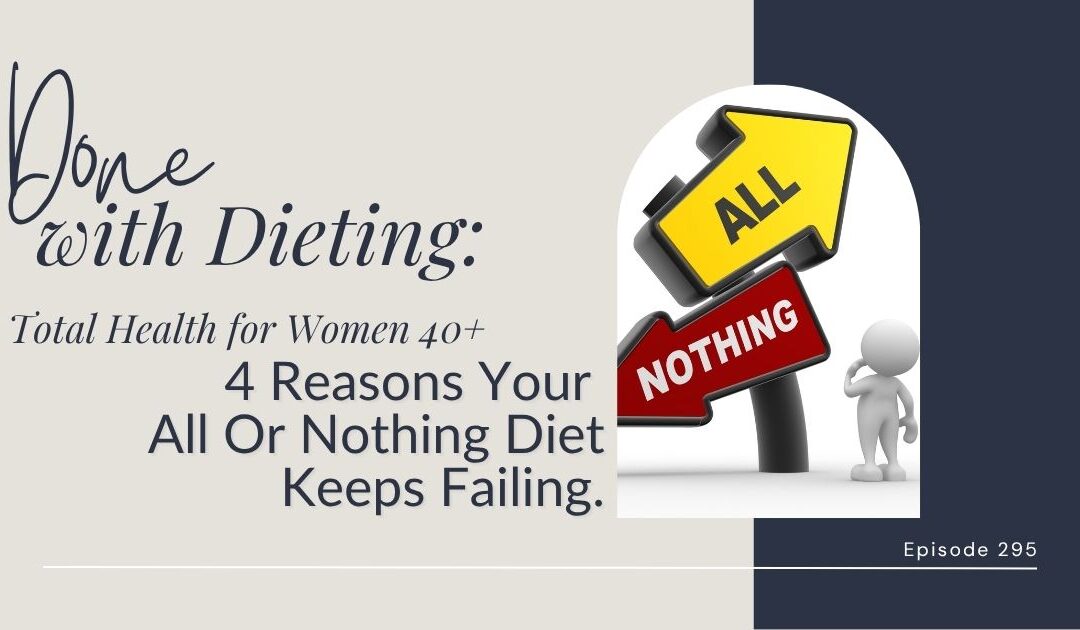
A new doctor ran a body composition test on me. The first thing he said was that my body fat was higher than he wanted it to be. And for about ten seconds, I did the exact thing I tell my clients not to do. I started planning how to change everything at once.
I stopped myself. I got a second test. I sat with two different sets of numbers that didn't fully agree with each other. And here's what I didn't expect: even with the numbers in hand, I still couldn't see my own situation clearly enough to know what to do next.
This episode isn't really about whether going all in is good or bad. It's about what trying hard actually means, and why the amount of effort you're putting in might not be the amount your body actually needs. I'm walking through four specific reasons all or nothing backfires, reasons that have nothing to do with how badly you want it or how hard you're willing to work.
By the end, I'll tell you what I decided to do about my own numbers, and why the answer surprised even me.
The Listener Takeaway: Why This Episode Matters
If you've ever gone all in on a Monday and quietly given up by the following weekend, this episode explains why that keeps happening, and it isn't about your discipline. It's about capacity, margin, and what "trying hard" has been trained to mean.
You'll walk away with a real answer to a question most women never stop to ask: not how much can I possibly do, but how little do I actually need to do to get a result I can keep. And you'll hear me admit, out loud, that knowing all of this didn't mean I could see my own situation clearly either.
Are you loving the podcast, but arent sure where to start? click here to get your copy of the Done with Dieting Podcast Roadmap (formerly Total Health in Midlife) Its a fantastic listining guide that pulls out the exact episodes that will get you moving towards optimal health.
Take the Quiz: Why Do Your Healthy Habits Keep Falling Apart? If you've ever wondered why you know exactly what to do but still can't seem to stick with it, this quiz was built for you. In about 3 minutes, it identifies your specific pattern: the real reason your follow-through keeps breaking down, and what to address first. Your results are delivered straight to your inbox.
I am so excited to hear what you all think about the podcast – if you have any feedback, please let me know! You can leave me a rating and review in Apple Podcasts, which helps me create an excellent show and helps other women who want to get off the diet roller coaster find it, too.
Watch or Listen to the Episode:
WHAT YOU'LL LEARN
- Why going all in on your diet and exercise routine at the same time works against your nervous system, not just your schedule
- What the minimum effective dose is, and why doing less might get you closer to your actual goal than doing more
- Why starting at 100% leaves you with nowhere to go once you hit a plateau, and why that plateau isn't proof you're failing
- Why one off day, one skipped workout, or one scoop of ice cream doesn't have to turn into a three week spiral
RESOURCES
- Free 30 Minute Diagnostic Call: A real conversation about what's actually getting in your way, whether that's all or nothing thinking or something else entirely.
- B Minus Habits framework, referenced in this episode as the alternative to pass or fail thinking
- 215: Preparing for Plateau— If the plateau story in this episode hit home, this one goes deeper into why plateaus happen and how to stop reading them as failure.
- 204: How to Create Sustainable Health Habits — This is where the B Minus Habits framework and the River of Misery concept first showed up, useful if you want the fuller picture behind today's fourth reason.
Full Episode Transcript:
295 - All or Nothing Thinking
[00:00:00]
Elizabeth: So I wanna share something a little bit vulnerable with you today. I recently went to a new doctor, and he looked at my body composition results and told me that the number was higher than he wanted it to be. And for a while there, I did the exact thing that I don't tell my clients to do. I started planning on how to fix it, all of it, immediately.
I knew I didn't have time to add additional workouts in my day, but I started thinking about my diet and what I could cut and where had I been eating like an asshole. And then I stopped myself. But here's what I haven't told anyone yet. I went and I got a second opinion, not from a different doctor, but I wanted to make sure that the data that we were looking at about my body fat levels was accurate.
So I got a second test, and then I sat with those numbers. I [00:01:00] still couldn't see my own situation clearly enough to know what to actually do next. So today isn't just about why going all in backfires. I'm sharing what I did instead and why the thing that actually helped me is probably the last thing that you'd expect from someone who's coached this over a decade.
This one gets a little personal and close to home for me, so stick around
Welcome to the Done With Dieting Total Health for Women Over 40 podcast, the podcast for women who are done with the start over cycle and ready for a way of taking care of themselves that actually works.
Hey, everyone. Welcome back to the Done with Dieting podcast. I am your host, Elizabeth Sherman, and I am really glad that you are here with me today. Now, I wanna talk to you about something that you've probably done more times than you'd like to admit. Maybe there's something that's a catalyst, you can't quite button your jeans, or you see that number on [00:02:00] the scale that you just don't wanna see, or you're just tired of being tired.
But whatever it is, you decide this is the week. You are going all in. You're gonna change all the things. So you cut out sugar, maybe you decide to join that new gym and figure out your class schedule for the next month, and you're only gonna drink water, no exceptions. And honestly, for a few days, it works.
You feel strong. You're starting to sleep better. You feel like the woman who has this all figured out. But then life starts to life. Maybe a late meeting runs long, or your sleep is starting to get disturbed. You're waking up in the middle of the night. Someone brings donuts into the office, or your kid needs you at 10:00 at night when you were supposed to be asleep at 9:00, and the thing starts crumbling.
Now, here's the part that gets me. You probably walked away [00:03:00] from all of that thinking that there was something wrong with you, that you didn't want it badly enough, that you are the person who can't seem to stick with anything. Now, I don't think that's true. Your effort was never the problem. The problem was the plan.
The plan was built wrong from the start, and today I wanna show you why. Going all in doesn't feel hard in the moment because you're motivated, but it works against the exact thing that you're trying to build, a body and a routine that you can actually trust day after day without forcing yourself through it.
Now, by the end of this episode today, you will understand why going all in so often backfires, and what to do instead so that you can keep the results that you're working for, more energy, better sleep, quieter food noise, and clothes that fit the way you want them to
Now, some people tell me that they [00:04:00] need a total overhaul, that going gradual doesn't work for them. I wanna suggest that the going all in doesn't work for them either, otherwise they wouldn't be struggling. But that's not the point. What I actually wanna unpack with you today is what going all in actually means, because I don't think most of us have ever stopped to really ask that question.
We've been taught that committing looks like doing everything all the time without complaint. You have to go to the gym five days a week. Every meal, you have to track it. No wine, no dessert, no days off. That's the picture that we've been sold as commitment. But I want you to consider something a little bit different today.
Here's the real question that I want you to sit with. Not how much can you possibly do, but how little do you [00:05:00] actually need to get real results and then keep doing it long enough for something to actually change? Your energy, your sleep, the number on the scale, if that's what you're after.
None of that changes from a plan that you can only follow for 11 days. Now, that's not a low bar. It's actually a smarter bar. See, we've been conditioned to believe that if some is good, more is better. But I really wanna challenge that belief, and in today's episode, I wanna share the four real reasons why going all in works against you and why.
Now, these reasons have nothing to do with how much you want it or how hard you're willing to work. I'm gonna walk you through all four in this episode because once you can see them, you'll understand why that approach hasn't stuck no matter how many times you've tried [00:06:00] it. So let's start with the first one.
Now, I see this play out constantly with my clients, with my friends, and all over social media too. A woman decides that she's ready to make a change, and instead of picking just one thing, she goes after all of it at once. She's got a new meal plan. She's working out five days a week at the gym. She's cutting out alcohol completely.
She turns her lights out by 9:00 every night, and she's meditating for 30 minutes every morning at 6:00. Oh, and don't forget, 96 ounces of water every single day. Now, any one of those on its own is something that you could gradually build into your week and actually keep, but stacked together all at the same time, it feels like too much, and there's nothing familiar left in her day.
What she eats is different. How she moves is different. When she sleeps is different. When she [00:07:00] drinks is different. Every anchor that she used to have is gone all at once. What's actually happening here has nothing to do with how much she wants it or how hard she's willing to work for it. Her nervous system and her social environment can only hold so much new information and new routines before they start treating the whole thing like a threat And that's not a figure of speech.
That's just how we are built as humans. New routines take time, energy, and attention. They take decisions that your brain used to make for you automatically, and now it has to make them all over again, except this time intentionally, all day, on top of everything else that you're already carrying. So the load stacks up fast, and when she finally stops, when she finally skips the workout, pours the wine, sleeps through the alarm, and misses the gym, that's not [00:08:00] her giving up.
That's her hitting the edge of what she's actually had to give that week, and almost nobody names it that way. We call it falling off track. We call it losing motivation. What's really going on is much simpler than that. See, her capacity to do it all ran out before the month did. Now, here's what I want you to notice about it.
If the problem is capacity, then telling someone that she needs to want it more or commit is just plain wrong. The fix is asking for less at once so that there's room to adjust so that you can actually keep going. That's the whole case for starting smaller than you think you should, and not because you can't handle more, but because handling more all at once doesn't leave you room to run on anything by day 12. [00:09:00] It's all too much change all at once. And so the second point is a belief that I want you to question. More effort always gets you more results. I mean, it sounds logical, right?
But said another way, if some is good, more is better. Now, this is not true. That's the assumption running under almost everything we try. I know that this, like, comes up for me all the time. More cardio, more restriction, more meditation minutes, more supplements. If a little bit helps, we assume that a lot must help more.
But that's not actually how your body works. There's a concept called the minimum effective dose. Now, it's the smallest amount of something that you can do that still gets you the real result that you're after. Now, past that point, you're not getting nothing, but you're also not getting a [00:10:00] lot more. You're just putting more effort for a smaller and smaller return.
It's called diminishing returns, and once you understand it, you start looking at your routine differently. Three strength workouts a week might get you nearly everything that six would. 10 minutes of quiet in the morning might settle your nervous system almost as much as 30. Eating enough protein and vegetables most days might move your energy more than eliminating an entire food group ever will.
The goal was never maximum effort, it's sufficient effort, the amount that actually works for your real life that you can sustain. Now, I wanna tell you about my client Jordan, because her story flips this idea on its head in a way that you might recognize. Now, Jordan came to me believing that she needed to eat less.
That's what she had been told for years: cut calories, cut [00:11:00] more, stay under a number that kept shrinking every single time her results stalled. Now, in looking at her behaviors and her results, Jordan needed to do the opposite. We needed to increase her calories. Now, this was super scary for her, but we did it slowly and methodically and not all at once,
Because jumping her intake up overnight would have not only felt terrifying, but it would have backfired as well. Now, here's what happened. We gave her body more fuel during the day, and as a result, her weekends changed.
The nighttime eating that she had been fighting for years, like find herself in the kitchen at night when the lights were out, that started to even out and stop. She wasn't white-knuckling her evenings anymore, and her sleep improved. Her workouts got stronger because she actually had something in the tank to build muscle from.[00:12:00]
Now, none of that came from actually doing more. It came from finding the amount that actually worked for her body instead of the amount that she thought she was supposed to be doing, the amounts that the apps told her to aim for, the amounts that eat less and exercise more dictates. And I'll be honest with you, I'm in the middle of figuring this out for myself right now, too.
At the beginning of the show, I mentioned a body composition test that I took. Part of what I'm sitting with is whether what I've been doing is actually the right amount for my body at this stage of life, or whether I've been operating off of an old rule book that doesn't apply to my body anymore. Now, I don't have all of that figured out right now, but I'll tell you more about where that lands in another episode.
But here's what I want you to take from Jordan's story right now and from my own: more doesn't automatically [00:13:00] produce better or faster results. Sometimes the answer isn't in pushing harder. It's finding the actual amount that your body needs and trusting that sweet spot is just enough Now, I wanna go back to the point where my doctor told me that my body fat was higher than he would've liked, because there's a piece of it that I haven't told you just yet.
Now, on the drive home from the appointment, I felt the pull to go all in immediately. Control my portions, cut sugar, you know, all the things. My brain wanted to create a plan and execute it right then, and it wanted that plan to be swift and intense as possible starting that day.
I caught myself, and I wanna tell you why that matters beyond just needing better information at first. If I had gone straight to maximum effort that day, cutting my food all the way down, adding more workouts or longer workouts on [00:14:00] top of my current routine, or eliminating anything remotely indulgent or enjoyable, here's what would probably have happened.
I would've plateaued eventually. Everybody does, because bodies adapt. Now, that's not a flaw in the plan. That's just how our physiology works. But if I had already been at 100% when this plateau hits, theoretically in the future, I would not have anywhere left to go to adjust.
I wouldn't be able to add another workout because my workout time would be maxed out. I wouldn't be able to cut my food further without real rebound consequences, and I would've already used every lever that I had on day one before I even knew if my body needed all of that in the first place. And here's what happens to most women in this exact spot.
When you [00:15:00] plateau, and just because there's nothing left to adjust, it doesn't feel like a normal part of the process. It feels like proof that no matter how hard I work, nothing will get me to my goal, and that this is just proof that her body is broken, or she's doing something wrong, or she's just one of those people that is not destined for the body that she wants.
Now, none of that is true. A plateau is not your body failing you. See, your body is designed to survive and give you life, so this is your body doing exactly what it's built to do: adjusting to whatever you're asking of it, and then holding steady until you ask for something different. That only becomes a problem when you've got nothing left to ask for.
This is why starting with a margin matters so much more than starting with intensity. If I begin at [00:16:00] 60% instead of maxing out on day one, I've got somewhere to go when progress slows. I can add more time to my workout. I can adjust my food a little bit. I can experiment because I built in room to experiment with when I started.
Starting smaller isn't playing it safe. It's the only way to actually have options later when you actually need them. Now, I'm still in the middle of figuring out where my own sweet spot is and what I'm doing, but I can tell you this much already: whatever I land on, I'm not starting at maximum.
I'm leaving myself room to grow into it because I want somewhere to go when my body inevitably adjusts So I wanna tell you about my client Claire, because I think that you'll recognize in her story immediately, even if the details aren't yours. Now, this past summer, Claire went out with her husband for a date [00:17:00] night, and they had dinner, and afterwards as they were walking down, the street, through town, he spotted an ice cream shop and said, "Hey, I feel like some ice cream.
Let's go get some." Now, she didn't wanna be the wife who says no. She didn't wanna be high maintenance, and it was one scoop. It was a warm summer evening, connecting with her husband. Nothing big about all of it. By the next morning, though, her inner critic had already started in. "You really messed up this time.
Why even bother anymore? One scoop of ice cream turned into a full-blown spiral that pulled her off track for the next three weeks. Now, I want you to sit with that for just a second because the math just does not add up. One scoop of ice cream does not undo three weeks of progress.
Like, it is not physically possible. What derailed her wasn't the ice cream. It was what she told herself that the [00:18:00] ice cream meant. This is what all-or-nothing thinking does. It turns your plan into a pass-fail system. You're either doing it perfectly or you failed completely, with no variation in between.
The second you eat the thing that wasn't on the plan, or skip the workout, or sleep through your early morning routine, the all-or-nothing brain doesn't say that you just had a one-off moment. It says that you blew it, and if you've already blown it, why bother holding the line for the rest of the day? You may as well eat whatever the hell you want and skip the rules for the rest of the week and start fresh on Monday.
One moment doesn't just stay one moment. It becomes permission to abandon everything else. Here's the alternative, and it's something that I talk a lot about with my coaching clients, the idea of adopting B-minus habits. Now, a [00:19:00] B-minus habit means executing good enough. It doesn't require perfection because as humans, we are not perfect.
And it's not about lowering your standards. I want to be really clear about that because I know how it can sound. It's not settling for less than what you want. It's changing what your expectations are for yourself. It's changing what executing the plan actually means. Instead of pass or fail, it's a continuum.
You can plan to be off track for a moment and then back on track for the very next one without a three-week detour in between. Now, if Claire had been working from that frame of mind the morning after the ice cream, there would have been no spiral. There's just breakfast, and that is the whole shift.
It's not about you eat the ice cream. It's about what happens in your head the moment after you do So [00:20:00] let me go back to where I began, that doctor's office visit and the body composition test, the moment that I felt the pull to go all in. Now, I told you that I stopped myself and got more information first.
That part is true. What I didn't tell you yet is what happened after. After I got the second test, I sat with both sets of numbers, and even with everything I know, even with the years that I have spent studying this and coaching hundreds of women through this exact thing, I still could not see the forest from the trees in my own situation.
I could not figure out my own situation clearly enough to know what to do next. So I hired my own coach. And I wanna share what I think that means because I think it matters more than the fact itself. It doesn't mean that anything went wrong, or that I'm a bad coach, or anything about me.
It doesn't mean my [00:21:00] own work doesn't hold up. If anything, it's proof that it does, and that I trust the power of coaching and getting support when I need it. I built my entire practice around the idea that knowing what to do and being able to actually do it are two different things, and that sometimes the gap between them isn't something you close by reading more or trying harder.
Sometimes, as in my case, we know so much that we can't see all of the details. Knowledge can get in our way. Sometimes someone else has to help you see what you can't see from inside your own situation, even when you're the one who wrote the book on it. That doesn't mean anything. That's just what's true for people, all people, including the ones who teach this stuff for a living.
So here's what I want you to walk away with today. Stop asking yourself [00:22:00] how much you can possibly do, and start asking how little you actually need to do, the amount that gets you a real result and that you can keep doing it without falling apart in three weeks. And then ask yourself the harder question: Can you actually see your own situation clearly enough to know what that amount is?
Or is there a piece of this that you can't get to on your own, no matter how much you already know? Now, again, that's not a question about discipline. It's not even really a question about diet. It's a question about whether you're carrying this all alone when you don't have to be.
So thank you so much for spending this time with me today. Now, I know that your time is valuable, and I don't take it for granted that you chose to spend part of your time with me here. If any of this has landed for you, if you recognized yourself in [00:23:00] Claire's spiral or Jordan's story, or even in my own doctor's office moment, I would love to help you figure out what's actually getting in your way. I offer a free 30-minute diagnostic call where we talk through your specific situation together.
There's no pressure, there's no sales pitch, just a real conversation about what's going on for you and what might actually help. You can find the link in the show notes or go to elizabethsherman.com/diagnostic. That's all I have for you today. Have an amazing week, and I will talk to you next time.
Bye-bye. Hey, thanks for tuning in today. If what we talked about is landing and you're ready to figure out what's actually getting in your way, I would love to invite you to a free diagnostic session with me. It's 30 minutes long, just us, looking at where your specific weight keeps breaking down and where you need support applying what you already know.
You'll leave with a clear picture of what's driving it and what would actually help next. No shame, no macros, no [00:24:00] pretending you have infinite capacity, and certainly no lecture about trying harder. Go to elizabethsherman.com/diagnostic to grab your time. I would love to see you on the call
Enjoy the Show?
- Don’t miss an episode, follow the podcast on Spotify and subscribe via Apple Podcasts or RSS.
- Leave me a review in Apple Podcasts.
- Join the conversation by connecting with me on Social!


Elizabeth is a Master Certified Life and Health Coach with over 20 years of experience, dedicated to helping women in midlife thrive through holistic health and wellness. Her personal journey began with a desire to reduce her own breast cancer risk, which evolved into a mission to guide women through the complexities of midlife health, from hormonal changes to mental clarity and emotional resilience.
Elizabeth holds certifications from prestigious institutions such as The Life Coach School, Precision Nutrition, and the American Council on Exercise, as well as specialized training in Feminist Coaching and Women’s Hormonal Health. Her approach is deeply empathetic, blending her extensive knowledge with real-life experience to empower women in their 50s and 60s to build sustainable health habits that last a lifetime.
Recognized as a top voice in women’s health, Elizabeth speaks regularly on stages, podcasts, and webinars, inspiring women to embrace midlife with energy, confidence, and joy. Her passion is helping women regain control of their health, so they can fully engage in the things that matter most to them—whether that’s pursuing new passions, maintaining strong relationships, or simply feeling great in their own skin.