
Stress management, not skincare, is the most effective anti-aging strategy available, because chronic stress directly breaks down the collagen, sleep quality, and cellular repair that products only ever address on the surface.
TL;DR
- Chronic stress raises cortisol, and cortisol measurably breaks down collagen, disrupts sleep, and drives inflammation, the actual mechanisms behind visible aging.
- Yale research found people with a positive view of aging lived about seven and a half years longer, largely because of a stronger will to live.
- Some of what ages you is structural (genetics, circumstances, access) and some of it is self-generated (worry, resentment, fear). Only the second is something you can work with directly.
- Before your next purchase or procedure, ask the honest question: is this because it feels good, or because you're afraid of looking old?
- Harder circumstances don't disqualify you from feeling and looking better. The lever is just in a different place.
Why Stress Management Beats Every Anti-Aging Product
You've probably spent more money on your face this year than you've spent on your stress. Serums, retinol, maybe a filler appointment. All of it aimed at the same target: looking less tired, less worn, less old. For most of us, that routine doesn't feel like vanity. It feels like a lifeline, the thing standing between us and looking as worn down as we sometimes feel.
Sun exposure plays a role, but the biggest driver of visible aging is stress, specifically the chronic, low-grade kind that never fully switches off, and it's the one cause almost no one names out loud. No product on the shelf touches it, because there's nothing to ring up at the counter for it. No bottle, no serum, no appointment required.
This isn't about giving up your routine, or swapping it for something trendier. Stress is the actual cause behind a lot of what shows up on your face, at a cellular level, and it's the part of the anti-aging conversation that keeps getting left out.
Stress Is Aging You, and No One's Talking About It
Here's the actual mechanism, because it matters more than another product recommendation would.
When you're stressed, your body releases cortisol. In short bursts, cortisol is fine. It's supposed to be there. The trouble starts when stress never fully switches off and cortisol stays elevated for months or years at a time.
Chronically high cortisol does measurable damage. A 2024 clinical and cellular study in the Journal of Cosmetic Dermatology found that cortisol and epinephrine, the two hormones your body releases under stress, directly downregulate the genes responsible for producing collagen types I and III in human skin cells. That's the protein structure that keeps skin firm. The same study found slower wound healing and increased oxidative DNA damage in skin cells exposed to stress hormones.
Then there's sleep. Stress is one of the most common reasons women in midlife lose it. A study out of University Hospitals Case Medical Center, published in Clinical and Experimental Dermatology, compared women with chronic poor sleep quality against women who slept well. The poor sleepers showed significantly more fine lines, uneven pigmentation, and slower recovery from environmental damage, using a validated clinical skin aging scale.
And then there's inflammation. Cortisol drives it throughout your entire body, not only your skin. It shows up in your joints, your heart, and yes, your face.
None of this is a moral failing. Your body does this chemically when stress runs high for long enough, whether or not you do yoga or feel calm about your life most days. Serums work on the surface. This is happening underneath it.
“The single biggest driver of visible aging isn't your skincare routine. It's the stress you're carrying that never fully switches off.”
The Two Piles of Stress, and Why Only One Is Yours to Work
Some of what ages you is structural. It's the commute you can't shorten, the climate you live in, the cost of your groceries, the caregiving that landed on you and not on anyone else. None of that is optional, and no amount of a good attitude changes it.
But there's a second pile: the stress you generate yourself. The worry loop at eleven at night about your kid, your marriage, your bank account, the number on the scale. The resentment simmering underneath an ordinary commute. The anxiety about things that haven't happened yet and may never happen.
That second pile is worth examining, because unlike the first, it isn't fixed.
Here's what matters most. If your circumstances are genuinely harder than someone else's, this doesn't disqualify you from anything. It means the lever available to you might be smaller, or located somewhere different, than it is for a woman whose life has more built-in ease. You are not unavailable for feeling better in your body just because your circumstances are harder. The mechanism works the same way for everyone. Chronic stress ages the body. Managing what's actually yours to manage still moves the needle, wherever you're starting from.
“You are the only one who marinates in your own resentment. The traffic doesn't feel it. Your bank account doesn't feel it. You do.”
There's a study I think about often. A Yale researcher named Becca Levy followed a group of adults 50 and older for years and found that the people who held a more positive view of getting older lived about seven and a half years longer than the people who held a negative one. A lot of that difference came down to something simple: a stronger will to live. It isn't a study about wrinkles, and I don't want to overstate what it found. But it's hard not to connect the dots between how a woman feels about her own aging and how she treats her body along the way, including which purchases she reaches for and why.
The Question Worth Asking Before Your Next Purchase
Now here's the harder question, and it's worth sitting with before you buy anything else.
Research on why women buy anti-aging products found something worth noting. Age itself didn't predict whether a woman bought anti-aging products. Aging anxiety did, meaning how afraid she was of getting older in the first place.
That's worth pausing on. Fear of aging, more than aging itself, is driving a real amount of spending in this category. And that fear doesn't come from nowhere. Researchers studying anti-aging motivations have found that most of us frame our use of these products in terms of health and appearance rather than aging directly, in ways that quietly reinforce the idea that looking your age is something to fix.
This is where ageism enters the conversation, and I mean that word seriously, the same way I'd use sexism or ableism. Ageism is the belief that getting older makes a person less valuable, less attractive, less worth looking at. It's built into advertising, into casting, into the way we talk about a woman who lets her hair go gray in public. And it gets internalized. You can hold every progressive belief about aging in your head and still feel a small hit of dread looking in the mirror, because the message was never really optional to absorb.
So here's the question I'd ask you to sit with. Before your next serum, your next appointment, your next product: are you doing this because it feels good and you genuinely enjoy it? Or are you doing it because you're afraid of what looking older says about you?
Both answers are allowed. I've had procedures done (lashes, lips, brows, etc), and some of it I love, and that isn't a problem. But if the honest answer is fear, that's worth knowing, because fear is expensive and it doesn't actually slow down the mechanism that's aging you. Managing your stress does that.
“Wanting to feel good in your skin and fearing what aging says about your worth are not the same thing, even though the industry profits from blurring the two.”
This is exactly the territory I explore in The Skill of Self-Trust, because knowing your own motives is a skill you can build, not a fixed part of your personality.
What Products Can Do vs. What Stress Management Does
| What Skincare and Procedures Can Do | What Managing Your Stress Can Do |
| Temporarily plump or smooth the surface | Slow collagen breakdown at the cellular level |
| Hydrate and protect the skin barrier | Improve sleep quality, which is when your skin actually repairs itself |
| Address visible texture and tone | Lower inflammation throughout your entire body, not just your face |
| Feel good and be genuinely enjoyable | Extend your actual healthspan, not only your appearance |
Both columns can be true for you at the same time. This isn't an argument for giving anything up. It's a reminder of which one is doing the heavier lifting.
What to Actually Do About It
- Learn the mechanism. Cortisol breaks down collagen and elastin, disrupts the sleep your skin needs to repair itself, and drives inflammation throughout your body. Today: read the two studies linked in the Sources section below, so this isn't just something you took my word for.
- Sort your stress into two piles. Structural (your commute, the weather, other people's choices) and self-generated (worry, resentment, anxious loops about things that haven't happened). This week: for three days, jot down what's stressing you and mark which pile it belongs to.
- Ask the motive question. Before your next purchase or procedure, pause and name the honest reason. This week: before you buy anything new for your face, answer the question out loud or in writing first.
- Work one lever in the self-generated pile. Pick one recurring worry, something about money, a relationship, or a decision you keep circling, and practice noticing when you're marinating in it rather than actually living your life. Next week: track it daily, and notice when the marinating starts.
The goal was never a life with zero stress. That isn't real, and you wouldn't want it anyway. Some stress is what gets you out of bed in the morning. The goal is to stop drowning in the part that was always optional.
If you want to hear what this looks like when someone actually does the work, not just reads about it, Chris's story on episode 279 is a good place to start.
Frequently Asked Questions
Yes. Chronic stress keeps cortisol elevated, and elevated cortisol breaks down the collagen and elastin that keep skin firm, disrupts the sleep your skin needs to repair itself, and drives inflammation throughout your body. Researchers have measured this directly at a cellular level, not just observed it anecdotally.
Managing your stress can slow the mechanisms known to accelerate aging, including collagen breakdown, poor sleep, and chronic inflammation. It won't undo aging entirely, nothing does, but it addresses the actual cause in a way that topical products can't.
Genetics play a real role, and so does circumstance: lower cost of living, easier access to rest, a climate that allows an easier pace of life. Chronic stress levels, sleep quality, and how much of your day goes to worry you're generating yourself also play a measurable part.
No. Wanting to feel good in your skin isn't a problem. What's worth examining is whether the motivation is enjoyment or fear, because fear-driven spending doesn't address what's actually aging you, and it can come at a real cost to your peace of mind.
Internalized ageism is absorbing the cultural message that getting older makes you less valuable or less worth looking at, so completely that it starts to feel like your own opinion rather than something you were taught. It shows up as dread in the mirror, not just a belief you'd state out loud.
Many can improve hydration, texture, and the appearance of fine lines on the surface. What they can't do is address the cortisol-driven collagen breakdown, sleep disruption, and inflammation that stress causes throughout your body, which is a big part of what's actually aging you.
Cortisol downregulates the genes responsible for producing collagen types I and III, along with other proteins that keep skin structurally sound. Chronically elevated cortisol also slows wound healing and increases oxidative damage at the cellular level, research published in the Journal of Cosmetic Dermatology has found.
The Real Secret
The skincare industry was never going to tell you this, because there's no bottle for it and nothing to ring up at the counter. The thing that's actually aging you fastest doesn't photograph well, and it doesn't have a five-star review section.
You get to keep whatever you genuinely enjoy: your skincare, your filler, your lash appointment. None of that is the problem. The problem is mistaking it for the thing that actually works, and spending your money and your peace of mind chasing a fear instead of addressing the mechanism underneath it.
Seeing this clearly is the first step. Actually working through the stress you're carrying, the resentment, the worry loops, the fear underneath the purchase, is a different kind of work entirely.
Managing your stress is habit number six of the eight fundamental habits I teach my clients, the ones that mean you're taking care of yourself in a way that actually holds up, long after any trend cycle moves on. I put all eight in a free guide called The 8 Habits That Healthy People Do and Why They Don't Stick.
Grab it at elizabethsherman.com/habits, and join my list while you're there so you don't have to figure this out alone.
Evidence & Attribution
- Levy, B.R., Slade, M.D., Kunkel, S.R., & Kasl, S.V. (2002). Longevity Increased by Positive Self-Perceptions of Aging. Journal of Personality and Social Psychology, 83(2), 261–270. DOI: 10.1037/0022-3514.83.2.261. PubMed: https://pubmed.ncbi.nlm.nih.gov/12150226/
- Pujos, M., et al. (2024). Impact of Chronic Moderate Psychological Stress on Skin Aging: Exploratory Clinical Study and Cellular Functioning. Journal of Cosmetic Dermatology. DOI: 10.1111/jocd.16634. https://onlinelibrary.wiley.com/doi/10.1111/jocd.16634
- Oyetakin-White, P., et al. (2015). Does poor sleep quality affect skin ageing? Clinical and Experimental Dermatology, 40(1), 17–22. DOI: 10.1111/ced.12455. https://onlinelibrary.wiley.com/doi/abs/10.1111/ced.12455
- Muise, A., & Desmarais, S. (2010). Women's Perceptions and Use of "Anti-Aging" Products. Sex Roles, 63, 126–137. https://link.springer.com/article/10.1007/s11199-010-9791-5
- Calasanti, T., et al. Rationales for Anti-aging Activities in Middle Age: Aging, Health, or Appearance? PubMed. https://pubmed.ncbi.nlm.nih.gov/27507687/
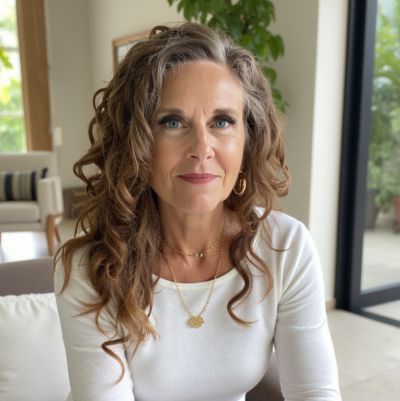
Elizabeth is a Master Certified Life and Health Coach with over 20 years of experience, dedicated to helping women in midlife thrive through holistic health and wellness. Her personal journey began with a desire to reduce her own breast cancer risk, which evolved into a mission to guide women through the complexities of midlife health, from hormonal changes to mental clarity and emotional resilience.
Elizabeth holds certifications from prestigious institutions such as The Life Coach School, Precision Nutrition, and the American Council on Exercise, as well as specialized training in Feminist Coaching and Women’s Hormonal Health. Her approach is deeply empathetic, blending her extensive knowledge with real-life experience to empower women in their 50s and 60s to build sustainable health habits that last a lifetime.
Recognized as a top voice in women’s health, Elizabeth speaks regularly on stages, podcasts, and webinars, inspiring women to embrace midlife with energy, confidence, and joy. Her passion is helping women regain control of their health, so they can fully engage in the things that matter most to them—whether that’s pursuing new passions, maintaining strong relationships, or simply feeling great in their own skin.