Most diet culture advice tells you that eating less requires iron willpower, white-knuckling through cravings, and tracking every crumb on an app. But here’s the reality: humans make hundreds of food decisions every single day, and most of them happen on complete autopilot.
You didn't finish the bowl of chips because you failed; you finished them because they were sitting within arm's reach while you watched TV. If you want to stop overeating without feeling deprived, you don't need more discipline—you need an environment that does the heavy lifting for you.
Here are 5 practical, shame-free strategies to adjust your daily friction points so you naturally and mindlessly eat less.
Here's the scene:
You're out to dinner with friends. It's been a lovely dinner; you've really enjoyed the evening and have gotten completely swept up in the conversation. The server comes over to start clearing the plates & dishes. As he approaches you, and asks whether you're finished, you look down at your plate. What do you see? What do you say?
Is there food still on your plate? Are you finished eating?

I am reading this great book called Mindless Eating. The author, Brian Wansink, a food researcher at Cornell, says that if you asked folks, "How do you know when you're done eating?" or, "How do you know when to eat?" you'd think that most would answer these two questions with 'I eat when I'm hungry; and I stop when I'm satisfied.' But that's not the case. Far too often we eat for other reasons.
In the book, he exposes how we're tricked into eating for reasons other than hunger, or overeating when we don't mean to.
I totally identify with the idea that we often eat for reasons other than hunger. I grew up as the youngest child in a family of 8: 2 parents, 5 girls, 1 boy.
When I think about my earliest memories of the dinner table, or eating with my family, it's pretty chaotic. It was all for one, and one for all. If I didn't eat quickly, and get my second helpings first, with 7 other hungry mouths, I wasn't getting any.
Additionally, with 6 kids, my parents were pretty disciplined in our daily routines. So we ate at the same time every day. And because we didn't have money to waste, (and in our family food equated money) we all had to finish what was on our plates. 'Eat your spinach. You know, there are starving children in Africa,' my mom would say.
And my mom was the definition of an emotional eater.
I know that for years, I ate because of an emotional response, it was time to eat, and either cleaned my plate, or went back for seconds and ate until I was full. Not just satisfied, but past satisfied on the hunger scale, and FULL.
Because the question I was asked at the end of dinner wasn't, 'Are you finished?' Or 'Have you had enough?' But rather, 'Are you full?'
How that question is asked, is so important. And so, this type of conditioning as a child had a HUGE influence on my eating patterns as an adult, and led to some pretty unhealthy attitudes towards food in adulthood.
Think you just lack willpower around food?
If you know what healthy eating looks like but still find yourself wandering into the kitchen on autopilot, willpower isn't your problem—friction is. In about 3 minutes, find out the real pattern breaking your consistency and what to tweak first:
Okay, so back to the research. We know that there are two different types of cueing that determine when we start eating, what we eat, and when we stop. We have internal and external reasons for eating. We may not even be aware of these cues - especially the external ones! But once you start getting clued in, you can make better choices for yourself.
Internal Cues
- Stop eating when you're satisfied
- Eating when you're hungry
- Stop eating when the food doesn't taste good any longer
External Cues
- Eat according to time of day
- Eating because it's there (you know what I'm talking about - that stale mix that's on the table that you're eating even though you don't like it)
- Stop eating because television show is over
- Stop eating because plate is clean/there's no more left
- Stopping eating because everyone else at the table is done eating
- Matching your eating speed to the eating speed of others you're dining with
Here's what the research has to say about folks who eat due to internal cues versus external cues: Folks who eat according to their internal cues tend to be leaner than folks who eat according to external cueing.
Okay. So, that's good to know. BUT does that mean that if you're out of touch with your internal hunger cues, and you only eat because of those external reasons, that you're doomed? No. BUT there are some things that you can do to trick yourself:
- Portion out less - If you're someone who struggles with being a member of the clean plate club, or the deprive/binge cycle, this trick might work for you. Our brains and stomachs don't really know the difference between 20% more, 20% less, and normal portioning out of foods. So, if you're having pasta for dinner, and your partner gave you 20% less on your plate than you normally eat, you really wouldn't be able to tell the difference, hunger wise.
- Make it appear like more - Consider this optical illusion.

In both of these patterns, the center circle is the same size. But it looks bigger in the left pattern because the surrounding circles are smaller. How you can apply this same logic to your eating, is to eat off of smaller bowls and plates. Think about it: an egg in the middle of a 14" dinner plate will look smaller than that same egg on an 8" salad plate.
It's best to eat according to your hunger cues. But that can take a lot of time and practice. It also takes a lot of mental focus (something that we don't always have later in the day).
So, while you're practicing eating towards your internal hunger cues, these are a few ways that you can minimize the damage. Follow the tips above to limit the amount of mental energy you spend thinking about your food.
Because we have more important things to think about. Like solving world peace. Or why waist trainers are even a thing.
Frequent Questions
Mindlessly eating less means reshaping your physical environment and serving routines so you consume fewer calories naturally without actively restricting, measuring food, or relying on willpower.
Using smaller dinner plates (such as 8- to 9-inch plates instead of 11- to 12-inch plates) creates an optical illusion that makes portions look fuller. This triggers visual satiety earlier, leading you to serve and eat less without feeling deprived.
Increase the physical friction required to get the food. Keeping snack foods out of open sightlines, storing them in opaque containers inside high cabinets, or leaving leftovers packed away at the stove rather than family-style on the dining table substantially cuts autopilot snacking.
Tired of trying to "control" food?
When you find yourself mindlessly reaching for food you aren’t even hungry for, banning snacks isn't the fix. Grab my free guide to uncover the underlying emotional triggers, environmental cues, and daily fatigue actually driving the urge:
* Mindless Eating is an affiliate link to Amazon.com
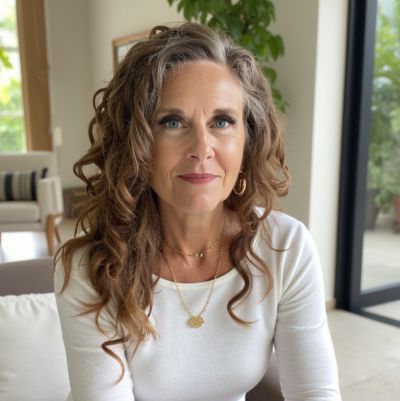
Elizabeth is a Master Certified Life and Health Coach with over 20 years of experience, dedicated to helping women in midlife thrive through holistic health and wellness. Her personal journey began with a desire to reduce her own breast cancer risk, which evolved into a mission to guide women through the complexities of midlife health, from hormonal changes to mental clarity and emotional resilience.
Elizabeth holds certifications from prestigious institutions such as The Life Coach School, Precision Nutrition, and the American Council on Exercise, as well as specialized training in Feminist Coaching and Women’s Hormonal Health. Her approach is deeply empathetic, blending her extensive knowledge with real-life experience to empower women in their 50s and 60s to build sustainable health habits that last a lifetime.
Recognized as a top voice in women’s health, Elizabeth speaks regularly on stages, podcasts, and webinars, inspiring women to embrace midlife with energy, confidence, and joy. Her passion is helping women regain control of their health, so they can fully engage in the things that matter most to them—whether that’s pursuing new passions, maintaining strong relationships, or simply feeling great in their own skin.