If you've noticed you're hungry an hour after a full meal, wide awake at 2am after doing everything right, or flat after a workout that used to leave you energized, you're not imagining it, and you're far from the only one.
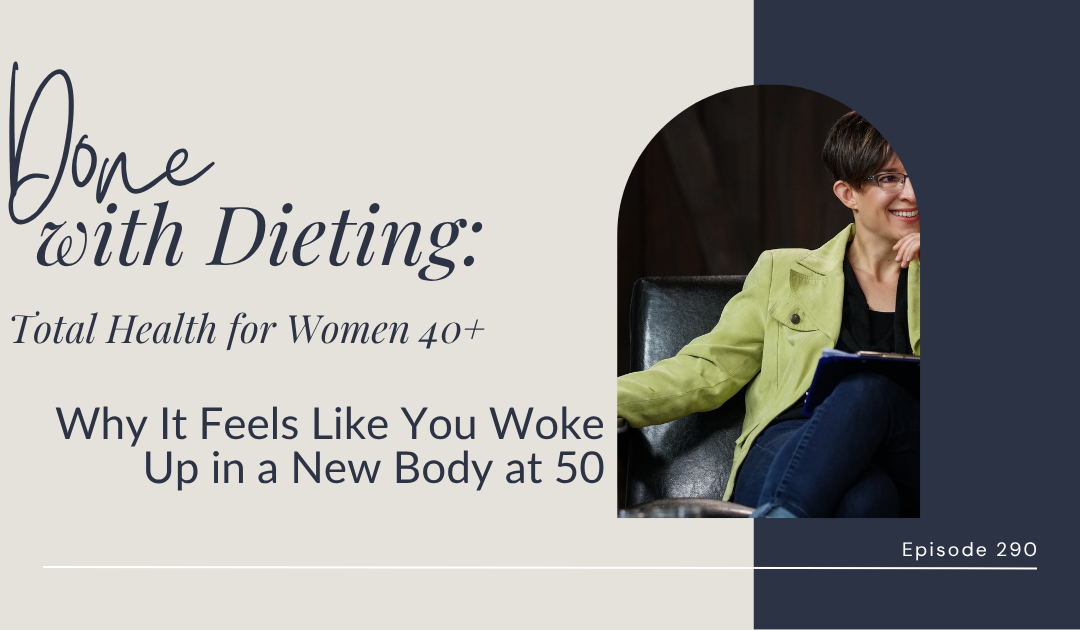
This episode features Krista Scott-Dixon, a coach and educator with decades of experience in behavior change and health coaching. Krista spent years as director of curriculum at Precision Nutrition and now does similar work with Girls Gone Strong's menopause coaching materials, alongside a private coaching practice that includes clients ranging from everyday women to search and rescue teams. Her new book brings real counseling and therapy tools into nutrition and health coaching, built on the idea that most coaches, and most women, were never actually taught how change happens.

Together, we get into why hunger, energy, mood, and sleep can all stop feeling reliable somewhere in your 40s and 50s, and why treating perimenopause as one hormone problem misses what's actually going on. Krista makes the case that this stage belongs in the same category as a major illness, a career change, an identity shift, or the end of a relationship. She also introduces the idea of self-trust as a skill, one that gets socialized out of most women long before hormones ever enter the picture.
If you've been white-knuckling your way through a body that no longer responds the way it used to, this conversation will change how you think about what's actually happening, and what to do with it.
The Listener Takeaway: Why This Episode Matters
If you've started to wonder whether something is wrong with you because your body stopped responding the way it used to, this episode gives you a different way to understand what's happening. You'll walk away seeing your hunger, your energy, and your mood as information instead of a malfunction, and understanding that self-trust is a skill you can rebuild.
This conversation is for the woman who's exhausted from trying to force an old rulebook onto a body and a life that have both changed, and who's ready to stop treating that as a personal failure.
Are you loving the podcast, but arent sure where to start? click here to get your copy of the Done with Dieting Podcast Roadmap (formerly Total Health in Midlife) Its a fantastic listining guide that pulls out the exact episodes that will get you moving towards optimal health.
Take the Quiz: Why Do Your Healthy Habits Keep Falling Apart? If you've ever wondered why you know exactly what to do but still can't seem to stick with it, this quiz was built for you. In about 3 minutes, it identifies your specific pattern: the real reason your follow-through keeps breaking down, and what to address first. Your results are delivered straight to your inbox.
I am so excited to hear what you all think about the podcast – if you have any feedback, please let me know! You can leave me a rating and review in Apple Podcasts, which helps me create an excellent show and helps other women who want to get off the diet roller coaster find it, too.
Watch or Listen to the Episode:
WHAT YOU'LL LEARN
- Why your hunger, fullness, and energy signals can suddenly feel unreliable in your 40s and 50s
- Why perimenopause belongs in the same category as a major illness, career change, or relationship ending, and why that reframe matters
- What self-trust actually is as a skill, and when most women lose access to it
- Why the health advice that used to work on your body stops working, and what that has to do with trust rather than effort
RESOURCES
- Krista Scott-Dixon's new book, Applied Nutrition Coaching and Counseling: Theory to Practice
- Girls Gone Strong's menopause coaching materials
- Krista's website
- Reach out to Elizabeth directly to talk about coaching
- 256 - Fearing Hunger: How Dieting Trained You to Overeat— If today's episode made you rethink your hunger signals, this one breaks down exactly why fear of hunger got installed in the first place.
- 254 - How to Trust Yourself Around Food Again in Perimenopause — Krista talked about self-trust as a skill you can rebuild. This episode gives you a perimenopause-specific starting point for actually doing it.
Full Episode Transcript:
290: KSD
Krista: [00:00:00] I feel like perimenopause and menopause is like truth serum. And I have this wackadoodle, probably completely unscientific hypothesis about how the hormones that are present in our body earlier in our reproductive lives are there to kind of almost anesthetize us against a lot of the BS, because if it, if we didn't have these, these coursing through our veins to kind of keep us a little bit quiet, we would be feral and raging and, and saying, "This isn't right," like, "This is crap."
Like I, I think that but then all of a sudden the veil gets ripped away from our eyes and we're like, "What the heck, man?"
Elizabeth: Welcome to the Done With Dieting Total Health For Women Over 40 podcast, the podcast for women who are done with the start over cycle and ready for a way of taking care of themselves that actually works.
Hey, everyone. Welcome back to the Done With Dieting podcast. I am your host, Elizabeth Sherman, and I am really glad that you are here with me today because [00:01:00] I have an amazing guest. So I wanna start by sharing something that my guest, Krista Scott-Dixon, said to me before we'd even been recording for just 10 minutes, because I have not stopped thinking about it ever since.
She said, in reference to all the things that happen in a woman's body at this stage of our lives, "Congratulations, you have woken up in a new body, and now you get to discover it."
And if that is not just the explanation for what happens at this stage of life, I don't know what it is. Now, if you've ever stood in your kitchen wondering why you're starving after an hour after a full meal, or you've woken up at 2:00 AM after doing everything right that day, or you've even noticed that a workout that used to leave you feeling amazing now leaves you feeling just exhausted, this episode is going to explain why.
And if you've been listening to the podcast since the [00:02:00] early days, you might actually remember Krista. She was on the show way back in episode 46, and we were talking about the science of self-compassion. Now, a few things have changed since way back then in 2001. Krista has spent years as the director of curriculum at Precision Nutrition, but these days she is doing similar work at Girls Gone Strong, building out their menopause coaching materials, and running her own private coaching practice with clients ranging from regular people to search and rescue teams.
She is just a powerhouse. She also just published a new book bringing real counseling and therapy tools into nutrition and health coaching because it turns out that many coaches and trainers were never actually taught how change happens. We get into why your hunger, your energy, your mood, and your sleep can all stop feeling [00:03:00] reliable somewhere in your 40s and 50s, and why that's simply what happens mid-transition.
It's the same category as major illness, a career change, an identity shift, or even a relationship ending. It's not a personal failure, it's simply biology and timing.
Krista also talks about something that she calls self-trust as a skill, and exactly where that got socialized out of most of us before we even understood what was happening. By the end of our conversation today, you are gonna walk away with two things. You're gonna understand exactly why the old rules for reading your own body stop applying in midlife, and two, you're gonna hear a concrete way to start rebuilding trust with a body that feels unfamiliar instead of white-knuckling through it or writing yourself off as broken. I loved every minute of having this [00:04:00] conversation. I hope you do, too. Here's Krista
Elizabeth: Okay. All right, everyone, welcome Krista Scott-Dixon to the show.
Krista, I am super excited that you are here today, and gonna just grace us all with your infinite wisdom. No, no, no big, , pressure there. , Tell everyone who you are, what you do, and anything else you wanna share.
Krista: Yeah. Okay. Well, infinite wisdom is a little bit like telling someone to be funny or be cool- I know
right away. Um, but yeah, I'm Krista Scott-Dixon. I am a coach, uh, I'm an educator, and at this point in my life, in my career trajectory, I specialize in things like behavior change, especially around health behaviors, health and lifestyle behaviors. Although, that said, side note, a lot of these things connect to other life things, so life transitions, life changes, existential crises, that kind of stuff.
But in general, I coach around health behaviors as well as things like mental [00:05:00] performance, , stress and resilience. , My day job is, , helping develop curriculum as well as helping to develop, , AI coaching in various apps. So I do a bunch of different things, but they all sort of hang together with the umbrella of coach and educator.
, Writer, I guess. I've got a new book out. , That's part of it, but, , yeah, coach/educator I think is a good umbrella title.
Elizabeth: Awesome. And I know that you specifically work with folks in transition. And, you know, when we started talking about, , coming on this podcast, , you know, I don't ... I mean, obviously perimenopause, menopause is a transition.
I don't know if I really thought about it that way anymore. How did you come to that realization? And, um, yeah, just tell us more about that piece, the perimenopause, menopause transition that many women experience that they might not see themselves as that. [00:06:00]
Krista: Yeah, so I mean, early in my coaching days when I was in my 20s and 30s, I was working with women who were going through pe- perimenopause, but we didn't really know a lot a- about it at the time.
And so there was no really coherent story about it that someone could point to and say, "Oh, yes, what you're experiencing is this." , And it wasn't, it was ironically, , when I accidentally managed to give myself a little bit of an eating disorder in my 30s, , when I was competing in sports and cutting weight and all this kind of stuff, and I experienced symptoms that were very similar to what a woman in perimenopause would be going through.
, And I didn't have any frame for it, so of course what did I do? I got on the internet, , asked Dr. Google, and, a lot of the symptoms I saw I recognized. I was like, "Oh, this is wild." Like- Why, why is this not a conversation that more people are having? And now luckily my doctor was incredibly informed.
I was lucky to live in a large city with like [00:07:00] really current healthcare. , But by and large, like a lot of my clients were just kind of out in the wilderness, so to speak, like experiencing these things, not really sure why they were happening. And at the time as a younger coach, I was really at a loss.
So now fast-forward, now that I'm in my 50s, I have a very good frame of reference for this because I've been on this roller coaster myself and so I feel like I've, I've done this twice. So I did it in my 30s, uh, you know, got back to, to normal and then came back for a second round feeling, uh, you know, much more practiced and, and knowing what to expect.
And but, but really because we know that a huge, , majority of folks who are seeking out health information, personal training, um, you know, nutrition advice, that kind of stuff, are women at midlife because of all of the changes that are happening. And in my clients and in myself, of course I noticed it's not just physical changes.
So of course physical changes are a, are a big part of the agenda. Your body is doing different things, [00:08:00] unexpected things, things you've never seen before or, like stuff that you used to love doesn't work for you anymore. Maybe you have new food intolerances, like a lot of it is very, very new. So there's the physical stuff but there's also the emotional stuff, the cognitive mental stuff, the life stuff.
Uh, your parents maybe are aging or dying or you're having big relationship changes or your kids are moving out of the house or like all of, or you're just starting to wonder like what the heck you're doing with your life, right? And so a lot of big changes also happen around this time. So it's almost like the hub of a bicycle wheel this period in time.
It really is this huge transition. So I guess after decades of coaching, first seeing women go through it, going through it myself twice, it's become abundantly clear to me that this is a really profound transition and I would advocate for a really positive one. Now again, there's lots about [00:09:00] it that sucks.
You know, things hurt, things randomly break. Like, that's absolutely true. But I'm a big advocate for seeing this as really, uh, your, your gateway to the next chapter, and really an invitation to ask yourself, like, "What do I want the next decades of my life to look at or to look like?" Because as women, we can realistically hope to live into our 70s and 80s now.
And so there's a lot of life left. Uh, the average age of menopause is 52. So, like, what are we supposed to do with ourselves over the next while, right? So it's a real invitation to reinvent and reconceptualize. And, you know, it's a just a fascinating middle space. So for all of these reasons, I think it's a transition, and ideally, we, we would kind of honor it, uh, in that way.
Elizabeth: Yeah. You know, I, I have a lot to say about that. One is I feel [00:10:00] like, myself included, I don't know about you, but I see a lot of my clients go through this, like when we re- go into perimenopause. It's like we're digging our heels in, and we're resisting it, and we're like, "No, no, no, I don't wanna do this." And then, like, getting on the other side of menopause, I was like, "Oh my God, this is amazing."
And I so wish that so many other women will, like, come along with that, because like you said, it's not something that we need to fear. It can be something that we get to create and grow, right?
Krista: Yeah, absolutely. And I think that one of the... I mean, it is changing fast, and so I feel super hopeful and really excited.
But w- when I was going through it, like, , I feel like we didn't have any models- Mm-hmm ... , or, or there were very few models. Like, my mother's dead now, but, you know, so I can't ask her. Same with my grandmother. [00:11:00] But even in the brief conversations we did have about it, like they couldn't tell me anything, which I also think is interesting.
It's almost like generationally they also lacked a particular sense of themselves and their lives and their bodies. And I think our generation is much more interested in, like, thinking about ourselves and like what are we doing and what am I feeling and what does it mean. And so I think that also factors into the experience where we have an opportunity where I think previous generations didn't to kind of sit back and go, "Huh," like, "What is going on?
What do I make of it? What is the meaning here?" Because we're not just, like, constantly consumed with farm work and factory work and, you know, like just the tasks of daily life. We have the leisure time. We have the financial independence usually. We have, like, all of these other resources in our lives now that enable us to [00:12:00] have that luxury of stepping back and going, "Huh," like, "What is this?"
So yeah, I personally experience this as a very positive, empowering, amazing time. Again, there's crappy parts, right? Like, so I, I would say actually only the physical part is, is crappy. I mean, I think the life transition stuff, like there's death and loss and caregiving and stuff. Yeah. Um, but by and large, I've experienced this as an overwhelmingly positive, interesting, exciting time.
I feel like I'm just getting my second wind. I feel like I'm just... If you're just listening to this, you can kind of imagine, like, cracking your neck, right? Like, I feel like the whole first 52 years was just a warmup, and now we're really getting cooking.
Elizabeth: Yeah. Well, and what's funny is I kind of feel like midlife is this time, like you had said, where there are so many things that are converging on us.
There's the parents and there's the job and there's our body, and also, like [00:13:00] moving into this phase of life, we're also- What were revered differently by society. Um, and it feels like midlife is this time where it shines a spotlight on the thing or the things that are not serving us anymore, and it kind of says, "Hey, you need to get this together, otherwise you're gonna keep going with it."
Like, you've been able to function by doing these half, you know, baked strategies for so long, but now we need to get things together
Krista: Do you get
Elizabeth: that sense?
Krista: Absolutely. I feel like, I feel like perimenopause and menopause is like truth serum. And I have this wackadoodle, probably completely unscientific hypothesis about how the hormones that are present in our body earlier in our reproductive lives are [00:14:00] there to kind of almost anesthetize us against a lot of the BS, because if it, if we didn't have these, these coursing through our veins to kind of keep us a little bit quiet, we would be feral and raging and, and saying, "This isn't right," like, "This is crap."
Like I, I think that but then all of a sudden the veil gets ripped away from our eyes and we're like, "What the heck, man?" Yeah. Like, and part of that's experience, part of that's age and wisdom and insight, like there's a lot of factors in the mix. But my cuckoo doodle unscientific hypothesis is that these hormones function kind of like, uh, you know, uh, like complicity drugs in our bodies in some ways, enabling us to tolerate certain things and, and then, like you say, we enter this period where we're like, "Is this really working for me?
Is how I'm operating, how I'm thinking, how I'm living, how I'm doing things, my belief system, is this serving me now?" And maybe it's not even, it wasn't even necessarily wrong [00:15:00] earlier in life perhaps. Sometimes it is. Sometimes you're like, "Oh my God, I can't believe..." But other times maybe you're like, "That was perfectly good, but now I've moved on.
I don't need to stagnate in this previous phase." For example, I- I've, I've never had children, but like I'm sure a lot of women are like, "And I'm done." Like, "I'm done with changing diapers. I'm done with teenagers." Like, "I'm just ready to tie a bow on this and get to the next phase." So I definitely think that, um, you know, whether it, whether it's our health, whether it's a job, whether it's an identity, whether it's a relationship, we do come to this truth point, and sometimes in very painful ways because sometimes the truth that is revealed to us is not necessarily one that we want to see.
It's just there in front of our faces. So sometimes that can be very painful. But it's better to live truthfully than continuing to [00:16:00] play, you know, cosplay your life.
Elizabeth: Yeah. Um, yeah, I think, so listeners of the podcast know that I went through a whole, uh, period where I was really trying to stop people-pleasing.
And, like, that whole self-abandonment I think is encouraged for women, and we get to this phase when we're, we kinda look around and we're like, "Wait a minute, I have been doing for everyone else with the promise that if I do that, then I will get mine," right? And we're like, "Wait a minute, I'm not getting mine."
So how do I go ahead and, you know, make that happen? Because this is your only one life, and so you are ultimately responsible for that, and we can't change the past, but we can inform the future. And so I love what you were saying [00:17:00] about, "I'm just getting started. I'm just getting my second wind," because you have a lot of life ahead of you
Krista: Yeah, and as you're ta- I'm just jotting down a little note here, 'cause one of the things I wanna say about that is, uh, uh, definitely a lot of women are, are indoctrinated into the cult of people pleasing, and sometimes it's a very logical strategy to keep ourselves safe in a world that can be dangerous for us.
Other times it's just kind of like a cultural and social habit that's just more comfortable. Uh, not for us necessarily. Like, there are costs to it, right? So there's kind of a surface level comfort or a surface level ease. But ultimately, underneath the water, the base of the iceberg, immense personal cost, uh, to us.
So only at the most superficial level is it an effective strategy or is it, quote-unquote, easier. Um, and so then, like you say, a lot of women get to this point where they're like, "Oh, God, I'm so over this." But then the question is, [00:18:00] well, how do you get yourself out of this, right? Mm-hmm. And so there's kind of a combination of what are you working against, but also what are you moving towards?
And I think the first part is where a lot of women get stuck because then they're like, "Well, do I just turn into a bitch?" Like, what happens here, right? What's the plan? Like, just pushing against something, like a teenager rebelling, and there's a reason they call this a second puberty, right? So just pushing against something- That something that you're pushing against is still the reference point, so you're ultimately still responding and reacting to something else outside of yourself, versus if you think about like, well, what am I working towards?
That's much more like, oh, like what about my values and my priorities and the things that I truly think are important in life? How can I move in that direction to make my behaviors, the things I say, the things I do, the things I manifest in the world, [00:19:00] much more congruent with that North Star? What's my hopeful future that I want to work towards?
So yes, there is going to be some pushing back, like someone's gonna say, "Hey, listen, can you take on this extra responsibility that will be completely thankless and uncompensated and probably ignored, but that is expected of you?" You're gonna be like, "Hmm, no, I'm, I'm not doing that anymore." Um, and just a- as a side note, I, I also wanna call out this belief that I think we were given, which is when you overgive, when you abandon yourself to serve others to the complete like erasure of yourself, then people will appreciate it and be grateful, and then they will give back to you.
But the problem is that actually doesn't work. All the- all that you're teaching them is you are effectively an appliance. You are like a rice... I call it like the rice cooker. You, you, you [00:20:00] become a rice cooker that sits on the counter and serves rice when asked. And nobody is like, "Gosh, I wonder if the rice cooker's okay.
I'm really appreciative of that rice cooker." No, you just become an appliance. So when you behave in this way, you train others around you. This person is completely happy to just erase themselves in, in the service of this task. So that's a side note. But, you know, it, it is really worth sitting down and saying to yourself, "Okay, what is it I'm working towards?
Um, and then how can I start shifting my behaviors in very, very tiny experiments?" Because a, again, a lot of women are like, "Oh, does this just mean I become a raging, you know, uh, displeasing everybody?" I mean, hey, listen, a lot of women do go that route, and they're like, "This feels terrific. I let everybody down.
It's kinda awesome." But for most people, it's a little bit more comfortable to try like little experiments in daily life, and actually I work with my clients on this if, if folks are like really freaked out by this. I'm like, "Okay, go to Starbucks, [00:21:00] place an order, and then change your mind, but in a very polite way."
Be like, "You know what? I'm so sorry. I, I know I said oat milk. Could I have regular milk?" Like do something in a tiny way- Low risk ... to inconvenience... Yeah, super low risk. Be very courteous. "I'm so sorry, I'm changing my mind." And get p- these little tiny practice reps in of just being like 1% less agreeable.
Again, still honoring your values, still being a good person. Or e- express a preference. "Hey, uh, where do you wanna go for dinner?" "Oh, well, I've been thinking I'd like to go to this place," instead of, "I don't know. What do you wanna do?" Like, start to have preferences. "I'd prefer not to. I would prefer to. Now I'm leaving the party.
Goodbye." Stuff like that.
Elizabeth: Yeah, like even if you don't care where you go to dinner- Yeah ... just pick a place.
Krista: Have a preference. Have a preference. And I've noticed that a lot of women, especially middle-class w- class white women, really seem to struggle with expressing themselves [00:22:00] directly. There's a lot of very indirect, vague communication of like, "Well, I don't know.
I'm wondering about this. What do you guys think?" Like, you can just experiment with like, "I prefer, I would like, I would not like." Like it's so simple, but it actually feels like a lot for a lot of people.
Elizabeth: Yeah. Well, and you know, it's so interesting because at the beginning when you introduced yourself, you were talking about habit change and how, um, you know, when we're, when I think about habit change, I think about health a lot, but what you're just describing here is also habit.
It's how we express ourselves, how we are in relationship, how we deal with, I would say, conflict, although it might be conflict. There, it's definitely part of it, but for sure, like, how we want to express ourselves.
Krista: Mm-hmm. Yeah. Everything, everything is a skill. Mm-hmm. Everything is a behavior. Everything is an action.[00:23:00]
And so when you grasp this concept that literally everything in the world, having a relationship, driving a car, learning an instrument, conversations, everything is a skill, and skills are made up of little tiny behaviors that you practice to- Mm-hmm ... to, to build those skills. Once you grasp this and you also understand that you can start at the most granular level, a 10-second action, a one-minute action, a five-minute action.
I have a little side business I call the 1% Better Academy, 'cause it's all these little 1% actions. How could you just, like, poke this 1%? Once you get your head around this, it's like, oh, I don't have to overhaul my life.
Elizabeth: Mm-hmm.
Krista: All I'm going to do is try little 1% experiments, adjust this, adjust that, gather the data, see how it goes.
How do I feel? How am I operating? Does it create a little bit more ease? Does it create a little bit of productive [00:24:00] discomfort? 'Cause a lot of the time what we're kind of pushing back against is not actual harm. It is not actual violence. Like, that's a, you know, that's the extreme end of the spectrum that women do face, but most of the time what we're dealing with is, like, awkwardness.
Like- Yeah ... I don't wanna hurt someone's feelings. I don't want to feel awkward. I don't want this to be kind of, like, socially uncomfortable. A lot of the time, that's the only consequence, so if you could become more skilled at moving through discomfort and not being overwhelmed by it, not being freaked out by it.
So your mom calls and is like, "Hey, would you like to schlep in the car for four hours for the holidays this year with kids and dogs or whatever?" And you're like, "I don't think so." The only terrible thing that's gonna happen is a socially awkward discussion, potentially, and some emotional manipulation maybe, right?
But you're not gonna be physically harmed by this. And [00:25:00] so in a lot of cases, it's really just, like, training ourselves to get through the ickiness of this.
Elizabeth: Yeah, well, it's, it's dis- it's disappointing someone else- Yes ... or disappointing yourself. Yes. So either way, you're disappointing someone. Mm-hmm. And so whose feelings are, I don't wanna say more important, but, like, mom will get over it.
Krista: Mom has had- Hopefully ... 75 years to work on this, and, and may she have many more years, but, but, you know, when we give ourselves that sovereignty, we give others that sovereignty too. Mm-hmm. Like, now I'm inviting you to be a grownup as well. I'm inviting you to be an adult who can regulate their feelings while I'm working on mine.
So it's kind of like we start inviting the world to be different for us as well. So instead of me feel- feeling like I have to manage your feelings, now I'm like, "Oh, no, but wait a minute. You're a grown-ass [00:26:00] person. I'm a grown-ass person. I'm gonna work on me and you can work on you. Maybe you will, maybe you won't.
It's not really my problem." But, but it's like you said, it's disappointing others versus disappointing ourselves, and I think we become less and less willing as we get older to abandon ourselves, and I think that's a beautiful thing.
Elizabeth: Yeah. Well, and I think that the other thing that I kinda wanna go into, you had mentioned it when you introduced yourself, that, you know, I think a lot of times we think about health and fitness, or yeah, health, as sitting in these two silos of all you have to do is eat this and exercise this way.
But what you said, and a lot of what my show is about, is how the other parts of our lives really impact our ability to take care of our health, that our health does not live in a silo. Um, yet many women [00:27:00] don't... They're just like, "All I have to do is try harder."
Krista: Mm-hmm.
Elizabeth: And what I- I'm wondering if you can help make the connection between having sovereignty, being able to disappoint other people, I know that this is probably a big question, um, and- That giving us more space to be able to take care of our health and prioritize ourselves.
Krista: Mm, yeah, great question. I mean, the first thing I would say is there is no such thing as a separate domain of health.
Elizabeth: Mm.
Krista: Literally everything you're marinating in is health. Every time you have a toxic conversation at work, it affects your health. Every time you violate your own values and boundaries, it affects your health.
Every time you overwork, overextend, get overbusy, literally everything you do in your life is your health [00:28:00] because you can never be outside of your body and outside of yourself. It's just an imaginary division and, and I think something just very part of, like, North American kind of post-industrial culture where there's this idea of, like, there's a thing called health and it lives in another part somewhere.
It's a, it's a, it's a special part of life, like a hobby. It's like if you're into woodworking, you have a woodworking shelf where you... Or a, a, or shed where you do woodworking and, and it's a separate part of your life that you choose to do for an hour a week or whatever. Health doesn't work that way. Like, every day is heart day.
Every day is kidney day. Every day is oxygen circulating in your body day. So literally every moment- is somehow connected to your health. And I don't say that to freak people out, like, oh my God, you have to be thinking about this all the time. I just wanna say there's no division. It is [00:29:00] always there with us.
And so the connection between sovereignty and health is the more... Okay, so now there's a part of health that's just the roulette wheel of life. There's a part of it that is outside of our control, and I, I also mention this because I think, again, in North America, we have an idea of if I put in all the right inputs, I will get the right outputs, and I will never get sick and I will never die, and then if I did get sick, it's because I did something wrong or bad.
Now, clearly we could argue some inputs are better than others. That's fair to say. But some of our health is outside our control. Now, that all said, um, being able to be sovereign means that you are choosing to do the health inputs that will lead to a better output. So if you can say, "I'm sorry, um, I won't be available for this time because that's the time when I'm doing some kind of self-caring [00:30:00] behavior," right?
"Sorry, um, I have a, I don't know, my Zumba class that I go to that I love, and it's like it boosts my social health. I love the people there. It boosts my physical health. Um, it's just fun. I enjoy it. That's my time. I really enjoy it." Or, um, I go hiking with a fr- I every, every Tuesday I go for a hike or a walk with a friend.
That's my time. I try not to book other things at that time. Um, you know, not being overridden by people's preferences. I'm choosing to go to bed. I'm choosing to eat this. I'm not choosing to eat that. Uh, I'm not gonna drink so much alcohol. Like, whatever it is Being sovereign, um, allows you to do those health behaviors much more effectively, and also in a way that's much more aligned with you.
So you don't have to follow whatever fad crap is out there. You can test it in your own body and have that awareness and insight in your own body and go, "Well, how does this work for me? I'm gonna try this on me, and I'm gonna sense into how that was for me, and then I will [00:31:00] see, does this make sense for me?"
And so it gives you so much more simplicity because you're not pushed and pulled by all of the grifty advice out there. Like, just as an example, like, oh, you should work out according to your hormonal status and your menstrual cycle. Like girl, like most women can't even be as active as they want. Like, let's just get folks walking around the block.
Like, you know, and even if that were meaningful to you, you get to be the one that says, "Oh, today is a day where I feel like this," because I've gathered this in- input and this insight from myself, not from some abstract chart that I saw on Instagram.
Elizabeth: Yes, I love that. I'm so glad you brought that up because People ask me all the time about things like vibration plates and weighted vests, and yes, those things are terrific, but [00:32:00] if you're not eating vegetables, like, how good is it, right?
Like, we wanna make sure that we have the basics first before we move on to, like, the finer points. And I feel like so much of our collective thought process is about optimizing.
Krista: Yeah.
Elizabeth: And I love your take on optimizing. So let's share about that.
Krista: Well, and it's funny you mention the weighted vest. My weighted vest is literally within arm len- arm's length of me 'cause I threw it on the couch after, uh, running out with it this morning.
I'm, uh... I love my weighted vest personally, but, but part of that is it's, I just think it's fun. Like, I like the challenge of it, so I'm a, I'm a weighted vest, uh, lady. Um-
Elizabeth: Well, and
Krista: I'm
Elizabeth: not saying that there's anything wrong with weighted vests- Oh, yeah. ... or vibration plates. I just feel like some people, we, we get over-committed to certain things, and neurotic almost to a point- Yes
about what we are and are not doing.
Krista: Yes, absolutely. Absolutely. And [00:33:00] my question as a coach would be, do you love that vibration plate? Is that fun for you? Does that feel energizing? Does that feel good, or does it feel like an obligation? Yeah. And you can just fill in the blank. Do you like blank? Does blank feel good?
Uh, is, do you want it to be part of your life? Is this the person that you wanna be? Like, really everything can go in that bucket. But yeah, I'm an... My take on optimization is that I'm an optimization hater. I'm a hater. And, and to be clear, like, optimizing, the context that I'm describing it is the context in which people become babysitters of their wearables or- Mm-hmm
I, I describe it as, like, metrics farming. Like, they mistake the metrics first of all for something meaningful, and second of all, for the job that they're here to do. So instead of saying- "Oh, I'd like to sleep a little better 'cause I feel good when I sleep better. I'm more on, I'm more energetic, I'm in a better mood."
They're like, "Oh, no, my [00:34:00] sleep score was whatever. I only got this much time. I need to please the sleep score." Like, what is the point of the sleep score? The whole goal here is to help you sleep better so that you can do the things you wanna do in your life and, and feel good, right? It's the same thing e- with exercise.
However many reps you get, however much weight it is, whatever exercise you choose is not the objective. The objective is to live a juicy life where you're strong, and independent, and you move well, and you have capacity. So w- when we try to optimize, first of all, we go right back to people pleasing, except it's metrics pleasing.
So now we get caught up in the little monkey dance trying to please metrics that may or may not even be accurate, which is, like, my favorite part of all of this. Um, like, my Garmin gives me the whackest heart rate sometimes, and I'm like, I don't- I'm pretty sure that's not true. So we're
Elizabeth: trying to please metrics and it makes- Well, I have a friend who [00:35:00] was like, "My Apple Watch isn't as accurate as my Oura Ring."
And I was like, "How do you know?" And he's like, "Because they have totally different numbers." I'm like, "But how do you know?"
Krista: Which one is right? Yeah. So, so then we're like-
Elizabeth: Sorry ...
Krista: dancing for our metrics. We're like, "Notice me, love me. Am I doing a good job?" Like, what are we doing here? This is crazy pants. And, and so, uh, but it also presumes that you could somehow isolate a particular quality about something, turn it into a score, and then by chasing a score- I, I mean, I don't even know what the goal is really.
Like, you could be better, you could have a better life. Like, it's never really articulated-
Elizabeth: That you get a gold star at the end of life- Yeah. ... for being the
Krista: healthiest. It's, it's never really articulated to, to me what, what am I getting out of this? Like, ex- exactly. Like, what's, what do I win here?
Elizabeth: Yeah. Right.
Krista: Yeah, yeah. I think it's just a way for people to be crazy in 2026, and I think [00:36:00] it's one of those, like, inappropriate applications of technology where it's like, "Well, we can, so now we should." Mm-hmm. So because we can measure, let's say, sleep with an incredible degree of accuracy using wearable devices in a way that our ancestors could never have imagined, well, then we probably should.
Mm-hmm. It- and it's kind of like the way that AI has inserted itself into our lives. It's like, "Hey, would you like to..." You know, like when you're writing an email and it's like, "Would you like to do this better?" And you're like, "No. Like, just let me do my thing." So it has this kind of intrusive quality to it where you're just like, "I was fine before.
Like, none of this was necessary," but now that it's here, it's, like, caught me up in this whole... Like, I've gotten all tangled up in it, and it feels almost, uh, very hard to escape. So yeah, I'm, I'm an optimization hater.
Elizabeth: Well, it, it just feels like it's dieting, just bro dieting, [00:37:00] and done- Thank you ... in a different context.
Krista: Thank you. Yes. It is bro diet. That's exactly what it is.
Elizabeth: Yeah. Anyway, so let's move on to your textbook. So you have a textbook for coaches, right? About why health and wellne- w- well, explain it and yeah, we'll go from there. Yeah.
Krista: Yeah, yeah, totally. So I mean, I have a, I have a background in counseling as well, and teaching too.
Um, and so, like, one of the things I noticed as I worked with a lot of coaches and fitness professionals, and I was a personal trainer myself back in the late '90s, early 2000s, um, and I really noticed that a lot of trainers and coaches didn't know how to change behavior or work with their clients effectively.
And it's not because we didn't know how to do these things, it's because the information and the skills from one domain, which is counseling, psychotherapy, social [00:38:00] work, teaching, you know, these kinds of domains, was not really available to these people. Or, like, they weren't... There was no crossover somehow.
They weren't crossing the streams, and part of that is just because these worlds seem to operate independently, unaware of each other. But another reason I think is because a lot of trainers and coaches feel like, "Oh, well, I can't say that or talk about that," 'cause that's doing therapy. Mm. Uh, and so I think we have an idea of what therapy and counseling involve, which is, like, lying on the couch and talking about your dreams or talking about your childhood trauma or whatever.
But a lot of counseling and therapy is about building a relationship, , a safe, secure, supportive relationship in which- The person is, , much more able to explore change and doing things differently and is kind of, like, supported along the way. So this book kind of grew out of this tension for me, and the other issue is that maybe coaches learn a little nugget or two about behavior [00:39:00] change.
So maybe they learn about habits, for example, how to form a habit, or they learn about setting goals, or they learn, um, you know, maybe about doing a worksheet of some kind to track some data. But they don't learn it all as a coherent system or, like, a full toolbox. So this book is saying, look, what are some of the greatest hits of therapy and counseling?
Hmm. Like, the most high-percentage moves, the things that we know, like, really work based on evidence and based on experience, and what are the versions of those that are super simple, like a single question or a certain way of collecting data or a certain way of running a session? Like, what do we know is just a really good way to do this, and then how could we bring this into health, fitness, nutrition coaches' lives, make it applicable to them?
So it's officially about nutrition coaching and counseling, um, but it can be applied to any kind of health and, and fitness. So but yeah, so that was apparently I needed to write, like, 700 pages about [00:40:00] this. But it's like a deep dive into why does this stuff work, what does it mean, and how do you do it without, again, quote unquote, "doing therapy."
Maybe you're an athletic coach and you've got, like, five minutes on the sidelines with an athlete. What kind of conversation are you having? So it's meant for, like, very real world, skill-based stuff. Hmm. And the other challenge is that a lot of trainers and coaches might learn about changing behaviors, but they don't learn the skills.
So maybe they take a workshop or they listen to a podcast or whatever and they're like, "Oh, those are some good ideas," and then they don't do them. Even stuff like listening, right? If I go to teach trainers, they're like, "Well, I'm a good listener. I'm a nice person," right? I'm like, "Okay, well, let's time you.
Let's put you in a conversation and let's time you, how long you can listen, how effectively you reflect back." And inevitably they get, like, 20 seconds in and they're like, "Oh my God, I'm dying. [00:41:00] I need to interrupt this person." So I think there's a big gap between our perception of how good we are at these skills and our ability to execute them, especially under pressure, like when things get weird in a session.
So that was a very long synopsis, but that's the gist of the book.
Elizabeth: Yeah. Well, and I think it kind of goes back to what we were talking about before, about, like, when ... As, 'cause I was a personal trainer as well in, I guess it was the 2000s. , - I was single. I, you know, had all this time on my hands. I was working with folks in midlife who had parents and jobs and kids and, you know, all of this responsibility, and I remember not really...
Like, I was such a jerk back then. I, I really hate to say it, but I really was. Because I was the trainer that was like, "I don't get it. I don't understand why it's not working for you. It worked for everyone else," or, "I don't understand why you can't be, quote-unquote, [00:42:00] compliant," right? Mm-hmm. Not taking into account, like, the rest of their lives, even though I'm sure that my clients were telling me, I just wasn't listening.
Mm-hmm. I wasn't really putting myself in their world of what was happening outside of my door.
Krista: Mm-hmm. Yeah, and I'm sure so many trainers have very similar stories, and they look back with a mixture of regret and maybe a bit of embarrassment and a bit of egg on their face, especially as they go through the same life challenges and they're like, "Oh, okay.
That's, that's what that client meant when they talked about this or that." So yeah, it is a little bit of a, a humbling wake-up call. But it's also an invitation, because what happens when we learn these skills and practice them is that coaching gets infinitely easier, because now I'm not fighting with my client about making them do my agenda and then getting [00:43:00] mad because they're not being compliant.
Like, now I'm like, "Hey, man, where do you wanna go? I'm here to facilitate that, whatever that is. Where do you really wanna go? Oh, you're doing this? Okay, cool. Do you like that? Great. I don't care, then." Like, you know, "You're drinking three glasses of wine a night. You still love it, it still works for you? All right.
None of my business. Let's go work on, you know, whatever it else it is you want to do. Oh, improving your walking distance? Great. Let's go there." So it makes coaching so much more enjoyable, so much more relaxed, , and you can truly enjoy, like, being with your clients and learning about them as people and really getting to hear their stories.
And, like, once you stop seeing them as problems to fix, and more like just a kind of a, a cast of wacky and colorful characters that you're, that you're learning to know and love, it's so fun, and everybody's interesting. Everyone has stories. Everyone has funny quirks and complexities. So it just makes [00:44:00] coaching so much easier and so much more fun, and then paradoxically, the more you're able to accept and love and support your clients, the more open they become to changing.
So I think we have this idea that, you know, we just have to push people and, and give them tough love and make them work harder. And that is a demonstrable failure. Like, there's evidence from, uh, like psychotherapy and counseling that therapists who consider themselves, like, the hard line therapist, you know, the therapist that, like, keeps it real, they have way more churn, their clients don't get the results, um, they drop out, um, like they just don't have as positive an outcome.
So even if you're someone who loves to push and challenge your clients, and like one of the groups of clients that I work with is high performers, high stakes clients, like military, first responders, search and rescue, you know, those kinds of folks. They really have to perform, and they love to be pushed, but I still have to do that relationship work.
I still have [00:45:00] to, , align with them and show them, "I'm here in your corner. I'm not just here to be an asshole who yells at you." So even if I'm challenging you, there's ways to do it that work better, , than others.
Elizabeth: Yeah. Well, and I remember as that young personal trainer that I had an incident where I was like, "I need to get better at this."
Krista: Mm.
Elizabeth: And by getting better, meaning, like, I could see that other people didn't have the problem that I was having, and that's actually when I found you. So you were one of the huge instruments in me being where I am today. So I have to thank you for that.
Krista: Aw. That's so nice. Thank you.
Elizabeth: , So let's talk a little bit about, you had mentioned earlier that self-trust was a skill, and that is totally my jam. So let's talk a little bit about that and how you see self-trust as being a skill.
Krista: Mm-hmm. [00:46:00] Yeah, I, I think trusting ourselves is something that's very much socialized out of us- Mm
as we grow up. So especially around our bodies, right? And so it's like when you're a little kid, and maybe you have a sibling, especially a little brother or big brother, and they punch you in the arm, and you're like, "Ow," and the sibling is like, "That didn't hurt." Yes. Or you're a little kid, and you have to go to the bathroom, and you go to the bathroom, and then like, I don't know, half an hour later you have to go to the bathroom again, and your parent is like, "Oh my God, you just went to the bathroom," or, "You just had dinner.
How can you be hungry again?" So we get... Or so many, or even like when we're in a situation where we're like, "Ugh," like even if we don't have the words for it, we're like, "This situation feels icky, it feels off, it feels wrong. I don't like this person, I don't like this animal," like whatever it is. And often it's like, "Oh, no, but [00:47:00] you have to like this person, 'cause that's your Auntie So-and-So.
That's whatever, whatever," right? Um, "Let them give you a hug, let them give you a kiss," and you're like, "Ugh, I don't feel good," right? So there's like, childhood is just full of these moments where adults are like, "Don't... I don't, I don't believe your version of reality." And so, and then of course with other s- for- types of socialization, whether it's like what we wear, what we eat, like if we get into the dieting world, then it's like completely dissociate from your hunger cues, from your fullness cues, from the impact of your eating choices on your energy, on how you feel, on your mood.
Like, we're just, as a friend of mine says, we're all, we've all evacuated our bodies, so we're all just walking around as, as these empty containers because we live in a culture that at every turn we are asked to evacuate our bodies. We live in communities where we don't [00:48:00] use our bodies. We sit in cars, we sit at computers.
Uh, we don't use our bodies to do things. There's no connection between our food and like how it got to us. So we're living this weird like s- permanent state of dissociation, so it makes a lot of sense that people, especially women, and of course for women in particular, they get overridden all the time, right?
You meet someone and you're like, "They're icky," or, "I don't feel safe around them," or, "I don't, I'm, that's not funny." And we're told, "Oh, so and so's just joking. So and so's a nice person. Don't make a fuss. Don't make a scene." So even into adulthood, our perspectives are just constantly overridden. So it's like we have to start not just from zero, but from like negative 100 in learning to trust ourselves again.
Now, the good news is that signal is always there. It just takes practice to come back to it. So a lot of women will say, "Well, I, [00:49:00] I'd love to do more like a intuitive eating or something like that, but I just feel like-" I can't listen to my body. I don't know when I'm hungry or when I'm full. Like, listen to my body doesn't work for me."
And it's like, okay, but have you practiced it with any kind of, like, focused attention? So it's like, it's like learning, um, it's like if you go to the physio and they give you those weird little rehab exercises that are like, you know, involve some kind of concentration or some very specific position.
It's like that. So how can we amplify the signals for you and help you sense into just every tiny clue, and over time build the competence? So for example, for a woman that says, uh, "I don't know how to feel my hunger cues," I'll be like, "Okay. Well, one thing you can do is go and drink a really big glass of ice water and s- and feel the sensation of it going down your esophagus and into your tummy.
Right? See if you can start to attend to [00:50:00] the physical signals that that part of your digestive tract is going to send you. Uh, can you... Not everyone's comfortable with this, but can you put your hand on your belly? Can you, can you add a little bit of feedback when you're eating, kind of press against your belly a little bit to help that, uh, signal from your stomach, 'cause th- th- there's those mechanical stretch receptors, right?
Can you amplify the information that you're getting so that you can actually hear it and, and perceive it? Um, if you're afraid of being hungry, um, if you can do this safely, try, like, skipping lunch or try even a full 24-hour fast if it's safe for you to do it, and really, like, keep a journal of, like, what is this like?
What am I noticing? Oh, wow, I'm lightheaded. My tummy's growling. Okay, cool." Right? So training people in the same way that you would train them to have any skill competence is how we do this, but the emphasis is on that self-trust as a skill. So tell people, "Look, it's gonna get [00:51:00] messy." Like, it's gonna be difficult in the beginning, but if you can somehow amplify the signals, try some experiments that will help you get more information, and then just iterate on that.
That's how to do it. Um, the other piece I will say is we don't always know what we do like or what does feel good or right, but we sure know what we don't So often if you start with what doesn't feel good, what you don't like, what doesn't feel safe, what doesn't feel comfortable, that's a great place to start 'cause then you can just cross that off your list.
Like, I don't enjoy this. I don't like this activity. I don't like this vibe. Cool, now you have permission to never do that again unless it's something that's necessary for you. Um, a lot of time that's very freeing to people to just say, if that doesn't feel good to you... It's like, um, in nutrition coaching, like, oh, I know I'm supposed to get more protein, but I truly don't like [00:52:00] this high protein food Cool You don't want to eat it It's dead to you now.
You never have to eat it again.
Elizabeth: Right. Yeah. Well, and what's really interesting about what you're saying, I think, is that as we move from our younger years into midlife, our body signals do change a lot.
Krista: Yes.
Elizabeth: And so I can see where, like, not trusting yourself because you're like, "But this was never an issue before, so-
Krista: Yes
Elizabeth: h- how do I rectify that now?"
Krista: Yeah. Yeah, and that's a great question, and the way that I've come to think of it is like, congratulations, you've woken up in a new body.
Elizabeth: Yeah.
Krista: And now you get to discover it. You get to learn all about it, and, and you can go on little adventures with it, little experiments. It's kind of like traveling.
You go to a new place, what do you do? Oh, let's [00:53:00] check out the restaurants. Let's check out the museums. Let's walk down the street, and what kind of music are they listening to? Like, all of this. Let's try the public transit system. It's exactly the same way. So you've woken up in a new country or a new body, and now take it out for a spin.
Try some experiments. What happens when you do this, when you do that? Keep your notes. Jot down your data. Oh, um ... So for example, the thing I've discovered is, um, morning mobility. It was funny, my ... I was telling a friend about this yesterday, she's like, "You're starting to sound like an old person." I'm like, "Well, I guess that's where we're going."
But it's true. If I get up in the morning and I do my mobility on the living room floor for like 5, 10 minutes, my body feels better, and that is a new thing. I have to now commit to daily mobility. I- that was never ... I used to, in my 20s, I would walk into the gym, right into the squat rack, do some heavy squats, z- literally zero warmup.
Elizabeth: Yeah.
Krista: And, and that's definitely not a thing now. So [00:54:00] but, but so, so by learning to be in this new body, I'm like, okay, let me try this mobility. I have to do it anyway. I've already broken something. My physio was like, "You gotta do this," so I'm like, all right, fine. Right? So I already have to do this. But now by considering my
So instead of saying, "Oh, no, I can't believe I have to do this now. This sucks so much," it's like, okay, day zero with a new body. What are we learning? Oh, when I do this, this, and this- Then I feel better. Okay, cool. Put that in the owner's manual, right? So you, you think about writing yourself a little owner's manual of handling instructions for yourself, except you're starting on day zero today.
So it's a completely blank piece of paper, and you get to learn, and you get to discover, and you get to take notes, and you can do it without judgment. I used to be able to eat shrimp, now I can't eat shrimp anymore. Like, whatever it is. I used to do this exercise. I used to love this sport. I used to like this person.
I used to like this and that. Doesn't matter. Today's the new body. Yeah. So what do, what are you learning [00:55:00] about the new body?
Elizabeth: I remember a long time ago seeing something, I forget where it was, where you were talking about how aging is so cool for you, and seeing a wrinkle and being like, "Oh my God, that is just the neatest thing in the whole world."
And it really kind of opened my mind to the idea that you could be fascinated by aging instead of being bummed out by it
Krista: Yeah. I mean, listen, you're gonna get older regardless, so you get to decide how are you gonna g- how are you gonna show up? And I think a lot of people say, "Oh, but, like, does that mean you don't care?
You don't take care of yourself?" No. You can, you can ... I think, you know, when we l- we can fire up our critical thinking here a little bit and understand that these things can be simultaneously true. I can enjoy feeling strong in the gym. I can continue to [00:56:00] seek whatever I define as high performance, and also I can enjoy and appreciate the journey and all of the signs of aging as they emerge.
Like, these things can be simultaneously true. Even the stuff that I d- that I don't like can be like, that's okay, that's where we're here. That's, that's where we're at as well. So all of the things can be true. Like, aging is a very complex experience, but if you have decided to make it only a negative experience, only a deficit experience, now you're still fricking aging but it's gonna suck, right?
So the way I'm- Yeah, you get to choose ... you know, you get to pick. It's like your death. It's like your end of life. Uh, now, you know, we can't always choose the way we go out, right? Maybe it'll be in a really cool, like, shark attack or something that looks really good on social media. But, like, most of us will have some say in how our end of life goes, and you get to choose that too a lot of the [00:57:00] time.
You get to say, how do I want the last chapter of my life to look? Versus I'm never gonna think about death, I'm gonna try to fight death every step of the way. Guess what? It's coming for you. So we can do this the easy way or the hard way, right? And, and so the more we can kind of take this perspective of, like, certain things are going to happen, how do I show up to them with sovereignty, with grace, with perspective, with self-direction?
You get to be the boss of a lot of these things in as much as anyone could. So you get to decide, um, you know, I can, I can sit home and cry about, like how stuff's happening, or I can just get on with it, truly.
Elizabeth: Yeah, it's, it's a full circle moment because we were talking about the perimenopause, like digging your heels in and, like- Mm-hmm
avoiding it. And, like, yeah, you c- you get to choose how, what experience you wanna have.
Krista: Yeah, and I totally get that. I mean, there's a moment when [00:58:00] we all want to avoid. Like, we want to forgive ourselves for the avoidance input, where you're just like... It's like when your kid comes home with something or the dog barfs on the rug and you're like, "Oh, God."
"Are we doing this," right? And part of your brain is like, what if we got on a plane to Costa Rica right now and left no forwarding address and faked our own death or something like that, right? We all have the avoidance impulse. It's completely normal, but the psychological research shows us very clearly avoidance leads to poor outcomes.
You will have worse physical health, you will have worse mental health, psychological health, emotional health, life health, whatever if you consistently avoid things. So the only way to do it is to turn and face it and go through it. It's like Carl Jung said, "The only way out is through." So the more that we turn to face this, and, and not even in a confrontational way, but in a way of engagement.
Like, the more that we are in enthusiastic relationship with it face to face, [00:59:00] the better we're gonna do. So that's the wisdom, I guess.
Elizabeth: So Krista, I have to tell you that, um, I could probably sit here and talk to you for hours longer, but I don't wanna take up your, any more of your time. You have proved your brilliance.
So you have lived up to the hype.
Let's, uh, finish up by, is there anything else you wanna share with the listeners?
Krista: No. I mean, if folks wanna find me, um, I'll share some places where they can. I'm on Instagram, on my own Facebook. You can Google Krista Scott Dixon. I finally got my website up and running. Finally arrived in the 21st century with a, my own website of, with my actual name.
It only took me, like, 20 years to get around to it. Um, but yeah, so if people wanna reach out, I mean, I still do one-on-one coaching, which I l- I really love, actually. I love just sitting down with people and talking about their stuff and- Mm-hmm ... um, so, you know, if folks are [01:00:00] interested in coaching or what I do, I'm not too hard to find, so definitely reach out.
Elizabeth: Well, and I love your Morning Walking Musings. They're
Krista: really great. Yeah. Yeah.
Elizabeth: Awesome. Thank you for being here today.
Krista: Oh, thanks for having me.
Elizabeth: So thank you for spending this time with me and Krista today. Conversations like this one are exactly why I keep doing this show. If you walk away with nothing else, I hope it's this: what's happening in your body right now, the signals that used to make sense and suddenly don't, is simply what a real transition looks like from the inside.
It's not a personal failure, but rather biology and timing. And the skill Krista talked about, learning to trust your hunger, your fullness, your discomfort, and your own gut instinct again after years of being told that they weren't to b- be believed, that's a skill that you can rebuild. It doesn't happen by pushing harder, but it [01:01:00] happens by paying closer attention on purpose and giving yourself permission to have preferences again.
Now, if you know a woman who's been white-knuckling her way through all of this instead, someone who's exhausted from trying to force her old rules onto a body and a life that have both changed, send her this episode right now.
Reclaiming her health now means it stops getting in the way of the things that she wants to do in the future, and she doesn't have to figure that out all alone. And if what you heard today landed somewhere real, if you're ready to get your own health under control instead of managing it around everyone else's needs, reach out to me via the podcast, email, or social media.
I would love to talk to you about what coaching together could look like. Thank you again for being here today. That's all I have for you today. Have an amazing week, and I will talk to you next time. Bye-bye.
Hey, before you go, if [01:02:00] you're ready to stop forcing yourself into someone else's idea of a healthy routine and discover your own, take a look at the Life Proof Your Health Playbook. It's a step-by-step guide that helps you to build a foundation that actually supports your life instead of competing with it.
Inside, you'll learn how to create margin, plan with flexibility, and anchor habits in a way that feels natural, not exhausting. You'll also get a full video and audio series so that you never feel lost along the way. To get the Life Proof Your Health Playbook, go to eshermandev.wpengine.com/life-proof-playbook
and get your copy there. And you'll find everything that you need in the show notes. Let's make your health something that finally fits the life you have
Enjoy the Show?
- Don’t miss an episode, follow the podcast on Spotify and subscribe via Apple Podcasts or RSS.
- Leave me a review in Apple Podcasts.
- Join the conversation by connecting with me on Social!


Elizabeth is a Master Certified Life and Health Coach with over 20 years of experience, dedicated to helping women in midlife thrive through holistic health and wellness. Her personal journey began with a desire to reduce her own breast cancer risk, which evolved into a mission to guide women through the complexities of midlife health, from hormonal changes to mental clarity and emotional resilience.
Elizabeth holds certifications from prestigious institutions such as The Life Coach School, Precision Nutrition, and the American Council on Exercise, as well as specialized training in Feminist Coaching and Women’s Hormonal Health. Her approach is deeply empathetic, blending her extensive knowledge with real-life experience to empower women in their 50s and 60s to build sustainable health habits that last a lifetime.
Recognized as a top voice in women’s health, Elizabeth speaks regularly on stages, podcasts, and webinars, inspiring women to embrace midlife with energy, confidence, and joy. Her passion is helping women regain control of their health, so they can fully engage in the things that matter most to them—whether that’s pursuing new passions, maintaining strong relationships, or simply feeling great in their own skin.